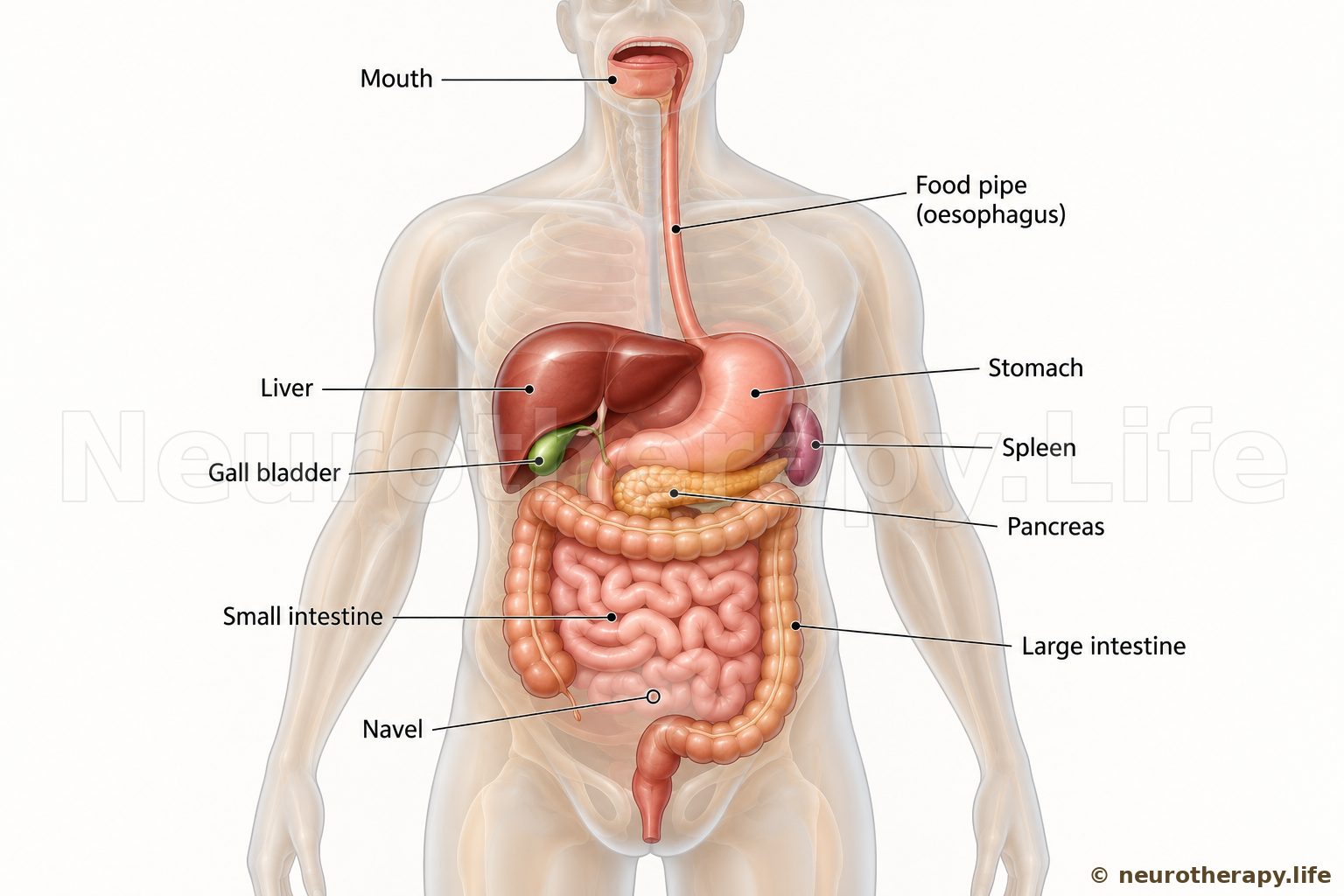
A long, clever tube and its helpers turn every meal into the raw material your whole body is built from. In Guruji's teaching it is the kitchen that feeds every other organ, so it is the first thing put right.
Overview
What is the digestive system?
Your digestive system is the group of organs that turns food and drink into the nutrients your body uses for energy, growth and repair. It is one long tube — the digestive tract — that runs from your mouth to your anus, plus helper organs that pour juices into it: the liver, gall bladder and pancreas.
Muscles in the tube grind food and move it along. Enzymes — natural chemical scissors — cut it into pieces small enough to pass into your blood. Whatever the body cannot use leaves as stool.
In Guruji's teaching, this system is the kitchen that feeds every other organ. That is why, in long-standing illness, Neurotherapy (LMNT) puts the digestion right first.
The digestive system: one tube from mouth to exit, and the helper organs that pour their juices into it.
Function
What does the digestive system do?
Digestion is teamwork between muscle and chemistry. Muscles grind food and move it along. Juices full of enzymes — natural chemical scissors — cut it into pieces small enough to pass into the blood.
Takes in food and water, and starts breaking starch down in the mouth.
Grinds and churns food with muscle, and moves it along by waves of squeezing (peristalsis).
Digests food with acid, bile and enzymes into sugars, amino acids and fats.
Absorbs nutrients, vitamins, minerals and water into the blood.
Kills many germs that come in with food, using stomach acid and the gut's own defences.
Houses trillions of helpful bacteria that ferment fibre and make some vitamins.
Removes waste as stool.
Chew and wet
Teeth crush food. Saliva softens it and its enzyme, amylase, starts breaking down starch — which is why a chapati tastes sweeter the longer you chew.
Squeeze down the food pipe
A wave of muscle carries each swallow to the stomach in a few seconds. A ring-shaped valve at the bottom closes so acid does not come back up.
Churn in acid
The stomach churns food with hydrochloric acid and the enzyme pepsin, which starts cutting up protein. The acid also kills many germs that came in with the food.
Bile and pancreatic juice join in
In the first part of the small intestine, the duodenum, the pancreas adds a juice that neutralises the acid and digests protein, fat and starch. The gall bladder squeezes in bile from the liver to break fat into tiny droplets.
Absorb
Along the small intestine, the villi soak up sugars, amino acids, fats, vitamins and minerals. Blood from the gut goes first to the liver, which sorts and stores what came in.
Save water, then empty
The large intestine takes back water and salts, and its bacteria ferment leftover fibre. What remains becomes stool, stored in the rectum until you go to the toilet.
How does the digestive system work with other organs?
Heart, blood and circulation — Blood carries every absorbed nutrient away from the gut — first to the liver, then to the whole body.
Glands and hormones — Glands build their hormones from what digestion supplies; the pancreas itself makes insulin, and gut hormones tell the stomach, gall bladder and pancreas when to work.
Nervous system and brain — The gut's own nerve net works with the brain through the vagus nerve.
Lymph and immunity — Stomach acid and the immune tissue in the gut wall guard the body against germs in food.
Two groups: the tube that food travels through, and the helper organs that add juices without food ever passing through them.
The digestive tract (the tube)
Mouth — Teeth, tongue and salivary glands. Chewing and saliva begin digestion.
Food pipe (oesophagus) — A muscular tube, about 25 cm long, from the throat to the stomach. A ring-shaped valve at its lower end keeps acid from coming back up.
Stomach — A stretchy, J-shaped bag that makes acid and pepsin and churns food. Its exit gate, the pylorus, lets food out a little at a time.
Small intestine — The longest part, in three sections: duodenum (where bile and pancreatic juice arrive), jejunum and ileum. Most digestion and absorption happens here.
Large intestine — The caecum (with the appendix), the colon, the rectum and the anus. It takes back water, houses gut bacteria and forms stool.
The helper organs
Liver — Makes bile for digesting fat, and processes everything absorbed from the gut.
Gall bladder — A small pouch under the liver that stores bile and squeezes it out after a fatty meal.
Pancreas — Sends digestive juice to the duodenum, and makes insulin for blood sugar.
The journey
MouthSeconds to a minute
Chewing and saliva turn a bite into a soft ball. Starch digestion begins.
Food pipeAbout 5–10 seconds
A muscle wave pushes the swallow down to the stomach.
StomachAbout 2–4 hours (longer for fatty meals)
Acid and pepsin work on the food. The stomach lets out a little at a time through its exit gate, the pylorus.
Small intestineAbout 3–5 hours
Bile and pancreatic juice finish digestion, and most nutrients are absorbed here.
Large intestineAbout 1–2 days, often more
Water is taken back and bacteria work on fibre. Stool slowly takes shape.
ExitWhole trip: usually about 1–3 days
Times differ a lot between people and meals. In LMNT teaching, what comes out is read closely: food that leaves in its own shape or colour has not been digested.
Where is the digestive system located?
The digestive tube starts at your mouth and runs down the neck and chest as the food pipe. It passes through the diaphragm, the dome-shaped breathing muscle under your lungs. Below it, most of the system fills your belly, from just under the ribs down to the pelvis.
The stomach sits high on the left, tucked under the ribs. The liver fills the upper right, with the small gall bladder hanging beneath it. The pancreas lies deep behind the stomach, and the spleen sits at its left end. The small intestine coils in the middle, around the navel, and the large intestine frames it like a picture frame.
The navel is the belly's natural centre point. Neurotherapy (LMNT) reads several of its examination points in relation to it — for example Mu, checked horizontally to the left of the navel.
Inside, the tube is lined with a moist, pink layer kept slippery by mucus. The stomach is a J-shaped bag with folds (rugae) that flatten out as it fills. The small intestine is a soft, coiled tube, velvety inside with millions of villi; the large intestine is wider and puckered into little pouches.
The liver is a large, reddish-brown wedge. The gall bladder is a small, pear-shaped, greenish pouch. The pancreas is soft, pale yellow and lumpy, about the shape of a long, flat tadpole.
How big is the digestive system?
The food pipe is about 25 cm long. An adult stomach comfortably holds about 1 to 1.5 litres after a meal. The small intestine is several metres long — about 3 to 5 metres in a living person, and longer when measured relaxed after death. The large intestine is about 1.5 metres long but much wider.
The liver weighs about 1.5 kg — the heaviest organ inside the body. The pancreas is about 15 cm long. The gall bladder is about 7–10 cm long and holds roughly 30–50 ml of bile.
Its daily work is large too: about 7 litres of digestive juices a day, and tens of trillions of bacteria living in the large intestine. A meal usually takes about 1 to 3 days from plate to toilet.
Conditions and disorders
What conditions and disorders affect the digestive system?
Digestive problems are among the most common reasons people see a doctor. Some are short and mild, like a bout of loose motions; others are long-lasting and need regular care.
Constipation or loose motions, or a change in bowel habit
Food seen in the stool in its own shape or colour
Loss of appetite or weight loss without a reason
Blood in the stool, black stool, or yellow eyes — see a doctor
What tests check the digestive system?
Blood tests — Liver function tests, blood count for anaemia, and tests for pancreas enzymes or infection.
Stool test — Checks for hidden blood, germs, worms or poor fat digestion.
Breath or stool test for H. pylori — Looks for a common stomach germ linked to ulcers.
Ultrasound of the abdomen — Sound waves show the liver, gall bladder (stones) and pancreas without any needle.
Endoscopy and colonoscopy — A thin, flexible tube with a camera looks inside the food pipe and stomach, or the large intestine.
CT or MRI scan — Detailed pictures of the belly organs when a closer look is needed.
How are digestive problems treated?
Food and daily habits — Regular meals, more fibre, enough water, less fried and spicy food, and moving every day.
Medicines — Doctors may prescribe acid-reducing medicines, laxatives, anti-diarrhoea medicines, or antibiotics for an infection.
Fluids and ORS — For loose motions and vomiting, replacing water and salts comes first.
Procedures and surgery — Some problems need a procedure through an endoscope, or an operation — for example removing an inflamed appendix or a gall bladder full of stones.
Specialist care — A gastroenterologist (a doctor for the gut) or hepatologist (a liver doctor) looks after long-term conditions.
Neurotherapy (LMNT)
Guruji's own central teaching is short: every gland and organ can make its chemicals in the right amount, at the right time, only when the raw materials arrive from digestion. The raw material of the hormones comes from just three things — cholesterol, the amino acid tyrosine, and proteins — and apart from vitamin K and folic acid, the vitamins must come from food. Picture one kitchen supplying a hundred homes. If the kitchen runs at half strength, every home is a little short, and the weakest shows it first. So in long-standing illness, whatever the disease, LMNT corrects the digestion first. The first sign it looks for is UDF — Un-Digested Food in the stool, such as tomato skins, seeds, peas or beetroot colour coming out as eaten. The work is aimed at three levels: the stomach (acid and pepsin), the accessory organs and small intestine (digestion, absorption and use of nutrients), and immunity. The acid matters because pepsin works only at a pH of 3 or below, and the acid also kills germs that come in with food. Patients are asked to come for the first ten days in a row to set the digestion right; Guruji's teaching reports that by then a majority of symptoms had eased, even before the main complaint was treated.
Points
(15) Medulla — Opens OLD UDF: for acetylcholine, one of the three things the stomach needs to make acid.
(10) Medulla — Stimulates the vagus nerve, which drives every part of the digestive system except the descending colon.
Rt. Parkhoo — Right hip: folic acid and thiamine — thiamine keeps the stomach's smooth muscle and its exit gate working.
Lt. Parkhoo — Left hip: B₁₂ and niacin — niacin helps the glands make and release their secretions.
Pan — The pancreas point; pain here is a level-two sign of poor digestion and absorption.
Gal — The gall bladder point; used for hydrochloric acid in CCK Normal, and part of Normal and NAN.
Liv — The liver point, part of the Normal and Ajay Normal formulas.
Spl — The spleen point, part of the Normal formula.
Gas Only — To increase the digestion of protein in the stomach; always followed by Gas 'I'.
Gas 'I' — To increase absorption in the intestine.
Mu — Checked horizontally to the left of the navel; pain here means the inflammation work comes first.
(2) S4 – S5 — The sacral point that reaches the descending colon — the one part the vagus does not.
ONS — With TF and NNS, given to set right the abdomen after the inflammation work.
Organ Clearance — The general remedy: increases blood flow to the organs; safe daily even for small children and the elderly.
“If the stomach, the lungs and the kidneys work properly, then disease simply cannot come.”
— Dr. Lajpatrai Mehra
“The coming of UDF is itself a chief cause of the coming of the great diseases.”
— Dr. Lajpatrai Mehra
“It is not enough that one eats proteins. The important thing is to digest them.”
— Dr. Lajpatrai Mehra
Never do this
(10) Medulla is not given to people with diabetes or cancer. Heart patients get only (10) Left Medulla. This applies wherever it heads a formula — FAN's prefix, CCK Normal, Chole, Vater and Formula No. 4. (10) Medulla
When Liv° is tender, keep the order: inflammation work first while Mu is tender, then after five minutes (3) ONS (20) TF (6) NNS; then UDF work until stools are normal; only then, if Liv° is still tender, the alkali formula. Liv°
Gas Only is always followed by Gas 'I' — the two are an inseparable pair. Gas 'I'
If any treatment causes an adverse effect, one treatment of NAN or FAN is the named way to normalise it. NAN
Keep taking prescribed medicines. Neurotherapy (LMNT) works alongside your doctor's care, not in place of it.
See a doctor soon for: blood in the stool or black, tar-like stool; vomiting blood; food sticking when you swallow; yellow eyes or skin; weight loss you cannot explain.
Severe sudden belly pain, a hard swollen belly, or chest pain after a meal: call emergency services (108/112) at once.
Care
How can I keep my digestive system healthy?
Small daily habits make a big difference to the gut.
Eat calmly and chew well
Eating in a hurry and then rushing off pulls blood away from the gut. Sit, chew, and give the meal a few quiet minutes.
Keep regular meal times
Your gut works in rhythm. Eating at roughly the same times, and not without limit, helps it keep that rhythm.
Plenty of fibre
Vegetables, fruit, dal and whole grains keep stools soft and feed your helpful gut bacteria.
Drink water through the day
Enough water helps the large intestine keep stools soft. LMNT teaching adds one rule: nothing is drunk with the food itself.
Move every day
A daily walk helps the gut move food along and eases constipation.
Look before you flush
Now and then, notice your stool. Skins, seeds or colours coming out as eaten are worth mentioning to your therapist; blood or black stool is worth a doctor's visit.
Sit, don't walk, right after eating
LMNT teaching says do not walk about for twenty minutes after a meal — sitting in vajrāsana is very good. It matters most for heart patients and anyone breathless on walking.
Don't hold back the urge
Go to the toilet when your body asks, and try to go at the same time every day.
Common questions
How long does it take to digest a meal?
Food usually leaves the stomach in 2–4 hours and passes through the small intestine in 3–5 hours. The large intestine takes a day or two, often more. From plate to toilet is usually about 1 to 3 days, and it varies a lot between people.
Should I drink water with my meals?
LMNT teaching says nothing is drunk with the food itself — drink freely between meals instead. Mainstream medicine sees no harm in a few sips. If you take tablets with food or have kidney or heart advice about fluids, follow your doctor.
I sometimes see bits of food in my stool. Is that normal?
A few tough plant skins, such as sweetcorn, often pass through healthy people. In LMNT teaching, though, food regularly coming out in its own shape or colour — tomato skins, seeds, peas, beetroot colour — is called UDF (Un-Digested Food) and is taken as the first sign of weak digestion. Tell your therapist; see a doctor if there is also blood, weight loss or pain.
Is passing gas every day normal?
Yes. Most healthy people pass gas about 13 to 21 times a day, mostly from gut bacteria working on fibre. See a doctor if gas comes with pain, weight loss or a change in bowel habit.
Can I live without a gall bladder?
Yes. The liver keeps making bile, which then flows straight into the intestine instead of being stored. Some people find very fatty meals harder to digest afterwards.
Why does Neurotherapy (LMNT) start with digestion when I came for something else?
In Guruji's teaching every gland builds its chemicals from what digestion supplies. So in long-standing illness the first ten days or so go to setting the digestion right, and the treatment for your complaint is built on top of that.
What should I ask my doctor or therapist?
Which part of my digestive system is causing my symptoms?
Do I need any tests, such as blood tests, a stool test, an ultrasound or an endoscopy?
Which foods should I eat more of, and which should I avoid?
Could any of my medicines be upsetting my stomach?
Which warning signs mean I should come back at once?
For my therapist: do I have UDF, and how long will the digestive work take before my main complaint is treated?
Surprising facts
1Your gut's inner surface is about half a badminton court
The lining of the small intestine is folded, and the folds are covered in tiny finger-like bumps called villi. Spread flat, the whole digestive lining covers about 30 square metres. You may have heard 'a tennis court' — careful measurement in 2014 showed that was far too big, but half a badminton court is still astonishing.
Source: Helander & Fändriks, Scand J Gastroenterol 2014 — about 32 m², 'half a badminton court'
2Your gut lining rebuilds itself every few days
The cells lining your small intestine live only about 3 to 5 days. Then they are shed and replaced by new cells rising from tiny pits below. Along with a thick coat of mucus, fast renewal is part of why the stomach and gut do not digest themselves.
Source: van der Flier & Clevers, Annu Rev Physiol 2009 — intestinal lining renewed every 4–5 days; Guyton & Hall (mucus barrier)
3You carry about as many gut bacteria as your own body cells
An adult carries roughly 38 trillion bacteria, most of them in the large intestine — about the same number as the body's own cells. The old saying '10 bacteria for every human cell' turned out to be wrong. These tiny guests help break down fibre and make some vitamins, such as vitamin K.
Source: Sender, Fuchs & Milo, PLoS Biology 2016 — about 38 trillion bacteria vs about 30 trillion human cells; vitamin K: NIH Office of Dietary Supplements
4Your gut has a 'second brain'
The walls of the gut hold their own net of nerves, the enteric nervous system — some 200 to 600 million nerve cells. It can run the gut's squeezing and juice-making by itself, even without orders from the brain. It still talks to the brain all day, mostly through the vagus nerve.
Source: Furness, Nat Rev Gastroenterol Hepatol 2012 — 200–600 million enteric neurons; works independently of the CNS
5Most of your serotonin is made in the gut
Serotonin is a chemical messenger best known for mood. Yet about 90% of the body's serotonin is made by special cells in the gut lining, where it helps the gut move. Gut bacteria even help decide how much is made.
Source: Yano et al., Cell 2015 — gut makes about 90% of the body's serotonin; bacteria regulate it
6You could swallow standing on your head
Food does not simply fall down to the stomach. Rings of muscle in the food pipe squeeze it along in a wave, called peristalsis. That is why astronauts can eat in space, and why food still goes the right way when you lie down.
Source: NIDDK (NIH), 'Your Digestive System & How It Works' — peristalsis moves food through the tract
7Your liver can grow back
The liver can regrow lost tissue on a large scale — something almost no other organ inside you can do. After up to about two-thirds of it is removed in surgery, the rest grows back to nearly full size within weeks to months. It also makes bile, which your intestine uses to digest fat.
Source: Michalopoulos, Am J Pathol 2010 'Liver regeneration after partial hepatectomy'; Johns Hopkins Medicine (liver functions)
8You make about 7 litres of digestive juice a day
Saliva, stomach juice, bile, pancreatic juice and intestinal juice add up to roughly 7 litres every day. That is more than a full bucket. Almost all of it is soaked back up by the intestines, so you do not lose it.
Source: Guyton & Hall, Textbook of Medical Physiology — daily secretion of intestinal juices, total about 6.7 L
A day in the life of your gut
1–1.5 Lof saliva made
about 1.5 Lof stomach juice
about 1 Lof pancreatic juice
about 1 Lof bile from the liver
about 7 Lof digestive juices in all — nearly all soaked back up
13–21times a healthy person passes gas
Yoga
Vajrāsana — sitting on the heels after meals Vajrāsana
Benefits
The one posture the classical teaching recommends straight after a meal.
Guruji's teaching names it as the good way to sit for twenty minutes after eating, instead of walking about.
The body's weight presses the folded calves — much as the Gas 'I' treatment does.
How to do it
Kneel on a folded blanket with your knees together.
Sit back on your heels, big toes touching.
Keep your back straight and rest your hands on your thighs.
Breathe normally and stay 5–10 minutes after the meal.
Take care
Skip it with a knee or ankle injury, recent knee surgery or severe knee pain — sit quietly on a chair instead. A cushion between heels and seat eases strain. Heart patients and anyone breathless on walking should especially follow the 'sit, don't walk' rule.
Pavanamuktāsana — the wind-releasing pose Pavanamuktāsana
Benefits
Its name says what it is for: it helps release trapped wind and eases a heavy stomach.
Gently presses and relaxes the belly.
The LMNT Abdomen Setting moves a patient's knees in much the same way, for people who cannot do it themselves.
How to do it
On an empty stomach, lie on your back.
Draw one knee to your chest and hold it with both hands; breathe slowly 3–5 times.
Change legs, then bring both knees in together.
Keep your head resting on the floor, then release slowly.
Take care
Not straight after meals. Avoid in pregnancy, with a hernia, after recent belly surgery, or with a slipped disc or severe back pain. People with high blood pressure or heart disease should keep the head down and not strain.
Named in the classical teaching among practices that support the digestive fire.
Calms the breath and relaxes the body, and the gut works better in a relaxed body.
Needs no movement of the belly, so it suits most people.
How to do it
Sit comfortably with a straight back.
Close the right nostril with the right thumb and breathe in through the left.
Close the left with the ring finger, open the right, and breathe out.
Breathe in through the right, switch, and breathe out through the left. That is one round.
Continue for 5–10 minutes, slowly and evenly.
Take care
Keep it gentle, with no breath-holding, if you have heart disease or high blood pressure or are pregnant. Stop if you feel dizzy. Do not do it with a blocked nose.
Watch
UDF (Anpacha Khaana) ka Neurotherapy Ilaaj | 40+ Bimariyon ki Jad | LMNT
A step-by-step demo of the full UDF (undigested food) treatment: 15 Medulla, Parkhoo at both hips, Half Kundli, 10 Medulla with 1 Gas Only and 1 Gas 'I', then the Gal, Spleen, Liver and Mucus points and Ajay Normal on the thighs and forearms. It is given to support digestion when food passes through undigested.
कमज़ोर पाचन और Gut Health का पक्का इलाज | LMNT Normal Treatment | @neurotherapylife
Shows the Normal treatment given with the feet: (8) Pan at the top of the thighs, then (3) Gal, (3) Spleen, (7) Liv and (5) Mucus on the thighs and forearms, without breaks. It is used to support digestion.
Chole Treatment in Neurotherapy | LMNT Formula for Digestion, Acidity & Fat Metabolism
A demo of the Chole treatment ((10) Medulla, (6) Gas 'I', (3) Gal), shared for acidity, heavy meals and the digestion of fats.
Indigestion Problems? How Neurotherapy Helps? अपच की समस्या? जानें न्यूरोथेरेपी कैसे मदद करती है?
A podcast conversation on indigestion: its common signs, causes such as rushed meals, stress and some medicines, and how Neurotherapy (LMNT) looks at digestion through the body's acid–alkali balance. No points are demonstrated.
LMNT Neurotherapy Diagnostic Pain Points
An overview of LMNT's diagnostic pain points — the places around the navel that the therapist presses to read the body before choosing a treatment.
Test yourself
Research
Strong evidence
Careful measurement showed the inner surface of the digestive tract is about 32 square metres — much smaller than the old 'tennis court' claim, but still about half a badminton court.
A review of the gut's own nervous system: hundreds of millions of nerve cells that can run the gut's movement and secretions on their own, in constant contact with the brain.
This page explains how the body works; it does not diagnose. Neurotherapy (LMNT) works alongside your medical care — keep taking the medicines your doctor prescribed, and see a doctor for any new or severe symptom.
Ready to begin?
Send COURSE for course details, or your name, age and health issue for a consultation.