Abdomen Setting: easing a very bad stomach without touching the belly
Abdomen Setting is a treatment for people whose stomach is very bad. No hand goes near the belly: the therapist holds the knees and gently moves the hips and low back through directions they have stopped going in.
Overview
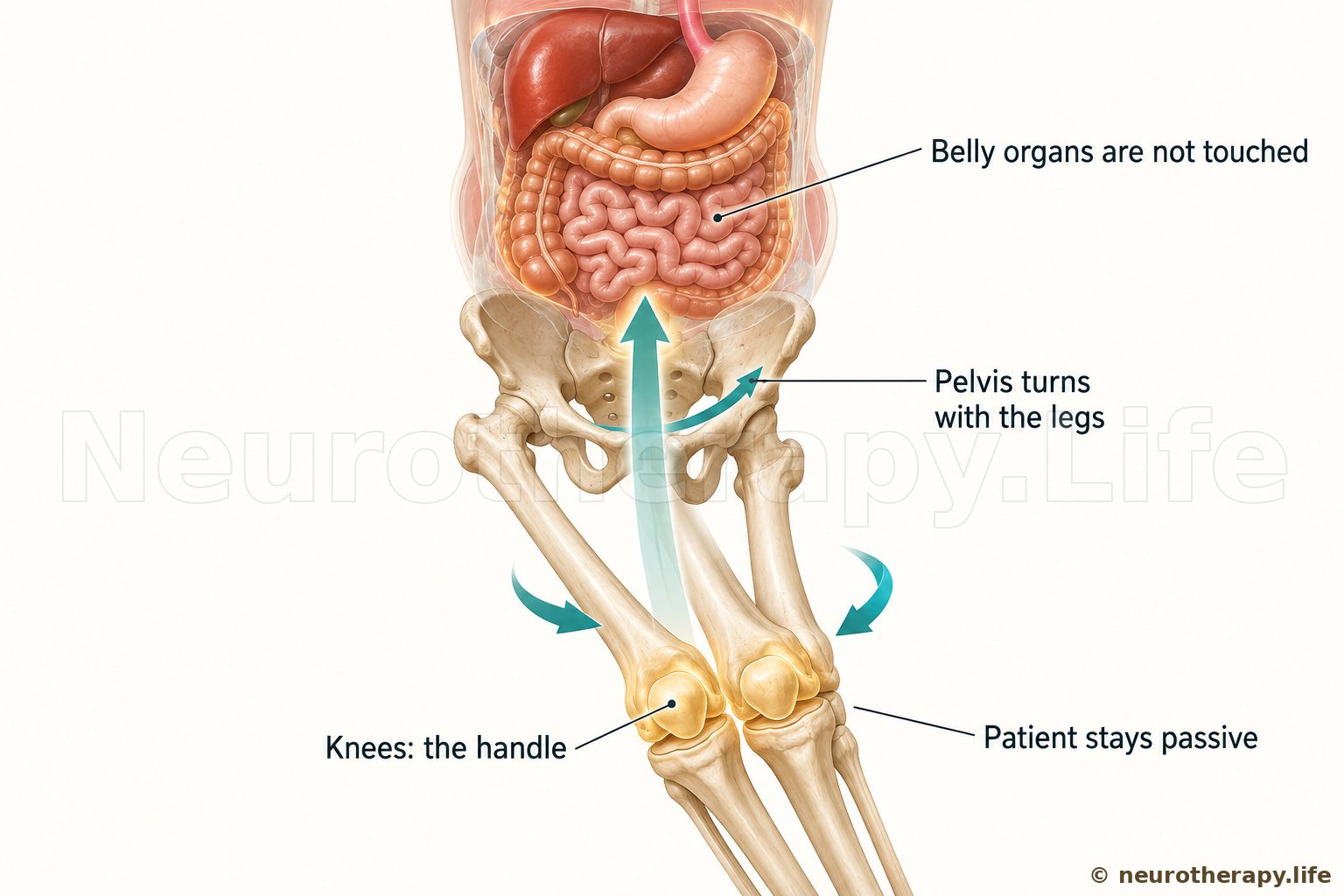
For people whose stomach is very bad, Abdomen Setting is one more treatment for setting the abdomen. What surprises people is that no hand goes near the belly at all. The therapist holds the knees, and the belly is helped by moving the hips and the low back through directions they have stopped going in.
The patient lies on the back. There are four gentle movements, all led from the knees: opening and closing the folded legs like a butterfly, taking the knees from side to side, and turning movements, including one in which the face turns one way and the knees go the other way. That counter-turn of the head is what makes the last movement complete.
The movements are passive. The therapist does all the work and the patient lets the legs be heavy. A patient who tries to help tightens the very muscles the movement is meant to lengthen.
Yoga has the same idea in pavanamuktasana, the wind-releasing pose, and in the lying twist, both used for wind and a heavy stomach. A person with a very bad stomach often cannot do these for themselves; Abdomen Setting does it for them. The exact method is taught hands-on in the course.
Key points
- Abdomen Setting is for people whose stomach is very bad.
- Nothing touches the belly; the knees are moved instead.
- The patient stays fully passive and does not help.
- It mirrors yoga's wind-releasing pose and lying twist.
Go deeper
Abdomen Setting
The full point page for Abdomen Setting
Digestive system
The digestive system
Stomach
The stomach
Abdominal pain
Abdominal pain
Constipation
Constipation
Opposite Point
Opposite Point, another treatment in this group
Setting the Stomach: The Digestive Formulas of Neurotherapy (LMNT)
Setting the stomach
Uncommon Problems: Neurotherapy (LMNT) Points Found One Patient at a Time
The full guide to treatments for uncommon problems
Read the full guide
This topic is part of: Uncommon Problems: Neurotherapy (LMNT) Points Found One Patient at a Time
Safety: when it is held back
- Not given in pregnancy beyond the early weeks; lying flat on the back is itself unsuitable later in pregnancy. Pregnancy care
- Not after recent abdominal, pelvic or hip surgery, and not after a hip replacement, where taking a bent knee across the body can put the joint out.
- Not where a spinal bone is known to have crumbled, or in brittle bones. Osteoporosis
- In everyone, the movement stops where the patient guards or resists.
- Neurotherapy (LMNT) works alongside your medical care. Do not stop or change any medicine on your own.
This page explains what a Neurotherapy (LMNT) treatment is for; it is not a self-treatment guide and does not diagnose. Neurotherapy (LMNT) works alongside your medical care — keep taking the medicines your doctor prescribed.