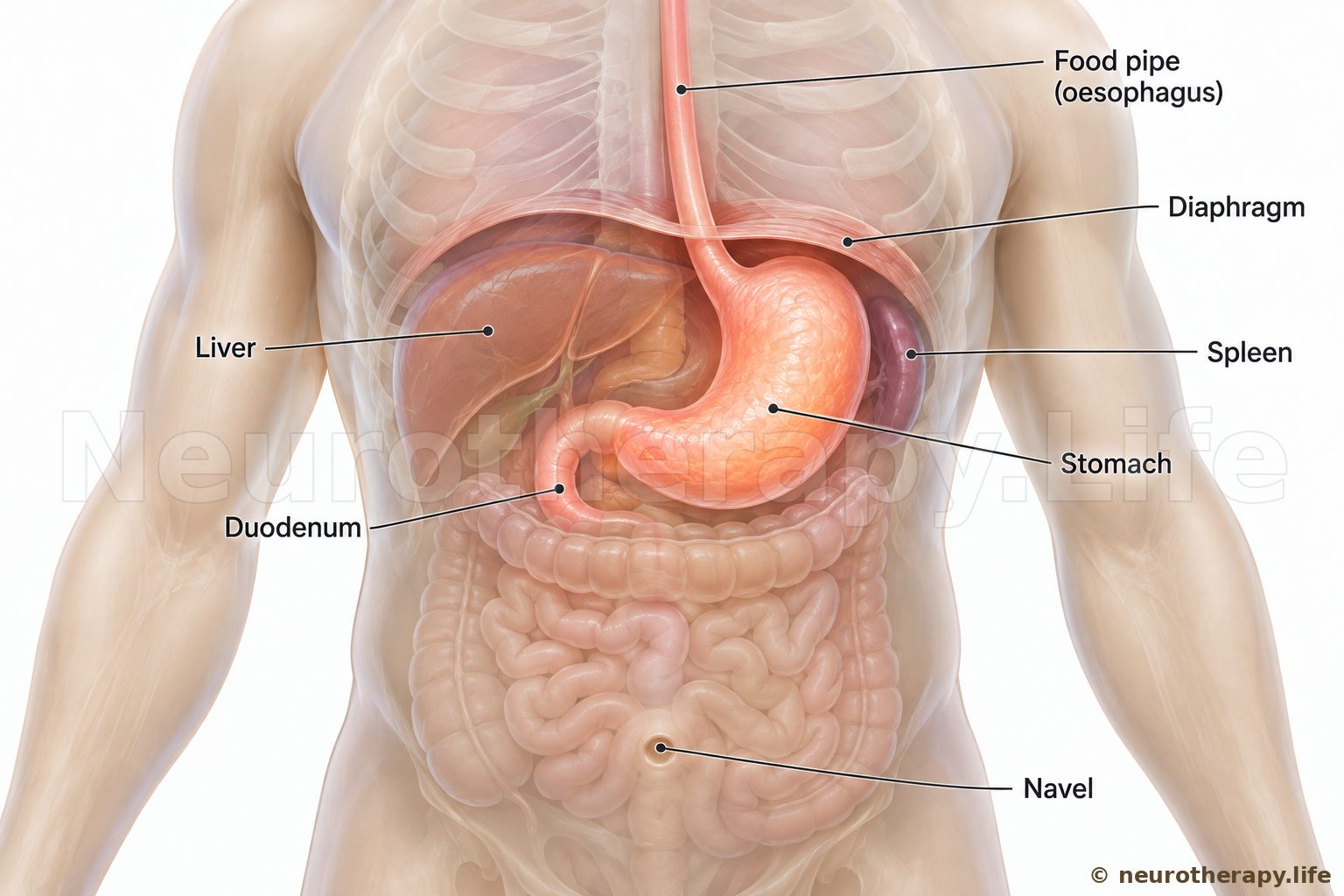
A stretchy, J-shaped bag high on the left of your belly that churns every meal in strong acid. In Guruji's teaching that acid is the first gate of health: when it runs short, food passes out undigested and germs pass in.
Overview
What is the stomach?
Your stomach is a hollow, muscular, J-shaped bag between your food pipe (oesophagus) and your small intestine. It holds a meal for a few hours, mixes it with acid and enzymes, and then lets it into the intestine a little at a time.
The stomach is part of your digestive system. Its lining makes hydrochloric acid, which kills most germs that come in with food, and pepsin, an enzyme that starts digesting protein. It also makes intrinsic factor — a helper protein without which your body cannot absorb vitamin B₁₂.
In Neurotherapy (LMNT) the stomach's acid is where digestion is checked first. Food seen in the stool in its own shape or colour is read as a sign that the acid is short — so the stomach is set right before most other work begins.
The stomach sits high on the left, tucked under the ribs — higher than most people think.
Function
What does the stomach do?
The stomach is a store, a mixer and a gatekeeper. It holds the meal, starts breaking it down, and passes it on slowly so the intestine is never flooded.
Stores food, so you can eat a meal at one sitting instead of nibbling all day.
Churns food with three layers of muscle until it becomes a thick, soupy paste called chyme.
Makes hydrochloric acid, which kills most germs that come in with food and drink.
Makes pepsin, which starts digesting protein — it works only in strong acid.
Makes intrinsic factor, which your small intestine needs later to absorb vitamin B₁₂.
Makes hormones: gastrin, which tells it to make acid, and ghrelin, which helps you feel hungry.
Lets food out a little at a time through its exit gate, the pylorus.
The stomach gets ready
The sight, smell or even the thought of food sends signals down the vagus nerve, and the stomach starts making juice before the first bite.
It relaxes to make room
As food arrives, the muscle relaxes and the folds of the lining (rugae) flatten, so a meal fits without the pressure inside rising much.
Three signals switch on the acid
The acid-making cells need three signals: acetylcholine from the vagus nerve, the hormone gastrin from the lower stomach, and histamine from neighbouring cells. In the acid, pepsin starts cutting up protein.
It churns
Waves of muscle, about three a minute, mix the food with juice and grind it into chyme.
The gate opens slowly
The pylorus lets out small squirts of chyme into the duodenum. An ordinary meal leaves the stomach in about 2 to 4 hours; a fatty meal stays longer.
The intestine answers back
When acid and fat reach the duodenum, it releases the hormones secretin and CCK. These call in pancreatic juice and bile, and slow the stomach until the intestine is ready for more.
How does the stomach work with other organs?
Vagus nerve — The main nerve that tells the stomach to make acid and to churn.
Pancreas — Its juice, rich in bicarbonate, neutralises the acid that leaves the stomach.
Gall bladder — Squeezes out bile when fatty food arrives; if bile is slow, the meal waits in the stomach.
Intestines — Receive the chyme, and their hormones decide how fast the stomach empties.
Blood — The stomach's intrinsic factor lets vitamin B₁₂ in, which the marrow needs to make red blood cells.
Spleen — Its neighbour on the left; the upper stomach gets part of its blood from branches of the spleen's artery.
Lymph and immunity — Stomach acid is one of the body's first defences against germs in food.
Anatomy
What are the parts of the stomach?
Doctors divide the stomach into regions from top to bottom, and its wall into layers. Special cells in the lining make the gastric juice.
Regions
Cardia — The top part, where the food pipe opens in. A ring of muscle here (the lower oesophageal sphincter) keeps acid from rising.
Fundus — The dome that bulges up under the left side of the diaphragm. Swallowed air collects here — the bubble you burp up.
Body — The large middle part, where most of the acid and pepsin are made.
Antrum — The lower part that grinds food hardest and makes the hormone gastrin.
Pylorus — The narrow exit, with a thick ring of muscle (the pyloric sphincter) that controls emptying.
The wall
The stomach wall has four layers, from inside out.
Mucosa (lining) — Millions of tiny pits lead down to the glands. A thick coat of mucus covers it.
Submucosa — A layer of blood vessels and nerves under the lining.
Muscle layers — Three layers — lengthwise, round and slanting. The extra slanting layer is why the stomach can churn so well.
Serosa — A smooth, slippery outer skin that lets the stomach slide against its neighbours.
The juice-making cells
Parietal cells — Make hydrochloric acid and intrinsic factor.
Chief cells — Make pepsinogen, which the acid turns into active pepsin.
Mucous cells — Make mucus and bicarbonate, a shield that stops the acid burning the lining.
G cells — Sit in the antrum and release gastrin into the blood.
Histamine cells — Sit beside the acid cells and release histamine, one of the three signals for acid.
Where is the stomach located?
Your stomach lies in the upper left part of your belly, just under the diaphragm — the dome-shaped breathing muscle. Much of it hides behind the lower left ribs, above and to the left of the navel. Its upper end joins the food pipe just below the diaphragm; its lower end crosses the midline to join the duodenum on the right.
The liver covers part of it on the right. The spleen sits behind it on the far left, the pancreas lies behind it, and the large intestine runs below it. The heart is just above, on the other side of the diaphragm — which is why stomach burning is often felt in the chest.
In LMNT, the stomach and duodenum are read at the Gas point, on the midline between the breastbone and the navel. Guruji's teaching says pain between the solar plexus — the soft area below the breastbone — and the navel shows that blood flow is not right in parts of the stomach and intestine.
A full stomach is shaped like a fat letter J; an empty one is a flattened, floppy bag. It has a short inner curve (the lesser curvature) and a long outer curve (the greater curvature), from which a fatty apron, the greater omentum, hangs down over the intestines.
Outside it is smooth and pinkish-grey. Inside, the lining is soft and velvety, with thick folds (rugae) that flatten out as the stomach fills. Its exact shape and height change with every meal, with your posture and with your build.
How big is the stomach?
Empty, an adult stomach holds only a small cupful — about 50 to 75 ml. After a meal it stretches comfortably to about 1 to 1.5 litres, and it can take more at a very large meal.
It makes about 1.5 litres of gastric juice a day. An ordinary meal leaves it in about 2 to 4 hours.
Conditions and disorders
What conditions and disorders affect the stomach?
Stomach trouble is very common. Most of it is short-lived, like a bout of indigestion; some, such as an ulcer or bleeding, needs a doctor promptly.
Acid and burning
Acidity (heartburn and acid reflux)Acid rising into the food pipe — burning in the chest and sour burps. Gastritis and ulcers are close cousins.
Chest pain from indigestionChest discomfort that comes from the stomach — but the heart is always ruled out first.
AnaemiaWithout the stomach's intrinsic factor, vitamin B₁₂ is not absorbed and anaemia can follow.
AlkalosisIn LMNT teaching, low stomach acid can make the alkali look high — so UDF is treated first.
What are common signs of a stomach problem?
Burning in the chest or sour burps (heartburn)
Pain or burning in the upper belly, between the breastbone and the navel
Bloating, or feeling full after only a few bites
Nausea, vomiting, or loss of appetite
A heavy stomach or sour burps a while after fried food or heavy protein
In a baby: milk vomited as milk rather than as curd (a sign LMNT asks about)
Vomiting blood or 'coffee grounds', or black, tar-like stool — see a doctor at once
What tests check the stomach?
H. pylori test — A breath test, stool test or biopsy looks for a common germ that causes most ulcers.
Upper endoscopy — A thin, flexible tube with a camera looks at the food pipe, stomach and duodenum, and can take a tiny tissue sample (biopsy).
Blood tests — A blood count for anaemia from hidden bleeding, and vitamin B₁₂ levels.
Barium X-ray — You drink a chalky liquid that shows the outline of the food pipe and stomach on X-ray.
Gastric emptying study — Measures how fast a test meal leaves the stomach.
pH monitoring — A thin probe or capsule records acid in the food pipe over a day, for reflux.
How are stomach problems treated?
Food and habits — Smaller, regular meals; not lying down soon after eating; less alcohol, and no tobacco.
Acid-reducing medicines — Antacids, H2 blockers and proton-pump inhibitors lower or neutralise acid and let ulcers heal.
Antibiotics for H. pylori — A short combined course clears the germ in most people and stops ulcers coming back.
Anti-sickness medicines — Ease nausea and vomiting while the cause is found.
Vitamin B₁₂ — Injections or high-dose tablets when the stomach cannot make enough intrinsic factor.
Endoscopic treatment and surgery — A bleeding ulcer can often be sealed through an endoscope; surgery is kept for complications or growths.
Neurotherapy (LMNT)
In Guruji's teaching the stomach's acid has three separate works. It kills what came in with the food. It lets pepsin begin, because pepsin works only when the stomach's pH is 3 or less. And it opens the gate to bile: the acid food reaching the duodenum makes secretin only if the pH there is below 4.5, and secretin calls up the bile that digests fats. When the acid is short, all three fail together — and food begins to leave the body in its own shape or colour, which the teaching calls UDF (Un-Digested Food). Acid needs three signals — histamine, acetylcholine and gastrin — and the HCl treatment was built to reach each one in turn. The teaching adds a caution about burning: after fried food the acid is often normal, and the meal is simply waiting because the gall bladder is slow; the teaching's own estimate is that perhaps more than 80% of such patients are like this. That is why a therapist asks 'after which food, and how long afterwards?' This work supports your doctor's care; it does not replace it.
Points
Gas Only — The stomach point, given down both thighs. Used to increase hydrochloric acid, to help pepsin digest protein and to form intrinsic factor; also for nausea and vomiting.
Gas 'I' — The small-intestine point. It always follows Gas Only in anyone with constipation, piles or fistula, because Gas Only on its own can bind the bowel.
(15) Medulla — For acetylcholine — one of the three signals the stomach needs to make acid. It opens OLD UDF and the HCl treatment.
(10) Medulla — Stimulates the vagus nerve to the abdominal glands. The teaching says it can treble the stomach's acid — which is why it is blocked in acidity and ulcer.
(½) Ku – 6 secs — A single six-second hold at the base of the spine; in the HCl treatment, to provoke histamine from the mast cells.
(1) Pt. Gal × 6 treatments — In the HCl treatment, one station of Gal is used to stimulate the part of the stomach near the pylorus, where gastrin is made.
B₁₂ — At the left hip. In the HCl treatment the B₁₂ point is used because B₁₂ also provokes acetylcholine.
Rt. Parkhoo — Right hip: thiamine, which the smooth muscle of the stomach and its pylorus need to work properly.
Lt. Parkhoo — Left hip: niacin, which the glands need to make and release their secretions.
(8) Pan — For the pancreas's enzymes and its sodium bicarbonate, which calms the acid reaching the intestine; used in stomach ulcer and indigestion.
Made for patients whose UDF keeps coming back. Given 5 to 15 minutes after a UDF formula; its first four parts go after acetylcholine, histamine and gastrin, one by one.
Never given first. Even with a tender Liv°, the UDF formula comes before the alkali formula, because low stomach acid can make the alkali only look high.
“If the stomach, the lungs and the kidneys work properly, then disease simply cannot come.”
— Dr. Lajpatrai Mehra
“It is not enough that one eats proteins. The important thing is to digest them.”
— Dr. Lajpatrai Mehra
“We do not give treatment for any one disease; rather we treat according to the condition of the body on that day.”
— Dr. Lajpatrai Mehra
Never do this
In acidity or an ulcer of the stomach, Gas Only and (10) Medulla are blocked — the teaching says they can treble the stomach's acid. The Acid Treatment formula, Normal, Ajay Normal or Round Normal are given instead. Gas Only is never given where there is an ulcer in the stomach or duodenum. Gas Only
In anyone with constipation, piles or fistula, Gas Only is always followed by Gas 'I'. If the constipation is severe, (2) S4–S5 may be added. Gas 'I'
(10) Medulla is not given in diabetes or cancer. Heart patients get only (10) Left Medulla. (10) Medulla
(½) Ku, used in the HCl treatment, is not given during menstruation or in low blood pressure. (½) Ku – 6 secs
The Alkali Treatment formula is never given first: the undigested food is dealt with before it, even when Liv° is tender. ALTF (chief form)
Keep taking prescribed medicines. Do not stop an acid tablet on your own — that is your doctor's decision.
See a doctor soon for: vomiting blood or 'coffee grounds'; black, tar-like stool; food sticking when you swallow; vomiting that will not stop; weight loss you cannot explain; or new indigestion after the age of 55.
A baby who vomits forcefully again and again, is hungry straight afterwards and is not gaining weight, or any vomit that is green or yellow with bile, needs a doctor the same day. How to tell a patient to see a doctor
Chest pain or pressure after a meal, with sweating, breathlessness or pain spreading to the arm or jaw, may be the heart: call 108/112 at once. Heart attack (myocardial infarction)
Care
How can I keep my stomach healthy?
The stomach likes rhythm, calm and clean food.
Eat at regular times, and stop before you are stuffed
An overfull stomach pushes acid upwards. Smaller meals are easier on it.
Sit, chew and eat calmly
The stomach starts working with the first smell of food; a hurried meal gives it no time.
Drink between meals, not with them
LMNT teaching says nothing — water or cold drink — is taken with the food itself, so the acid is not diluted. Drink freely between meals.
Sit, don't lie, after eating
Lying down within two or three hours of a meal makes reflux more likely. LMNT teaching advises sitting quietly — vajrāsana is good — for twenty minutes rather than walking about.
Be careful with painkillers
Common painkillers such as ibuprofen, diclofenac and aspirin can damage the stomach lining. Take them only as your doctor advises.
No tobacco, little alcohol
Both irritate the lining and loosen the valve at the top of the stomach.
Clean hands, clean food
Washing hands and eating freshly cooked food lowers the load of germs the acid has to fight.
Look before you flush
Skins, seeds or colours coming out as eaten are worth telling your therapist; black stool or blood is worth a doctor's visit the same day.
Common questions
Why does my stomach growl?
When the stomach and small intestine are empty, a strong wave of muscle sweeps through them roughly every 90 to 120 minutes to clear out leftovers. Air and fluid moving along make the rumble. It is normal, and a sign the gut is doing its housework.
Why doesn't the stomach digest itself?
Its lining is covered by a thick layer of mucus with bicarbonate trapped in it, which keeps the acid away from the cells. Pepsin is made in an inactive form and switches on only in the open stomach. And the surface cells are replaced every few days. An ulcer forms when this shield is broken — most often by the germ H. pylori or by painkillers.
Is heartburn always a sign of too much acid?
Not always. Reflux is ordinary acid in the wrong place, because the valve at the top of the stomach lets it rise. Guruji's teaching adds another cause: after fried or heavy food, the meal may wait in the stomach because bile is slow, and the acid waiting with it burns. Ask yourself which food brings it on, and how long afterwards — and tell both your doctor and your therapist.
Does spicy food cause ulcers?
No. Most ulcers are caused by the germ H. pylori or by painkillers such as aspirin and ibuprofen. Spicy food can make existing symptoms feel worse, so cut back if it bothers you.
Should I drink water with my meals?
LMNT teaching says nothing is drunk with the food itself, so the stomach's acid is not diluted — drink freely between meals instead. Mainstream medicine sees no harm in a few sips. If you take tablets with food, or have medical advice about fluids, follow your doctor.
Can a person live without a stomach?
Yes. After the whole stomach is removed, usually for cancer, the food pipe is joined to the small intestine. People then eat small meals often, and need vitamin B₁₂ injections for life because intrinsic factor is gone.
What should I ask my doctor or therapist?
Is my burning from acid reflux, gastritis, an ulcer — or something else?
Should I be tested for H. pylori, or have an endoscopy?
Could any of my medicines, such as painkillers, be hurting my stomach?
How long should I take my acid medicine, and how do I stop it safely?
Should my vitamin B₁₂ level be checked?
For my therapist: is my Gas point tender, do I have UDF, and which treatments are blocked for me?
Surprising facts
1Your stomach juice is sharper than lemon juice
Gastric juice usually has a pH of about 1.5 to 3.5 — at the strong end of the scale, often more acidic than lemon juice or vinegar. Guruji compared it to the acid used to clean drains, and said that whatever is eaten must change its form in it, chewed or not.
How does a bag of acid not burn a hole in itself? Its lining is coated with a thick gel of mucus that traps bicarbonate — the chemical in baking soda — right against the cells. The acid is neutralised before it can touch them. The surface cells are also replaced every few days.
Source: Allen A, Flemström G. Gastroduodenal mucus bicarbonate barrier: protection against acid and pepsin. Am J Physiol Cell Physiol 2005;288:C1–C19; Guyton & Hall (renewal of the gastric lining)
3A doctor drank germs to prove a point — and won a Nobel Prize
For decades ulcers were blamed on stress and spicy food. In 1984 Australian doctor Barry Marshall drank a culture of the bacterium Helicobacter pylori, developed stomach inflammation within days, and showed the germ was the culprit. He and Robin Warren received the 2005 Nobel Prize in Physiology or Medicine.
Source: The Nobel Prize in Physiology or Medicine 2005 (nobelprize.org, press release); Marshall BJ et al., Med J Aust 1985;142:436–439
4We learned how digestion works through a hole in a man's stomach
In 1822 a young trapper, Alexis St. Martin, was shot in the stomach by accident. He survived, but the wound healed with an opening from his stomach to the outside. The army surgeon William Beaumont spent years studying digestion through it, dangling food on a string, and showed that digestion is a chemical process driven by acid.
Source: Beaumont W. Experiments and Observations on the Gastric Juice and the Physiology of Digestion. Plattsburgh, 1833
5Your stomach cleans house between meals
When the stomach is empty, a strong wave of muscle sweeps from it through the small intestine about every 90 to 120 minutes, pushing out leftovers and germs. This 'housekeeper' wave is what you hear as a growl — and eating stops it at once.
Source: Deloose E, Janssen P, Depoortere I, Tack J. The migrating motor complex: control mechanisms and its role in health and disease. Nat Rev Gastroenterol Hepatol 2012;9:271–285
6Without your stomach, vitamin B₁₂ can't get in
The stomach's acid cells make intrinsic factor, a protein that grips vitamin B₁₂ and carries it to the far end of the small intestine, where it is absorbed. If intrinsic factor is missing, B₁₂ passes straight through, and a form of anaemia follows. LMNT teaching names forming intrinsic factor among the uses of the Gas Only point.
Source: NIH Office of Dietary Supplements, 'Vitamin B12 — Health Professional Fact Sheet'; Guyton & Hall (intrinsic factor). LMNT: wiki_db 25.3-2 (Gas Only)
7Your hunger hormone comes mainly from the stomach
Ghrelin, the hormone that rises before meals and makes you feel hungry, was discovered in 1999 — and most of it is made by cells in the stomach wall. When the stomach fills, ghrelin falls.
Source: Kojima M et al. Ghrelin is a growth-hormone-releasing acylated peptide from stomach. Nature 1999;402:656–660
A day in the life of your stomach
~1.5 Lof gastric juice made
~3churning waves a minute while digesting
2–4 hfor an ordinary meal to leave
90–120 minbetween cleaning waves when empty
1.5–3.5the usual pH of its juice
Yoga
Vajrāsana — sitting on the heels after meals Vajrāsana
Benefits
The one posture traditionally recommended straight after a meal.
Guruji's teaching names it as the good way to sit for twenty minutes after eating, instead of walking about.
Keeps you upright, so acid is less likely to rise than when you lie down.
How to do it
Kneel on a folded blanket with your knees together.
Sit back on your heels, big toes touching.
Keep your back straight and rest your hands on your thighs.
Breathe normally. Start with 5 minutes and build up towards 20 after meals.
Take care
Skip it with a knee or ankle injury, recent knee surgery or severe knee pain — sit upright on a chair instead. A cushion between heels and seat eases the strain.
Belly breathing (diaphragmatic breathing)
Benefits
Trains the diaphragm, the muscle that also helps close the valve at the top of the stomach.
In a small controlled study, people with reflux who practised it daily had less acid rising into the food pipe.
Calms the body, and the stomach works better in a relaxed body.
How to do it
Sit comfortably with a straight back, or lie on your back with knees bent.
Place one hand on your upper chest and one on your upper belly.
Breathe in slowly through the nose so the belly hand rises and the chest hand stays still.
Breathe out gently through the mouth or nose, letting the belly fall.
Practise 5–10 minutes, once or twice a day, on an empty or light stomach.
Take care
Keep it gentle and never strain or hold the breath. Stop if you feel dizzy. After a recent belly operation, ask your surgeon first.
Makarāsana — the crocodile pose Makarāsana
Benefits
A resting pose: the floor gives gentle feedback as the belly moves with each breath.
Relaxes the back and shoulders along with the breath.
A calm body supports calm digestion.
How to do it
On an empty stomach, lie face down on a mat.
Spread the legs a little apart, heels in and toes out.
Fold your arms in front and rest your forehead on them.
Breathe slowly, feeling the belly press into the floor and release. Stay 3–5 minutes.
Take care
Not after meals. Avoid in pregnancy, after recent belly surgery, or if lying face down causes pain or breathlessness.
Watch
1 Gas Only Point (3, 6, x3, x6) Clinical Guide by Dr. Diwakar Shukla | Practical Demo For Students
A practical demo by Dr. Diwakar Shukla on the 1 Gas Only point — given as 3, 6, ×3 and ×6 — for relief from gas.
LMNT 1 Gas I Point Practical Training | Dr. Diwakar Shukla |Clinical Guide & Positioning for Student
A practical demonstration of where the Gas 'I' point lies down the calves, how the patient is positioned, and how the six-second presses are given.
The video shows the (1) Gas 'I' count. In Parkinson's the count is (12) Gas 'I' — still exactly six seconds at every place, and never with loose motions.
कमज़ोर पाचन और Gut Health का पक्का इलाज | LMNT Normal Treatment | @neurotherapylife
Shows the Normal treatment given with the feet: (8) Pan at the top of the thighs, then (3) Gal, (3) Spleen, (7) Liv and (5) Mucus on the thighs and forearms, without breaks. It is used to support digestion.
Indigestion Problems? How Neurotherapy Helps? अपच की समस्या? जानें न्यूरोथेरेपी कैसे मदद करती है?
A podcast conversation on indigestion: its common signs, causes such as rushed meals, stress and some medicines, and how Neurotherapy (LMNT) looks at digestion through the body's acid–alkali balance. No points are demonstrated.
Test yourself
Research
Strong evidence
A major review of how the stomach controls its acid: acetylcholine from the vagus nerve, the hormone gastrin and histamine from neighbouring cells all act on the acid-making cell — the same three signals LMNT's HCl treatment is built around.
In a small randomised study, people with reflux who practised belly breathing every day for four weeks had less acid in the food pipe and a better quality of life than those who did not.
This page explains how the body works; it does not diagnose. Neurotherapy (LMNT) works alongside your medical care — keep taking the medicines your doctor prescribed, and see a doctor for any new or severe symptom.
Ready to begin?
Send COURSE for course details, or your name, age and health issue for a consultation.