1Your stomach is as acidic as a battery
Stomach acid can reach a pH of about 1 to 2 — strong enough to kill most germs that arrive with food.
Source: Guyton & Hall, Medical Physiology, 14th ed. — gastric secretion.
Also called: ALTF, Alkali Treatment Formula, Alkaline Treatment Formula
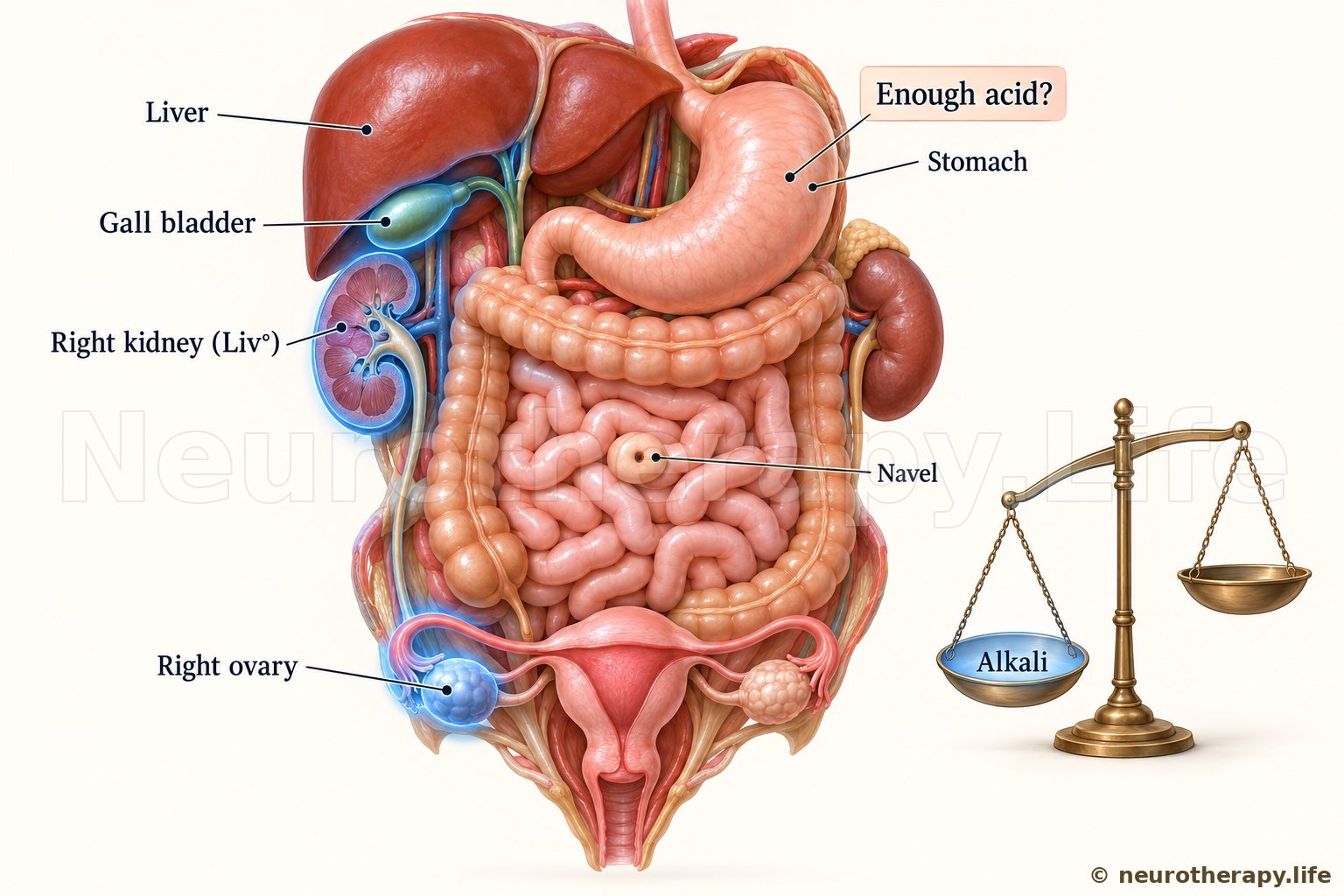
ALTF, the Alkali Treatment Formula, is Neurotherapy (LMNT)'s formula for the alkali side: the patient with more pain at Liv°, the right kidney point, and the signs of alkalosis. It works on the organs of the right side of the navel — and it is given only after the undigested-food (UDF) question has been answered.
LMNT teaching reads the body's acid–alkali balance at two points beside the navel. Pain at Mu°, the left kidney point, points to acidosis (too much acid); pain at Liv°, the right kidney point, points to alkalosis (too much alkali). Each side has its own family of formulas, mirror images of each other.
For patients with more pain at Liv° and less at Mu°, a formula was made that eases the organs of the right side — Gal, Liv, Liv°, Rt. Ov. and the right chest. The symptoms of alkalosis were seen to settle, and a raised blood pressure began to come down, so it was named the Alkali Treatment Formula.
Then came Guruji's sharpest insight. The alkali may only look raised because the stomach's acid has fallen. So before ALTF, the therapist checks the Gas point and asks about undigested food in the stool — and if either is present, the UDF formula comes first. Many patients never need ALTF at all once that is done.
(1) Gal (1) Liv – 3 points (1) Rt.Ov (1) Liv° (2) Rt. Ch. Only × 3 trt.
ALTF works through the right-side points, listed here as a set with what each contributes. Unlike its acid-side mirror, it has no Pan step — the absence is part of the formula. The exact method is taught hands-on in the Neurotherapy (LMNT) course. This page lists the points of the formula and what each one contributes; it does not describe how any point is given. For the method, watch the demonstration video of each point on its own page and learn hands-on from a trained Neurotherapist. Please do not give a formula from a written description alone.
The gall bladder point, on the left thigh. The gall bladder lies on the right of the navel.
The liver point in its three-station form, along the left arm and thigh. The liver is the largest right-side organ.
The right ovary point, part of the right-side group.
The right kidney point. It is the point that shows alkalosis, and here it is treated as well as read.
The right chest alone. In LMNT teaching the right chest eases Liv° pain, the mirror of the left chest used on the acid side.
Position: Lying on the back (supine) throughout.
The exact technique is taught hands-on in the Neurotherapy (LMNT) course. See the course →
LMNT teaching links raised alkali with more water held in the blood, which raises blood volume and so the blood pressure. Easing the right-side organs is meant to bring the alkali, and with it the pressure, back down.
But a balance can tip for two reasons: one side grows heavier, or the other grows lighter. If the stomach is short of blood supply, it does not make enough hydrochloric acid, proteins are not digested, and food comes out undigested. Then alkali only looks high because acid has fallen. The Gas point tells the therapist this.
So the path runs over days: first the UDF formula; then the stool comes properly and the Gas pain goes; the patient is re-examined each day. Only if Gal, Liv and Liv° still hurt after that is ALTF given. Where an organ no longer needs it, a reduced form is used, because an organ that has no need should not be roused.
ALTF heads the alkali-side family and mirrors the acid-side ATF.
Only after UDF, and only when Gal, Liv and Liv° still hurt. These are the situations LMNT teaching links with the alkali side.
Because your alkali may only look raised. If your stomach is not making enough acid — shown by pain at Gas or undigested food in the stool — that is corrected first with UDF. Then you are checked again.
They are mirror images. ATF is for the acid side (pain at Mu°) and works on the left; ALTF is for the alkali side (pain at Liv°) and works on the right. Giving the wrong one pushes the patient further the wrong way.
ALTF is the one formula of the acid–alkali family that does not open with the pancreas point. LMNT teaching treats the absence as part of the formula, not a gap to fill.
No. Neurotherapy (LMNT) works alongside medical care. Any change in medicines is for your doctor to decide.
Stomach acid can reach a pH of about 1 to 2 — strong enough to kill most germs that arrive with food.
Source: Guyton & Hall, Medical Physiology, 14th ed. — gastric secretion.
Pepsin, the stomach's protein-cutting enzyme, is made as an inactive form. Only strong acid turns it on — no acid, and proteins pass on half-digested.
Source: Guyton & Hall, Medical Physiology, 14th ed. — pepsinogen activation.
Blood stays between pH 7.35 and 7.45. The lungs and the kidneys share the work of keeping it there — the kidneys by releasing bicarbonate when needed.
Source: Guyton & Hall, Medical Physiology, 14th ed. — acid–base regulation.

An overview of LMNT's diagnostic pain points — the places around the navel that the therapist presses to read the body before choosing a treatment.
This page explains what a Neurotherapy (LMNT) treatment is for; it is not a self-treatment guide and does not diagnose. Neurotherapy (LMNT) works alongside your medical care — keep taking the medicines your doctor prescribed.
Send COURSE for course details, or your name, age and health issue for a consultation.