Also called: Acid Treatment Formula, Adr version, ATF with Adr, Acid treatment
ATF form (a) is the usual form of the Acid Treatment Formula — the Neurotherapy (LMNT) formula for acidosis, a body short of water with too much acid in the blood. It ends with the left chest and the adrenal point, and it is given only on a day when the Mu° point is clearly tender.
Overview
What is ATF, form (a)?
Neurotherapy (LMNT) reads two broad directions in the body. Acidosis means too much acid in the blood, which this therapy links with a shortage of water; it usually shows as pain at Mu°, the left-kidney point beside the navel. Alkalosis is the opposite direction and shows at Liv°. ATF, the Acid Treatment Formula, is the chief formula for the acid side.
ATF is written in two forms. Both share the same opening; they differ only at the end. Form (a) ends with the left chest and the adrenal point, Adr. It is the default: most people have been found to benefit more from this form than from form (b).
Every acid-reducing treatment in this family works on the left side, and every alkali-reducing one on the right. The reason given is that the left kidney filters most of the acid. In ATF, the side of a point is part of what the point is.
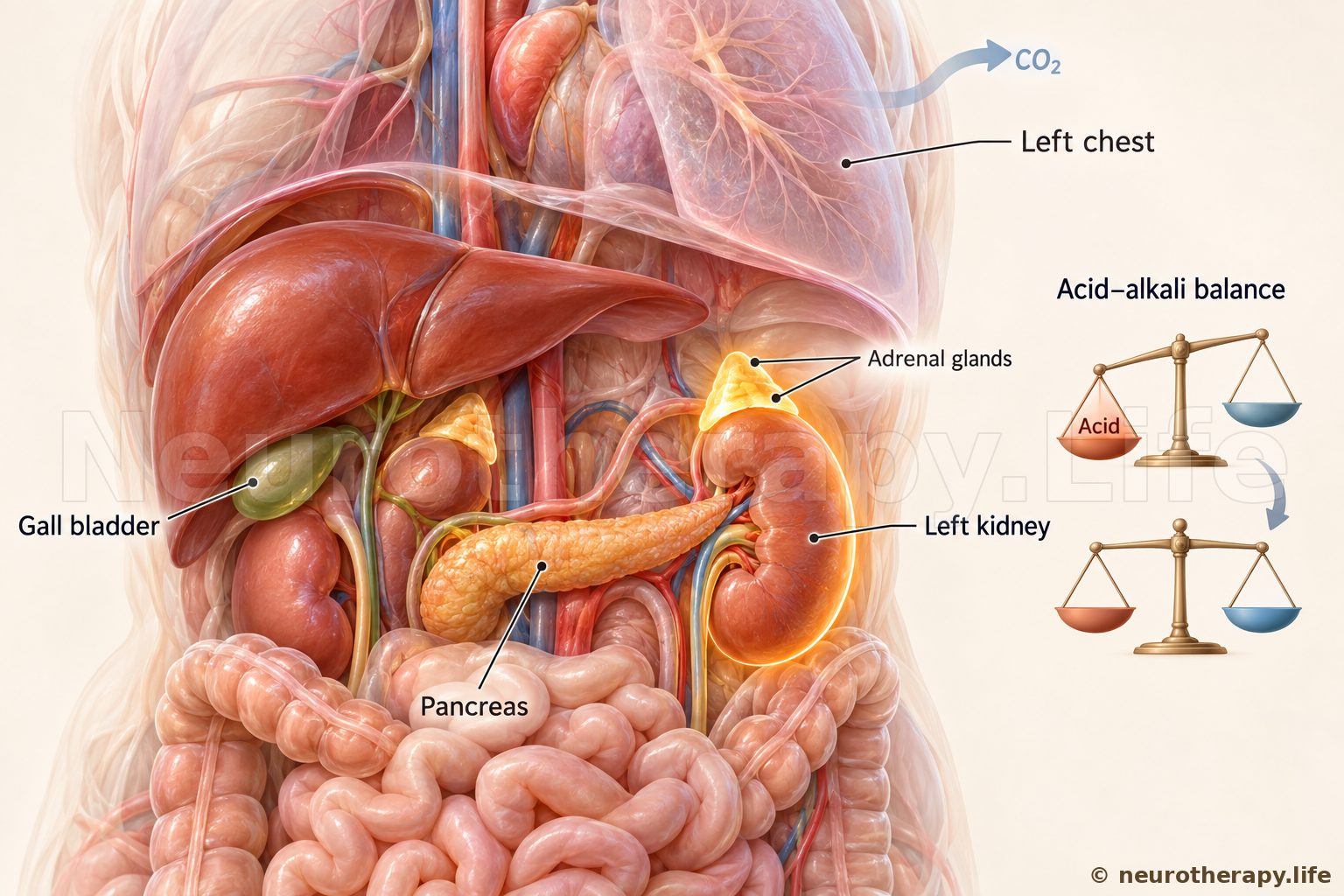
ATF form (a) works through the digestive organs, the left kidney, the left chest and the adrenal glands to bring an acid-heavy body back toward balance.
What it is for
What is ATF form (a) used for?
To help reduce acidosis — the root this therapy finds under many different complaints — on a day when Mu° is clearly tender.
Things that 'fall out of place' because muscles have gone loose: prolapse of the rectum or womb, hernia, varicose veins, low blood pressure.
Wearing-away (degenerative) joint and bone problems such as cervical or lumbar spondylosis, joint pain without cause, migraine near the temples, and stomach or duodenal ulcer.
Points it works through
Which points does ATF form (a) work through?
(8) Pan (1) Gal (3) Mu° (1) acid (4) Lt. Ch. Only (6) Adr
ATF form (a) works through six points across the front, side and back of the body. They are listed here as a set, with what each one contributes. The exact method is taught hands-on in the Neurotherapy (LMNT) course. This page lists the points of the formula and what each one contributes; it does not describe how any point is given. For the method, watch the demonstration video of each point on its own page and learn hands-on from a trained Neurotherapist. Please do not give a formula from a written description alone.
The adrenal point, on the back with the patient face down. It is used to calm inflammation anywhere in the body and to lower the acid of the blood.
Position:Lying on the back (supine) for most of the formula, on the side for the Acid point, and face down (prone) for the adrenal point.
The exact technique is taught hands-on in the Neurotherapy (LMNT) course. See the course →
How it works
How does ATF form (a) work?
The formula moves from the gut to the kidney to the chest to the adrenal glands. First the digestive juices of the pancreas and gall bladder are roused, because both help neutralise acid as food leaves the stomach. Then the left-kidney point and the Acid point are worked to take out their pain. The left chest helps the body breathe out carbon dioxide, which is itself one of the body's acids. Last, the adrenal point is used to settle inflammation and lower blood acid.
The gate matters more than the formula. ATF is given only when there is more pain at Mu° and none, or very little, at Liv°. The finding is made by hand on the day, minutes before treatment — not from the name of the disease, and not from what was given yesterday.
Form (a) is chosen when none of the four circumstances that call for form (b) is present: a recent injury, a recent viral or bacterial infection, pimples or boils, or itching, allergy or a skin rash that came up recently. If a patient says Adr did not suit them, the therapist moves to form (b).
Its family
Which formulas are related to ATF form (a)?
ATF has two present forms, an older heavier generation, and a few variants built on the same opening.
ATF, form (b) — The sister form: the same opening, but it ends with thymus and chest. Chosen after injury, infection, pimples or a recent rash.
ATF, old heavy form — The earlier, heavier generation of both forms. The present light form is what is given today.
No pain at Mu°, no ATF. It is given only when there is more pain at Mu° and none or very little at Liv° — checked by hand on that day, every day. Mu°
Never give ATF in alkalosis. Repeating it on a body that has already been corrected can push it past the middle into the alkali side, which shows as more pain in the body. Alkalosis
Adr lowers immunity, so it is not given in septicaemia, HIV/AIDS or cancer. It lowers acid and raises alkali, so it is not given in high blood pressure. ADR
In heart patients, a senior teacher is consulted before Adr is given — elsewhere the teaching considers that Adr can harm heart patients. Heart
In diabetes, Loveleen Sulta ulta given alongside ATF is said to add benefit. A treatment that can lower blood sugar can also drop it too far, so sugar is checked and medicines are changed only by the doctor. Diabetes
Pan is not given in fits or seizures, nor in schizophrenia. Gal is not given in leukaemia or a raised white-cell count, nor in asthma. Pan
Bleeding from the back passage, a hernia that turns hard or will not go back, or a sudden worst-ever headache need a doctor the same day — not a session. How to tell a patient to see a doctor
Keep taking the medicines your doctor prescribed — a thyroid tablet included. Neurotherapy (LMNT) works alongside your medical care, never instead of it.
Guruji says
“Before giving Acid treatment one must certainly check the pain of Mu°. If there is no pain in Mu° then Acid treatment is not to be given! The second thing is that one and the same person may, on different days, need a different treatment according to the pain points.”
— Dr. Lajpatrai Mehra
A teaching case
A teaching case recorded by Guruji: the same treatment, two days running
At a camp, a low-spirited woman with intense pain at Mu° was given the Acid treatment and felt great relief. The next day, because of the crowd, the same treatment was repeated without checking her. Her pain came back worse: her body had crossed to the alkali side, and Guruji now found the pain at Liv°. One treatment of NAN brought her back to normal.
A composite case written to teach the reasoning — not one patient’s file.
Common questions
What is the difference between ATF form (a) and form (b)?
The opening is the same. Form (a) ends with the left chest and the adrenal point and is the usual choice. Form (b) ends with thymus and chest and is chosen after a recent injury, infection, pimples or boils, or a new rash or allergy.
I felt much better yesterday. Why not give exactly the same today?
Because yesterday's treatment has changed your body. If the acid has already come down, the same formula again can push you the other way. Your pain points are checked fresh every day, and the treatment follows them.
Is the acid in the blood the same as stomach acid?
No. Stomach acid is hydrochloric acid and stays in the stomach. The acidity of the blood comes from other acids — such as uric, lactic and carbonic acid — which the kidneys and lungs keep in balance.
Why is it worked on the left side?
In this therapy the left kidney is held to filter most of the acid, so acid-reducing work is done on the left, and alkali-reducing work on the right.
What should I ask my therapist?
Was my Mu° tender today, and how does it compare with Liv°?
Is there any reason I should have form (b) instead?
(To the doctor) Should my thyroid or sugar be tested?
Surprising facts
1Your lungs are an acid outlet
Carbon dioxide dissolves in blood as carbonic acid. Every breath out removes acid, which is why breathing can shift blood chemistry within minutes.
Source: Guyton and Hall Textbook of Medical Physiology, 14th ed., acid–base regulation
2Blood is kept in a very narrow range
Healthy blood pH stays close to 7.4. Even small moves away from it are felt across the body, so the kidneys and lungs work non-stop to hold it there.
Source: Guyton and Hall Textbook of Medical Physiology, 14th ed.
3Bicarbonate is the duodenum's antacid
When acidic food leaves the stomach, the pancreas pours bicarbonate-rich juice into the duodenum to neutralise it within moments.
Source: Guyton and Hall Textbook of Medical Physiology, 14th ed., pancreatic secretion
Watch
शरीर में Acid बढ़ जाए तो क्या करें? | Blood pH Balance Treatment | LMNT Acid Treatment Formula
Shows the Acid Treatment formula step by step: (8) Pan, (3) Gal, (5) Mu°, 3 Acid on the side of the right thigh, (4) Chest Only, and (6) Adr on the upper back, given without breaks. It is used to support the body's acid–alkali balance when acid is raised.
Note: the Acid Treatment formula is given only when the Mu° point is tender, and (6) Adr is not given in high BP, diabetes, cancer or HIV — the therapist checks first.
This page explains what a Neurotherapy (LMNT) treatment is for; it is not a self-treatment guide and does not diagnose. Neurotherapy (LMNT) works alongside your medical care — keep taking the medicines your doctor prescribed.
Ready to begin?
Send COURSE for course details, or your name, age and health issue for a consultation.