1Small glands, big jobs
Each adrenal gland weighs only about 4 to 5 grams — less than a teaspoon of sugar — yet its hormones help govern salt, sugar, stress and inflammation in the whole body.
Source: Gray's Anatomy, 41st ed., suprarenal glands.
Also called: Adr, Adrenal point, एड्रिनल पॉइंट
ADR is the Neurotherapy (LMNT) point named for the adrenal glands, the small hormone glands that sit on top of the kidneys. It is given on the middle of the back while you lie face down, and the number written before it — (2), (4) or (6) — decides which of several quite different treatments you receive.
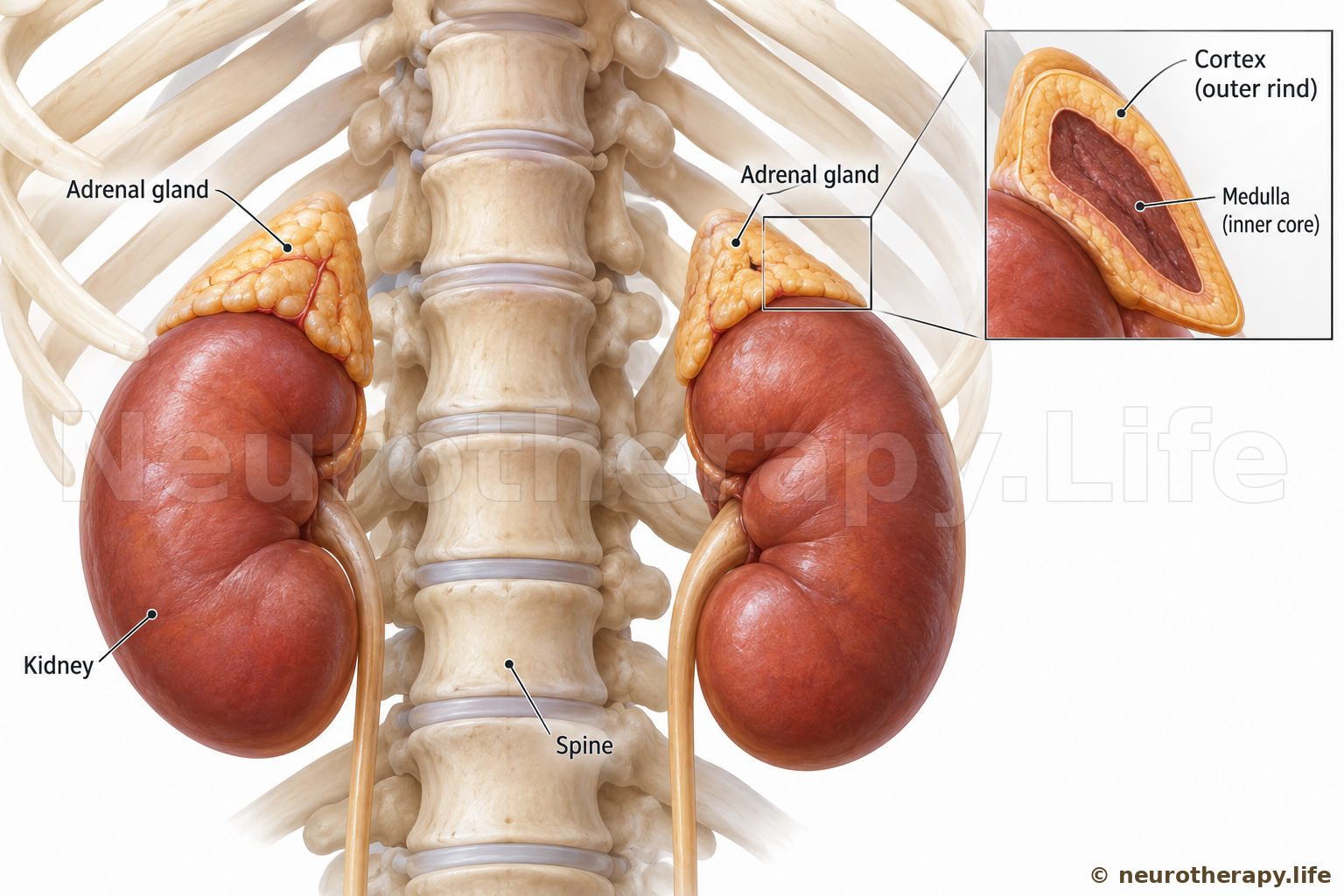
Adr is short for adrenal. You have two adrenal glands, one sitting like a small cap on top of each kidney, deep at the back of the upper belly. Each is really two glands in one wrapper: an outer rind, the cortex, and an inner core, the medulla.
The cortex makes the 'slow' hormones — chemical messengers carried in the blood. One holds salt in the body, one raises blood sugar, and one calls off inflammation (the red, hot swelling of an over-active defence). The medulla makes the 'fast' hormones that a sudden fright releases.
In Neurotherapy (LMNT), ADR is aimed at the cortex; its sister point SWT is aimed at the core. The teaching says that stimulating ADR in different numbers produces different effects. So (2) Adr, (4) Adr and (6) Adr are separate treatments given at one place — and a caution written against one of them does not automatically travel to the others.
You lie face down with one and a half pillows under the chest: the chest rests on the upper pillow and the chin on the lower one, which sticks out a little beyond the edge. This arrangement is compulsory, so that the head stays straight and the breathing free.
ADR is given on the middle part of the back, close beside the sixth bone of the upper back (T6) and at a few places across the mid-back — close to the spine, never on the bone itself.
Why there, when the glands sit deep above the kidneys? The gland itself cannot be reached by a hand, so the search moved to its wiring. The teaching chose this level because the nerve supply of the adrenal cortex was understood to come from about this part of the spine — and it marks that statement with a question mark of its own, because it came from reading and inference, not dissection.
How this point is given — the tool, the pressure, the count and the exact movement — is deliberately not described here. Watch the demonstration video on this page, and learn the method hands-on from a trained Neurotherapist before giving it. Please do not give any point from a written description alone: a point given in the wrong place or the wrong way can do harm.
The number written before a point's name is not a strength setting. Each numbered form is a separate named treatment with its own method and timing, taught hands-on in the course.
The exact technique is taught hands-on in the Neurotherapy (LMNT) course. See the course →
LMNT teaching describes ADR as a way of stimulating the adrenal cortex, with each numbered form aimed at a different product of it. Body science confirms that the cortex makes a salt-holding hormone, a sugar-raising hormone and the body's own anti-inflammatory hormone. How a hand on the back reaches them is the therapy's own explanation, offered from long clinical experience, and the therapy itself says it has not been proved by laboratory tests.
Each number is a separate named treatment with its own uses and its own bars.
ADR is never chosen from a disease name alone. The therapist picks the right number for today's findings — and reads the bars first.
The adrenal treatment itself — the seed of the whole inflammation family.
The Inflammation Treatment Formula — (6) Adr with (30) Medulla over two days.
The Acid Treatment Formula ends with (6) Adr in its usual form.
The formula for very long-standing constipation uses (4) Adr.
Ends with (2) Adr — for shortage of sugar and sodium.
Ends with (10) Adr — calcium deposited between joints or in the tissues.
“When the patient comes for the first time, then — even before beginning treatment — on their diagnosis card block those points which, according to their disease, are not to be given, so that no harm will come to the patient.”
No. The glands lie deep, above the kidneys. The point was placed where the teaching understood their nerve supply to come from, and the therapy itself marks that with a question mark. What it reports is what patients have felt, over many years.
Because they are different treatments. (6) Adr is for inflammation, (2) Adr for salt loss. The number is a selector, not a stronger or weaker dose.
Not (2) Adr or (6) Adr — both are blocked in high blood pressure. Your therapist will choose other points.
Nothing is given — no medicine of any kind. The teaching's idea is that the body's own cortisol is encouraged. Never stop a steroid on your own; only your doctor can change it.
Each adrenal gland weighs only about 4 to 5 grams — less than a teaspoon of sugar — yet its hormones help govern salt, sugar, stress and inflammation in the whole body.
Source: Gray's Anatomy, 41st ed., suprarenal glands.
The cortex and the medulla come from different tissues in the unborn baby — the medulla grows from the same cells that make nerves. They only end up wrapped together.
Source: Guyton & Hall, Textbook of Medical Physiology, 14th ed., adrenocortical hormones.
Cortisol in the blood is highest in the early morning, around waking, and lowest late at night — one reason the body's defences and energy change through the day.
Source: Guyton & Hall, Textbook of Medical Physiology, 14th ed.
Aldosterone from the adrenal cortex tells the kidneys to hold on to sodium. Where salt is held, water is held with it — which is why it can raise blood pressure.
Source: Guyton & Hall, Textbook of Medical Physiology, 14th ed., aldosterone.

Shows the Acid Treatment formula step by step: (8) Pan, (3) Gal, (5) Mu°, 3 Acid on the side of the right thigh, (4) Chest Only, and (6) Adr on the upper back, given without breaks. It is used to support the body's acid–alkali balance when acid is raised.
Note: the Acid Treatment formula is given only when the Mu° point is tender, and (6) Adr is not given in high BP, diabetes, cancer or HIV — the therapist checks first.

A Hindi demonstration of the treatment given when a urine infection has gone on long enough to become inflamed: Liv° and Mu°, Chest Only, 20 Round Arrow along the spine, then (6) Adr on the back.
A urine infection — especially with fever, loin pain or blood in the urine — needs a doctor first. (6) Adr is not given with high blood pressure or when immunity is already low; the video does not say this.
This page explains what a Neurotherapy (LMNT) treatment is for; it is not a self-treatment guide and does not diagnose. Neurotherapy (LMNT) works alongside your medical care — keep taking the medicines your doctor prescribed.
Send COURSE for course details, or your name, age and health issue for a consultation.