When the Hand Must Stop: Blocked Points and Safety in Neurotherapy (LMNT)
Because Neurotherapy (LMNT) wakes up glands, some points must not be given in certain diseases, where those glands are already working too hard. 'Blocking' means writing these points on the patient's card before any treatment is planned — and knowing which findings stop a session and send the patient to a doctor.
Overview
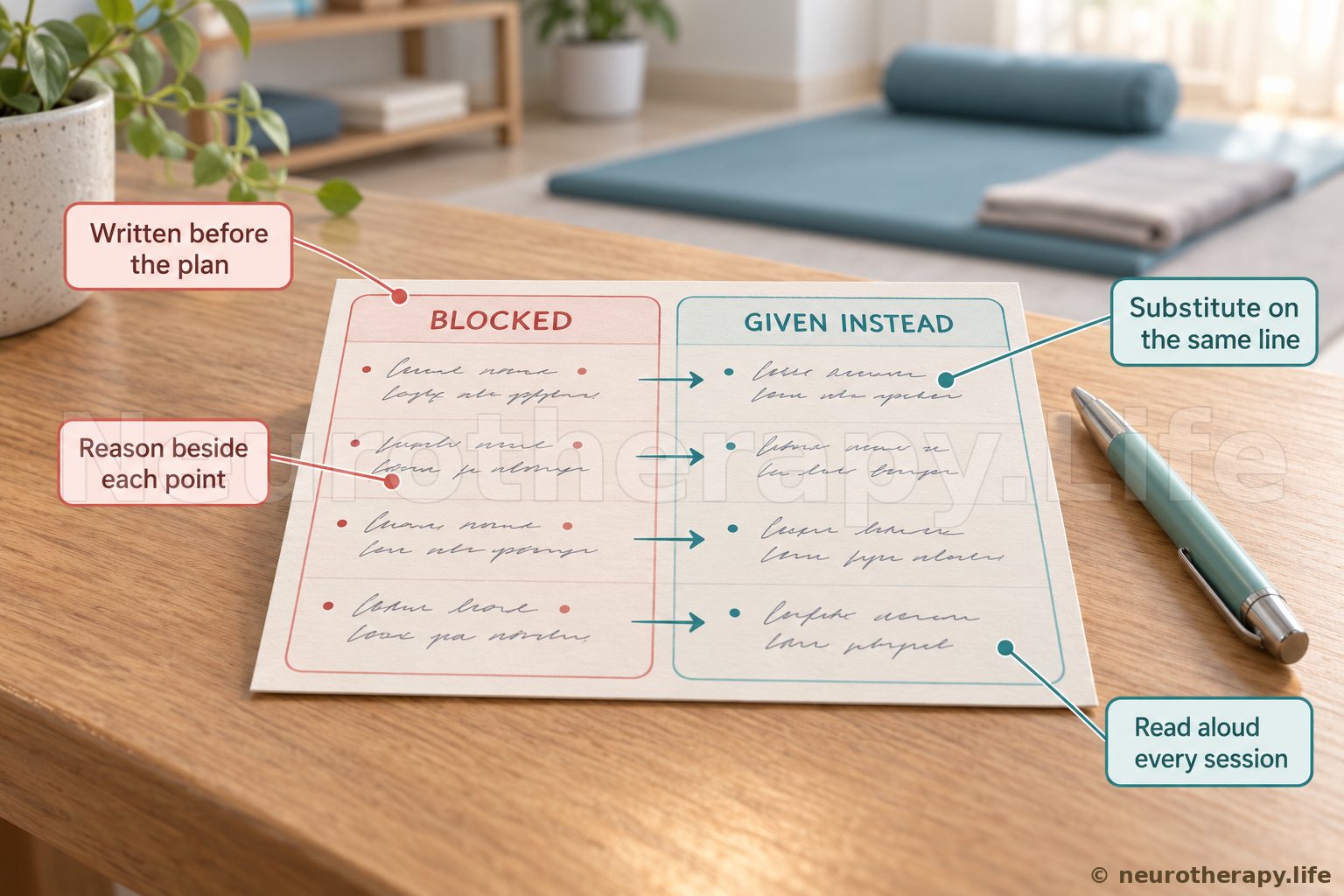
Because Neurotherapy (LMNT) wakes up glands, some points must not be given in certain diseases, where those glands are already working too hard. 'Blocking' means writing these points on the patient's card before any treatment is planned — and knowing which findings stop a session and send the patient to a doctor.
Two cards, written minutes apart
A teaching case, put together from many first mornings: two men with diabetes come about their knees. A newer therapist writes the diabetes list of points not to be given on the first card, each with its reason. A senior therapist knows the list by heart and writes nothing. A week later a third therapist covers for both. One card tells her everything; for the other she has to ask in the corridor. Nothing went wrong — but one patient's safety rested on four minutes of ink, and the other's on a conversation.
What blocking is
In some diseases certain glands become hyper — they work more than they should. Neurotherapy (LMNT) works by rousing glands, so it must know in which diseases which glands must not be roused. A blocked point is therefore not a dangerous point. It is a good point aimed the way the disease is already travelling: a sugar-raising point in diabetes, or a point that lowers immunity where immunity has already failed. On the next patient's mat the same point may be the best thing available.
Guruji called the act of marking these points blocking. At the first visit, after the history and findings and before a single point is planned, the therapist looks up every condition the patient has — not only the one they came about — and writes the closed points in a fixed, boxed place on the card. Beside each goes the reason in a few words, and the substitute on the same line where one is given. The list is read aloud at the start of every session, so that no therapist, on any tired morning, gives it by mistake.
The block is not for ever
The treatment keeps improving how the glands work, so the warning is needed only until the chief symptoms of that disease have ended. After that, if there is a need, those points can be given. The day a block can be lifted is itself treated as a result — proof that the glands have improved. A card that carried many blocked points in one season and only a few some months later has recorded real progress.
Lifting a block is a decision, not a drift. It is written as a new line with the date and the name of whoever decided, while the original line stays visible above. It rests on the chief symptoms really ending — a sugar or blood pressure measured properly over time — and not on the patient simply feeling much better.
Six families of blocking
About twenty conditions carry their own blocked lists. They fall into six families, and learning the idea behind each family makes the lists easy to remember. The details, reasons and substitutes for each condition are on the condition pages and in the course.
- The immune group: where the body's defences attack their owner (autoimmune disorders, arthritis, diabetes, most kidney diseases), the points that raise them — the Thymus group, Lymph, Armpits, Ton 'P', Ton 'T', Spl — are closed. Where defences are failing (infections, septicaemia), (6) Adr, which lowers them, is closed instead.
- Acid and the bowel: in acidity, ulcer, piles and constipation, points that raise stomach acid such as Gas Only and (10) Medulla are closed, and Dys is closed in constipation. In loose motions the mirror happens: Gas 'I' and Const are closed.
- Pressure and the heart: each point that can push blood pressure up is closed in high BP, and those that lower it are closed in low BP. In heart disease, forceful chest-area work and points that burden the heart are closed, and (10) Medulla is never given on both sides — only (10) Left Medulla.
- Bone and growth: in bamboo spine and bone spurs, the points that lay down more bone are closed. In the growing years, points that may close the growth plate early are closed — the only bars whose harm cannot be undone.
- Cancer: points that raise sugar or oestrogen, or lower immunity, are closed — and never a point that stimulates the organ the cancer is in.
- The rest: asthma (Spl, Thrd, Gal), a running nose (Mu, (6) Adr, Spl), fits (Pan and Pit — 'do not give Pit to a Fit'), schizophrenia (Pan), and open wounds (the Heparin formulas, which stop the clotting a wound needs).
When a patient has more than one condition
A man with diabetes, a heart condition and failing kidneys is an ordinary patient in any clinic. His card follows four plain rules.
- Blocked lists add up; they never cancel each other.
- Where one condition recommends a point and another blocks it, the block wins.
- A substitute must clear every list on the card, not only the one that suggested it.
- Where no substitute is written, none is invented — the question goes to the supervising therapist first.
Findings that stop a session on the spot
A blocked point changes the plan; some findings end the session altogether and turn it into a referral. These are asked first and are never explained away by the therapy's own picture of the body.
- Pain that does not settle when the angle is changed — and any chest pain or tightness: sit the patient up and arrange emergency help if it is new, changing, or comes with breathlessness, sweating or pain into the jaw or arm.
- Sudden dizziness with unsteadiness, double vision, slurred speech, a drooping face or arm weakness, or the worst headache of one's life.
- Fever with shivering or new confusion; one leg hot, swollen and tender; numbness in the seat with new bladder or bowel trouble.
- Back pain in someone treated for cancer, a fall in a frail person, or weight falling off without trying.
How to say 'not today'
Not everybody can be treated by every therapist, and the kind answer is the clear one. Say it early, with the patient sitting and dressed. Say what you found, not what you fear. Name the day — today means today. Give a short written note of what was found and what was not done. And do not discharge them: they are welcome straight back once they have been seen. Neurotherapy (LMNT) uses no medicine and never tells anyone to stop theirs; it works alongside the doctor's care, never instead of it.
Key points
- A blocked point is a good point aimed the way the disease is already going.
- Blocking is done on the card at the first visit, before the plan — each point with its reason and substitute.
- A block lasts only until the chief symptoms end; lifting it is a dated, named decision and a sign of improvement.
- With several conditions, the lists add up and the block always wins.
- Where no substitute is written, none is invented.
- Certain findings end the session at once and turn it into a referral.
- Medicines are never stopped by the therapist; Neurotherapy (LMNT) works alongside medical care.
Topics in this guide
Go deeper
The Record That Shows the Truth: The Patient Card in Neurotherapy (LMNT)
How the blocked panel sits on the diagnosis card
From Findings to a Plan: How a Neurotherapy (LMNT) Diagnosis Is Built
From findings to a plan — what comes before the first point
The Child, the Elder and the Frail: Neurotherapy (LMNT) for Delicate Bodies
Children, the elderly and the frail
Weeks, Not Sessions: How a Neurotherapy (LMNT) Course Is Planned
Weeks, not sessions — when a block is lifted in a course
Diabetes
Diabetes — the longest blocked list
High blood pressure
High blood pressure and the points that raise it
Cancer care: Neurotherapy (LMNT) support
Cancer care: what Neurotherapy (LMNT) can and cannot do
Autoimmune disorders
Autoimmune disorders and the Thymus group
Treating Women: Periods, Pregnancy and Care
Bars in periods and pregnancy
Safety: when it is held back
- In cancer, never give (10) Pan, Thymus, Pit, Lu + Sh, Rt. Ov., Lt. Ov. or (30) Medulla. Also closed in cancer: WD, (10) Medulla, (4) Adr, (6) Adr, (4) Pan and Spl, and any point that stimulates the organ the cancer is in. Neurotherapy (LMNT) does not treat cancer; it runs alongside the cancer team's care, never instead of it. Cancer care: Neurotherapy (LMNT) support
- In heart disorders, (10) Medulla is never given on both sides — only (10) Left Medulla. Chest pain stops the session until a doctor has ruled out the heart. Heart attack (myocardial infarction)
- In septicaemia, (6) Adr is never given: it lowers immunity, and given by mistake fits can come on immediately. Septicaemia itself is a hospital emergency. Septicaemia (sepsis)
- Never ATF in alkalosis, never ALTF in acidosis. Correcting the Two Kingdoms: Acid and Alkali Formulas
- In diabetes, check that the feet can feel touch; where feeling is reduced, only light hand contact is used, never body weight. Diabetes
- Thymus and Thymus + Chest are not given in pregnancy, polio, inflammatory diseases, heart disease, diabetes, rheumatoid arthritis, autoimmune disorders or kidney disease — and so the heparin formulas that contain them are closed too. Th + Ch
- Never advise stopping or reducing any medicine — above all a medicine for fits, blood pressure or the heart. Ask the prescribing doctor. How to tell a patient to see a doctor
- Small children get light treatment, given with the hands. The Child, the Elder and the Frail: Neurotherapy (LMNT) for Delicate Bodies
Guruji says
“By our treatment the working of the glands goes on improving. It is not necessary that this warning is for ever.”
Common questions
You keep saying you cannot give this and that. Will the treatment still work for me?
The list is long because it is written down, not because little is left. Only the few treatments that would push your condition further the wrong way are held back; everything else is still available, and with most conditions that is a great deal.
My sugar has been normal for months. Can those treatments be given now?
Possibly — and that is good news, because it means the glands are working better. Blocks are lifted one at a time, only when the chief symptoms have really ended, ideally with readings from your doctor. Each lifted block is written on your card with the date.
Are you sending me away because you have given up on me?
No. You are being sent to someone who can look inside the body, which a therapist cannot. It is one appointment in the middle of your course, not the end of it. Come straight back once you have been seen.
I feel wonderful now. Can I stop my tablets?
Ask the doctor who prescribed them: 'I have no trouble at all now — must I still take the same quantity?' That decision is the doctor's. Neurotherapy (LMNT) never tells anyone to stop a medicine.
Test yourself
Explore more
Organs
Body systems
Diseases
Points
Formulas
Topics
Read more
This page explains what a Neurotherapy (LMNT) treatment is for; it is not a self-treatment guide and does not diagnose. Neurotherapy (LMNT) works alongside your medical care — keep taking the medicines your doctor prescribed.