Septicaemia (sepsis)
Sepsis is a medical emergency: call emergency services (108/112) or go to hospital now. It happens when the body's reaction to an infection runs out of control and starts to damage its own organs. Neurotherapy (LMNT) has no place in the emergency — LMNT is offered only for recovery, after the hospital has treated the person.
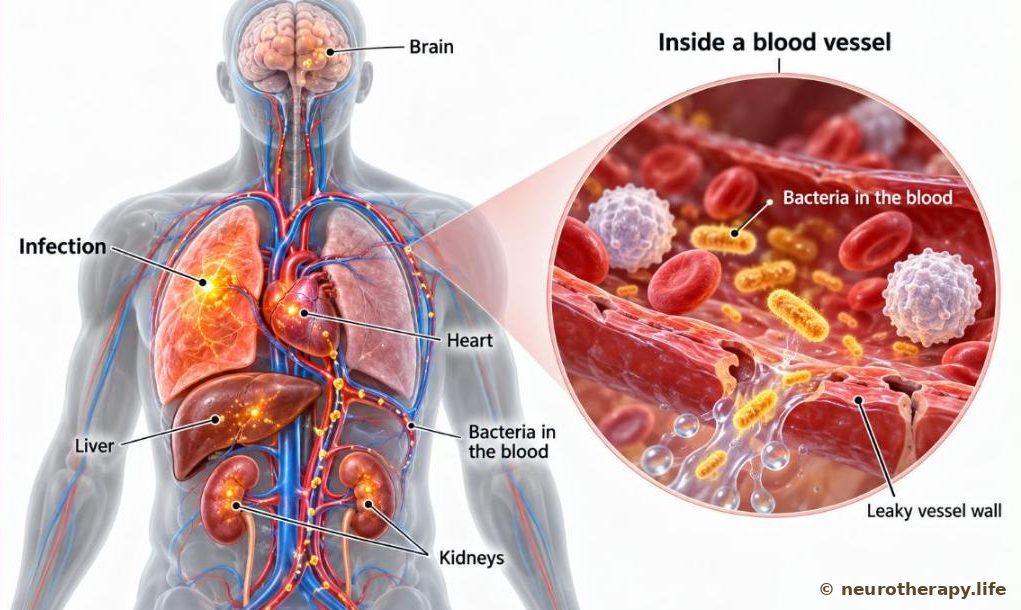
- Sepsis causes an estimated 48.9 million cases and 11 million deaths a year — 20% of all deaths worldwide
- Almost half of all cases — about 20 million — are in children under 5
- About 15 of every 1,000 patients in hospital develop sepsis
Source: World Health Organization — Sepsis fact sheet; MedlinePlus; NHS
What is Septicaemia (sepsis)?
Normally the immune system fights an infection where it is. In sepsis the body's response becomes extreme: it spreads through the whole body and starts to harm its own organs. Septicaemia means germs, usually bacteria, have got into the blood; it can lead to sepsis.
Without fast hospital treatment, sepsis can lead to septic shock — the blood pressure falls dangerously low and several organs begin to fail. Every hour counts, which is why the first step is always the hospital.
What are the symptoms?
- Breathing very fast, or a very fast heartbeat
- Confusion, slurred speech or not making sense
- Blue, pale or blotchy skin, lips or tongue
- Fever or a very low temperature, shivering, cold clammy skin
- A rash that does not fade when you press a glass on it
- Passing very little or no urine; severe pain
What causes it, and who is more likely to get it?
It starts with an infection
People at higher risk
- Adults over 65, babies under 1 year, and pregnant women
- People with diabetes, lung disease, kidney disease or cancer
- Anyone whose immune system is weak
How is it found?
Sepsis is recognised and treated in hospital. Doctors examine the person and use tests to find the infection and check how the organs are coping.
Blood culture
Finds which germ is in the blood, so the right medicine can be chosen.
Lactate and procalcitonin
Blood tests that show how severe the infection is and whether the organs are short of oxygen.
X-ray or CT scan
Finds where the infection started, such as the lungs or the belly.
A neurotherapist looks before touching: shivering in a warm room, fast breathing, confusion, a spreading red wound or very little urine end the session at the door. The person goes to hospital now, with a short written note of what was seen.
How Neurotherapy (LMNT) sees Septicaemia (sepsis)
LMNT teaching says it plainly: a body in which bacteria have got into the blood in large numbers has not come for a course of treatment — it has come for a hospital. So in LMNT the emergency belongs entirely to the doctors. And one point is barred outright: (6) Adr lowers the thymus and immunity, and given by mistake in septicaemia, fits can come on at once.
Once the hospital has treated the infection and the doctor agrees, LMNT teaching turns towards the body's own defence for recovery: Thymus, Th + Ch — always with the Armpits — the Viral Treatment Formula, and Spl, which LMNT uses to help the spleen make white cells and antibodies. This is after-care alongside the doctor, never a replacement for hospital treatment.
Whether or not the patient gets immediate benefit from our treatment, let no harm reach him through our carelessness — attend to this.
Neurotherapy (LMNT) treatment for Septicaemia (sepsis), step by step
Emergency first — 108/112
Call emergency services (108/112) immediately. LMNT works best alongside your existing medical care — always call emergency services first. Do not drive yourself; let someone go with you.
After the hospital — examine first
Only after discharge, with the doctor's agreement. The therapist reads the hospital notes, checks the diagnostic points Liv° and Mu°, and asks at every visit: anything new since last time — anywhere?
Strike out (6) Adr
(6) Adr is blocked on the card — and ITF, which contains it, with it — even if it was helping the person for another illness before.
Support recovery of the defences
Th + Ch, always with the Armpits; the Viral Treatment Formula; and Spl — given lightly, in the recovery period only.
Points and formulas used
Never do this
- Call emergency services (108/112) immediately. LMNT works best alongside your existing medical care — always call emergency services first.
- Go to hospital at once for very fast breathing, confusion or slurred speech, blue, pale or blotchy skin, lips or tongue, fever or very low temperature with shivering, a rash that does not fade when pressed, or very little urine. In a baby or small child: fast or difficult breathing, unusual sleepiness, not feeding, or a weak or constant cry.
- (6) Adr is never given in septicaemia — it lowers the thymus and immunity, and given by mistake, fits can come on at once. ITF, which contains it, is not given either. (6) Adr
- No hands-on treatment during the acute illness. LMNT is given only in recovery, after hospital treatment and with the doctor's agreement.
- Tell your therapist about any new wound, burn, fever or infection, even a small one — it can change what is safe that day.
- Children get half the adult dose and light treatment only, given by a trained therapist.
- Cancer: if the person has cancer, (10) Pan, Thymus, Pit, Lu + Sh, Rt. Ov / Lt. Ov and (30) Medulla are never given — the therapist changes the plan.
- Keep taking the medicines your doctor prescribed. Neurotherapy (LMNT) works alongside your medical care, never instead of it.
From practice
The session that lasted four minutes
A teaching case — a composite from practice, not one patient's file
A man of 47 · powerloom operator · on a course of treatment for rheumatoid arthritis, doing well
- What was found
- On his eleventh visit he came late, brought by his brother. He was shivering under a shawl in a hot room, breathing fast, and had passed urine only once since the day before. A small burn on his shin from eight days earlier was red well beyond the dressing. His brother said: "Since yesterday he is talking differently."
- What was done
- Nothing was given. His card said (6) Adr — the point that had helped his arthritis ten times — and in a septic body it is the one point that can bring on fits. Within four minutes he was seated, his brother was told he needed a hospital this morning, and a written note went with them. He was admitted and treated with antibiotics through a drip.
- What it teaches
- A correct plan is not the same as a safe session — a new illness can arrive between visits. Ask the person who came with the patient, and ask every time: anything new since last time, anywhere? Stopping is also a treatment.
From Ayurveda and the kitchen
Test yourself
What research says
- Strong evidence
The international definition used by doctors: sepsis is life-threatening organ damage caused by the body's out-of-control response to an infection. It explains why sepsis is judged by how the organs are coping, not just by the infection.
- Strong evidence
About 49 million people had sepsis in 2017 and 11 million died — nearly one in five deaths worldwide. The burden was highest in lower-income regions, including South Asia.
No clinical trial of Neurotherapy (LMNT) in sepsis or in recovery from sepsis has been published yet. Improvements reported by neurotherapists are clinical observations.
For you
Parents of young children
A baby who is very sleepy, not feeding, breathing fast or has a rash that does not fade needs a hospital now — do not wait for the morning.
People with diabetes, kidney disease or low immunity
Keep wounds and burns clean and covered, and show your doctor any that gets redder, hotter or more painful.
Anyone recovering from sepsis
Tiredness, weakness and poor sleep can last for weeks. Finish every medicine, keep follow-up visits, and start gentle care only when your doctor agrees.
This page explains; it does not diagnose. Neurotherapy (LMNT) works alongside your medical care — keep taking the medicines your doctor prescribed, and see a doctor for any new or severe symptom.