Your body has a second river besides blood. It is called lymph, and it has no pump at all — it moves only when your muscles move and your chest breathes. On its way home it passes through hundreds of small filter stations, the lymph nodes, where your defence cells check it for germs.
Overview
What is the lymphatic system?
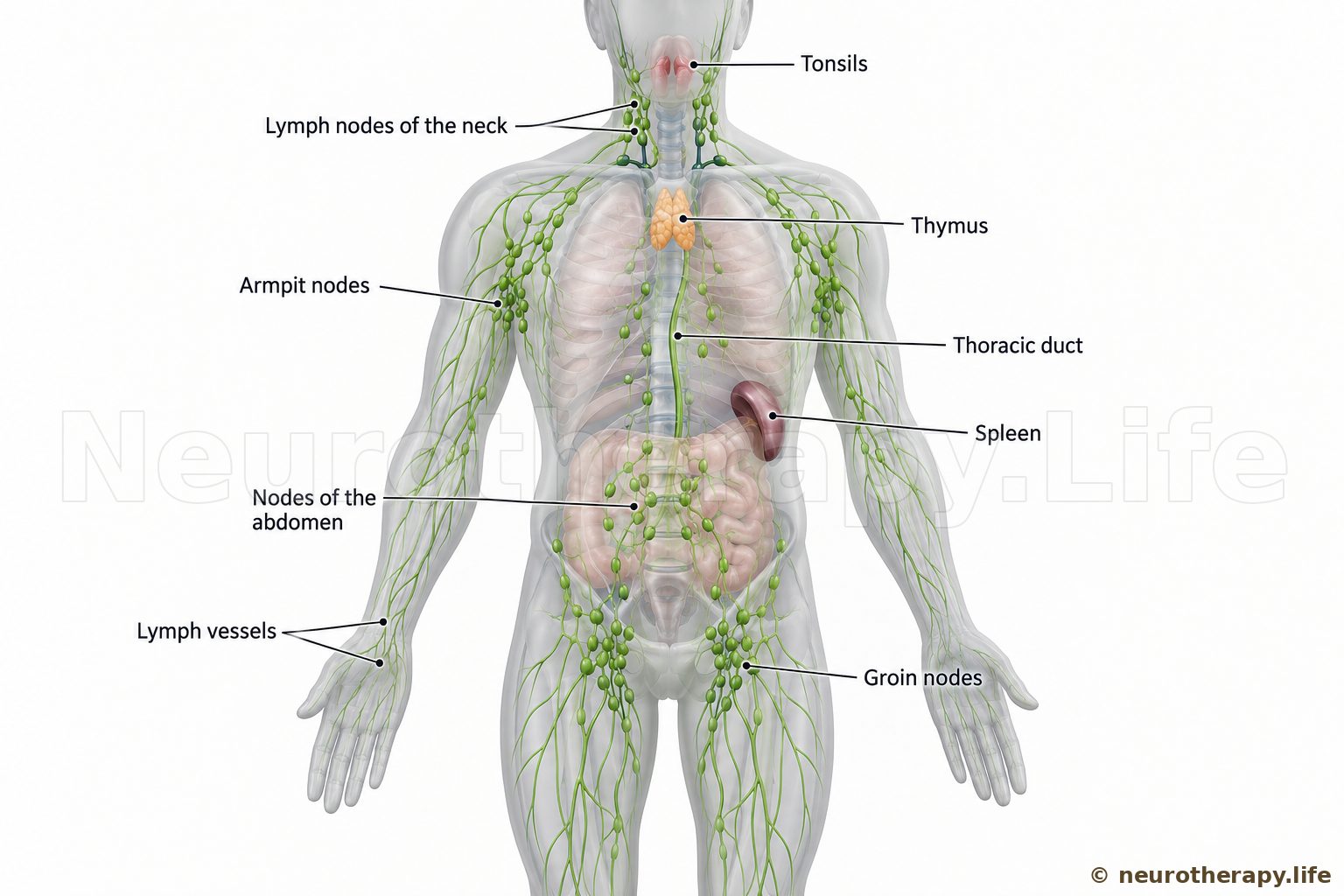
The lymphatic system is a network of thin tubes (lymph vessels), small bean-shaped filters (lymph nodes) and a few organs — the spleen, the thymus, the tonsils and the bone marrow. It drains extra fluid from your tissues and brings it back to the blood, and it is home base for much of your immune system.
Your immune system is your body's defence force. Its soldiers are the white blood cells — above all the lymphocytes (the T cells and B cells) — and the antibodies they make. These cells are born in the bone marrow, many are trained in the thymus, and they travel and gather along the lymph routes.
Neurotherapy (LMNT)'s own definition names two fluids, not one: it aims to improve the flow of blood and of lymph in the organs. Blood has the heart to push it. Lymph has nothing but movement, breathing and posture — which is why people who are bed-bound or sit all day tend to swell and catch more infections.
The lymphatic system: a web of thin vessels, hundreds of filter stations (nodes), and the organs where defence cells are made, trained and stored.
Function
What does the lymphatic system do?
Blood does not touch your cells directly. At the tiniest blood vessels a clear, watery fluid seeps out and bathes the cells. Most of it seeps back into the blood, but some is left behind. The lymphatic system collects this left-over fluid, cleans it on the way, and returns it to the blood near the base of the neck. The same routes carry the body's defence cells.
Drains the extra tissue fluid — about 2 to 3 litres a day — and returns it to the blood, so that the tissues do not swell.
Carries fats absorbed from the small intestine, through special lymph channels called lacteals, into the blood.
Filters the lymph in the nodes, trapping germs, dead cells and damaged or abnormal cells.
Makes, trains and stores the white cells that fight infection — in the bone marrow, the thymus, the spleen and the nodes.
Makes antibodies — proteins that lock on to a particular germ — and keeps a memory of germs it has met before.
Fluid leaks out
At the tiniest blood vessels (capillaries), watery fluid seeps out into the spaces between the cells, carrying food and oxygen to them.
Tiny lymph tubes collect it
Dead-end lymph capillaries lie among the cells. Their walls have overlapping edges that open like flaps to let fluid in but not out. Now the fluid is called lymph.
Squeezed onward
Larger lymph vessels have one-way valves. Each time a muscle tightens, the chest breathes or a pulse beats beside them, the lymph is squeezed one step onward — never back.
Checked at the nodes
On the way the lymph passes through several lymph nodes. Here white cells inspect it, eat germs and debris, and start a defence if they find something foreign.
Home to the blood
The lymph gathers into two main ducts that empty into large veins at the base of the neck. The larger one, on the left, carries about three-quarters of the body's lymph.
How does the lymphatic system work with other body systems?
Heart, blood and circulation — Lymph starts as fluid that leaks from the blood and ends by pouring back into the blood. Without it, the blood would slowly lose its fluid and proteins into the tissues.
Digestive system — Fats from food travel through the gut's lymph channels. The gut wall also holds a great deal of immune tissue, which guards the long surface where food meets the body.
Lungs and breathing — Every breath moves the diaphragm, which helps pump lymph up the chest. The tonsils and the nodes around the airways guard the doorway for germs we breathe in.
Muscular system — Working muscles are the lymph's main pump — especially the calf muscles when you walk.
Skin — Unbroken skin is the first wall against germs. When the skin is cut, the nearest lymph nodes — in the groin, armpit or neck — are the next line of defence.
Glands and hormones — The thymus is both a gland and an immune organ. Stress hormones such as cortisol from the adrenal glands can turn the immune response down.
Blood — The white blood cells — the immune system's soldiers — travel in both rivers, blood and lymph.
The system has four kinds of parts: the fluid itself, the vessels that carry it, the nodes that filter it, and the organs where defence cells are made and trained.
Lymph and its vessels
A one-way drainage network, from tiny dead-end tubes to two large ducts.
Lymph — A clear, slightly yellowish fluid made from blood plasma. It carries proteins, fats, white cells and debris, but no red cells.
Lymph capillaries — The smallest, dead-end tubes among the cells, with flap-like edges that let fluid in.
Lymph vessels — Thin-walled tubes with many one-way valves that give them a beaded look. They usually run beside veins.
Lacteals — Special lymph channels inside the finger-like villi of the small intestine that take up digested fat.
Thoracic duct — The body's largest lymph vessel. It runs up in front of the spine and empties into the veins at the base of the neck on the left, draining both legs, the belly and the left upper body.
Right lymphatic duct — A short duct that drains only the right arm and the right side of the head, neck and chest into the veins on the right.
Lymph nodes
Several hundred small filters, grouped in chains and clusters.
Neck (cervical) nodes — Drain the head, face, mouth and throat — these are the 'glands' that swell with a sore throat.
Armpit (axillary) nodes — Drain the arm, the chest wall and the breast.
Groin (inguinal) nodes — Just below the groin crease; they drain the whole leg and foot, the buttock and the lower belly wall.
Deep nodes — Inside the chest and the belly, along the airways, the intestines and the large blood vessels. These cannot be felt from outside.
Lymphoid organs
Where defence cells are made, trained, stored and put to work.
Bone marrow — The soft inside of bones, where all blood cells, including every white cell, are born. B cells also mature here.
Thymus — A gland behind the breastbone where T cells are trained to attack germs but leave the body's own cells alone. It is largest in childhood.
Spleen — The largest lymphoid organ, on the upper left of the belly. It filters the blood itself, removes worn-out red cells and stores white cells.
Tonsils and adenoids — Patches of lymph tissue at the back of the mouth and nose that guard the entrance for food and air.
Gut patches (Peyer's patches) and appendix — Groups of immune tissue in the wall of the intestine that sample what passes and watch for harmful germs.
The defence cells
Different white cells have different jobs, like the branches of an army.
B cells — Turn into plasma cells that make antibodies — proteins shaped to lock on to one particular germ.
T cells — Helper T cells direct the attack; killer T cells destroy cells infected by viruses and some abnormal cells.
Natural killer (NK) cells — Fast responders that destroy infected or abnormal cells without needing to be taught first.
Macrophages and neutrophils — 'Eating' cells that swallow germs and clear dead cells and debris.
Eosinophils — Fight parasites. They also release chemicals that can narrow the airways, which is why they rise in allergy and asthma.
Where is the lymphatic system located?
Lymph vessels reach almost every part of the body, running alongside the veins. The nodes you can sometimes feel lie just under the skin in the neck, under the jaw, in the armpits and in the groin. Many more lie deep inside the chest and belly.
All the lymph comes home at the base of the neck, where the two main ducts empty into the large veins just behind the collarbones. The spleen sits on the upper left of the belly under the ribs; the thymus lies behind the upper breastbone, in front of the heart.
The drainage is lopsided. Into the left side flow the lymph of both legs, all the belly organs and the left upper body; into the right side, only the right arm and the right side of the head and chest. LMNT teaching notes this lopsidedness and leaves the reason for it as an open question.
Lymph is usually clear or pale straw-coloured, like weak tea. After a fatty meal the lymph coming from the intestine turns milky white, because it is full of tiny fat droplets; this milky lymph is called chyle.
Lymph vessels are thin and almost see-through, with a beaded look from their many valves. Lymph nodes are small, soft, bean-shaped and pinkish-grey. A healthy node is usually too small and soft to feel.
How big is the lymphatic system?
You have several hundred lymph nodes — estimates range from about 450 to 700. Most are a few millimetres to about 1 cm long; a node larger than about 1 cm is usually worth a doctor's look.
The thoracic duct is about 38–45 cm long but only a few millimetres wide. The spleen is about 12 cm long and weighs about 150 grams. About 2 to 3 litres of lymph return to the blood each day — tiny beside the thousands of litres of blood the heart pumps.
Conditions and disorders
What conditions and disorders affect the lymphatic and immune system?
Problems fall into four families: the defence is too weak, the defence is too strong or aimed at the wrong target, the drainage is blocked, or the defence cells themselves grow out of control.
When the defence is too weak or overwhelmed
InfectionsGerms get the upper hand — often a sign that the body's power to resist has fallen.
Fever and viral feverFever is part of the defence: a warmer body slows many germs and speeds up immune cells.
Cancer care: Neurotherapy (LMNT) supportLymphoma is a cancer of the lymph nodes; other cancers can also spread through lymph routes. Care is led by the cancer team.
What are common signs of a problem with lymph or immunity?
Swollen, tender glands in the neck, armpit or groin, usually with an infection nearby
A gland that is hard, painless, fixed in place, growing, or still there after two to three weeks
Infections that come again and again, or wounds that heal slowly
Fever, drenching night sweats or weight loss without a clear reason
Swelling of an arm or a leg that does not go down with rest
A red streak spreading up a limb from a cut or a sore — this needs a doctor the same day
Rashes, sneezing or wheezing on contact with particular things (allergy)
What tests check the lymphatic and immune system?
Examination of the nodes — A doctor feels the neck, armpits and groin for size, hardness, tenderness and whether a node moves.
Complete blood count (CBC) with differential — Counts the white cells and each type — lymphocytes, neutrophils, eosinophils and others.
ESR and CRP — Blood markers that rise with inflammation or infection.
Antibody and infection tests — For example tests for HIV, for particular infections, or for autoantibodies (such as ANA or RF) in autoimmune disease.
Ultrasound, CT or PET scan — Show the size and shape of nodes, including deep ones that cannot be felt.
Needle test (FNAC) or biopsy — A few cells or a whole node are taken and examined under a microscope.
Lymphoscintigraphy — A scan that follows a tiny harmless tracer through the lymph vessels to show where drainage is blocked.
How are lymph and immune conditions treated?
Treating the infection — Antibiotics, antivirals or antifungal medicines, chosen by a doctor for the germ involved.
Vaccines — Teach the immune system to recognise a germ before it ever meets it.
Calming an overactive defence — Anti-allergy medicines, inhalers, and in autoimmune disease medicines that damp down the immune system — prescribed and monitored by a doctor.
Lymphoedema care — Compression garments, gentle specialist lymph-drainage massage, exercise and careful skin care.
Cancer treatment — For lymphoma and leukaemia: chemotherapy, radiotherapy, immunotherapy or bone-marrow transplant, led by a cancer specialist.
Neurotherapy (LMNT)
LMNT teaching puts lymph beside blood in its very definition, and it treats immunity as one of three levels on which digestive work acts: when digestion fails, germs that the stomach should have killed get through, and infections appear in many places. The therapy has six points of immunity — Thymus, Thymus + Chest, Armpits, Lymph, Ton 'P' and Ton 'T' — and they carry the longest list of people who must not have them. The key rule is that infection and autoimmune or inflammatory disease are handled in opposite ways: the body's resistance is raised in the first, and never in the second. This is support alongside medical care, never a replacement for medicine in an infection.
Points
Lymph — Given with both heels together just below the groin, pressed downward and inward for six seconds, to rouse the lymph nodes of the thighs. The teaching observes that a boil or injury on a toe makes the node of that thigh very tender.
Armpit — The armpit holds many lymph nodes; (12) Armpits is taught to open small blockages in them — for bacterial or viral illness, tonsils and sore throat, and in children for earache and mild cold.
Th. Only — The breastbone alone — three rubs a side, with no pressure and no rub on the way back. Given to raise disease-resisting power through the lymphocytes of the thymus.
Th + Ch — Thymus + Chest: whenever it is given, the armpits must be given too.
Spl — Taught to make white cells and antibodies through the spleen, for viral fever, septicaemia and HIV — but not in diabetes or other autoimmune disorders, nor in cold, allergy or asthma.
Subclavian — A thumb circuit along the collarbone and neck, given to rouse the lymph through the veins at the base of the neck. It is given only when both ring fingers are painful.
(6) Adr — Works the other way: it reduces immunity and is the chief point for inflammation — so it is not given where immunity is already low, as in septicaemia, HIV or cancer.
(1) Lymph (1) point Spl (1) Th. Only × 6 treatments — taught as beneficial for everyone to protect the body from disease, even after fever has come, and suitable for small children. Not given in autoimmune disorders.
The longest formula, in fourteen parts, given after a UDF formula in long-standing disease. In diabetes or any autoimmune disorder, parts V, VI and VII — (1) Thymus, (1) Lymph and (1) Ton 'T' — are left out.
Given twice. If the ring-finger pains clear — and with them the folic acid, B₁₂ and Liv°–Mu° pains — the problem was of the lymph; if not, the teaching turns to Raman.
The inflammation formula, over two days. It lowers immunity, so it is kept apart from the viral treatments — infection and inflammation are treated in opposite ways.
“We do not give treatment for any one disease; rather we treat according to the condition of the body on that day.”
— Dr. Lajpatrai Mehra
“Wherever there is a question mark, it is an indication that this is my own thinking, on which other people can now do research.”
— Dr. Lajpatrai Mehra
“Whether or not the patient gets immediate benefit from our treatment, let no harm reach him through our carelessness — attend to this.”
— Dr. Lajpatrai Mehra
Never do this
Emergency: a red streak spreading up an arm or leg from a wound, fast-spreading redness, high fever with shivering, confusion or a person who is suddenly very unwell — get medical help the same day, or call 108/112. Sepsis is an emergency, and pressure is never given over infected, hot or inflamed skin. Septicaemia (sepsis)
A gland that is hard, painless, fixed, growing or lasting beyond two to three weeks — or any lump with night sweats, fever or weight loss — needs a doctor's opinion this week. It is never 'treated and watched' on the mat. How to tell a patient to see a doctor
The immunity points — Thymus, Thymus + Chest, Lymph, Armpits, Ton 'P', Ton 'T' and Spl — are blocked in autoimmune disorders, arthritis, inflammation, polio, diabetes and kidney disorders. Raising immunity is the last thing wanted in a body whose defence is attacking itself. Which points are blocked in which disease: a quick reference
Armpits are not given in lymph node cancer, polio, diabetes or any autoimmune disorder. Thymus and Thymus + Chest are not given in pregnancy or heart disease. Armpit
(6) Adr lowers immunity: it is not given in septicaemia, HIV/AIDS or cancer, and not in high blood pressure. (6) Adr
A tender gland in the groin means something is draining into it. The therapist looks at the whole leg, the foot, between the toes and the nails to find the cause, rather than only pressing the gland. Lymph
Cancer: if the person has cancer, (10) Pan, Thymus, Pit, Lu + Sh, Rt. Ov / Lt. Ov and (30) Medulla are never given — and no one is ever advised to delay or stop treatment from the cancer team. Cancer care: Neurotherapy (LMNT) support
An infection needs the medicine a doctor prescribes. Keep taking it, and never stop an immune-suppressing medicine on your own. Neurotherapy (LMNT) works alongside your medical care, never instead of it.
Care
How can I keep my lymph moving and my defences strong?
Lymph has no pump of its own, so daily habits do the pumping. Most of these also help the immune system.
Keep moving
Walk every day and break up long sitting: every calf squeeze pushes lymph upward. On long journeys, flex your ankles and stand up when you can. Adults are advised at least 150 minutes of moderate activity a week (WHO).
Breathe deeply
Slow belly breathing moves the diaphragm up and down, which helps push lymph up through the chest.
Look after digestion
In LMNT teaching, poor digestion lets germs through and lowers resistance. Eat on time, chew well, and treat constipation and undigested food in the stool seriously.
Sleep enough
Most adults need 7 to 9 hours. Short sleep is linked with catching infections more easily.
Protect your skin
Clean cuts promptly and keep an eye on the feet, especially in diabetes. A small wound is the usual doorway to a swollen gland.
Take the vaccines you are advised
Vaccines train your defence ahead of time. Ask your doctor which ones are due for your age.
Stay away from tobacco
Smoking weakens the defences of the airways and slows healing.
Common questions
What are 'swollen glands'?
They are lymph nodes at work. When germs arrive — for example from a sore throat — the defence cells in the nearest nodes multiply and the node swells and may ache. It usually settles within about two weeks as the infection clears. See a doctor if it lasts longer, keeps growing, feels hard or fixed, or comes with fever, night sweats or weight loss.
Is lymph the same as blood?
No. Lymph is made from the watery part of blood that leaks into the tissues. It is clear or pale yellow, carries white cells, proteins and fats, but has no red cells. Only about 2 to 3 litres of it return to the blood each day.
Does lymph have a pump like the heart?
No. Lymph is moved by the squeeze of working muscles, the rise and fall of the diaphragm as you breathe, the gentle beat of nearby arteries and small contractions of the vessel walls, with one-way valves keeping it going forward. That is why long sitting, bed rest and tight clothing slow it down.
How can I boost my immunity?
There is no single pill. Good sleep, good digestion, regular activity, not smoking and the vaccines you are advised all help. And 'more' is not always better: in allergy and autoimmune disease the defence is already too active. LMNT teaching itself never gives the immunity points to such patients.
Can Neurotherapy (LMNT) kill viruses or bacteria?
No — and it does not claim to. LMNT teaching looks at the body's own power to resist, not at the germ, and aims to support that power. An infection still needs the medicine your doctor prescribes; Neurotherapy (LMNT) is given alongside it.
Why are the immunity points not given in diabetes or kidney disease?
LMNT teaching groups diabetes with the autoimmune disorders, and says that almost all kidney diseases are autoimmune too. In these, the body's defence is already turned against itself, so the points that raise immunity are blocked and other work is chosen instead.
What should I ask my doctor or therapist?
Is this swollen gland from an infection nearby, and how long should I wait before it is checked again?
Do I need a blood count or any other test for my repeated infections?
Is my condition one where the immune system is too weak, or too active?
Which vaccines are due for me?
Which signs mean I should come back the same day?
(To the therapist) Which immunity points are blocked for me, and why?
Surprising facts
1Your second river has no pump
Blood has the heart. Lymph has nothing of its own: it moves because your muscles squeeze its vessels, your diaphragm rises and falls, and one-way valves stop it slipping back. The calf muscle does so much of this work that it is often called the 'second heart'. Stand perfectly still for long enough — as soldiers on parade sometimes do — and people can faint.
Source: Guyton & Hall, Medical Physiology — the lymphatic pump (muscle contraction, respiration, valves); calf muscle pump in venous and lymph return; LMNT source 3.3 and 37.29.
2Only 2 to 3 litres a day
Your heart moves thousands of litres of blood a day. In the same day only about 2 to 3 litres of lymph flow back into the blood. It is slow because of what it carries — heavy proteins, fats and the body's defence cells.
Source: Guyton & Hall, Medical Physiology — total lymph flow about 120 mL/hour, 2–3 L/day; LMNT source 37.29.
3Three-quarters of your lymph comes home on the left
The thoracic duct drains both legs, the whole belly and the left upper body into the veins on the left side of the neck. The right lymphatic duct drains only the right arm and the right side of the head and chest. LMNT teaching notes this lopsidedness and prints the reason for it as an open question.
Source: Gray's Anatomy — thoracic duct and right lymphatic duct drainage territories; LMNT source 26.12-4.
4After a fatty meal, your lymph turns milky
Most fat from food does not go straight into the blood. It is packed into tiny droplets that enter the lymph channels of the gut. After a rich meal this lymph looks like milk, and it is called chyle.
Source: Guyton & Hall, Medical Physiology — absorption of fats as chylomicrons into lacteals; Gray's Anatomy — chyle.
5The brain's own drains were found only in 2015
For a long time doctors were taught that the brain had no lymph vessels at all. In 2015 two research teams showed fine lymph vessels running in the coverings of the brain, draining fluid and immune cells to the lymph nodes of the neck. Even well-known organs still hold surprises.
Source: Louveau A et al., Nature 2015;523:337–341; Aspelund A et al., J Exp Med 2015;212:991–999.
6A swollen gland is a node at work
When germs reach a lymph node, the defence cells inside it multiply fast to meet them. The node fills up and swells — which is why the glands under your jaw grow with a sore throat and shrink back afterwards.
The thymus, where T cells are trained, is at its busiest in childhood. After puberty it slowly shrinks and is replaced by fat. By then it has already trained a lifetime's supply of T cells.
~3/4of all lymph drains into the left side of the neck
Hundredsof lymph nodes — estimates range from about 450 to 700
~1 cmthe usual upper size of a normal node
Yoga
Deep belly breathing Udara śvasana (diaphragmatic breathing)
Benefits
Each deep breath moves the diaphragm, which helps push lymph up through the chest into the neck.
Slow breathing calms the stress response.
Gentle enough for older people and those recovering from illness.
How to do it
Lie on your back with knees bent, or sit upright on a chair.
Place one hand on your upper chest and the other on your belly.
Breathe in slowly through the nose for about 4 seconds, letting the belly rise while the chest stays almost still.
Breathe out gently for about 6 seconds and feel the belly fall.
Continue for 5 to 10 minutes.
Take care
Never force or hold the breath. Stop if you feel dizzy. If lying flat makes you breathless, do it sitting up and tell your doctor about the breathlessness.
Palm-tree stretch with heel raise Tāḍāsana
Benefits
Rising onto the toes tightens the calf muscles, which squeeze the lymph and veins of the legs upward.
Stretches the whole body and opens the chest for a fuller breath.
Easy to do several times a day, even in an office.
How to do it
Stand with feet together or a little apart, weight even on both feet.
Interlock your fingers and stretch your arms straight up above your head, palms facing up.
Breathing in, rise slowly onto the balls of your feet and stretch up.
Hold for a few seconds, then breathe out and lower the heels and arms.
Repeat 5 to 10 times.
Take care
Stand near a wall or hold a chair if your balance is unsteady. Keep the heels down if you have heel or calf pain. Avoid it while giddy or with recent ankle injury.
Legs up the wall Viparīta Karaṇī (supported)
Benefits
With the legs raised, gravity helps lymph and blood drain back from the feet and ankles.
Restful after a long day of standing or sitting.
Needs no strength — the wall does the holding.
How to do it
Sit sideways next to a wall with a folded blanket nearby.
Lie back and swing both legs up so they rest against the wall; slide the blanket under your hips.
Let your arms rest by your sides and breathe slowly.
Stay for 3 to 5 minutes to begin with.
To come out, bend the knees, roll onto one side and get up slowly.
Take care
Do not do this with glaucoma, uncontrolled high blood pressure, heart failure, a recent neck or back injury, during a period if it is uncomfortable, or in late pregnancy. One leg that is suddenly swollen, hot or painful needs a doctor, not yoga.
Watch
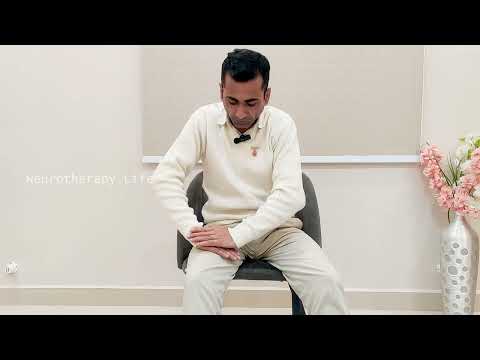
Spleen Point Self Treatment | बार-बार बीमार पड़ने का सही समाधान -How to Boost Immunity & Hemoglobin?
Shows how to give yourself the Spleen (Spl) point, shared for people who fall ill again and again, to support immunity and haemoglobin.
In LMNT teaching Spl is not given in diabetes or other autoimmune disorders, nor in cold, allergy or asthma, and nowadays not in cancer.
Test yourself
Research
Strong evidence
Researchers found true lymph vessels in the coverings of the brain of mice, and showed they carry fluid and immune cells to the lymph nodes of the neck — overturning the old teaching that the brain has no lymphatics.
A second team, working independently, described the same drainage system in the tough outer covering of the brain and showed it clears fluid and large molecules from the brain.
This page explains how the body works; it does not diagnose. Neurotherapy (LMNT) works alongside your medical care — keep taking the medicines your doctor prescribed, and see a doctor for any new or severe symptom.
Ready to begin?
Send COURSE for course details, or your name, age and health issue for a consultation.