About 20,000 breaths a day bring oxygen in and carry carbon dioxide — and acid — out. A centre at the base of your brain runs it all without being asked, and in Guruji's teaching the lungs are one of three organs that decide whether disease can take hold.
Overview
What is the respiratory system?
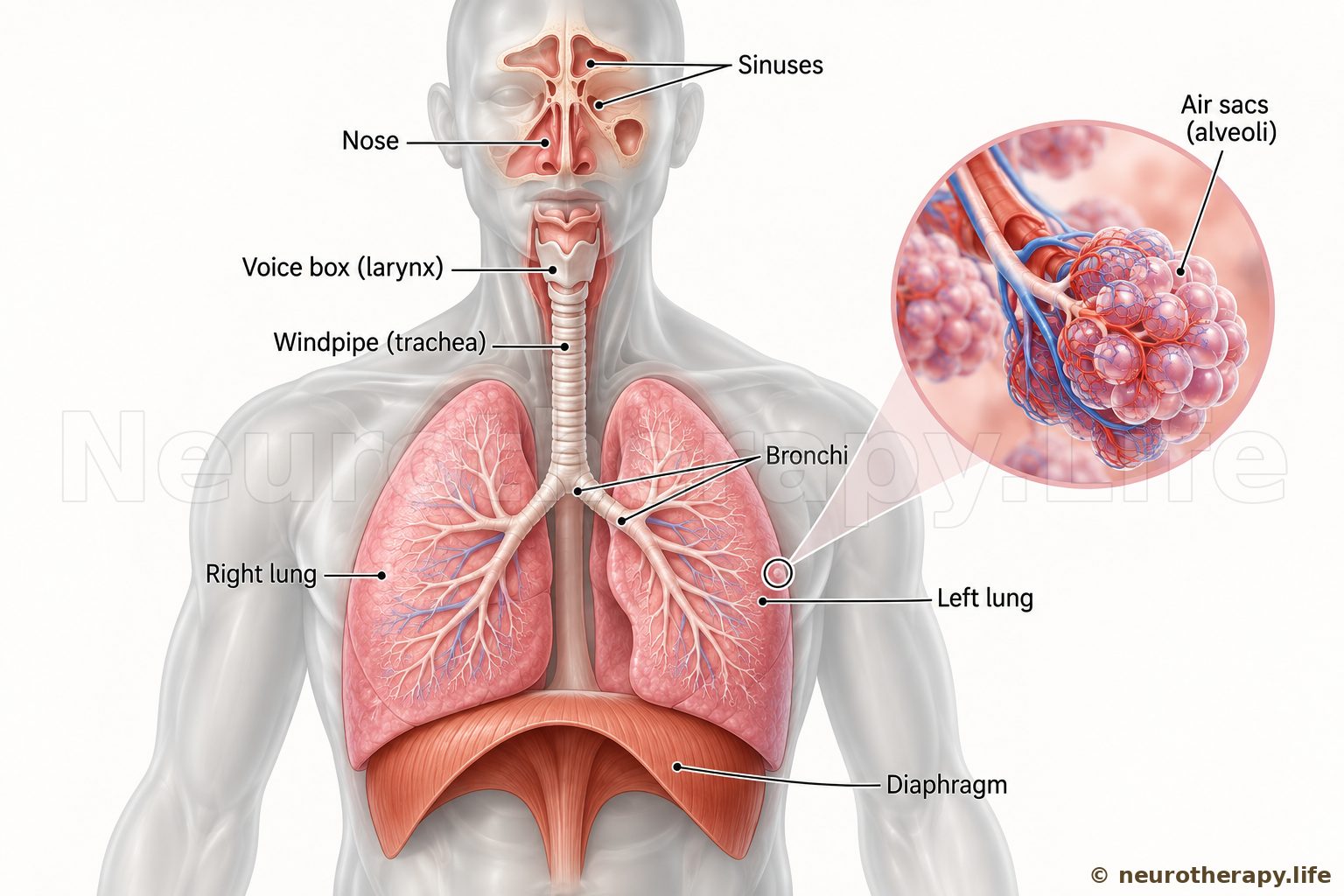
Your respiratory system is the set of organs that lets you breathe. It includes the nose and sinuses, the throat and voice box, the windpipe and its branches, the two lungs, and the muscles that move air in and out — above all the diaphragm.
Its main job is gas exchange: taking oxygen from the air into the blood and passing carbon dioxide from the blood out into the air. It also warms and cleans the air, lets you speak and smell, and helps keep the blood's acid–alkali balance steady.
In LMNT teaching the breath is also one of the body's exits for acid: carbonic acid collected in the tissues turns back into carbon dioxide, travels to the lungs and is breathed out. Guruji counted the lungs with the stomach and the kidneys as the three organs that keep disease away.
The respiratory system: an airway from the nose to millions of tiny air sacs, and a dome of muscle that powers every breath.
Function
What does the respiratory system do?
Breathing has two halves. Breathing in is active: muscles pull the chest open and air rushes in. Breathing out at rest is passive: the muscles relax and the springy lungs push air out on their own.
Brings oxygen into the blood for every cell to burn its fuel.
Removes carbon dioxide, the waste gas of that burning.
Keeps the blood's acidity steady — breathing faster blows off acid, breathing slower keeps it.
Warms, moistens and filters the air, and sweeps out dust and germs with mucus and tiny hairs.
Makes your voice and lets you smell.
Helps control blood pressure: the lining of the lung vessels activates the hormone angiotensin.
The signal
The breathing centre in the medulla, at the base of the brain, senses carbon dioxide rising and sends a signal down the nerves.
The diaphragm pulls down
The dome-shaped diaphragm tightens and flattens, and the muscles between the ribs lift the ribs up and out.
Air rushes in
The chest grows larger, the pressure inside falls, and air flows in through the nose, where it is warmed, moistened and filtered.
Down the airway tree
Air travels down the windpipe and through about 23 levels of branching tubes to the air sacs.
The exchange
Across a wall far thinner than tissue paper, oxygen moves into the blood and carbon dioxide moves out.
Let go
The muscles relax, the elastic lungs recoil, and the used air flows out. At rest the whole cycle takes about four seconds.
How does the respiratory system work with other systems?
Heart, blood and circulation — The right side of the heart pumps every drop of blood through the lungs to be loaded with oxygen.
Nervous system and brain — The medulla's breathing centre sets the rhythm; nerves carry its orders to the diaphragm and rib muscles.
Muscular system — The diaphragm, rib muscles and, when breathing is hard, the neck muscles do the pulling.
Kidneys and urinary system — Lungs and kidneys share the work of keeping the blood's acid–alkali balance: the lungs in minutes, the kidneys over hours and days.
An upper airway in the head and neck, a lower airway in the chest, the lungs themselves, the breathing muscles, and a control centre in the brain.
The upper airway
Nose and nasal cavity — Hairs and sticky mucus trap dust; curled shelves of bone (turbinates) warm and moisten the air.
Sinuses — Air-filled spaces in the bones of the face that drain into the nose and add nitric oxide to the air you breathe.
Throat (pharynx) — The shared passage for air and food behind the nose and mouth.
Voice box (larynx) — Holds the vocal cords, and the epiglottis — the lid that shuts the airway when you swallow.
The lower airway
Windpipe (trachea) — A tube held open by C-shaped rings of cartilage, running from the neck into the chest.
Bronchi — The two main branches, one to each lung, which keep dividing.
Bronchioles — The small airways, with rings of smooth muscle that can tighten — the tightening that causes wheeze in asthma.
Air sacs (alveoli) — Hundreds of millions of tiny bubbles wrapped in capillaries, where oxygen and carbon dioxide change places.
Mucus and cilia — The lining makes mucus to catch dust and germs, and tiny beating hairs sweep it up to the throat.
The lungs and their covering
Right lung — Three lobes; a little larger than the left.
Left lung — Two lobes, with a notch that makes room for the heart.
Pleura — Two thin, slippery membranes with a film of fluid between them, so the lungs glide against the ribs with every breath.
The breathing muscles
Diaphragm — A dome of muscle under the lungs, the main engine of quiet breathing.
Muscles between the ribs — Lift and spread the ribs as you breathe in.
Helper muscles of the neck — The big strap muscles of the neck join in only when breathing is very hard — a sign that breathlessness is severe.
The control centre
Breathing centre in the medulla — Sets the rhythm of every breath, day and night, without your thinking about it.
Chemical sensors — Sensors in the brainstem respond mainly to carbon dioxide and acidity; small bodies beside the neck arteries (carotid bodies) respond to a shortage of oxygen.
The journey
NoseA fraction of a second
Air is filtered by hairs and mucus, warmed and moistened.
Throat and voice boxA fraction of a second
Air passes the open epiglottis and the vocal cords.
Windpipe and bronchiLess than a second
Air flows down the ringed tube and divides into the two lungs.
Small airwaysAbout a second
Branching again and again, the air slows until it simply spreads out.
Air sacsLess than a second for each red cell
Oxygen crosses into the blood and carbon dioxide comes out, while each red cell passes through the lung capillary.
Out againAbout 2–3 seconds
The muscles relax and the used air flows back out the same way.
Where is the respiratory system located?
It runs from the tip of your nose to the bottom of your chest. The nose, sinuses and throat are in the head; the voice box and windpipe are in the front of the neck, with the food pipe just behind them.
The lungs fill most of the chest inside the rib cage, on either side of the heart. Their tops rise a little above the collarbones into the root of the neck; their bases rest on the diaphragm, which separates the chest from the belly — the liver and stomach lie just beneath it.
That high reach of the lung tops matters in LMNT practice: at the collarbone, Lu + Sh is given with very light, flat-palm pressure, and it stops at once if tingling runs into the arm.
The airway is lined with moist, pink tissue covered by a thin film of mucus. The windpipe looks like a ribbed vacuum-cleaner hose, its rings of cartilage giving it shape.
Healthy lungs are soft, spongy and pink, and so full of air that they float on water. Years of smoke or polluted air leave grey and black speckles in them.
How big is the respiratory system?
The windpipe is about 10–12 cm long and about 2 cm across. It divides again and again — about 23 times — before reaching the air sacs, of which an adult has roughly 480 million, with a surface of about 70 square metres.
At rest an adult takes 12–20 breaths a minute, each about half a litre, moving about 6 litres of air a minute. The lungs can hold about 6 litres when completely full, and about 1.2 litres always stays in them, even after the deepest breath out.
Conditions and disorders
What conditions and disorders affect the respiratory system?
Breathing problems can come from narrowed or irritated airways, infection, a blocked nose, weak control, or from outside the lungs altogether — the heart and the blood.
Narrowed or irritated airways
AsthmaThe small airways tighten and swell, causing wheeze and breathlessness.
Cough and bronchitisThe airway's cleaning reflex; bronchitis when the tubes are inflamed.
AllergyDust, pollen or smoke can set off sneezing, runny nose and wheeze.
Breathlessness on effort, at rest, or when lying flat
A cough lasting more than three weeks
Wheeze — a whistling sound when breathing out
Chest tightness or pain on breathing
Coughing up blood, or thick yellow-green phlegm with fever
Blocked nose, loss of smell or loud snoring with pauses in breathing
Blue or grey lips or fingertips
What tests check the respiratory system?
Pulse oximetry — A clip on the finger shows how full of oxygen the blood is (SpO₂); most healthy people read 95–100%.
Chest X-ray — Shows pneumonia, fluid, a collapsed lung or shadows.
Spirometry (lung function test) — You blow hard into a tube to measure how much air you move and how fast — the key test for asthma and COPD.
Peak flow — A small meter used at home to track asthma day by day.
Sputum tests — Check phlegm for infection, including tuberculosis.
CT scan of the chest — Detailed pictures of the lungs and airways.
Sleep study — Records breathing overnight to find pauses in breathing (sleep apnoea).
How are breathing problems treated?
Inhalers — Reliever inhalers open tight airways within minutes; preventer inhalers calm the swelling day by day.
Medicines for infection — Antibiotics for bacterial pneumonia; a full course of treatment for tuberculosis.
Oxygen — For people whose blood oxygen stays low.
Pulmonary rehabilitation — Supervised exercise and breathing training for long-term lung disease.
Vaccines and stopping smoking — Flu and pneumonia vaccines for those at risk, and help to quit tobacco.
Neurotherapy (LMNT)
LMNT teaching reaches the breath from three directions. The first is the brain: in the medulla there is a respiratory centre, and it works when acetylcholine is released. That was learned at the mat — a patient with difficulty breathing was given (15) Medulla and got relief at once, and the reading followed afterwards. The graded Medulla series then assigns numbers to the nose and breath: (5) for the nose and maxillary sinus, (7) for the feeling of the nose and throat, (9) to raise breathing when oxygen is short, by way of the sensors of the carotid bodies, and (11) when breathlessness is so severe that the neck muscles are being used — each given three times, a minute and a half apart. The second is the chest wall and neck: Electrical Waves relaxes the neck muscles, Lu + Sh rouses the lungs and opens the chest muscles, and Stretch relaxes the neck from the fingertips — given together in asthma and bronchitis. The third is acid: carbonic and lactic acid rise when breathing is poor, and carbonic acid leaves the body as carbon dioxide on the breath. More than 90% of it needs about sixteen breaths — roughly one minute — which is why a minute's rest is written after each joint in the all-joints rubbing. This is support alongside your doctor's care; keep your inhaler with you.
Points
(15) Medulla — The acetylcholine treatment — found in an emergency with difficulty breathing. Especially for those whose breathing stops and starts at night.
Medulla — One place behind the ears, different counts for different jobs: (5) nose and sinus, (7) nose and throat feeling, (9) breathing when oxygen is short, (11) very severe breathlessness, (1) loss of smell.
Electrical Waves — Heel or edge of the palm from behind the ear down the side of the neck — relaxes the neck muscles; found excellent for asthma and breathing difficulties.
Lu + Sh — Very light flat palms below the collarbones to rouse the lungs, then a firmer press above the shoulder joint to open the chest muscles; ordinarily six times.
Stretch — Over the forearm and out to the fingertips — relaxes the neck from the hand; part of the Oxygen formula.
Back Arrow — Blood supply to lungs — light rubbing on the upper back, given in all breathing-related diseases.
Ch. Only — Stimulates both wings of the lungs; (2)/(4) Ch. Only to expel carbon dioxide fully. Not in lung cancer.
Mukha Dhauti — No hand is placed: a normal breath in through the nose, then a forceful breath out through the mouth, in rounds of ten with a minute's rest — to let carbonic acid leave as carbon dioxide.
(6) Right Swt — For bronchial asthma, that is bronchitis: six presses beside the T6–T12 beads on the right side. Not given in high blood pressure.
(8) Ch. Only, Stretch, Back Arrow, H Arrow, the three spinal strokes twenty times each, then the arrows and Stretch again — to increase the oxygen in the tissues and cells. In chronic illness the arrows are given only as far as L1–L5.
“If the stomach, the lungs and the kidneys work properly, then disease simply cannot come.”
— Dr. Lajpatrai Mehra
“This matter is to be publicised as widely as possible: that the cord should not be cut until the child itself has cried properly for some time.”
— Dr. Lajpatrai Mehra
“Whether or not the patient gets immediate benefit from our treatment, let no harm reach him through our carelessness — attend to this.”
— Dr. Lajpatrai Mehra
Never do this
Emergency: blue or grey lips, gasping so you cannot finish a sentence, chest pain, sudden confusion, or an asthma attack not easing with the reliever inhaler — call 108/112. A low oxygen reading (below about 94% at rest) needs a doctor the same day.
A cough lasting more than three weeks, or coughing up blood, needs a doctor and a TB test. Cough and bronchitis
In asthma, Spl, Thrd and Gal are not given — with Spl and Thrd the trouble increases, and Gal can increase inflammation in the lungs. (4) Thrd is not given, because the cough increases. Asthma
Electrical Waves runs downward behind the big strap muscle of the neck — never forward onto its front edge, over the great artery to the brain. Electrical Waves
Lu + Sh raises blood pressure: it is not given in high blood pressure or heart disease. Its collarbone station is very light, flat palm only, and stops at once for tingling in the arm. Lu + Sh
Ch. Only is not given in lung cancer. (6) Right Swt is not given in high blood pressure; (6) Left Swt is not given in diabetes. Ch. Only
Mukha Dhauti: the one-minute rest between rounds is necessary — if too much acid leaves at once, the alkali rises for a while. It is stopped as soon as the pain it was given for has gone. Mukha Dhauti
In face-down treatments with pillows under the chest, a three-finger gap is kept at the throat so breathing stays free. Children get light treatment and half the adult dose.
Cancer: if the person has cancer, (10) Pan, Thymus, Pit, Lu + Sh, Rt. Ov / Lt. Ov and (30) Medulla are never given — the therapist changes the plan.
Keep taking the medicines your doctor prescribed, and keep your inhaler or oxygen with you. Neurotherapy (LMNT) works alongside your medical care, never instead of it.
Care
How can I keep my lungs and breathing healthy?
Clean air in, tobacco out, and a body that moves every day.
No tobacco, no smoke
Stopping smoking is the single best thing for your lungs at any age. Keep children away from cigarette and bidi smoke.
Keep the kitchen air clean
Smoke from wood or dung fires and mosquito coils harms the lungs. Use a clean fuel where possible, and keep a window open or use a chimney.
Breathe through your nose
The nose filters, warms and moistens the air far better than the mouth.
No cold water first thing
Guruji's rule: on waking, drink water at room temperature or warm — cold water first thing provokes phlegm.
Move every day
Walking and activity that makes you a little breathless keep the breathing muscles strong.
Protect yourself from infection
Wash your hands, cover coughs and sneezes, and ask your doctor about flu and pneumonia vaccines if you are older or have a long-term illness.
Mask up on bad-air days
On days of heavy smog or dust, limit time outdoors and wear a well-fitting mask.
Common questions
How many breaths a minute is normal?
For a resting adult, about 12 to 20. Babies and young children breathe faster. Breathing faster than 20 at rest, or struggling to breathe, is worth checking.
What is a good oxygen level on a finger meter?
Most healthy people read 95–100% at rest. Readings keep falling below about 94%, or you feel breathless, see a doctor. Cold fingers, nail polish and movement can give false low readings.
Why do I have to stop on the stairs to catch my breath?
Working leg muscles run short of oxygen and make lactic acid. LMNT teaching tells it simply: you stop on the landing not to rest your legs, but to fetch oxygen so that the acid can be turned back into fuel. New or worsening breathlessness on stairs should be checked by a doctor.
Is it better to breathe through the nose or the mouth?
Through the nose, whenever you can. It filters, warms and moistens the air, and adds nitric oxide from the sinuses. A nose that is always blocked is worth showing a doctor.
Can yoga or Neurotherapy (LMNT) help asthma?
Studies suggest yoga breathing can modestly improve asthma symptoms and quality of life. LMNT gives treatments such as the Oxygen formula and the neck-and-chest group as support. Neither replaces your inhalers — never stop them on your own.
What should I ask my doctor or therapist?
Is my breathlessness from my lungs, my heart or my blood?
Do I need spirometry, a chest X-ray or a TB test?
Am I using my inhaler the right way? Which one is the reliever and which the preventer?
What oxygen reading or symptoms mean I should go to hospital?
(To the therapist) Which points are blocked for me because of asthma, blood pressure or diabetes?
Surprising facts
1You breathe because of carbon dioxide, not oxygen
The strongest urge to breathe comes from carbon dioxide and acid building up in the blood, sensed by the medulla — not from oxygen running low. That is why holding your breath soon becomes unbearable, long before you are short of oxygen.
Source: Guyton & Hall — chemical control of respiration: CO₂/H⁺ act on the medullary chemosensitive area; peripheral chemoreceptors respond to low O₂. LMNT: (15) Medulla and the respiratory centre, respiratory.md §31.10.
2Humming boosts a helpful gas in your nose
Your sinuses make nitric oxide, a gas that helps fight germs and open the airways. Humming makes the air swirl in and out of the sinuses, and one study found it raised nitric oxide in the nose about fifteen-fold — the idea behind Bhrāmarī, the humming breath.
Source: Lundberg JO et al. Nat Med 1995;1:370–373 (paranasal sinuses produce NO); Weitzberg E, Lundberg JO. Am J Respir Crit Care Med 2002;166:144–145 (humming ~15-fold rise in nasal NO).
3Your out-breath still has plenty of oxygen
Air breathed in is about 21% oxygen; air breathed out is still about 16%. The body takes only a small part of each breath — which is why rescue breaths from another person can keep someone alive.
Source: Guyton & Hall — composition of expired air (O₂ about 15–16%); resuscitation guidelines on rescue breathing.
4About 20,000 breaths a day
At 12–16 breaths a minute you breathe roughly 17,000–23,000 times a day, moving about 8,000–9,000 litres of air at rest — far more when you are active.
Source: Arithmetic from normal resting rate (12–16/min × 1,440 min) and minute ventilation about 6 L/min (Guyton & Hall).
5A moving carpet cleans your airways
The airway lining is covered with millions of tiny hairs called cilia, each beating about 10–20 times a second. Together they carry a sheet of mucus — with the dust and germs stuck in it — up to the throat to be swallowed or coughed out. Tobacco smoke slows and damages this carpet.
Source: Bustamante-Marin XM, Ostrowski LE. Cilia and mucociliary clearance. Cold Spring Harb Perspect Biol 2017;9(4):a028241.
6You cannot breathe and swallow at the same time
Every time you swallow, breathing stops for a moment and a flap called the epiglottis folds down over the voice box, so food goes into the food pipe and not the windpipe. When this timing fails — after a stroke, for example — food can slip into the lungs and cause pneumonia.
Source: Guyton & Hall — the swallowing (deglutition) reflex with brief apnoea and epiglottic closure; aspiration pneumonia after stroke.
7A hiccup is your diaphragm tripping
A hiccup is a sudden, unwanted pull of the diaphragm. A split second later the vocal cords snap shut on the rushing air — and that snap makes the 'hic'. Hiccups that last more than two days need a doctor.
Source: Kahrilas PJ, Shi G. Why do we hiccup? Gut 1997;41:712–713 (diaphragm contraction followed ~35 ms by glottic closure); persistent hiccups >48 h (StatPearls).
8The whole airway tree divides about 23 times
From the windpipe to the air sacs, the airways split in two again and again — about 23 times. The first sixteen or so levels only carry air; only the last few do the exchange.
Source: Weibel ER. Morphometry of the Human Lung, 1963 (23 generations; conducting zone to about generation 16).
A day in the life of your breathing
~20,000breaths
~8,000–9,000 Lof air moved at rest
~350 Lof oxygen taken into the blood
~290 Lof carbon dioxide breathed out
~300–400 mLof water lost in the breath
16breaths — about a minute — to clear most of a load of carbon dioxide (LMNT teaching)
Yoga
Crocodile pose with belly breathing Makarāsana
Benefits
Makes you feel the diaphragm at work — the belly presses the floor on each breath in.
Relaxes the neck and shoulder muscles that tighten during breathlessness.
A calm resting position for slow, easy breathing.
How to do it
Lie on your front on a mat.
Fold your arms and rest your forehead on them; let the shoulders drop.
Let the legs relax, a little apart, toes turned out.
Breathe slowly through the nose, feeling the belly press into the mat as you breathe in and soften as you breathe out.
Stay for 3–5 minutes, then roll to your side before getting up.
Take care
Skip it in pregnancy, after recent belly surgery, or if lying face down makes you breathless — sit upright instead. Never use it during an asthma attack; use your reliever inhaler.
Cobra pose Bhujaṅgāsana
Benefits
Opens the front of the chest and stretches the muscles between the ribs.
Counters the rounded, slumped posture that squeezes the lungs.
Strengthens the upper back.
How to do it
Lie on your front with the legs together and the forehead on the mat.
Place the forearms on the mat with the elbows under the shoulders.
Breathing in, gently lift the head and chest; keep the hips and legs down.
Hold for 3–5 easy breaths, shoulders relaxed away from the ears.
Breathing out, lower slowly. Repeat 3 times.
Take care
Keep it low and pain-free. Avoid it in pregnancy, after recent belly or back surgery, or with a painful slipped disc unless your therapist or doctor agrees.
Humming bee breath Bhrāmarī
Benefits
Lengthens the out-breath and slows the breathing rate.
Humming raises nitric oxide in the nose and sinuses.
Calms the mind before sleep.
How to do it
Sit comfortably with a straight back and close your eyes.
Rest your index fingers gently on the ear flaps.
Breathe in slowly through the nose.
Breathe out slowly with the mouth closed, making a low, steady humming sound like a bee.
Repeat 5–10 times, then breathe normally.
Take care
Never force the breath or hold it. Skip it with an ear infection. Stop if you feel dizzy.
Watch
LMNT Oxygen Formula — Drugless Support for Asthma & Low Oxygen
This video shows the LMNT Oxygen formula, shared as support alongside medical care for asthma, breathlessness and low oxygen.
Note: keep your inhaler with you and use it as your doctor advised.
Test yourself
Research
Emerging evidence
In a small study of healthy people, humming raised nitric oxide in the nose about fifteen times compared with quiet breathing out, by moving air in and out of the sinuses.
A review of studies found that slow breathing, around six breaths a minute, makes the heart rhythm more flexible and the blood-pressure reflex more sensitive, and may calm the nervous system.
Following British doctors for 50 years showed that smoking cuts about ten years from life, and that stopping — even at 50 — gains back many of those years.
This page explains how the body works; it does not diagnose. Neurotherapy (LMNT) works alongside your medical care — keep taking the medicines your doctor prescribed, and see a doctor for any new or severe symptom.
Ready to begin?
Send COURSE for course details, or your name, age and health issue for a consultation.