1Your lungs are not twins
The right lung has three lobes and the left only two, leaving room on the left for the heart.
Source: Standring S (ed.), Gray's Anatomy, 41st ed., Elsevier 2016 — lungs.
Also called: Chest Only, Ch Only, चेस्ट ओनली, Lt. Ch. Only, Rt. Ch. Only
Ch. Only — Chest Only — is a soft sliding treatment from the chest up to the shoulders, given while you lie flat on your back. It works the chest without the thymus, it is used to balance acid and alkali in many formulas, and it is always paired with the Round Arrow. It is not given in lung cancer.
The chest group of Neurotherapy (LMNT) has four treatments built out of one another. Th. Only works the breastbone over the thymus gland; Ch. Only works the chest itself; Armpit works the armpits; and Th + Ch works all three together. 'Only' means the chest without the thymus — which is exactly why Ch. Only can be used where thymus work is barred.
Ch. Only is a rub (ghisāī), not a press. The therapist's sole slides softly across the chest toward the shoulders. In LMNT teaching it lowers alkali in the body — so the signs of acid rise — and it is said to govern the air element (vāyu tattva).
Because of that one-way pull, Ch. Only is almost never given alone. It is paired with the Round Arrow, which pulls the other way, and together they hold the acid–alkali balance at the close of many formulas. Its two side forms, Left and Right Chest Only, are used to lean the balance on purpose.
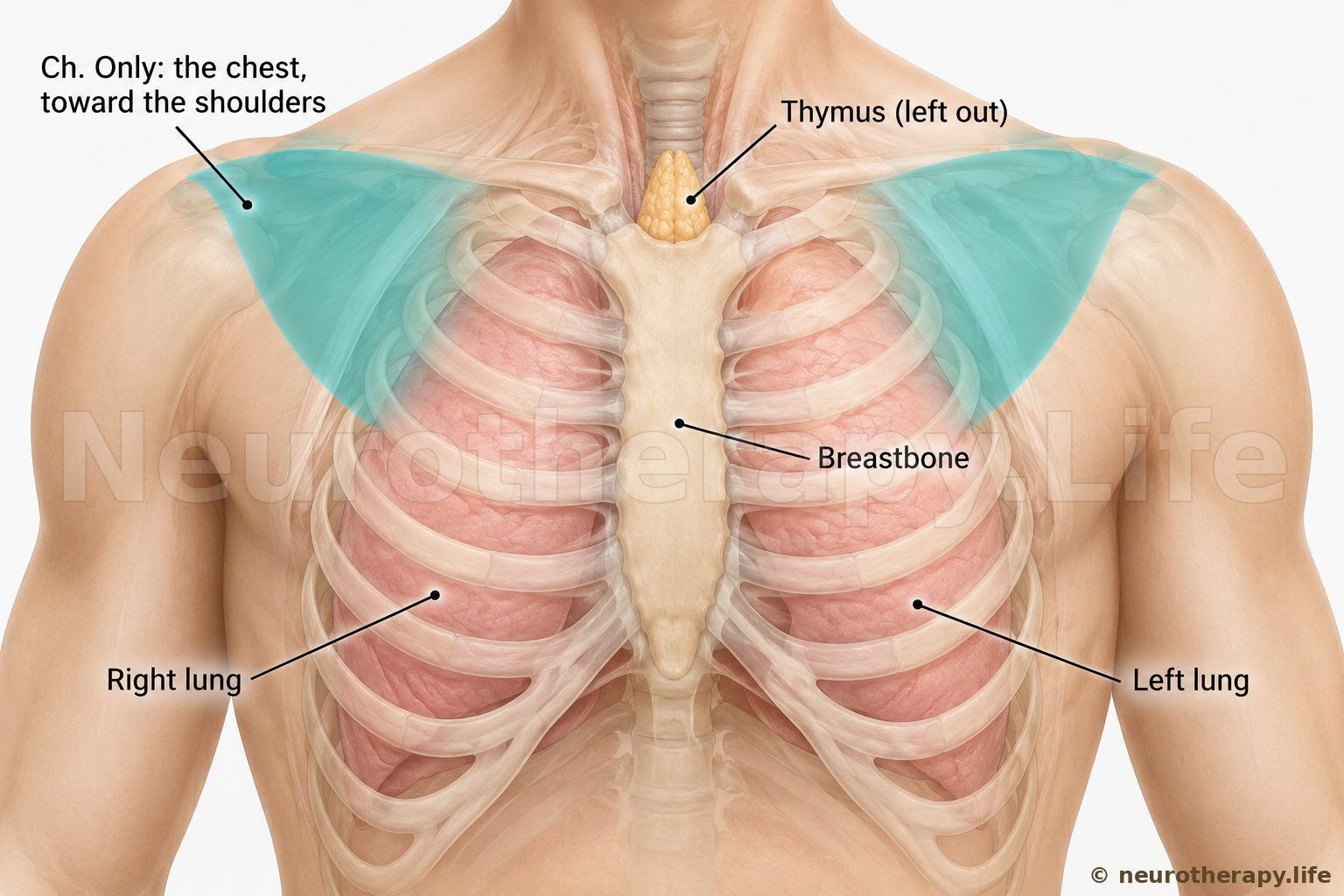
You lie flat on your back with no pillow at all — not under the head, not under the thighs — so that the chest and the shoulders are level. The therapist works from the head end.
It is given on the front of the chest, from the chest up toward the shoulders, on both sides — or on one side only when a card writes Lt. Ch. Only or Rt. Ch. Only.
In women the path crosses the breast. Consent, covering and a chaperone are not optional: the therapist explains where the foot will travel before it travels, keeps you covered to the edge of the working area, and asks each session.
How this point is given — the tool, the pressure, the count and the exact movement — is deliberately not described here. Watch the demonstration video on this page, and learn the method hands-on from a trained Neurotherapist before giving it. Please do not give any point from a written description alone: a point given in the wrong place or the wrong way can do harm.
The number written before a point's name is not a strength setting. Each numbered form is a separate named treatment with its own method and timing, taught hands-on in the course.
The exact technique is taught hands-on in the Neurotherapy (LMNT) course. See the course →
In LMNT teaching, Ch. Only lowers alkali — so the signs of acid rise — while the Round Arrow lowers acid. That observation is what makes the pair useful: given together and matched, they hold the balance; changed on purpose, they lean it. These are the therapy's own clinical findings, not textbook physiology.
Each written form is its own treatment. The side forms are not halves of a balance — they choose a side.
Ch. Only is rarely chosen for a disease by itself. It is chosen as part of a formula, and its form and side follow the findings at Liv°, Mu° and the stool.
Calcium and electrolyte uptake — Ch. Only and the Round Arrow added to keep the balance.
Provoking the kidneys, with the chest-and-arrow pair to keep acid and alkali level.
The reversed Kidney Clear, for when the body's own direction has turned round.
The Heparin formula headed by Medulla — paralysis, headache and brain disease.
The parent Heparin line, closed by Ch. Only.
The genes formula, with Ch. Only and the Round Arrow at its close.
Abdominal pain with no loose motions — the whole sphere around the navel supplied.
The alkali treatment formula, ending with Right Chest Only.
Because it is the chest only — without the thymus. That lets it be used where thymus work is barred, such as autoimmune disease or inflammation.
Because Ch. Only is balanced by the Round Arrow, which is given on the back. The two are a pair and are not separated.
The side forms are chosen from your findings. Left Chest Only is used to reduce the signs of acid and the pain at Mu°; the right form does the opposite.
It should not be. The sole slides so softly that it slips over the cloth, and most patients find it very comfortable.
The right lung has three lobes and the left only two, leaving room on the left for the heart.
Source: Standring S (ed.), Gray's Anatomy, 41st ed., Elsevier 2016 — lungs.
Every breath out removes carbon dioxide, which forms acid in the blood. Breathing faster or slower is one of the body's quickest ways to adjust its acid–alkali balance.
Source: Guyton & Hall, Textbook of Medical Physiology, 14th ed. — respiratory regulation of acid–base balance.
The thymus, behind the upper breastbone, is largest in childhood, where it trains the T cells of the immune system; in adults it is slowly replaced by fat.
Source: Standring S (ed.), Gray's Anatomy, 41st ed. — thymus.

This page explains what a Neurotherapy (LMNT) treatment is for; it is not a self-treatment guide and does not diagnose. Neurotherapy (LMNT) works alongside your medical care — keep taking the medicines your doctor prescribed.
Send COURSE for course details, or your name, age and health issue for a consultation.