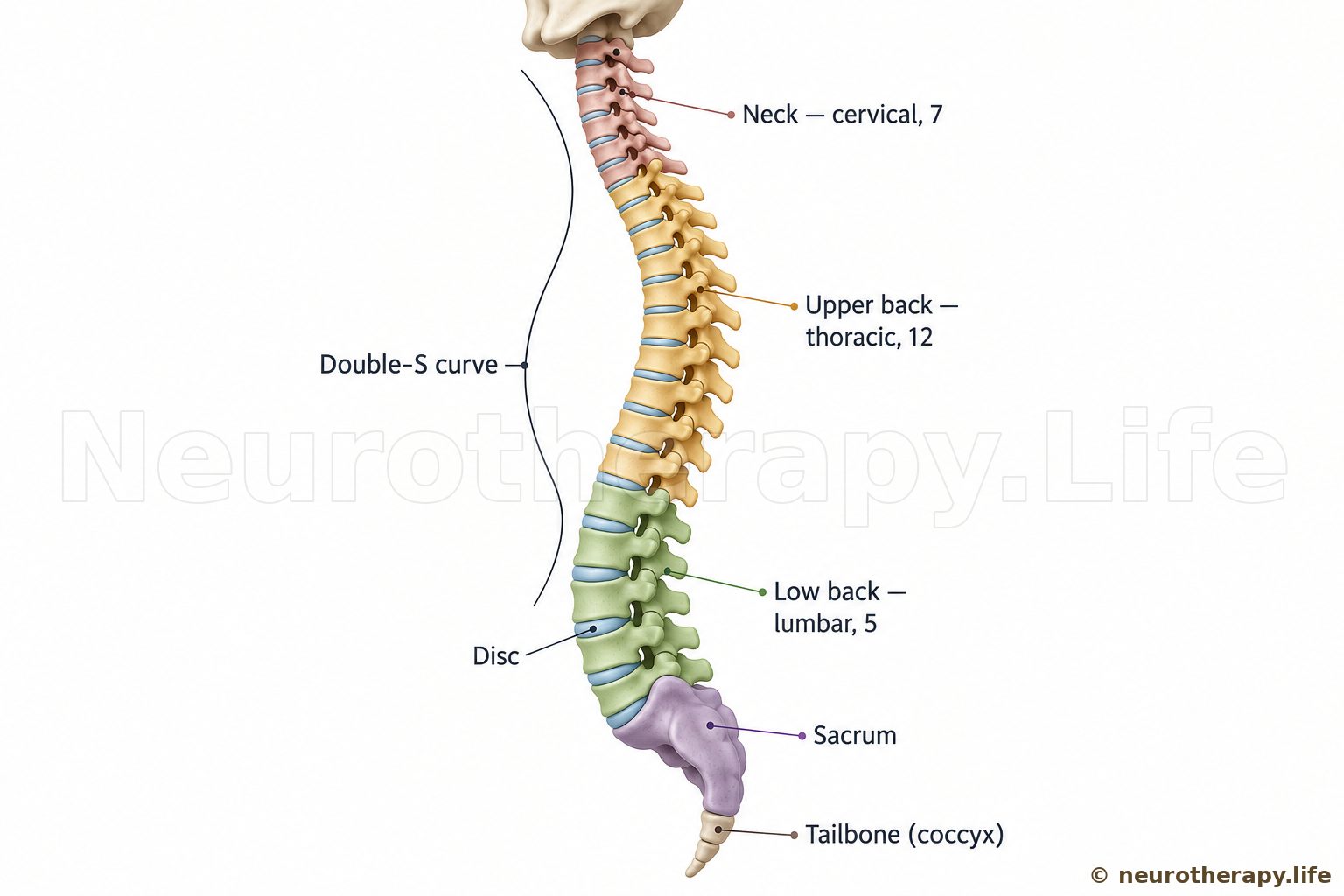
Your spine is a flexible column of 33 stacked bones, cushioned by discs, that holds you upright, lets you bend and twist, and carries the spinal cord safely inside it. In LMNT teaching, the strip of back on either side of it is one of the busiest places a therapist works.
Overview
What is the spine?
Your spine (backbone, or vertebral column) is the long chain of bones that runs down the middle of your back, from the base of your skull to your tailbone. The bones are called vertebrae — the 'beads' you feel when you run a finger down someone's back.
Between most of the bones sit soft, rubbery discs that absorb shock. Muscles and ligaments hold the column steady, and a tunnel through the middle of it protects the spinal cord, the great nerve cable between your brain and your body.
Back and neck pain are among the commonest reasons people see a doctor. Most of it settles within weeks, but a few warning signs mean the nerves are in danger and need a doctor the same day.
The spine from the side: five regions and a gentle double-S curve that works like a spring.
Function
What does the spine do?
The spine has to be two opposite things at once: strong enough to carry your head and trunk all day, and flexible enough to let you bend, twist and look over your shoulder.
Holds up the head and trunk and passes their weight down to the pelvis and legs.
Lets you bend forward and back, lean sideways and twist — a little at each joint, a lot in total.
Protects the spinal cord inside a bony tunnel.
Lets 31 pairs of spinal nerves leave through small gaps between the bones to reach every part of the body.
Absorbs shocks from walking, running and jumping through its curves and discs.
Gives anchor points for the ribs and for the muscles of the back, belly, shoulders and hips.
How does the spine work with other organs?
Spinal cord — The spine is the spinal cord's armour; the cord carries every message between the brain and the body.
Muscles — Deep back muscles and the belly muscles act like guy-ropes that keep the column upright and steady.
Neck — The top seven bones of the spine form the neck, carrying and turning the head.
Low back — The five low-back bones and the sacrum carry the most weight and are where back pain is commonest.
Kidneys — The kidneys lie against the back wall on either side of the upper low back; kidney trouble is often felt as back pain.
Skeletal system (bones and joints) — The spine is the central pillar of the skeleton; the skull sits on top, the ribs join it, and the pelvis carries it.
Nervous system and brain — Every nerve to the trunk and limbs leaves the cord between two vertebrae.
Anatomy
What are the parts of the spine?
The spine is made of five regions of bone, the discs between them, the joints and ligaments that link them, the muscles beside them, and the nerves that pass through.
The five regions
Cervical spine (neck) — 7 bones, C1–C7 — Small, very mobile bones. The top one (the atlas) carries the skull and lets you nod; the second (the axis) lets you turn your head.
Thoracic spine (upper back) — 12 bones, T1–T12 — Each joins a pair of ribs, so this part is the steadiest and moves least.
Lumbar spine (low back) — 5 bones, L1–L5 — The biggest, thickest vertebrae, because they carry the most weight.
Sacrum — Five bones fused into one flat triangle that wedges between the hip bones and forms the back of the pelvis.
Coccyx (tailbone) — Three to five tiny fused bones at the very end — an anchor for some pelvic floor muscles.
A single vertebra
Most vertebrae share the same basic plan.
Body — The thick, round block at the front that carries the weight.
Arch and spinal canal — A ring of bone behind the body; stacked together, the rings form the tunnel for the spinal cord.
Spinous process — The bony knob pointing backwards — the bump you feel down the middle of the back.
Transverse processes — Two side wings where muscles and, in the upper back, the ribs attach.
Facet joints — Small paired joints at the back that link each vertebra to the next and guide its movement.
Nerve openings (foramina) — Gaps between two vertebrae on each side, where a spinal nerve leaves.
Discs, ligaments and muscles
Intervertebral discs — 23 rubbery cushions between the vertebrae, each with a tough outer ring (annulus) and a soft jelly-like centre (nucleus). If the ring tears, the jelly can bulge out and press a nerve — a 'slipped disc'.
Ligaments — Strong bands running along the front and back of the column and between the knobs, holding the stack together.
Back muscles — On each side a long column of three muscle ropes (the erector spinae) keeps you upright, and short deep muscles link one vertebra to the next.
The spinal cord and nerves
Spinal cord — Runs down the canal from the brain but stops short — at about the level of the first or second low-back bone in adults.
Cauda equina ('horse's tail') — Below the cord's end, a bundle of nerve roots fills the canal, supplying the legs, bladder and bowel. Pressure on it is an emergency.
31 pairs of spinal nerves — Eight in the neck, twelve in the chest, five in the low back, five at the sacrum and one at the tailbone. Each soon splits into a large branch for the front of the body and limbs and a small branch for the back's own muscles, joints and skin.
Where is the spine located?
The spine runs down the middle of the back of your body, from the base of the skull to the top of the buttock crease. The knobs of the vertebrae lie just under the skin in the midline; the weight-bearing bodies lie deeper, towards the front.
In front of the neck spine lie the windpipe and food pipe; in front of the upper back, the heart, the great blood vessels and, on either side, the lungs. The kidneys lie against the back wall on either side of the upper low back, and the bowel and the body's main artery lie in front of the lumbar spine.
This is why, in LMNT teaching, the back is also read as a map: trouble in an organ in front of the spine is often felt as an ache in the back wall behind it — the kidneys in the flanks, the pancreas in the mid-back, the womb or prostate low over the sacrum. The teaching adds a warning: read it forwards, not backwards — most back pain is still muscle and posture.
From the front or back, a healthy spine is straight. From the side it has a gentle double-S shape: curving forward in the neck, backward in the upper back, forward again in the low back, and backward at the sacrum. These curves act like a spring.
The vertebrae get bigger from top to bottom — small and delicate in the neck, thick and chunky in the low back — because each lower bone carries more weight than the one above.
How big is the spine?
An adult spine is about 70 cm long in men and about 60 cm in women. It has 33 vertebrae — 24 that move separately, plus the fused sacrum and tailbone — which makes 26 separate bones in an adult.
The 23 discs make up roughly a quarter of the spine's length. Because they are squeezed a little through the day and refill overnight, most people are about 1 to 2 cm taller in the morning than at bedtime.
Conditions and disorders
What conditions and disorders affect the spine?
Most spine pain comes from muscles, joints and discs and settles with time. A smaller group comes from wear, inflammation, thin or broken bone, pressed nerves, or problems present from birth.
Back and neck pain
Low back painThe commonest back complaint; most settles within weeks, a few need a doctor the same day.
Kidney stonesA stone felt in the flank, spreading towards the groin.
Pregnancy careThe growing baby shifts the body's balance and loads the low back.
What are common signs of a spine problem?
Pain or stiffness in the neck, upper back or low back
Pain that spreads down an arm or a leg
Tingling, numbness or weakness in the hands or feet
Muscle spasm, or the body bent to one side
Loss of height, or a stoop that is getting worse
Numbness in the seat, trouble passing or holding urine, loss of bowel control, or weakness in both legs — hospital the same day
Back pain with fever, weight loss, a past cancer, or pain that wakes you at night — see a doctor first
What tests check the health of the spine?
Physical and nerve examination — Movement, tenderness, reflexes, feeling and strength in the arms and legs — often the most useful test of all.
X-ray — Shows the bones, their alignment, fractures and wear.
MRI scan — Shows discs, nerves and the spinal cord in detail. Many people without any pain also show disc changes, so the picture must match the symptoms.
CT scan — Detailed pictures of bone, useful after injury.
Bone density scan (DEXA) — Checks for thin bones where there is height loss or a collapsed vertebra.
Blood tests — ESR, CRP and HLA-B27 for inflammatory back pain; others to rule out infection.
Nerve conduction tests (EMG/NCV) — Measure how well nerves and muscles carry signals when a nerve may be pressed.
How are spine conditions treated?
Stay active — For ordinary back pain, keeping gently active helps more than bed rest.
Exercise and physiotherapy — Strengthening the back and belly muscles, stretching, and learning safe ways to lift and sit.
Medicines — Pain relief and anti-inflammatory medicines; specific medicines for inflammatory spine disease or thin bones — prescribed by a doctor.
Injections — Sometimes used near a pressed nerve to ease severe pain.
Braces — Short-term support after some fractures.
Surgery — For a nerve or the cord under dangerous pressure, an unstable fracture, or severe deformity.
Neurotherapy (LMNT)
In LMNT teaching, the spine is both a place to work and a map to read. Along it runs a family of strokes — On the spine, Beside the spine, the Round Arrow and others — given face down, which the teaching uses to stimulate the 31 pairs of spinal nerves that leave on either side. The low back has its own points, each with its own bar: nothing over a fracture, nothing onto the knee joint, and some jerk techniques only after much thought. And the back is read as a chart, because an organ in trouble in front of the spine often reports as an ache behind it. Before any of this, the therapist asks the warning questions every visit — because a few backs must leave the room and go to hospital the same day. LMNT works alongside a doctor's care, never instead of it.
Points
Beside the Spine — Two fingers straddle the column and rub, pressing a little downward and inward, from the neck down to L5 and back up to C7 without lifting the hand. The aim given is to stimulate the 31 pairs of spinal nerves.
On the Spine — The edge of the thumb rides the knobs of the spine from the neck to L5, then back up to T1.
Round Arrow — Down the right side of the beads to L5 and up the left, the pressure on the side of the beads.
L5–S1 Ghisai — Three stages over the lowest back and buttocks; the teaching uses it for sciatica and all back pains, especially lumbar spondylosis.
(6) L3, 4, 5 — Relaxes the back muscles from L1 to S1. Never given where there is a fracture in any bone between L1 and S1.
L4 Fracture — Worked on the inner calves, because the L4 nerve supplies that strip of skin; L5 Fracture uses the outer calves. Given only after a doctor has checked the fracture, on muscle, never on bone.
JJ⁺¹ — For the middle of the back and disc trouble at L1–L3. Not given with knee pain.
JJ⁺² — For low back pain, knee pain and disc trouble at L4–L5–S1. Not on the same day as BOF where there is sole pain.
Sudhakar — The arrows and strips of the back, for pain across the whole back.
Katka — A mild jerk beside the spine after the back has been relaxed — given only after much thought, with four pillows and a three-finger gap at the throat. Never in thin bones.
Dorsal — A light, counted glide with both thumbs over the midline at the back of the neck — never a thrust.
Thoracic T1/T2 — The station at the base of the neck, where the heart's pain nerves enter the cord.
Down Arrow — A palm slide from T1 down to L5 (with its partner, Up Arrow, from L5 up to T1) — which the teaching uses for two different kinds of dizziness.
Liv° — With Mu°, the kidney points in the flanks beside the spine, checked before any back plan, because they choose between Kidney Clear and Ulta Kidney Clear.
“Whenever there is an obstruction or blockage in the blood circulation of any part of the body, then pain or numbness is felt in that part.”
— Dr. Lajpatrai Mehra
“Whether or not the patient gets immediate benefit from our treatment, let no harm reach him through our carelessness — attend to this.”
— Dr. Lajpatrai Mehra
“The research is still to be done.”
— Dr. Lajpatrai Mehra
Never do this
Hospital the same day for numbness in the seat or inner thighs, new trouble passing or holding urine, loss of bowel control, or weakness or pain in both legs — the nerves at the bottom of the spine may be crushed. What is lost by waiting may not come back. How to tell a patient to see a doctor
See a doctor first for back pain after a fall (even a small one), sudden severe pain in someone with thin bones or on long-term steroids, back pain in anyone who has ever had cancer, pain that wakes you at night, or back pain with fever or weight loss. Low back pain
Never press on a fresh fracture or on the spine over it; (6) L3, 4, 5 is never given where there is a fracture between L1 and S1. The fracture points are given only after a doctor has checked the break, on muscle, never on bone. (6) L3, 4, 5
Neck: never the front or sides of the neck; glide, never thrust — no jerk, no turning of the head, no traction. Clumsy hands, an unsteady walk or new bladder urgency can mean the cord is squeezed: no neck work, see a doctor urgently. Neck
Katka and other jerk techniques are given only after much thought, with four pillows and a three-finger gap at the throat, and only a mild jerk — never in thin bones or a fused (bamboo) spine. Katka
Cancer: if the person has cancer, (10) Pan, Thymus, Pit, Lu + Sh, Rt. Ov / Lt. Ov and (30) Medulla are never given — the therapist changes the plan.
Keep taking the medicines your doctor prescribed. Neurotherapy (LMNT) works alongside your medical care, never instead of it.
Care
How can I keep my spine healthy?
The spine likes movement, strong support muscles and sensible loads.
Keep moving
Discs have almost no blood supply of their own; they are fed as you move. Get up from the chair every 30 to 45 minutes and walk every day.
Strengthen the support
Back and belly muscles act as the spine's guy-ropes. Gentle daily exercise keeps them ready.
Lift with your legs
Bend the knees, keep the load close to your body, and do not twist while lifting.
Sit and sleep kindly
Sit with the low back supported and feet flat. When lying down or getting up, roll onto your side first rather than sitting straight up.
Mind your weight and bones
Extra belly weight pulls on the low back; morning sun, calcium and protein keep the vertebrae strong.
Drink water and keep the bowel easy
LMNT teaching: hard stools and too little water often sit behind a stubborn back, so digestion and water are put right first.
Common questions
Is bed rest good for back pain?
Not for long. For ordinary back pain, a day or two of taking it easy is fine, but staying gently active helps you recover faster than lying in bed.
My MRI shows disc bulges. Is that why my back hurts?
Maybe, maybe not. Disc changes are very common in people with no pain at all, and become more common with age. Your doctor matches the picture with your symptoms and examination.
Why am I taller in the morning?
Through the day your discs are squeezed a little and lose some water; lying down at night they soak it back up. The difference is usually about 1 to 2 cm.
What is a 'slipped disc'?
The disc does not actually slip. Its tough outer ring tears and the soft centre bulges out, sometimes pressing a nerve and causing pain down an arm or leg. Many improve over weeks to months without surgery.
Why does the LMNT therapist ask about my bladder and past illnesses before touching my back?
Because a few back problems — pressed nerves at the bottom of the spine, a hidden fracture, or cancer spread to bone — must go to hospital, not to the mat. These questions are asked every visit, not just the first.
Can Neurotherapy (LMNT) be given on a spine that has had surgery?
Only after the surgeon agrees, never over a fresh wound, and with no pressure or jerk over the operated level. Tell your therapist exactly what was done.
What should I ask my doctor or therapist?
Is this ordinary back pain, or is a nerve being pressed?
Do I need a scan now, or can we wait and see?
Which warning signs mean I must go to hospital the same day?
Which exercises are safe for my back, and which should I avoid?
Should my bone density be checked?
(To the therapist) Are any back points barred for me, and why?
Surprising facts
1A giraffe has the same number of neck bones as you
Almost every mammal — mouse, human or giraffe — has exactly seven neck vertebrae. A giraffe's are simply much longer, each one up to about 25 cm.
Source: Galis F. Why do almost all mammals have seven cervical vertebrae? J Exp Zool 1999;285(1):19–26; Gray's Anatomy.
2You are taller in the morning
Your discs are squeezed through the day and lose a little water, then soak it back up while you sleep. Most people are about 1 to 2 cm taller when they wake than when they go to bed.
Source: Tyrrell AR, Reilly T, Troup JDG. Circadian variation in stature and the effects of spinal loading. Spine 1985;10(2):161–164.
3Astronauts grow taller in space
Without gravity squeezing the discs, the spine lengthens. Astronauts can grow up to about 3 percent taller in orbit — and shrink back when they return to Earth, often with back pain.
Source: NASA, Human Research Program — spinal elongation in microgravity (up to ~3% of height); Chang DG et al., Spine 2016;41(24):1917–1924.
4Your discs are fed by movement
Discs are the largest body parts with almost no blood vessels of their own. Food and oxygen seep in from the bone above and below, helped by the squeeze-and-release of everyday movement. That is one reason long hours of stillness are hard on a back.
Source: Urban JPG, Roberts S. Degeneration of the intervertebral disc. Arthritis Research & Therapy 2003;5(3):120–130.
5The cord is shorter than the spine
In a newborn the spinal cord reaches low in the back, but the spine grows faster than the cord. In adults the cord ends at about the first or second low-back bone. Below that, only nerve roots float in fluid — which is why doctors take a spinal fluid sample from the lower back.
Source: Gray's Anatomy — conus medullaris at L1–L2 in adults; lumbar puncture at L3–L4 or L4–L5.
6A baby's spine is one big C
A newborn's spine curves forward in one gentle C, as it was in the womb. The neck curve forms when the baby starts holding up its head, and the low-back curve when it begins to sit and walk.
Source: Gray's Anatomy — primary (kyphotic) and secondary (cervical and lumbar lordotic) curvatures.
7Painless backs show 'damage' too
When scientists pooled MRI scans of people with no back pain at all, disc wear showed up in about a third of 20-year-olds and over 90 percent of 80-year-olds. Many scan findings are part of normal ageing, not the cause of pain.
Source: Brinjikji W et al. Systematic literature review of imaging features of spinal degeneration in asymptomatic populations. AJNR Am J Neuroradiol 2015;36(4):811–816. The LMNT text (22.10) makes the same point.
8Most back pain gets better
Studies following people with a new bout of low back pain found that pain and disability drop sharply within the first six weeks for most. LMNT teaching says the same — and warns therapists that any treatment given to an ordinary back will look excellent.
Source: da C Menezes Costa L et al. The prognosis of acute and persistent low-back pain: a meta-analysis. CMAJ 2012;184(11):E613–E624. LMNT: wiki_db 22.10.
A day in the life of your spine
33vertebrae, 26 separate bones in an adult
23discs cushioning every step
31pairs of nerves leaving the spinal cord
~1–2 cmof height lost by evening, won back overnight
30–45 minthe longest to sit before getting up to move
Yoga
Cat–cow Mārjaryāsana – Bitilāsana
Benefits
Moves every level of the spine gently through bending forward and back.
The squeeze and release helps feed the discs and eases morning stiffness.
How to do it
Come onto hands and knees on a mat, hands under the shoulders, knees under the hips.
Breathe out and slowly round your back up towards the ceiling, letting the head drop.
Breathe in and let the belly sink gently, lifting the chest and looking slightly forward.
Move slowly with the breath, 8 to 10 times.
Take care
Keep the movement small and pain-free. Use a folded blanket under sore knees. With thin bones or a fused spine, skip the deep rounding; with neck problems keep the head in line. Stop if pain spreads down a leg.
Crocodile pose Makarāsana
Benefits
A resting pose that lets tight back muscles let go.
Slow belly breathing in this position gently moves the low back.
How to do it
Lie face down with the legs slightly apart and the heels turned in or out, whichever is comfortable.
Fold the forearms in front of you and rest the forehead on them.
Close your eyes and breathe slowly into the belly, feeling the low back rise and fall.
Stay for 2 to 5 minutes, then roll to your side to get up.
Take care
Avoid lying face down in pregnancy or soon after belly surgery. If the low back aches, place a thin pillow under the belly or lie on your side instead.
One knee to chest Ardha Pavanamuktāsana
Benefits
Gently stretches the low back and the buttock muscles.
Easy to do in bed on waking, before getting up.
How to do it
Lie on your back with both legs straight, or both knees bent if that is easier.
Bend one knee and hold the shin just below the knee with both hands.
Breathing out, draw the knee gently towards the chest; keep the head down.
Hold for 3 to 5 breaths, release, and change legs. Do 3 times each side.
Take care
Do not pull hard or lift the head. With osteoporosis, a recent hip replacement or a fresh disc problem, ask your doctor or physiotherapist first, because this bends the spine forward.
Watch
L5 S1 GHISAI
A demo of L5–S1 ghisai in its three parts, given face down with the front of the foot over the lowest part of the back and the buttocks, followed by the Fracture point with the legs raised on pillows. It is used for relief in low back pain.
FOR BACK PAIN - L1 TO L5, S1 - JJ+1 JJ+2
Shows JJ⁺¹ along the thighs and JJ⁺² just below the knees, given lying down with light jerks and pressure that rises over three rounds. JJ⁺¹ is for nerve trouble near L1–L3 and JJ⁺² for L4–L5–S1 in back pain.
L4 FRACTURE
A practical demonstration of the L4 Fracture point: the patient lies face down with pillows under the thighs and knees, heels turned inward, and the therapist, steadying their weight on two chairs, presses the inner calf muscles with the heel in three rounds of rising pressure, asking the patient how much they can bear, then gently massages the ankle area.
The demonstrator uses small jerks and says the spinal bead "sets at once" — that is his own remark, not a promise. In LMNT teaching this point is given only after a doctor has checked the fracture, the pressure stays on the calf muscle, never on the spine or a bone, and only as much as the patient can bear.
L5 FRACTURE
A practical demonstration of the L5 Fracture point: the patient lies face down with pillows under the thigh and knees, and the therapist presses along the calf muscles from just below the knee towards the ankle in three rounds of rising pressure, keeping off the knee and bone and checking the patient's comfort, then finishes by rubbing the heel and the top of the foot.
The demonstration uses small jerks. In LMNT teaching this point is given only after a doctor has checked the fracture, with the pressure on the calf muscle, never on the spine or a bone, and only as much as the patient can bear.
How to Give 4 Medulla, Raman & T1 T2 in Neurotherapy | LMNT Cervical, Shoulder pain & Numbness
This video shows the right way to give (4) Medulla, Raman and the T1–T2 point for neck and shoulder pain and numbness.
Could Neurotherapy Help Ankylosing Spondylitis ? क्या एंकिलॉज़िंग स्पॉन्डिलाइटिस में न्यूरोथेरेपी?
A short Hindi podcast conversation with a senior neurotherapist: what ankylosing spondylitis is, who gets it, its symptoms and complications such as bamboo spine and eye inflammation, and how Neurotherapy (LMNT) looks at it through acid–alkali balance and the parathyroid.
The talk calls Neurotherapy (LMNT) an “alternative medicine”. In LMNT teaching it works alongside your rheumatologist's care, never instead of it — keep your medicines and your exercises.
Test yourself
Research
Strong evidence
Pooling studies of people with a new episode of low back pain showed that most improve markedly within six weeks, though some keep low-level pain for longer.
MRI and CT scans of people without back pain often show disc wear, bulges and joint changes, and these rise steadily with age — so a scan finding alone does not prove the cause of pain.
A Cochrane review of 249 trials found that exercise therapy reduces pain and improves function in long-lasting low back pain compared with no treatment or usual care.
This page explains how the body works; it does not diagnose. Neurotherapy (LMNT) works alongside your medical care — keep taking the medicines your doctor prescribed, and see a doctor for any new or severe symptom.
Ready to begin?
Send COURSE for course details, or your name, age and health issue for a consultation.