Covering a limb from joint to joint: the station rule
Many points are given at a row of places down a limb, called stations. The rule is not a fixed number of places but that no gap is left between one joint and the next.
Overview
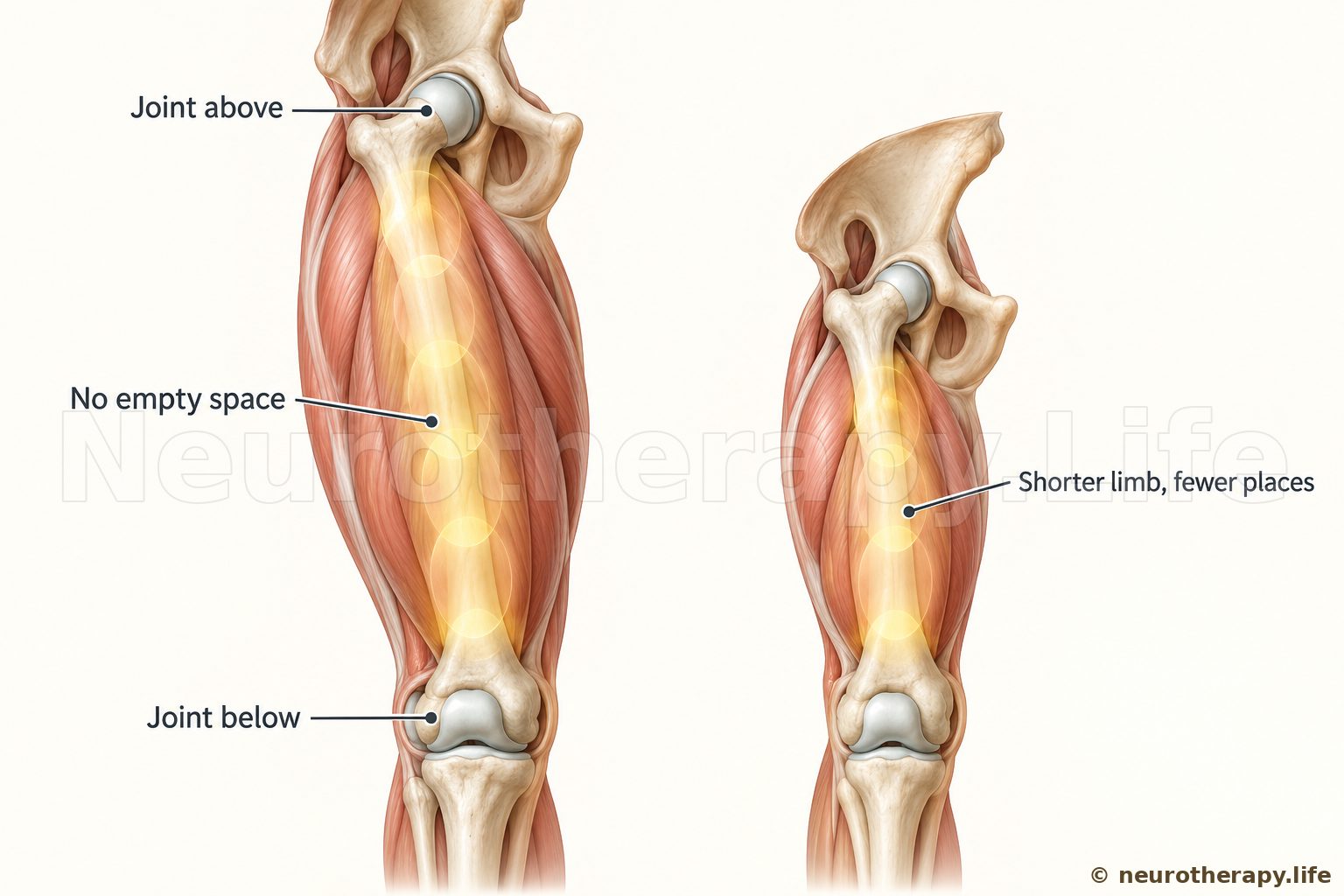
Points such as Gal, Spl, Liv, Mu, Gas, Gas I, Rt. Ov., Lt. Ov. and WD are not given at a single spot. They are given at a row of places, called stations, running from one joint of a limb to the next, for example from hip to knee or from elbow to wrist.
The source gives a usual number of stations for an ordinary person, and then says the number is not really the instruction. The main point is that no space should be left empty from one joint to the other. A tall patient may need more stations, a very small child fewer, and it also depends on the size of the therapist's foot. It is a matter of experience.
Nobody tells a painter how many strokes to use; they tell him not to leave bare wood. In the same way, the therapist decides the stations before any weight goes down, works from the upper joint towards the lower one, the way the muscles run and the fluids drain, and writes on the card what was used.
Between formulas there is a short gap. That is when the patient is turned, and when the therapist must ask how they are feeling. If any point makes the trouble worse, the chief therapist is consulted and the card is marked, so that the point is not given again without care.
Key points
- Stations are the places along a limb where a point is given.
- The rule is full cover from one joint to the next, not a fixed count.
- Longer limbs need more places, small children fewer.
- Work runs from the upper joint towards the lower one.
- The gap between formulas is the time to ask how the patient feels.
Go deeper
Placing the Patient: The Four Positions of Neurotherapy (LMNT)
Placing the patient: the full guide
Gal
Gal, given down the left thigh
Liv
Liv, an arm and a thigh together
WD
WD, given on both forearms
The ring rule: how the distance of a pain from the navel decides where on the limb it is treated
The ring rule: which station answers which pain
Where pillows go during treatment, and where they never go
Where pillows go, and where they never go
The Child, the Elder and the Frail: Neurotherapy (LMNT) for Delicate Bodies
Treating the child, the elder and the frail
Read the full guide
This topic is part of: Placing the Patient: The Four Positions of Neurotherapy (LMNT)
Safety: when it is held back
- Small children, very weak people and anyone with osteoporosis are treated with the hand only, never the foot. Lighter formulas for children, the elderly and the weak
- Where feeling has gone from the feet or lower legs, as in long-standing diabetes, firm pressure there is stopped. The patient cannot warn you that it hurts. Burning feet
- If the patient's trouble increases after any point, stop and take the chief therapist's advice before going on. Reactions after treatment
- The exact method is taught hands-on in the course, under a trained therapist. Please do not try it on yourself or others from this page.
Watch

A practical training demo on the Gal (gall bladder) point: how to give 1 Gal, 3 Gal and 1 Point Gal, used to support bile flow and digestion.
This page explains what a Neurotherapy (LMNT) treatment is for; it is not a self-treatment guide and does not diagnose. Neurotherapy (LMNT) works alongside your medical care — keep taking the medicines your doctor prescribed.