Also called: Gall bladder point, Gal point, (1) Gal, (3) Gal, (6) Gal, TF 'Gal', गॉल पॉइंट
Gal is the Neurotherapy (LMNT) point named for the gall bladder, the small sac under the liver that stores bile. It is given along the left thigh while you lie on your back, and it is used to stir the flow of bile — for digestion of fats, for skin trouble with constipation, and for injuries.
Overview
What is the Gal point?
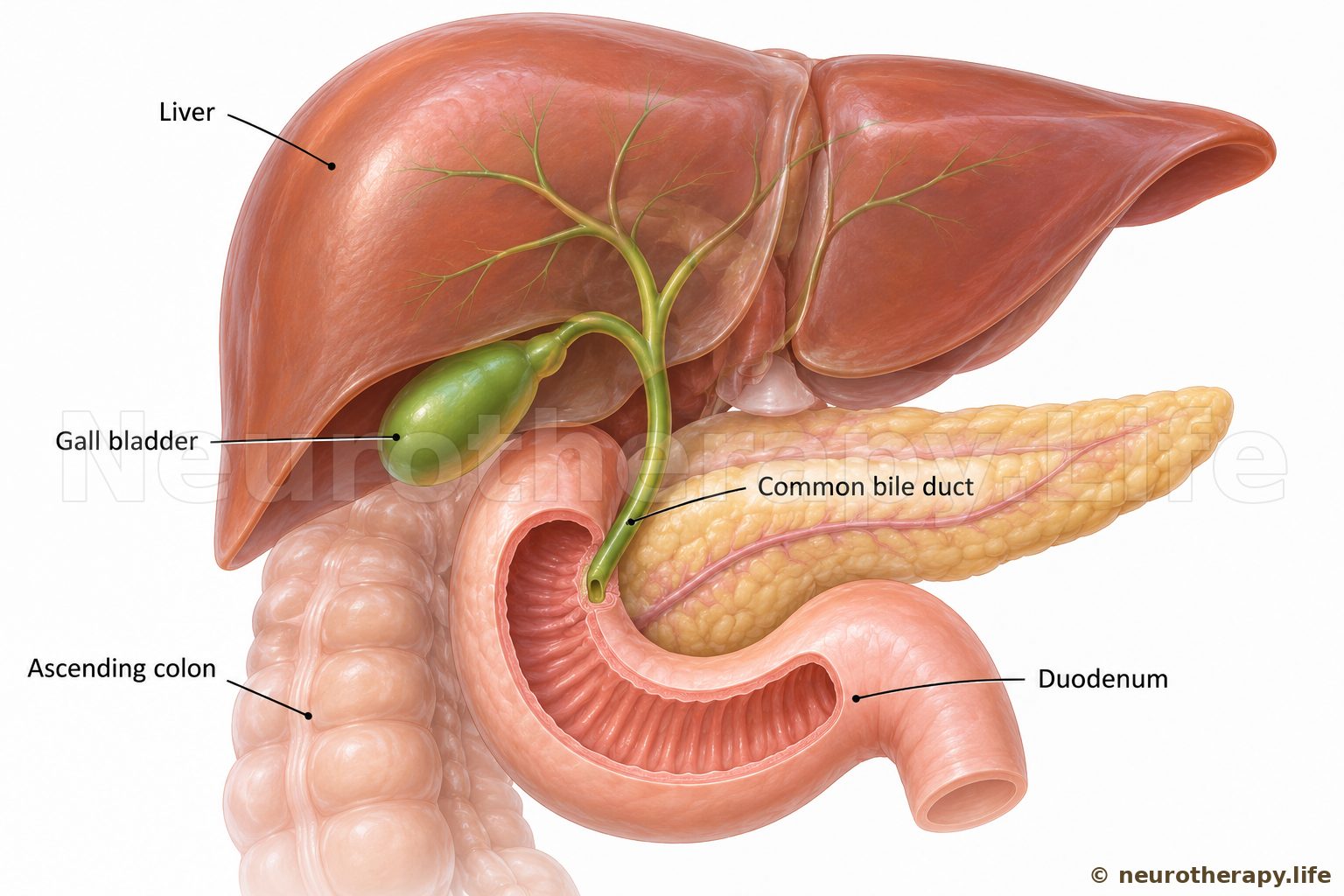
Gal is short for gall bladder. The gall bladder is a small, pear-shaped bag tucked under the liver on the right side, just where the lowest ribs cross. The liver makes bile all day — a yellow-green juice that breaks fat into tiny droplets — and the gall bladder stores it and squeezes it into the gut when a meal arrives.
In Neurotherapy (LMNT), Gal is a chemical point: it is named for what the treatment aims to rouse, not for the place it is given. The teaching says Gal stimulates the gall bladder so that bile is released in the quantity the body needs. It also says Gal stirs the upper part of the ascending colon — the first, rising stretch of the large bowel on the right.
The teaching gives bile two chief qualities: it is antiseptic, protecting against germs, and it is laxative, moving the bowel. That is why Gal turns up in so many formulas — the everyday Normal treatment, the fat-digesting Chole treatment, the Injury formula and the whole Star family for old joint pain.
The gall bladder stores the bile the liver makes and sends it into the gut with each meal. The Gal point is named for it.
Where it is given
Where is Gal given?
PositionLying on the back
Body areaFront of the left thigh, from just below the hip joint to just above the knee
You lie flat on your back with one pillow under both thighs, its edge close to the hips. Nothing goes under the head and nothing under the waist.
Gal is given on the front of the LEFT thigh, running from just below the hip joint down to just above the knee. The knee itself is not pressed.
Why the left thigh, when the gall bladder lies on the right? The Neurotherapy (LMNT) map crosses: pressure on the legs answers pains above the navel, and pressure on the left limb answers pains on the right. The Gal pain point sits under the right rib margin, so it is answered from the left thigh. In the same way its mirror, Spl, is named for the spleen on the left and given on the right thigh.
During examination, the therapist checks for tenderness at the Gal area of the belly, under the right rib margin. Where along the thigh the work is focused is chosen from where that tenderness lies.
How it is given
How is Gal given?
How this point is given — the tool, the pressure, the count and the exact movement — is deliberately not described here. Watch the demonstration video on this page, and learn the method hands-on from a trained Neurotherapist before giving it. Please do not give any point from a written description alone: a point given in the wrong place or the wrong way can do harm.
The number written before a point's name is not a strength setting. Each numbered form is a separate named treatment with its own method and timing, taught hands-on in the course.
SideLeft thigh only — the map crosses
The exact technique is taught hands-on in the Neurotherapy (LMNT) course. See the course →
What it does
What does Gal do in the body?
Neurotherapy (LMNT) teaching describes Gal as a way of rousing the gall bladder. Body science confirms what bile does; how a press on the thigh reaches the gall bladder is the therapy's own explanation, built from long clinical experience.
Stirs the gall bladder so that bile is released in the quantity needed — for the digestion of fats.
Stirs the upper part of the ascending colon, helping a sluggish bowel.
Is used to help lower cholesterol, alongside the doctor's care.
Is used wherever there is pus or discharge — in the ear or anywhere on the body — leaning on bile's antiseptic quality.
Helps the healing of a blow or an injury, which is why it opens each part of the Injury formula.
Is given for pain in the right front of the chest under the ribs — the pain of gall bladder and bile-related trouble.
Organs it reaches
Gall bladder — The organ Gal is named for — the bile store.
Liver — Makes the bile; Gal and Liv are often given together.
Intestines — Receives the bile; the ascending colon is stirred too.
Skin — In this therapy's reading, bile answers for the skin.
Its family
What are the forms and partners of Gal?
Each written form is its own named treatment. The cautions of Gal itself travel with all of them.
(1) Pt. Gal × 6 treatments — The spaced 'point' form — viral fever with Gal pain, and skin disease with constipation.
(9) Gal — The form aimed at temperament — excessive anger, and restless children.
Spl — The mirror point, on the right thigh, named for the spleen.
Liv — The liver point — Gal's most frequent partner.
Gal–Spl Ghisai — A rubbing treatment at the pelvic rim that borrows the Gal and Spl names.
TF — Toe Fingers — the left middle toe is the Gal toe.
What it is used for
What is Gal used for?
Gal is chosen from today's findings, above all tenderness at the Gal pain point — never from a disease name alone. The blocked list is read first.
Bile and digestion
Chest pain from indigestionBurning in the chest after fried food — often a slow gall bladder, not extra acid; Gal is part of the Chole treatment.
GallstonesPain under the right ribs in gall bladder disease — alongside the doctor's assessment.
High cholesterolListed among Gal's uses: to help lower cholesterol.
ConstipationBile is a natural laxative, and Gal stirs the ascending colon.
Skin
Skin diseaseSkin disease with constipation — where the benefit is said to be great.
PsoriasisAmong the skin diseases named for the spaced Gal form.
Not in leukaemia, blood cancer or other diseases arising from a raised white cell count. Leukaemia (blood cancer)
Not in asthma — the teaching records that Gal increases the trouble there. Asthma
Not for those passing little urine. The teaching says plainly: this is a matter of experience. Urinary problems
Cancer: the absolute cancer bars of this therapy apply in every formula containing Gal. Nothing here treats cancer; it is support alongside the oncologist. Cancer care: Neurotherapy (LMNT) support
Sudden severe pain under the right ribs with fever, yellow eyes or vomiting is a doctor's case the same day, not a Gal case. How to tell a patient to see a doctor
Keep taking every medicine your doctor has prescribed; only the doctor changes the dose.
Why is Gal given on my left leg if the gall bladder is on the right?
Because the Neurotherapy (LMNT) map crosses. Pressure on the left limb answers pain on the right of the navel. The point is named for the pain it answers, not for the leg it is given on.
Can Gal remove gallstones?
No such claim is made. Gal is used for the pain and the slow digestion that come with bile trouble. Stones are diagnosed and managed by your doctor, and Neurotherapy (LMNT) works alongside that care.
I have asthma. Will I get Gal?
No. The teaching records that Gal increases the trouble in asthma, so it is left out of your formulas.
Why does my card say (3) Gal and my friend's (6) Gal?
The number names a different treatment, chosen by the therapist from your findings and the formula being given. It is not a sign that one of you is more ill.
Surprising facts
1A litre a day
The liver pours about a litre of bile into the gut every day. The gall bladder stores it between meals and releases it when fat arrives.
Source: Begley M, Gahan CGM, Hill C. The interaction between bacteria and bile. FEMS Microbiology Reviews. 2005;29(4):625–651.
2Bile really is an antiseptic
Bile acids damage the membranes of many bacteria, which is one reason germs that reach the small gut have a hard time. Modern microbiology agrees with the old teaching that bile protects.
Source: Begley M et al., FEMS Microbiology Reviews 2005;29(4):625–651.
3The 'bile-bag mover'
The hormone that squeezes the gall bladder was found in 1928 and named cholecystokinin — Greek for 'that which moves the bile bag'. The Chole treatment takes its name from it.
Source: Ivy AC, Oldberg E. A hormone mechanism for gall-bladder contraction and evacuation. American Journal of Physiology. 1928;86(3):599–613.
Watch
Gal Point (Gallbladder) - How to Give 1 Gal, 3 Gal & 1 Point Gal | Practical Training for Students
A practical training demo on the Gal (gall bladder) point: how to give 1 Gal, 3 Gal and 1 Point Gal, used to support bile flow and digestion.
कमज़ोर पाचन और Gut Health का पक्का इलाज | LMNT Normal Treatment | @neurotherapylife
Shows the Normal treatment given with the feet: (8) Pan at the top of the thighs, then (3) Gal, (3) Spleen, (7) Liv and (5) Mucus on the thighs and forearms, without breaks. It is used to support digestion.
Chole Treatment in Neurotherapy | LMNT Formula for Digestion, Acidity & Fat Metabolism
A demo of the Chole treatment ((10) Medulla, (6) Gas 'I', (3) Gal), shared for acidity, heavy meals and the digestion of fats.
Test yourself
Research
Strong evidence
A review of how bile and bacteria meet in the gut: the liver releases about a litre of bile a day, and bile acids damage bacterial membranes — part of the body's defence against germs in the small intestine.
This page explains what a Neurotherapy (LMNT) treatment is for; it is not a self-treatment guide and does not diagnose. Neurotherapy (LMNT) works alongside your medical care — keep taking the medicines your doctor prescribed.
Ready to begin?
Send COURSE for course details, or your name, age and health issue for a consultation.