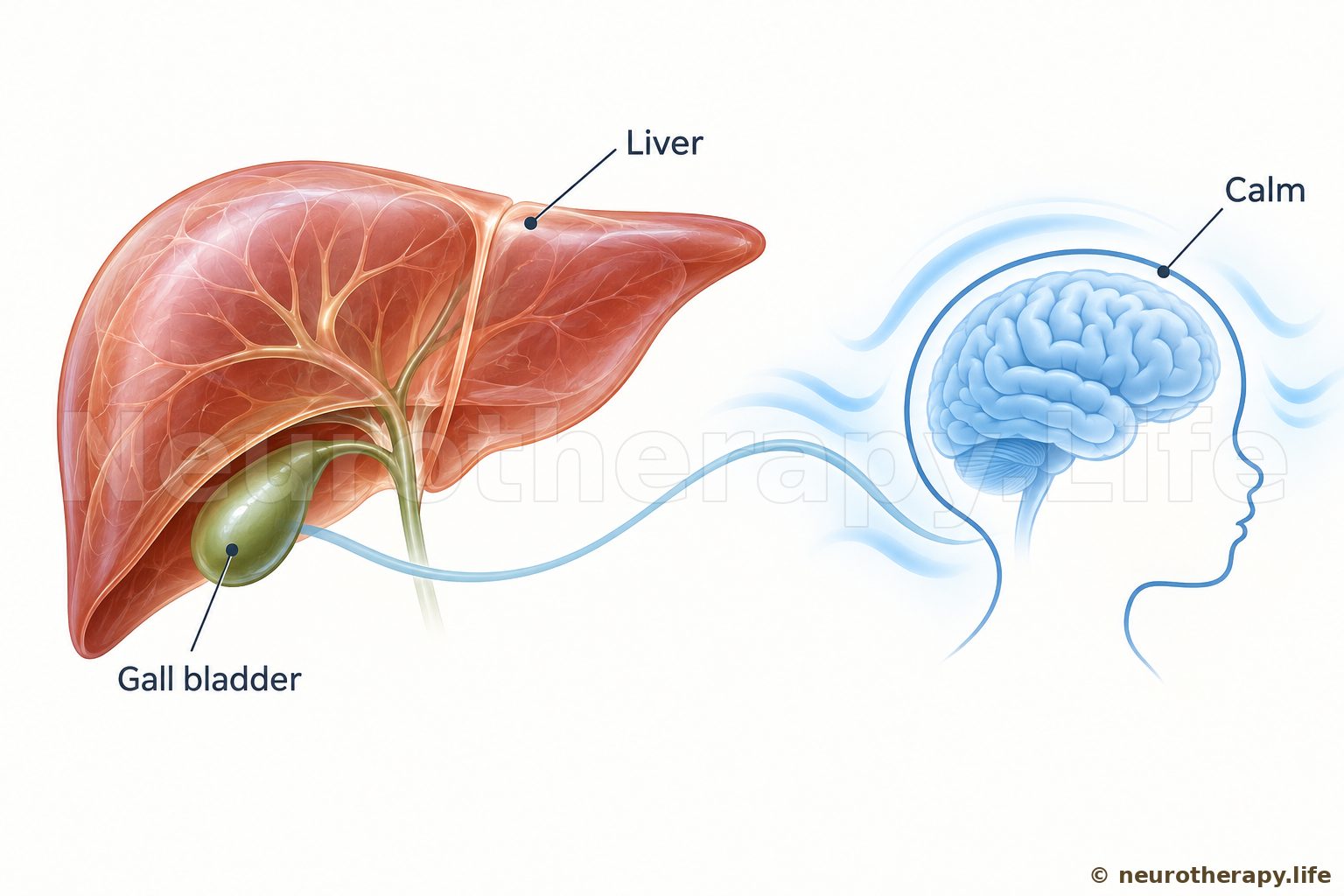
(9) Gal is a named form of the gall bladder point Gal, aimed not at digestion but at temperament. The teaching uses it to reduce excessive anger, and especially to settle hyperactivity and restlessness in children.
Overview
What is (9) Gal?
(9) Gal belongs to the Gal family — the point named for the gall bladder, the small bag under the liver that stores bile. The bracket number does not make Gal 'stronger'; it names a separate treatment with its own purpose.
It is the one entry in its family aimed at temperament. The teaching's reason is short and old: anger spoils the gall bladder. In everyday Hindi, too, an angry person is said to be full of bile — and the same link between bile and a hot temper runs through Indian and Greek medicine alike.
(9) Gal is the Gal form the teaching aims at temperament — anger and restlessness.
Where it is given
Where is (9) Gal given?
PositionLying on the back
Body areaFront of the left thigh, hip to just above the knee
Exactly where Gal is given: you lie on your back with a pillow under both thighs, and the work runs down the front of the left thigh, from just below the hip to just above the knee. The left thigh is used because the Neurotherapy (LMNT) map crosses — the left limb answers the gall bladder side on the right.
How it is given
How is (9) Gal given?
How this point is given — the tool, the pressure, the count and the exact movement — is deliberately not described here. A demonstration video for this point is being prepared; until it is on this page, learn the method hands-on from a trained Neurotherapist before giving it. Please do not give any point from a written description alone: a point given in the wrong place or the wrong way can do harm.
The number written before a point's name is not a strength setting. Each numbered form is a separate named treatment with its own method and timing, taught hands-on in the course.
The exact technique is taught hands-on in the Neurotherapy (LMNT) course. See the course →
What it does
What is (9) Gal used to do?
The teaching's claim is about temperament, reached through the gall bladder. It is offered from clinical experience; it is not a medical treatment for a behavioural or mental-health condition.
To reduce excessive anger — 'anger spoils the gall bladder'.
To settle hyperactivity and restlessness, especially in children.
It carries every caution of Gal itself.
Organs it reaches
Gall bladder — The organ the Gal family is named for.
Brain — Where temperament and restlessness are finally felt.
Its family
How is (9) Gal related to other points?
(9) Gal is a member of the Gal family; Gal's cautions stand for it.
Gal — The parent point — digestion of fats, skin, injury.
Persistent rage, aggression, or a child's difficulties with attention and behaviour need a doctor's or child specialist's assessment. This point is support, never a replacement for that care. How to tell a patient to see a doctor
Keep giving any medicine a doctor has prescribed; only the doctor changes it.
Guruji says
“Neurotherapy (LMNT) treats according to the condition of the body.”
— Dr. Lajpatrai Mehra
Common questions
Is (9) Gal a stronger Gal?
No. The number names a separate treatment with its own purpose — temperament — not a bigger dose of the digestive Gal.
Can it be given to my restless child?
Only after a trained therapist has examined the child, checked the Gal bars, and planned light treatment — and alongside any care the child's doctor advises.
Why would the gall bladder affect anger?
The teaching says anger spoils the gall bladder, and works the link in reverse. Science has not tested this link; it is offered from the therapy's own experience.
Surprising facts
1'Choleric' means full of bile
The English word choleric, meaning quick to anger, comes from the Greek cholē — bile. Ancient Greek medicine linked yellow bile with a hot temper, much as Ayurveda links excess pitta with irritability.
Source: Oxford English Dictionary, 'choleric', etymology from Greek kholē (bile); the classical four-humour theory.
2The gut speaks the brain's language
The nerve network in the gut wall uses many of the same chemical messengers as the brain — serotonin and acetylcholine among them. Gut and mood are more closely wired than most people think.
Source: Furness JB. The enteric nervous system and neurogastroenterology. Nature Reviews Gastroenterology & Hepatology. 2012;9(5):286–294.
3A gut full of nerves
The wall of the gut has its own network of nerve cells, often called the 'second brain', which runs digestion largely on its own.
This page explains what a Neurotherapy (LMNT) treatment is for; it is not a self-treatment guide and does not diagnose. Neurotherapy (LMNT) works alongside your medical care — keep taking the medicines your doctor prescribed.
Ready to begin?
Send COURSE for course details, or your name, age and health issue for a consultation.