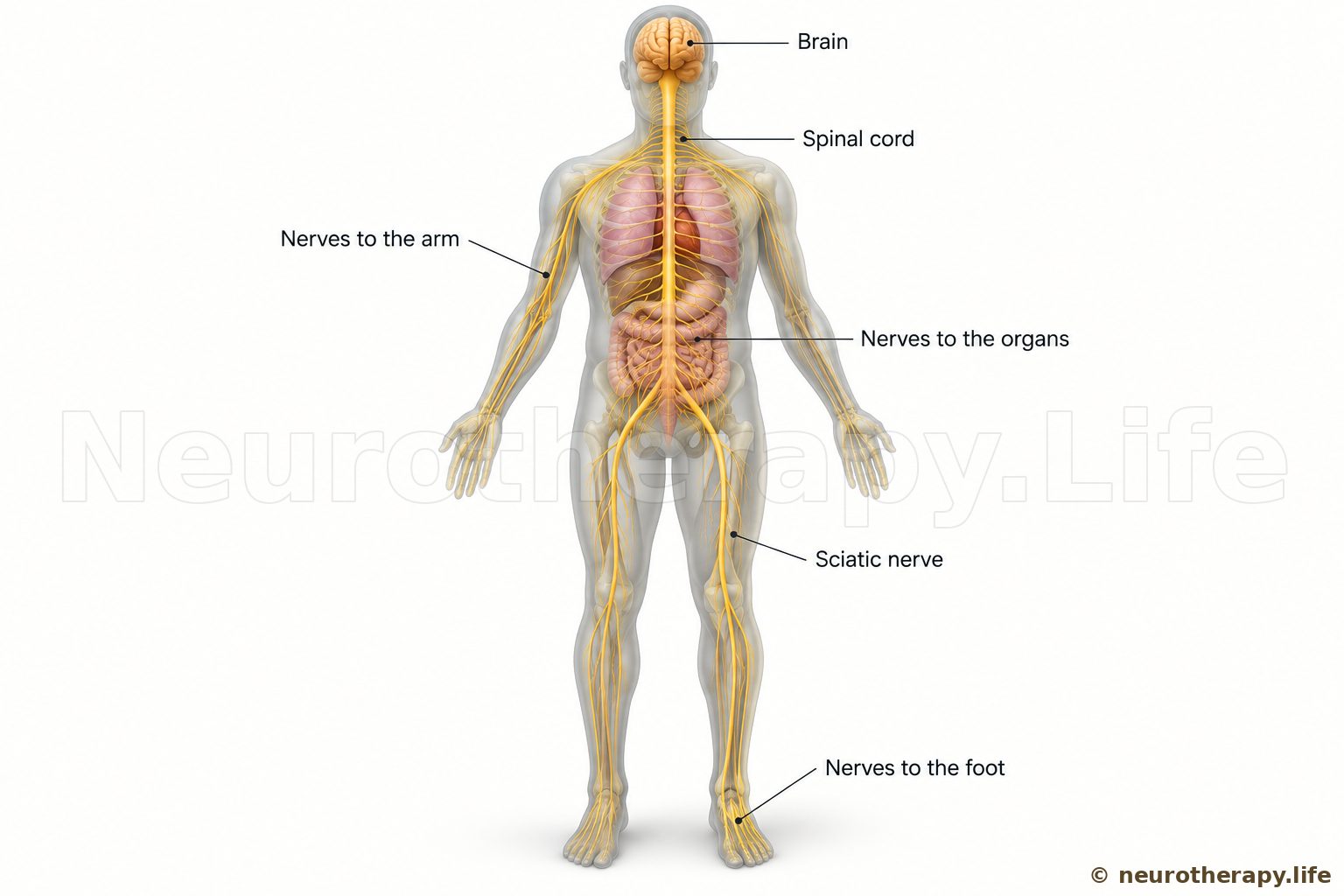
Your body's wiring: the brain, the spinal cord and the nerves that reach every corner of you. It carries reports in, sends orders out, and quietly runs your heart, breath and digestion without asking you first.
Overview
What is the nervous system?
The nervous system is the body's network of messages. It is made of the brain, the spinal cord, and the nerves that branch out from them to the skin, muscles and organs.
A nerve is a bundle of very long, thin nerve cells wrapped together, like the wires inside a telephone cable. Two kinds of traffic run along them. Reports travel in: hot, sharp, full, stretched. Orders travel out: move, relax, make juice, narrow this blood vessel.
Much of this work is automatic. A part called the autonomic nervous system runs your heartbeat, breathing, digestion, sweating and blood pressure day and night, without you having to think.
The therapy itself carries the word in its name. It was named Neurotherapy (LMNT) in 1976, in Mumbai, because benefit had been seen in so many disorders of the brain and nerves.
The brain and spinal cord are the headquarters; the nerves are the cables that reach every part of the body.
Function
What does the nervous system do?
Think of a busy city with a head office, highways and telephone lines. The brain is the head office, the spinal cord is the main highway, and the nerves are the lines running to every house. Messages flash along them as tiny electrical signals, passed from cell to cell by chemical messengers.
Sensing: it collects touch, pain, heat, cold, sight, sound, smell, taste and balance, and reports from inside organs such as a full bladder.
Thinking, memory and feeling: the brain makes sense of the reports, stores memories, and shapes mood and emotion.
Movement: it orders muscles to move — from a blink to a walk — and keeps each movement smooth and balanced.
Automatic control: it sets heart rate, breathing, blood pressure, sweating, digestion and bladder control.
Two moods: a 'fight-or-flight' half that speeds the body up in danger, and a 'rest-and-digest' half that calms it and lets the stomach work.
Blood flow: the walls of arteries have a coat of muscle, and that muscle takes its orders down a nerve. So nerves help decide how much blood each organ receives.
Protection: fast reflexes pull your hand from a flame, make you blink, cough or sneeze — often before you feel anything.
Command of the glands: a small brain area, the hypothalamus, directs the pituitary gland, which in turn directs many other hormone glands.
How does the nervous system work with other body systems?
Heart, blood and circulation — It speeds or slows the heart and widens or narrows blood vessels, moment by moment.
Lungs and breathing — The brainstem sets the rhythm of every breath and makes you breathe deeper when needed.
Digestive system — The vagus nerve and the gut's own nerve net run swallowing, churning, juices and emptying.
Glands and hormones — Nerves and hormones work as one team: the hypothalamus directs the pituitary, and nerves directly order the adrenal core to release adrenaline.
Muscular system — Every muscle contraction starts with an order down a nerve.
Doctors divide it in two ways: by place (central and peripheral) and by job (the parts you control and the parts that run themselves).
The central nervous system
The control centre, protected by bone and bathed in a clear fluid.
Brain — Inside the skull. It thinks, feels, remembers and gives most orders. Its main parts are the cerebrum, the cerebellum and the brainstem.
Brainstem and medulla — The stalk joining the brain to the spinal cord. It runs breathing, heartbeat and blood pressure.
Spinal cord — A cable about as thick as a finger, running inside the backbone. It carries messages up and down and handles quick reflexes.
Meninges and brain fluid — Three thin wrappings, and a clear cushioning fluid (CSF) that floats the brain and spinal cord.
The peripheral nervous system
All the nerves outside the brain and spinal cord.
12 pairs of cranial nerves — They leave the brain itself through small holes in the skull — for smell, sight, eye movement, the face, hearing, the throat, the tongue, and one, the vagus, that wanders down to the belly.
31 pairs of spinal nerves — Eight in the neck, twelve in the chest, five in the low back, five at the sacrum and one at the tail. Each leaves through its own gap between two vertebrae.
Nerve networks (plexuses) — Places where spinal nerves mix and re-sort before going to an arm or a leg.
Ganglia — Small knots of nerve cells outside the brain and cord that act as relay stations.
The automatic (autonomic) nervous system
The part that runs the organs without your permission. It works in two opposing moods, plus a third network of its own in the gut.
Sympathetic — 'fight or flight' — Roused by fear, anger, pain, cold and hurry. It quickens the heart, sends blood to the muscles and slows digestion.
Parasympathetic — 'rest and digest' — Roused by calm, warmth, slow breathing and safety. It slows the heart and switches digestion on. The vagus nerve carries most of it.
Enteric — the gut's own nerve net — Hundreds of millions of nerve cells in the wall of the gut that can run the waves of digestion on their own.
The building blocks
Nerve cell (neuron) — A cell body with short branches that receive messages and one long tail, the axon, that sends them on. One axon can be nearly a metre long.
Myelin — A fatty wrapping around many axons, like insulation on a wire. It makes signals travel much faster.
Synapse and chemical messengers — The tiny gap between two cells. Chemicals such as acetylcholine, dopamine and serotonin carry the message across it.
Support cells (glia) — Cells that feed, protect, clean and insulate the nerve cells.
The journey
A sensor firesInstantly
You touch a hot pan. Heat sensors in the skin of your fingertip turn the heat into an electrical signal.
Up the sensory nerveHundredths of a second
The signal races along the nerve of the arm towards the spinal cord.
A shortcut in the spinal cordA fraction of a second
Without waiting for the brain, the cord sends an order straight back out to the arm muscles.
The hand pulls awayBefore you feel it
Muscles contract and your hand jerks back — often before the pain reaches your awareness.
The brain feels and learnsA moment later
The message climbs to the brain: first a sharp sting, then a slower, dull ache carried by slower fibres. You look, you blow on your finger.
Memory keeps the lessonFor years
The brain stores the event, so next time you reach for a cloth first.
Where is the nervous system located?
Everywhere. The brain sits in the skull, and the spinal cord runs down a tunnel inside the backbone from the base of the skull to about the waist.
From there, nerves spread to every part of the body except a few places such as hair, nails and the outer skin cells. Your fingertips, lips and tongue have some of the densest supply of nerve endings.
The automatic nerves lie deeper: a chain of nerve knots runs down each side of the front of the spine, and the vagus nerve runs through the neck and chest into the belly.
The living brain is soft, pinkish-grey and deeply folded, like a large walnut. Its outer layer is 'grey matter', packed with cell bodies; inside is 'white matter', the insulated cables.
The spinal cord is a smooth, whitish rope. Nerves themselves look like shiny white cords or threads — some as thin as a hair, the largest about as thick as a thumb.
How big is the nervous system?
An adult brain weighs about 1.3 to 1.4 kg — around 2% of body weight — and holds about 86 billion nerve cells.
The spinal cord is about 45 cm long in an adult man and a little shorter in a woman, and about 1 cm thick.
The longest nerve, the sciatic nerve, runs from the low back to the foot. Near its start it is roughly as wide as a thumb.
Conditions and disorders
What conditions affect the nervous system?
Problems can start in the brain, the spinal cord, a single nerve, or the place where a nerve meets a muscle. Some come suddenly, like a stroke; others build slowly over years.
Brain
Paralysis and strokeA blocked or burst blood vessel starves part of the brain; weakness or loss of speech can follow.
Headache and migraineThe most common nerve complaint; migraine is a recurring headache often with sickness and light sensitivity.
Epilepsy (fits)Bursts of abnormal electrical activity in the brain cause fits.
MeningitisInfection and swelling of the brain's wrappings — an emergency.
HydrocephalusBrain fluid builds up when its drainage is blocked.
Weakness of a hand, arm, leg or one side of the face
A new, severe or unusual headache
Fits, fainting or blank spells
Dizziness, spinning or unsteady walking
Trouble speaking, understanding or swallowing
Double or blurred vision, or sudden loss of sight
Shaking, stiffness or slow movement
Memory loss or confusion
Shooting or burning pains along a limb
How do doctors check the nervous system?
Neurological examination — The doctor tests strength, feeling, reflexes, balance, eye movements, speech and memory.
MRI and CT scans — Pictures of the brain and spinal cord that show strokes, bleeding, tumours and damage to myelin.
EEG — Small sensors on the scalp record the brain's electrical waves; useful in fits.
Nerve conduction study and EMG — Measure how fast and well nerves carry signals and how muscles respond.
Lumbar puncture — A thin needle in the low back takes a little brain fluid to check for infection or inflammation.
Blood tests — Check sugar, vitamin B12, thyroid and signs of infection that can affect nerves.
How are nervous system problems treated?
Emergency stroke care — Clot-dissolving medicine or clot removal works best within the first few hours.
Medicines — Depending on the cause: for fits, Parkinson's disease, migraine, nerve pain, infection or immune attack.
Physiotherapy and rehabilitation — Exercises that retrain balance, strength and walking; the brain can form new pathways with practice.
Speech and occupational therapy — Help with speaking, swallowing and everyday tasks.
Surgery — To relieve pressure on a nerve or the spinal cord, drain fluid, or remove a growth.
Talking therapy and lifestyle care — Counselling, sleep routines and stress care for mood and sleep problems.
Neurotherapy (LMNT)
In LMNT, blood, nerve and gland are one system, not three. Guruji's teaching gives a plain chain: when an organ's blood or nerve supply falls short, the chemistry of the body's fluids changes, the muscles around the glands tighten, the glands make too much or too little, and disease follows. So treatment aims to restore the flow of blood, lymph and nerve signals to the organs, and let the glands work normally again. The nerves matter because they are the handles of the taps: the muscle in every artery wall takes its orders down a nerve. The therapy works on the skin, muscles and nerves you can reach — the nape, the spine, the limbs — at a set place and a set count. It never claims to touch the brain itself.
Points
Medulla — A counted downward rub behind the ears and down the sides of the neck. The number before the name decides which treatment it is; up to (12) the number is taught to point to the cranial nerve of that number.
(6) Medulla — The hypothalamus treatment, the first Medulla found: hunger, thirst and body temperature; used in meningitis, fits and paralysis in LMNT teaching.
(15) Medulla — The acetylcholine treatment. Acetylcholine is the messenger at the relay station of both automatic nerve systems, so it is given before any cranial-nerve Medulla: supply the messenger, then stimulate.
(8) Medulla — Linked with serotonin: deep sleep, low mood, giddiness and vertigo.
Mesencephalon — A counted rub in the soft gutters either side of the neck bones, named for the midbrain.
Dorsal — A light counted glide over the beads at the nape; mostly given in MS, MND and similar brain diseases, and LMNT says research on it is still going on.
Beside the Spine — Two fingers straddle the spine from neck to L5 and back — aimed at the 31 pairs of spinal nerves on both sides of the backbone.
Necklace — Close thumb-tip presses along the edge of the skull, to relax the muscles there so impulses come and go freely between brain and body; the pains of the whole body are said to lessen.
Feather Touch — The lightest treatment: fingertip strokes like a peacock's feather, 'for sending impulses through the whole body' — used in paralysis, stiffness, pain and brain diseases, and when nothing heavier can be given.
Paralysis Clockwise — Clockwise finger rolls down the inner side of a limb and up the outer, to open a hand bent inward and a leg that drags after a stroke.
(6) Medulla (8) Pan (7) Liv (8) Ch. Only — LMNT's formula for headache, brain diseases, paralysis after an infarct, meningitis, Bell's palsy and memory.
(10) Medulla (4) Thrd 'P' (20) Round Arrow (8) Pan — built to rouse the 'supervisors': the vagus, the anterior pituitary, and the path of messages along the spinal cord.
Its reasoning is a nerve map: a message from the brain must reach the organs through the 31 pairs of spinal nerves, so the road along the spine is cleared last.
“We do not give treatment for any one disease; rather we treat according to the condition of the body on that day.”
— Dr. Lajpatrai Mehra
“We cannot provoke the organs in an order of our own choosing.”
— Dr. Lajpatrai Mehra
Never do this
Emergency — think FAST: Face drooping, Arm weak, Speech slurred — Time to call an ambulance (108/112). Also call at once for a sudden, severe headache unlike any before, a first-ever fit, or sudden loss of sight, balance or feeling. In a stroke, every minute counts.
At the neck: glide, never thrust. No jerk, snap, twist or pull of the head. New neck pain or a new kind of headache with dizziness, double vision, unsteadiness, slurred speech or numbness ends the session — nothing is given at the head or neck, and the person is seen by a doctor the same day. Medulla
Clumsy walking, clumsy hands (trouble with buttons or coins) and new bladder urgency together can mean a squeezed spinal cord. No sustained pressure at the neck until a doctor has assessed it. Spinal cord
Fits: Pan and Pit are not given in Normal treatment ('Do not give Pit to a Fit!'); Pan may be given only inside the Heparin formula. Never advise stopping or reducing fit medicines. During a fit: protect the head, do not hold the person down, put nothing in the mouth, turn them on their side afterwards, and call for help if it lasts over five minutes. Epilepsy (fits)
Paralysis: before any work on a weak leg, compare the calves. One warm, swollen, tender calf may be a clot — nothing is rubbed and a doctor is seen the same day. Never pull on a weak arm after a stroke; support it from below. Paralysis Clockwise
(6) Medulla is not given to boys and girls aged 13 to 20 who come to increase height, unless there is a special need. If a brain shunt is fitted, the neck is pressed only lightly. (6) Medulla
Keep taking the medicines your doctor prescribed, exactly as told. Neurotherapy (LMNT) works alongside your medical care, never instead of it.
Care
How can I keep my nervous system healthy?
Nerves need a steady blood supply, good fuel, rest and protection. Most of what protects the heart also protects the brain.
Sleep 7–9 hours
Sleep is when the brain sorts memories and clears waste.
Move every day
Regular walking and exercise improve blood flow to the brain and nerves.
Guard blood pressure and sugar
High blood pressure is the biggest risk for stroke, and high sugar slowly damages nerves.
Eat for your nerves
Vitamin B12, folate and other B vitamins keep nerves healthy. Vegetarians may need a B12 check.
Protect your head and spine
Wear a helmet on two-wheelers and a seat belt in cars; avoid diving into shallow water.
Go easy on alcohol, avoid tobacco
Both harm blood vessels and nerve cells.
Give the calm half a turn
Slow breathing, unhurried meals and rest switch on 'rest and digest'. Worry keeps the stomach on short rations.
Common questions
What is the difference between the brain, the spinal cord and the nerves?
The brain is the head office in the skull. The spinal cord is the main cable running down inside the backbone. The nerves are the branches that leave these two and reach the rest of the body.
Can damaged nerves heal?
Nerves in the arms and legs can slowly regrow — roughly a millimetre a day — if the nerve's sheath is intact. Healing inside the brain and spinal cord is much more limited, but other areas can learn to take over with practice and rehabilitation.
Why does my foot 'fall asleep'?
Sitting on a leg presses on its nerve and blood supply. Signals stop getting through, so the foot goes numb, and 'pins and needles' come as the nerve wakes up. If numbness comes without pressure, or stays, see a doctor.
Can stress really upset my stomach?
Yes. Stress switches on the 'fight-or-flight' nerves, which pull blood away from the gut and slow digestion. Calm, slow breathing and unhurried meals switch the 'rest-and-digest' nerves back on.
Is Neurotherapy (LMNT) only for nerve problems?
No. The name came from the early benefit seen in brain and nerve disorders, but LMNT works through blood circulation, nerves and glands together, and most treatment begins with setting the digestion right.
Does Neurotherapy (LMNT) press on the brain or the spinal cord?
No. Both lie behind bone and no hand reaches them. The therapy works on the skin, muscles and nerves that can be reached, and LMNT teaching is clear that names such as 'Medulla' record an aim, not a place the thumb touches.
What should I ask my doctor or therapist?
Is my problem in the brain, the spinal cord or a single nerve?
Do I need an MRI, a nerve conduction test or blood tests such as vitamin B12?
Which warning signs mean I should go to hospital at once?
Which exercises or rehabilitation will help me most?
(To your therapist) Which points are barred for me because of fits, blood pressure or my neck?
(To your therapist) Should my treatment start with the digestion first?
Surprising facts
186 billion cells, and none of them is 'you' alone
Your brain holds about 86 billion nerve cells, and roughly as many support cells. Each nerve cell can connect with thousands of others. Every thought and memory is a pattern across huge teams of them.
Source: Azevedo FAC et al., J Comp Neurol 2009;513:532–541 (86 billion neurons)
2Why you feel pain twice
Stub your toe and you feel a sharp jab, then, a moment later, a dull throbbing ache. They travel on different wires. Fast, insulated fibres carry the sharp pain; thin, bare fibres carry the ache at little more than walking pace.
Source: Guyton & Hall, Medical Physiology — fast (Aδ) and slow (C) pain fibres; conduction ≈6–30 m/s vs ≈0.5–2 m/s
3A single cell a metre long
The nerve cell that moves your big toe starts in the spinal cord in your low back. Its tail runs all the way to the foot — nearly a metre of one living cell, not a chain of many.
Source: Standard neuroanatomy (Kandel, Principles of Neural Science) — lumbosacral motor neuron axons reach about 1 m
4Your gut has a 'second brain'
The wall of your gut holds hundreds of millions of nerve cells — more than your spinal cord. This network can run the waves of digestion on its own, even if its link to the brain is cut.
When you touch something hot, the spinal cord sends the 'pull back' order on its own. The message to the brain arrives a moment later, so you often feel the pain after your hand has already moved.
Source: Guyton & Hall — flexor (withdrawal) reflex, a spinal cord reflex
6'Pins and needles' is a nerve waking up
Sit cross-legged too long and your foot goes numb because pressure has blocked its nerve and blood supply. When you move, the tingling is the nerve coming back to life. LMNT's first teaching says the same thing in its own words: when the blood supply to a part is blocked, pain or numbness is felt there.
Source: Standard physiology of transient compression paraesthesia (Guyton & Hall); LMNT teaching sec. 1.3 / 6-intro
7Feeling a hand that is no longer there
Most people who lose a limb still feel it afterwards — its position, an itch, even pain. The brain's map of the body keeps the limb on file, long after it has gone.
Source: StatPearls, Phantom Limb Pain (Kaur & Guan) — phantom sensations reported by the large majority of amputees
A day in the life of your nervous system
≈86 billionnerve cells in the brain on duty
≈20,000breaths timed by the brainstem
≈100,000heartbeats paced up and down by nerves
31 + 12pairs of spinal and cranial nerves carrying the traffic
0times you have to remember to digest
Yoga
Śavāsana — the resting pose Śavāsana
Benefits
A simple way to switch from 'fight or flight' towards 'rest and digest'
Many people find it eases muscle tension and settles the mind
Safe for almost everyone, including older people
How to do it
Lie on your back on a mat, legs slightly apart, arms a little away from the body, palms up.
Close your eyes and breathe through the nose, slowly and easily.
Starting from the feet, let each part of the body go heavy and loose, up to the face.
Stay for 5 to 10 minutes, then roll to your side and sit up slowly.
Take care
If lying flat is uncomfortable for your back, place a pillow under your knees. In late pregnancy, or if lying flat makes you breathless or dizzy, lie on your left side instead. Always get up by turning to the side first.
Bālāsana — the child's pose Bālāsana
Benefits
A gentle, restful stretch for the back and hips
Resting the forehead and breathing slowly helps many people feel calmer
A good pause between more active poses
How to do it
Kneel on the mat with your big toes touching and knees together or slightly apart.
Sit back on your heels.
Breathing out, fold forward and rest your forehead on the mat or a cushion.
Rest your arms beside your body and breathe slowly for 1 to 3 minutes.
Take care
Avoid it with knee injuries, in pregnancy (or keep the knees wide), or soon after abdominal surgery. If you have high blood pressure or feel pressure in the head, keep the head raised on a cushion.
Slow belly breathing Udara Śvasana
Benefits
Slow breathing with a long out-breath gently engages the calming 'rest-and-digest' nerves
Can be done anywhere, sitting or lying
A useful few minutes before meals and before sleep
How to do it
Sit comfortably or lie down. Put one hand on your chest and one on your belly.
Breathe in slowly through the nose for about 4 counts, letting the belly rise while the chest stays quiet.
Breathe out gently for about 6 counts.
Continue for 5 minutes.
Take care
Never force the breath or hold it. If you feel dizzy or tingly, return to normal breathing. People with lung or heart disease should keep the counts short and comfortable.
Watch
M HAPARIN FORMULA
A demo of the M. Heparin formula — the Heparin formula headed by Medulla ((6) Medulla, (8) Pan, (7) Liv, (8) Chest Only) — used for neck and shoulder pain and for headache that keeps coming back.
बिना दवा गहरी नींद कैसे पाएं? | LMNT Serotonin Treatment for Sleep Disorders | Insomnia Root Cause
Shows the Serotonin treatment for sleep: (8) Medulla below the ears, 1 Gas 'I' at six points on the shin, (6) Adr on the upper back, and gentle massage behind the knees and at the back of the head. It is given to support deep, natural sleep.
Note: (8) Medulla is not given in high BP, inflammation or cancer; (6) Adr is not given in high BP, diabetes, cancer or HIV.
Cerebral Palsy in India: Challenges, Solutions & Role of Neurotherapy सेरेब्रल पाल्सी
A short Hindi podcast with a senior neurotherapist: what cerebral palsy is, its four types, early signs, causes before, during and after birth, and how Neurotherapy (LMNT) aims to support circulation to the brain and the master glands.
The talk calls Neurotherapy (LMNT) an “alternative medicine”. In LMNT teaching it works inside the child's team — doctor, physiotherapy, braces and medicines — never instead of it, and it does not reverse the brain injury.
भयंकर Migraine और सिरदर्द से तुरंत आराम | Migraine Pain Relief | 15 Medulla & Head Massage Point
Shows (15) Medulla four times below both ears, a fingertip head massage in lines from the forehead to the back of the head, and gentle circles between the eyebrows. It is shared as self-care for relief in migraine and headache.
Note: the video gives (15) Medulla; the LMNT migraine treatment uses (5) Medulla. Follow your therapist's plan.
FOR BACK PAIN - L1 TO L5, S1 - JJ+1 JJ+2
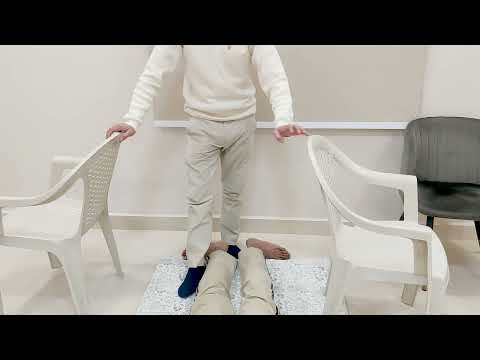
Shows JJ⁺¹ along the thighs and JJ⁺² just below the knees, given lying down with light jerks and pressure that rises over three rounds. JJ⁺¹ is for nerve trouble near L1–L3 and JJ⁺² for L4–L5–S1 in back pain.
Test yourself
Research
Strong evidence
Careful cell counting showed the adult human brain holds about 86 billion nerve cells, with a similar number of support cells — correcting the old '100 billion' guess.
This page explains how the body works; it does not diagnose. Neurotherapy (LMNT) works alongside your medical care — keep taking the medicines your doctor prescribed, and see a doctor for any new or severe symptom.
Ready to begin?
Send COURSE for course details, or your name, age and health issue for a consultation.