Also called: Mesencephalon point, the midbrain point, मेसेन्सेफ्लान
Mesencephalon is one of the three Neurotherapy (LMNT) points worked at the back of the neck while you sit on a chair. It is given in the soft grooves on either side of the neck bones and is meant to rouse the midbrain, the top part of the brainstem.
Overview
What is the Mesencephalon point?
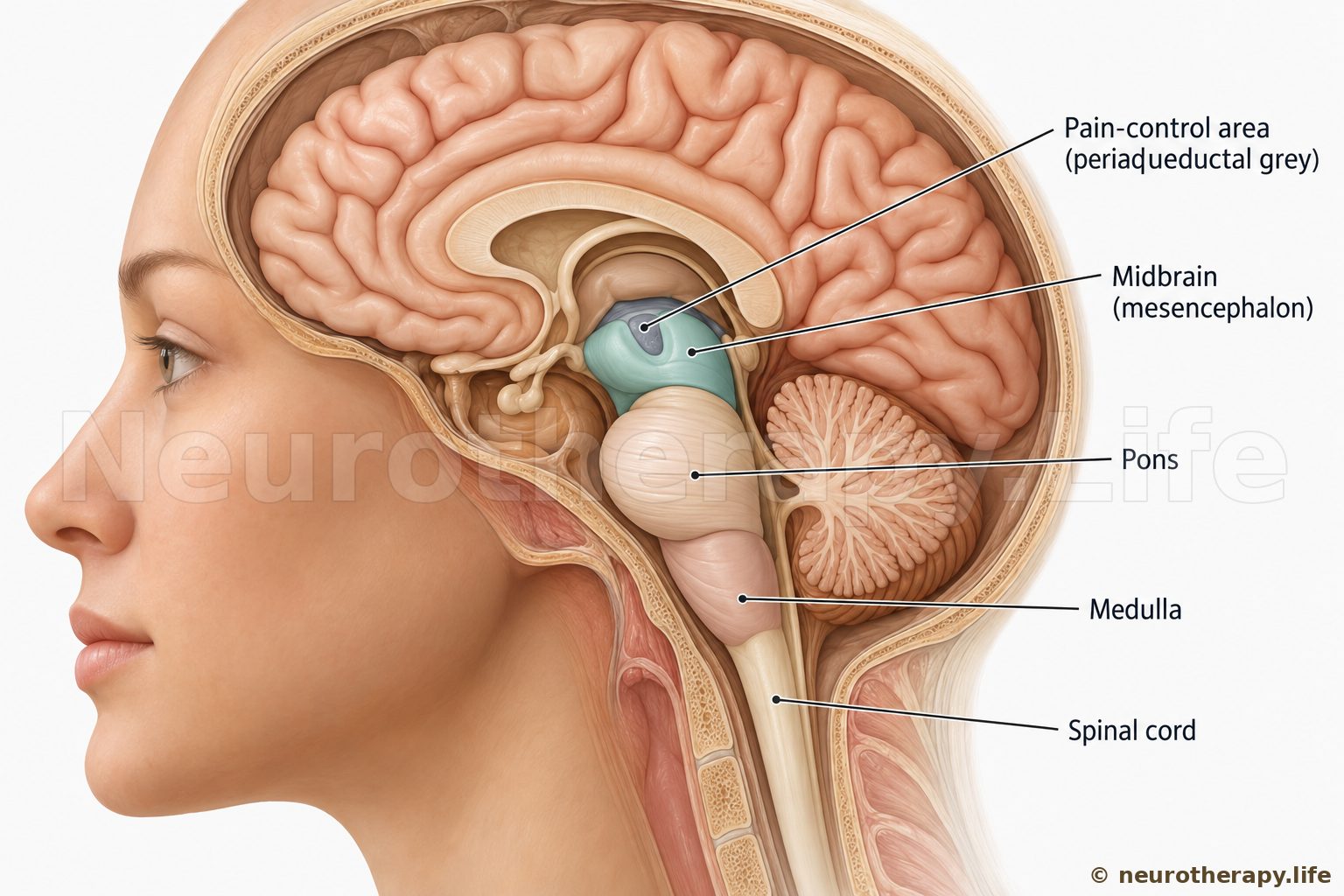
Mesencephalon is the medical name for the midbrain — the topmost segment of the brainstem, sitting above the pons and the medulla. Like the medulla, it lies deep inside the skull, well out of reach of any hand.
The point is named for what it aims at, not for where it is given. Guruji's teaching gives it one purpose: to rouse the part of the brain called the mesencephalon.
It is the middle of three lanes at the nape. Medulla is worked behind the ears and down the sides; Mesencephalon in the soft grooves beside the midline bone; Dorsal on the bony bumps of the spine itself. The touch is the same in all three — only the place of the thumbs differs.
The mesencephalon is the top part of the brainstem. The point is named for it, not placed over it.
Where it is given
Where is Mesencephalon given?
PositionSitting
Body areaThe soft grooves on both sides of the neck bones, at the back of the neck
You sit on a firm chair, feet flat, back supported, hands loose — exactly as for Medulla. A very ill or very weak patient can receive it lying down.
It is given at the back of the neck, in the soft grooves on either side of the midline bone. With the head dropped slightly forward, the row of bony bumps is the Dorsal lane; about a finger's width to either side, the bone falls away into a soft trough — that is the Mesencephalon lane.
How it is given
How is Mesencephalon given?
How this point is given — the tool, the pressure, the count and the exact movement — is deliberately not described here. A demonstration video for this point is being prepared; until it is on this page, learn the method hands-on from a trained Neurotherapist before giving it. Please do not give any point from a written description alone: a point given in the wrong place or the wrong way can do harm.
The number written before a point's name is not a strength setting. Each numbered form is a separate named treatment with its own method and timing, taught hands-on in the course.
The exact technique is taught hands-on in the Neurotherapy (LMNT) course. See the course →
What it does
What does Mesencephalon do in the body?
LMNT teaching gives this point one stated aim: to rouse the midbrain. Body science explains why the name is well chosen: the midbrain holds the body's own pain-suppressing switchboard. The point does not touch the midbrain; it plausibly speaks to it through the muscles and small joints of the neck.
The midbrain contains a pain-control centre that can turn a pain signal down before it reaches the part of the brain where pain is felt.
Under the thumbs lie the long muscle straps running from the skull down the neck, and beneath them the small joints of the neck bones with their nerves — the kind of steady input that can recruit that descending pain control.
The therapy names no disease list for it yet; it is given when a qualified therapist writes it on the card.
Organs it reaches
Brain — The midbrain, top segment of the brainstem, that the point is named for.
Neck — The muscle straps and small joints the thumbs actually work on.
Spine — The neck bones whose grooves form this lane.
Its family
Which points are its neighbours?
Medulla, Mesencephalon and Dorsal are one movement in three lanes, told apart only by where the thumbs are.
Medulla — The outer lane — behind the ears and down the sides of the neck.
Dorsal — The centre lane — on the bony bumps of the neck themselves.
(4) Medulla — (4) Medulla is listed for the midbrain in the cranial-nerve index.
Endorphin — Another seated neck point aimed at the body's own pain relief.
Thoracic T1/T2 — The separate station just below the base of the neck.
What it is used for
What is Mesencephalon used for?
The source gives Mesencephalon one aim — rousing the midbrain — and does not yet give it a list of diseases of its own. It is given only when a qualified therapist writes it on the card, usually beside the other nape points.
Ask every headache patient first: is this the first bad headache ever? Did it reach full strength within seconds? Any change in sight, speech, walk or face? Any fever? If any answer is worrying, give nothing at the head or neck and send for a doctor. How to tell a patient to see a doctor
Dizziness, greying of vision or nausea during neck work ends the treatment for the day. Vertigo and giddiness
No. The midbrain lies deep inside the skull. The point is named for what it aims at; the thumbs work only on the soft grooves at the back of the neck.
How is it different from Medulla?
Only by the lane. Medulla is behind the ears and down the sides; Mesencephalon is in the grooves beside the midline bone. The touch is the same.
What is it used for?
Its stated aim is to rouse the midbrain. The therapy does not yet give it a disease list; it is given only when a qualified therapist writes it on your card.
Surprising facts
1The brain's own painkiller switch
A grey zone around the fluid channel of the midbrain — the periaqueductal grey — can switch off pain signals in the spinal cord. Stimulating it in animals produced deep pain relief.
Source: Guyton & Hall, Textbook of Medical Physiology (14th ed.), the analgesia system of the brain.
2Where Parkinson's begins
The substantia nigra, whose dopamine cells fade in Parkinson's disease, lies in the midbrain.
Source: Gray's Anatomy (41st ed.), midbrain.
3Reflexes for eyes and ears
Small bumps on the back of the midbrain turn your eyes and head towards a sudden flash or a sudden sound before you have even thought about it.
Source: Gray's Anatomy (41st ed.), superior and inferior colliculi.
This page explains what a Neurotherapy (LMNT) treatment is for; it is not a self-treatment guide and does not diagnose. Neurotherapy (LMNT) works alongside your medical care — keep taking the medicines your doctor prescribed.
Ready to begin?
Send COURSE for course details, or your name, age and health issue for a consultation.