Also called: Endorphin point, एंडोर्फिन, एंडोर्फिन पॉइंट
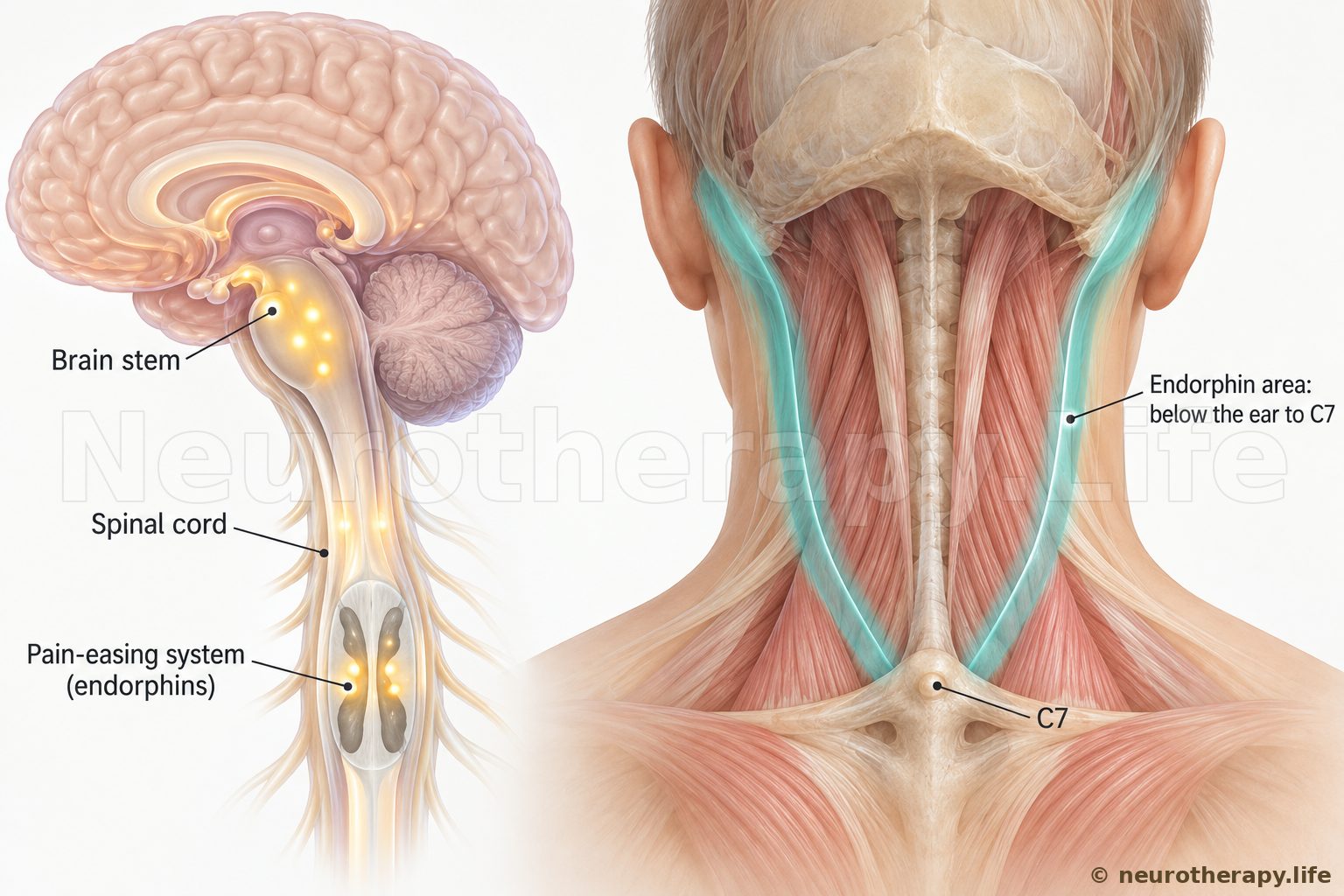
Endorphin is a seated Neurotherapy (LMNT) point given down the back of the neck, from just below the ear to the base of the neck. It is used to lessen the feeling of pain in the body, and it opens the long Complement System formula.
Overview
What is the Endorphin point?
Endorphins are the body's own pain-quietening chemicals — small messengers made in the brain and spinal cord that turn down how strongly pain is felt. The Endorphin point is named after them, because its stated work is to reduce the sensation of pain.
The therapy is honest about the name. The body really does make its own pain-easing chemicals, and a strong feeling in one place really can raise the threshold for pain felt in another. But naming a patch of skin 'Endorphin' does not prove that pressing it releases endorphins. The name is a memory hook, not an address.
Endorphin begins at the same spot as Medulla — just below the ear — but goes a different way and works differently. A simple line keeps them apart: 'Medulla runs down the side and rubs; Endorphin runs down the back and presses.'
The body makes its own pain-easing chemicals. The Endorphin point is named after them; it runs down the back of the neck.
Where it is given
Where is Endorphin given?
PositionSitting
Body areaBack of the neck, both sides together, starting from the hollow below the skull where Medulla is given and working along three lines; seated
You sit on a firm chair, head straight; the therapist stands behind you and may rest your forehead against the free hand or a helper so the head does not move.
It starts in the hollow below the skull at the back of the neck — the place where Medulla is given — and runs along the back of the neck in three lines, both sides together. The demonstration video shows the lines; it never touches the front or side of the throat.
How it is given
How is Endorphin given?
How this point is given — the tool, the pressure, the count and the exact movement — is deliberately not described here. A demonstration video for this point is being prepared; until it is on this page, learn the method hands-on from a trained Neurotherapist before giving it. Please do not give any point from a written description alone: a point given in the wrong place or the wrong way can do harm.
The exact technique is taught hands-on in the Neurotherapy (LMNT) course. See the course →
What it does
What does Endorphin do?
The stated work of the point is simple: it reduces the sensation of pain — it lessens the feeling of pain in the body. Body science offers a plausible route, though it has not been tested for this point.
Used to ease the feeling of pain while the cause is being treated by other points and formulas.
Opens the Complement System formula, for patients ill for years — so the long treatment begins with pain eased.
Works over the strap muscles of the neck and the scalp nerves at the top of its run — the same ground as Medulla, worked downward.
Organs it reaches
Brain — The brain and spinal cord make the body's own pain-easing chemicals.
Spinal cord — Pain signals pass through the cord, where they can be turned down before they reach the brain.
Neck — The back of the neck, where the point is given.
Its family
Which points are its neighbours?
Endorphin belongs to the seated group worked at the nape.
Medulla — Starts at the same spot, but glides down the side of the neck to the shoulder.
Dorsal — Glides down the midline bumps of the neck.
Mesencephalon — Works the soft grooves beside the neck bones.
Thoracic T1/T2 — The station just below C7, where Endorphin's run ends.
Ptyalin — Its companion in the Complement System formula — for saliva and digestion.
What it is used for
What is Endorphin used for?
The source gives it one job — easing the feeling of pain — so it is added where pain is a main complaint, alongside the treatment of the cause.
Autoimmune disordersThe Complement System formula begins with Endorphin — but in autoimmune disease and diabetes its immunity-raising steps are left out.
Nothing below C7, and no pressure ever on the front or the sides of the neck.
No neck work after a stroke, or a passing weakness, numbness or loss of vision, within the last three months. Paralysis and stroke
New neck pain or a headache unlike any before, with dizziness, double vision, slurred speech or numbness: stop and get urgent medical help. How to tell a patient to see a doctor
Easing pain does not replace finding its cause. Neurotherapy (LMNT) works alongside medical care; no painkiller or other medicine is stopped because of it.
That has not been proven. The body does make its own pain-easing chemicals, and the point is named after them, but the name is a reminder of its purpose — easing pain — not a proof of how it works.
How is it different from Medulla?
Both start just below the ear. Medulla glides down the side of the neck to the shoulder; Endorphin presses down the back of the neck to C7.
Can I stop my painkillers if this helps?
No. Any change in medicine is decided by your doctor, never by the therapist.
Surprising facts
1Your own morphine
The word endorphin means 'endogenous morphine' — morphine made inside the body. These chemicals act on the same receptors that pain medicines like morphine use.
Source: Hughes J et al., Identification of two related pentapeptides from the brain with potent opiate agonist activity, Nature 1975;258:577–580; Guyton & Hall, Textbook of Medical Physiology, 14th ed. — pain control.
2Pain has a gate
In 1965 two scientists proposed that the spinal cord works like a gate: touch and pressure signals can partly close it, so less pain gets through to the brain. It is part of why rubbing a bumped elbow helps.
Source: Melzack R, Wall PD, Pain mechanisms: a new theory, Science 1965;150:971–979.
3The midbrain's pain switch
A small area in the midbrain, around the brain's central fluid channel, can send signals down the spinal cord that turn pain down before it is felt.
Source: Basbaum AI, Fields HL, Endogenous pain control systems, Annu Rev Neurosci 1984;7:309–338.
This page explains what a Neurotherapy (LMNT) treatment is for; it is not a self-treatment guide and does not diagnose. Neurotherapy (LMNT) works alongside your medical care — keep taking the medicines your doctor prescribed.
Ready to begin?
Send COURSE for course details, or your name, age and health issue for a consultation.