The Body's Own Pharmacy: How the Body Makes and Balances Its Chemicals
Your body makes its own acids, alkalis, hormones, enzymes and antibodies out of the food you digest. Neurotherapy (LMNT) holds that illness begins when an organ goes short of blood, nerve signals or raw material — so the work is to repair the maker, not to supply the chemical from outside.
Overview
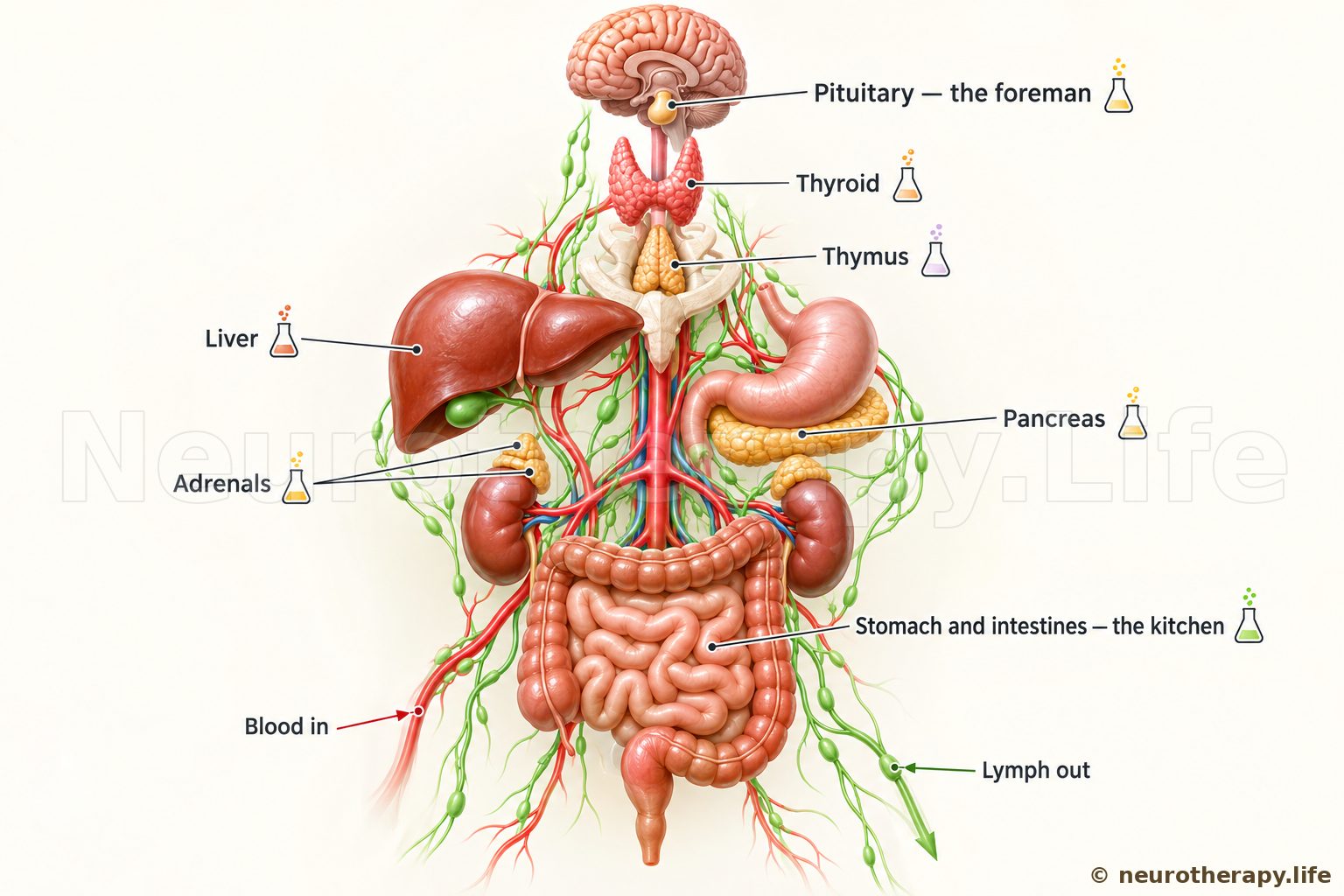
Your body makes its own acids, alkalis, hormones, enzymes and antibodies out of the food you digest. Neurotherapy (LMNT) holds that illness begins when an organ goes short of blood, nerve signals or raw material — so the work is to repair the maker, not to supply the chemical from outside.
The body is a factory with its own pharmacy
The whole therapy rests on one sentence: the body can make, within itself, every kind of chemical it needs to stay well. It makes the acid that digests your food and the alkali that neutralises it. It makes hormones (chemical messages between organs), enzymes (chemicals that cut food small enough to absorb) and antibodies (the body's defenders). It makes the substances that keep blood flowing inside the vessels and the ones that seal a cut. It makes all of this from what you ate, without being asked.
In this view, illness comes when the balance of these inner chemicals is disturbed. It shows in two ways: the inner environment drifts out of range (acid and alkali, blood pressure, blood sugar, temperature), or the levels of made chemicals like hormones and enzymes rise or fall. The treatment does not supply the chemical. It works to restore the gland that makes it, so it makes the right amount at the right time again.
One supply of blood, shared out
Unless there is an accident or an operation, the amount of blood in a body stays the same. It is shared out among all the organs at once. So if one area is short, another has more than it needs. Any method that can shift some flow from the place of excess to the place of shortage should help. That is the engine of this therapy.
Picture a house with one water tank on the roof. Open the courtyard tap wide, and the bathroom tap runs thin — not broken, just short. Close the courtyard tap and the bathroom runs strong again. Nothing was repaired; the supply was redirected. Inside the body, every organ has its own tap. After a meal more goes to the belly; in fear, more goes to the muscles and less to the gut. Trouble begins when a tap that should open properly several times a day opens only a little, for years. An organ short of blood for a long time slides towards disease.
The second river: lymph
The therapy names two fluids, not one: blood and lymph. Blood does not touch your cells directly. A clear fluid seeps out of the smallest vessels and bathes the tissue. Most of it returns to the blood, and the rest — with waste, absorbed fats and defence cells — is collected into thin channels and carried back to the blood near the base of the neck. That returning fluid is lymph. On the way it passes through lymph nodes, small filter stations that swell in your neck when your throat is sore.
Blood brings in what an organ needs; lymph takes away what it must be rid of. Blood has the heart as its pump. Lymph has no central pump like the heart; it is pushed along mostly by body movement, muscle use, breathing and posture, with tiny one-way valves keeping it moving onward. This is why people who are bed-bound or sit still all day have more problems than people who are active. A place with good supply but poor drainage is not a healthy place.
Nerves are the handles of the taps
A nerve is a bundle of very long cell fibres, like wires in a telephone cable. Reports travel inward (this is hot, the stomach is full) and orders travel outward (contract, relax, release). A nerve carries no blood to an organ, but it decides how much blood the organ gets: every artery of any size has a coat of muscle, and that muscle takes its orders down a nerve. Tighten the coat and the pipe narrows; relax it and the pipe widens. A tight muscle around a vessel also squeezes it, so relaxing that muscle opens the vessel. That is why pressure and release on muscle is, in this therapy, a way of working on circulation.
The nerves that run the organs work in two opposite moods. Fight-or-flight is roused by tension, fear, anger, pain, cold and hurry; it sends blood to muscles and shuts down digestion. Rest-and-digest is roused by calm, warmth, slow breathing, lying down and feeling safe. Almost everything in this therapy touches one mood or the other.
Blood, nerve and gland are one system
A gland is simply an organ whose job is to make something and release it. Some pour their product down a tube, like the salivary glands and the pancreas into the gut. Others release it straight into the blood — these products are hormones, made by the pituitary, thyroid, adrenals, pancreas, ovaries, testes and parathyroids. Guruji taught that the countless disease names come down to a few among some eight to ten glands not working properly. The liver and pancreas are the raw-material works; the pea-sized pituitary under the brain is the foreman that tells other glands how much to make.
Put them together and the chain is: poor blood or nerve supply changes the body's fluids; that changes how tight the muscles around a gland are held; the gland's output changes; and since every function is run by the glands' secretions, the body begins to malfunction. Think of a sponge in a closed fist. Pour water on it and the water runs round, not in. Open the hand and the sponge drinks. Muscle held tight for years is a fist closed around an organ.
Digestion is the key to health
Guruji's own contribution is this: every gland and organ can make its chemicals in the right amount and at the right time only when the raw materials come from properly digested food. So the work of every gland depends on the digestive system. Picture one kitchen feeding a hundred homes. If it runs at half strength, no home is destroyed, but each is a little short and the weakest shows it first. That is why poor digestion does not cause one disease; it causes whichever disease that body is most prone to.
Guruji taught that the hormones are built mainly from cholesterol, the amino acid tyrosine, and proteins. The thyroid, for example, builds its hormones on tyrosine, which is freed when protein is digested. Most vitamins, too, must come from food. Body science adds a striking fact here: the gut has its own large network of nerves, the enteric nervous system, which can run digestion, local blood flow and fluid movement on its own. This is why a course of Neurotherapy (LMNT) so often spends its first days on the belly, even when the complaint is somewhere else.
Why the taps run thin: causes and posture
The causes are ordinary and mostly self-made: no control over what we eat and how we live (aahaar-vihaar), sitting and rising badly, polluted surroundings, mental tension, work beyond one's capacity, poor nutrition, fear and anger. Each small daily habit — eating in a hurry, running for a bus after a meal, sleeping too little — takes a little blood away from digestion. None makes anyone ill on its own. Repeated for twenty years, they add up.
Posture matters too. Most people lean to one side when sitting, standing and walking — the bag always on one shoulder, the child always on one hip. A body bent to one side compresses that side for most of the day, so an organ there may get less blood. This is why one kidney, not both, is so often found sluggish, and why the examination asks which side is short. Leaning also explains a quiet benefit of the therapy: pressure on the arms and legs gives a stretch like yoga postures do, for people who cannot stretch themselves.
Key points
- The body makes its own chemicals — acid, alkali, hormones, enzymes, antibodies — from digested food.
- Neurotherapy (LMNT) aims to restore the gland that makes a chemical, not to supply the chemical.
- Blood is a fixed supply shared among organs; an organ short of blood for long slides towards disease.
- Lymph has no central pump — it moves mainly when you move.
- Nerves control how wide blood vessels open, so blood, nerve and gland work as one system.
- Every gland depends on digestion for its raw material — that is why work often begins at the belly.
- Daily habits and one-sided posture slowly rob organs of blood.
Topics in this guide
Go deeper
Glands and hormones
Glands and hormones — the makers
Lymph and immunity
Lymph and immunity — the second river
Digestive system
The digestive system — the kitchen for every gland
Pituitary gland
The pituitary — the foreman of the glands
Thyroid
The thyroid and its need for tyrosine
The Fire and the Ash: Undigested Food in the Stool
The fire and the ash: what poor digestion leaves behind
Food as Medicine: Eating and Drinking Rules
Food as medicine
Between Two Sessions: Daily Rules for Patients
Daily rules between two sessions
Hypothyroidism
Hypothyroidism — a slow thyroid
Safety: when it is held back
- Keep taking any tablets your doctor prescribed, including thyroid, sugar or blood-pressure medicines. Neurotherapy (LMNT) works alongside them; any change of dose is for your doctor, based on your reports. How to tell a patient to see a doctor
- Keep your scheduled blood tests, so progress can be judged on real numbers rather than guesses. Reading the Reports: Which Tests Change the Treatment
Guruji says
“If the stomach, the lungs and the kidneys work properly, then disease simply cannot come.”
“It is not enough that one eats protein. The thing that matters is that it is digested.”
Common questions
If my body makes its own medicine, why did I fall ill?
Because the making needs three things, and one has been short for a long time: raw material from properly digested food, blood delivered to the organ that does the making, and the nerve's instruction at the right moment. Your body has not forgotten how; it has been short of supplies.
Is a gland the same as the lumps in my neck when my throat is sore?
Hindi uses one word, granthi, for both. The lumps in your neck are lymph nodes — filter stations. A hormone gland is a factory that makes a chemical and sends it into the blood. Both matter in this therapy, for different reasons.
Does the treatment take blood away from somewhere else?
It moves flow from a region that has more than it needs to one that has been short. The body does this by itself all day — towards the belly after a meal, towards the legs during a run.
Why does what I eat matter if you are the one treating me?
Because every gland is built from food you digested. The therapist can help how well you digest, but cannot put back what never went in. That half of the work belongs to you.
Watch

A podcast conversation on indigestion: its common signs, causes such as rushed meals, stress and some medicines, and how Neurotherapy (LMNT) looks at digestion through the body's acid–alkali balance. No points are demonstrated.
Test yourself
Research
- Strong evidence
A review of how lymph moves. Lymph vessels squeeze in segments with one-way valves, and outside forces — muscle use, breathing, gut movement and body compression — also push it along. Fast walking raised lymph flow at the ankle many times above the flow during sleep.
Moore JE Jr, Bertram CD. Lymphatic System Flows. Annual Review of Fluid Mechanics. 2018;50:459–482.
- Strong evidence
A review of the enteric nervous system — hundreds of millions of nerve cells in the gut wall. It has complete reflex pathways that control the gut's muscle movements, local blood flow and fluid movement, working alongside the brain and the hormone glands.
Explore more
Organs
Body systems
Diseases
Points
Topics
Read more
This page explains what a Neurotherapy (LMNT) treatment is for; it is not a self-treatment guide and does not diagnose. Neurotherapy (LMNT) works alongside your medical care — keep taking the medicines your doctor prescribed.