Food as Medicine: Eating and Drinking Rules
How and when you eat and drink can help or hold back Neurotherapy (LMNT) treatment. These rules cover the gap after the bath, sitting to eat, when water is drunk and how much, sour foods during joint pain, and what to drink in diarrhoea.
Overview
How and when you eat and drink can help or hold back Neurotherapy (LMNT) treatment. These rules cover the gap after the bath, sitting to eat, when water is drunk and how much, sour foods during joint pain, and what to drink in diarrhoea.
A rule without its reason gets kept the wrong way
A teaching case: a woman in her seventies with painful knees improved for eleven days and then stopped improving. She had been told to avoid sour things, and she believed she was. Asked to list everything she ate the day before, she named curd every day and tamarind chutney every evening — and said she had given up amla, because someone told her it was the sourest thing in the house. She had kept the two things she should have left and left the one fruit she was allowed.
Nobody lied and nobody was lazy. She had been given a rule without its reason. That is why every rule below travels with its reason, and why some are honestly marked 'a matter of experience'.
Before, during and after the meal
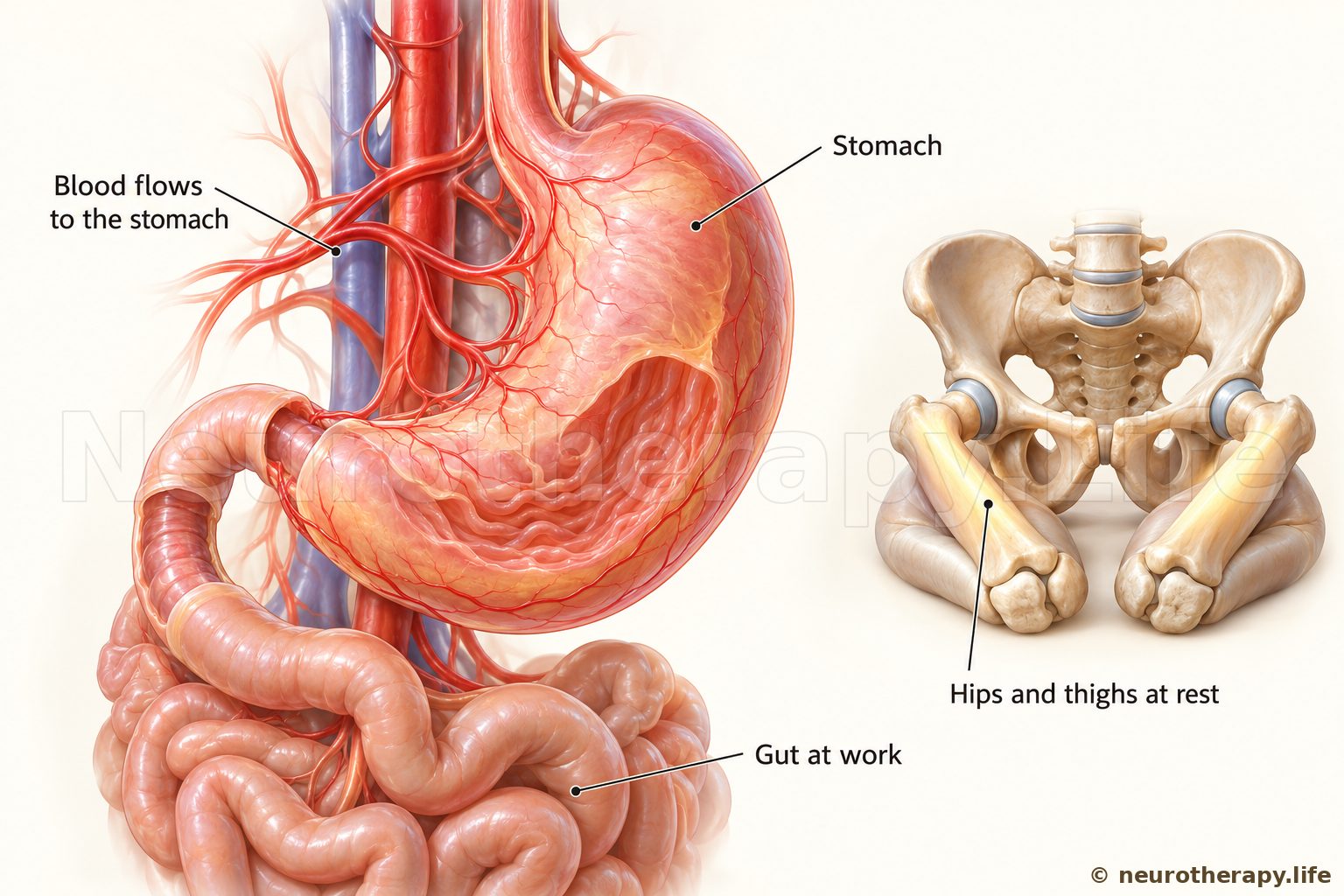
Bathe first, then eat — with at least forty-five minutes between a cold bath and breakfast. After the bath the blood stays near the skin while the body warms up; food eaten then is digested less and leaves gas. If food must come first, bathe only after it is digested. The easy way is to fill the gap with sitting jobs: tea for the family, prayers, the newspaper.
Wash the hands well before eating. Eat sitting on the floor, cross-legged (palathi or chaukri), so the feet do not hang and more blood goes to the stomach. Chew well: more saliva helps digest chapati, rice and other starches. Keep a glass of water near for a morsel that sticks, or if you choke.
Do not walk about for twenty minutes after eating; sitting in vajrasana is very good. Walking or heavy work straight after a meal makes the heart supply the stomach and the limbs at once. This matters most for heart patients and anyone who gets breathless on walking.
For school and college children, the answer is to eat breakfast a little earlier, do the sitting tasks after it, and leave for the bus without running. The same habit helps office-goers.
Water: when, how much and how
Do not drink water in the middle of a meal or just after it. Drink half an hour before, or half an hour after. The stomach makes hydrochloric acid (HCl), which helps the enzyme pepsin digest dal and proteins, and is strong enough to kill germs. Water with the meal weakens both the acid and the saliva. A sip or two for a dry mouth or a stuck morsel is always allowed.
Through the day, drink about ten to twelve glasses — a glass half an hour after the meal, then one every hour to hour and a half. Tea and cold drinks do not count; the body treats them as food. Too little water is linked in this teaching with constipation, rheumatism, low blood pressure and acidity.
- Drink sitting down.
- Prefer water from an earthen pot to fridge water; warming very cold water wastes the body's energy.
- No cold water on waking — it is said to provoke phlegm. Wait after milk or tea before drinking water.
- No water straight after melon or watermelon.
- Do not drink cloudy, smelly or bubbly water — sewage may have entered the supply.
Sour foods and joint pain
In Neurotherapy (LMNT), pain in the joints is often linked with acid rising in the blood, and Ayurveda too says sour food increases pain. So people with body or joint pain keep away (parhez) from sour things such as curd, tamarind, tomato and lemon, while the pain lasts.
Fruits are sorted by how they taste before they ripen. Those sour when unripe and sweet when ripe — orange, sweet lime, apple, mango — are kept away. Those bitter or bland when unripe — banana, chikoo, papaya, custard apple, guava, fig and amla — may be eaten with relish.
The teaching adds an honest test. Lemon is given as a treatment during a fast, but taken with food it may increase pain. Kokum is said to be excellent for acidity, but each patient should try it and see whether it brings joint pain. The practical method: remove one food completely for two weeks, compare the mornings, and give it back if nothing changed.
In illness: diarrhoea and fever
In diarrhoea, do not give plain water alone — it increases the stool. Give water with sugar and salt (and lemon), sipped slowly. The gut can still take in water when salt and sugar travel with it. The strength must be right: use an ORS packet mixed exactly as printed, or six level teaspoons of sugar and half a level teaspoon of salt in one litre of clean water. If no proper drink is at hand, plain water is still far better than nothing.
During a fever, and for some days after it, the liver and gall bladder are said not to work properly. That explains why appetite goes in a fever and returns slowly. No special diet rule is attached to this, so none should be invented.
Key points
- Bathe first, then eat — at least forty-five minutes between a cold bath and breakfast.
- Eat sitting on the floor, chew well, and stay seated for twenty minutes after the meal.
- Drink water half an hour before or after meals, not during — but keep a glass near for a stuck morsel.
- Drink water through the day as a rhythm, sitting, and not ice-cold.
- During joint pain, sour foods are kept away; fruits are sorted by their unripe taste.
- Test one food at a time on yourself, and give it back if nothing changes.
- In diarrhoea, give a correctly measured salt-sugar drink in small sips.
Topics in this guide
Go deeper
Between Two Sessions: Daily Rules for Patients
The rules of sleep, rising and bathing
The Two Kingdoms: Acidic and Alkaline Bodies
Acid and alkali — the two kingdoms of the body
The Fire and the Ash: Undigested Food in the Stool
Why digestion comes first
Setting the Stomach: The Digestive Formulas of Neurotherapy (LMNT)
Treatments that set the stomach right
Treating Women: Periods, Pregnancy and Care
The milk rule for heavy bleeding, and pills in pregnancy
Arthritis and joint pain (osteoarthritis)
Joint pain and the acid side
Diarrhoea (loose motions)
Loose motions, and when to see a doctor
Stomach
How the stomach makes its acid
Safety: when it is held back
- The water rules never override a doctor: tablets are taken with water exactly as prescribed, and anyone told to limit fluids (for example by a kidney doctor) follows that doctor. Kidney disease
- Chest pain, pressure or breathlessness after meals is a question for a doctor, not just a digestion complaint. See a doctor and continue treatment alongside. Angina (chest pain from the heart)
- See a doctor at once for diarrhoea in an infant or small child, blood in the stool, vomiting that will not stop, or signs of drying out such as sunken eyes, a dry mouth or no urine for many hours. Diarrhoea (loose motions)
- A salt-sugar drink made too strong makes diarrhoea worse; measure it exactly every time.
- Never reduce or stop medicine for fits (epilepsy) or any other prescribed medicine because a diet is being kept. Epilepsy (fits)
- Curd, tomato, lemon and tamarind give protein, calcium and vitamin C. Remove them one at a time, and take special care with people who are anaemic, elderly or already eat a narrow diet. Anaemia
Guruji says
“The patient has to try it for himself and see. Every single thing will not have the same effect on every person.”
Common questions
My doctor says curd is good for my calcium. Who is right?
Your doctor is right that you need calcium. What is asked here is to stop one sour food for two weeks as a test while you have joint pain. Milk and paneer are not on the list, and any calcium tablet your doctor gave you continues exactly as prescribed.
Then what is left to eat?
Plenty: banana, chikoo, papaya, custard apple, guava, fig and amla, all your dals, grains and vegetables, milk, paneer and ghee. Only a few sour foods and fruits are kept away, and only while there is pain.
My knees will not let me sit cross-legged. What do I do?
The aim is that the feet do not hang. Sit on a low stool with the feet flat on the ground, or put a box under your feet on a chair. Never force a painful knee.
Is stomach acid a bad thing?
No. The stomach makes it on purpose to digest protein and to kill germs that arrive with food. That is why it is not diluted with water during the meal.
Test yourself
Research
- Strong evidence
A major review of how the stomach controls its acid: signals from the vagus nerve, the hormone gastrin and histamine all act on the acid-making cells — the acid that digests protein and guards against germs.
- Strong evidence
In children with diarrhoea, the lower-salt oral rehydration solution used today worked better than the older formula: fewer children needed an unplanned drip, stool output was lower and there was less vomiting.
Explore more
Organs
Body systems
Diseases
Formulas
Topics
Read more
This page explains what a Neurotherapy (LMNT) treatment is for; it is not a self-treatment guide and does not diagnose. Neurotherapy (LMNT) works alongside your medical care — keep taking the medicines your doctor prescribed.