Daily food habits for good digestion: breakfast time, chewing and water
Three simple habits support digestion: eat breakfast a little earlier so you are not rushing out, chew food well, and drink water half an hour before or after meals rather than with them. Diet rules (parhez) are added a few at a time, each with its reason.
Overview
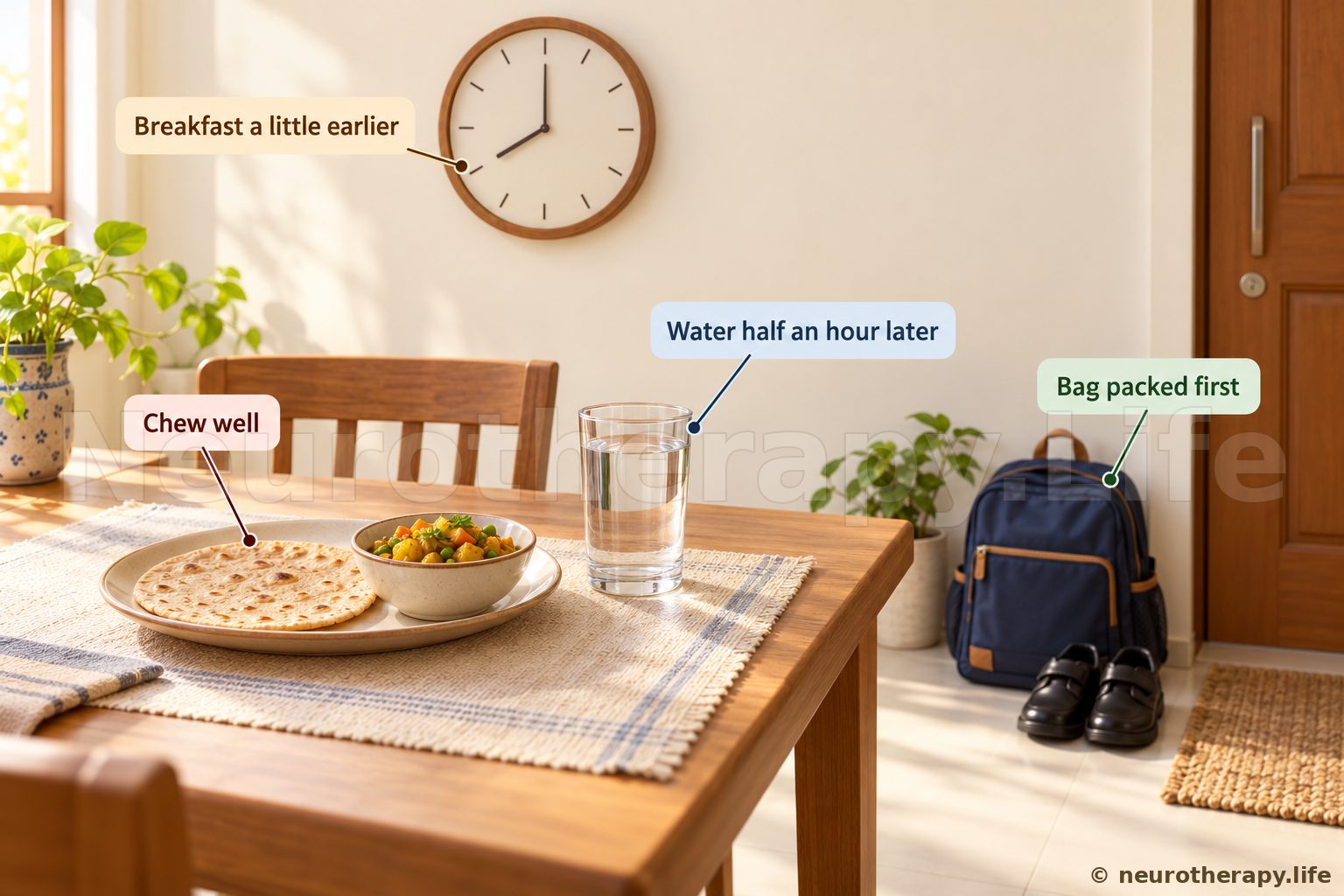
School and college children often run to catch a bus straight after breakfast. If they are trained from a young age to eat breakfast a little earlier, do the small tasks that can be done sitting after the meal, and then set out calmly, many childhood illnesses can be avoided. The same holds for adults going to the office.
Chew food well so that more saliva comes out. Saliva starts digesting chapati, rice and other starchy foods in the mouth. You can test this yourself: chew a plain piece of chapati for a long time and it turns sweet. The teaching also links the movement of the jaws to the working of the nerves and, through them, to digestion.
Do not drink water in the middle of a meal or just after it. Drink half an hour before eating, or half an hour after. Water during the meal weakens the saliva and the stomach acid, and a strong stomach acid is also a gate that stops germs. Keep a glass nearby for a sip if a morsel sticks or the mouth is dry.
Through the day, drink plain water in a rhythm: a glass half an hour after a meal, then a glass every hour or so. Tea and cold drinks are made from water, but the body treats them as food, so they cannot replace water. Water mainly prevents the acid-side complaints; once a disease has set in, extra water alone helps less, and the treatment does the correcting.
Key points
- Move breakfast a little earlier so no one runs straight after eating.
- Chew well; digestion of starch begins in the mouth.
- Water half an hour before or after meals, not with them.
- Plain water through the day; tea is not a substitute.
- Diet rules are given two at a time, each with its reason.
Go deeper
Food as Medicine: Eating and Drinking Rules
Food as medicine: the full guide
How to drink water: seven everyday rules and the reason for each
How water is drunk, and the waters to avoid
Sour foods and joint pain: the sour rule, and how to test one food at a time
Lemon, kokum and other sour foods
Stomach
The stomach and its protective acid
Acidity (heartburn and acid reflux)
Acidity and how meals affect it
Constipation
Constipation and the water you drink
Read the full guide
This topic is part of: Food as Medicine: Eating and Drinking Rules
Safety: when it is held back
- Take medicines exactly as your doctor said, even if that means water with food. The water rule never overrides a prescription.
- If a doctor has told you to limit fluids, for example in heart failure or advanced kidney disease, follow that doctor’s amount, not a general number. Kidney disease
- A person with a dry mouth may sip water freely during meals to avoid choking.
- Someone with broken or missing teeth or a painful mouth needs food prepared differently and a dental check, not an instruction to chew more. Mouth
Watch

A podcast conversation on indigestion: its common signs, causes such as rushed meals, stress and some medicines, and how Neurotherapy (LMNT) looks at digestion through the body's acid–alkali balance. No points are demonstrated.
This page explains what a Neurotherapy (LMNT) treatment is for; it is not a self-treatment guide and does not diagnose. Neurotherapy (LMNT) works alongside your medical care — keep taking the medicines your doctor prescribed.