Your mouth is where digestion begins, where taste lives and where speech is shaped. Teeth harder than any bone grind your food, up to a litre and a half of saliva a day starts digesting it, and a tongue that is almost pure muscle tastes, moves and talks — all at once.
Overview
What is the mouth?
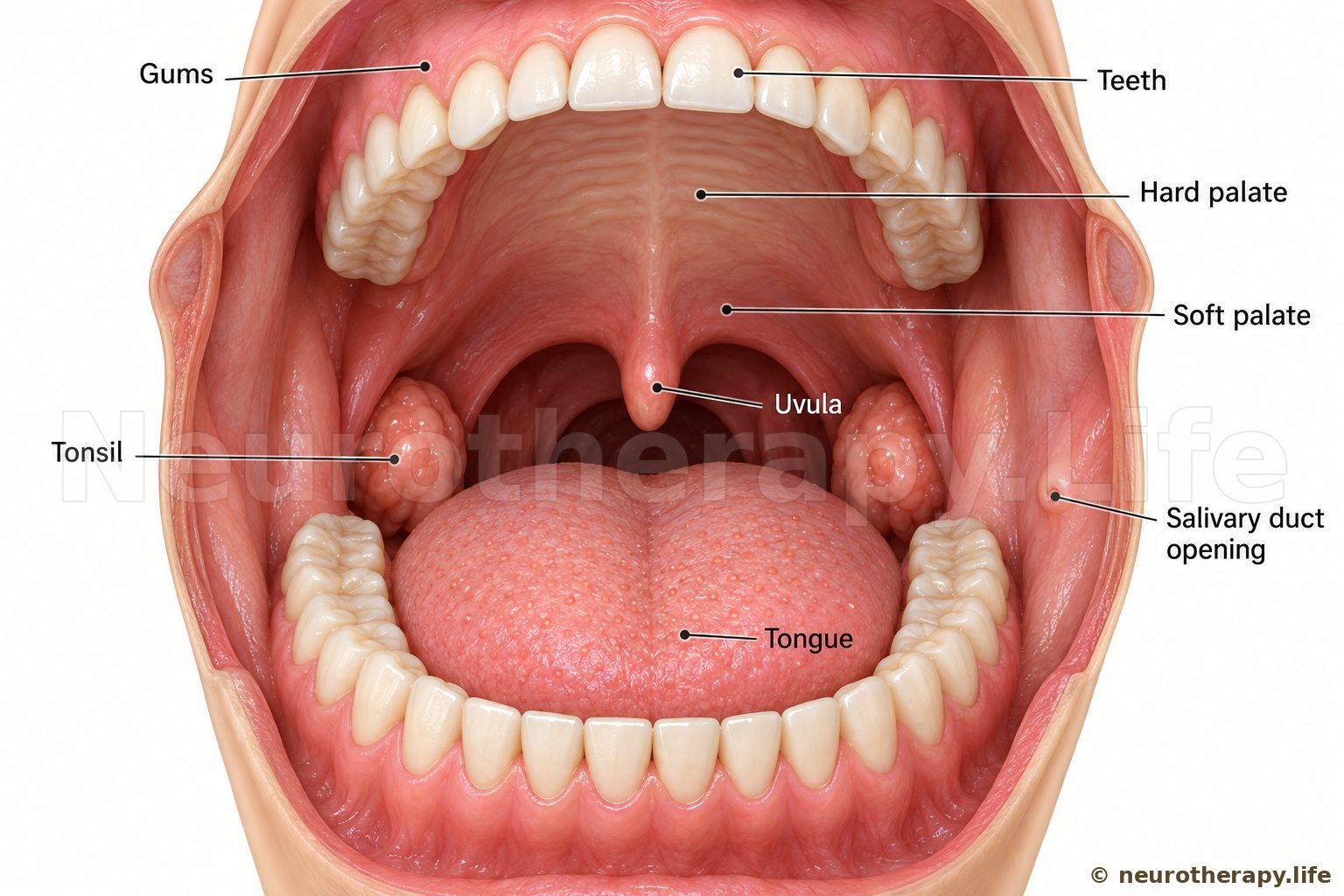
Your mouth (oral cavity) is the opening at the start of the digestive tract. It holds the teeth, the tongue, the gums and the openings of the salivary glands, and is roofed by the palate, which separates it from the nose.
The mouth does many jobs: it bites and chews, wets food with saliva, starts the digestion of starch, tastes, shapes speech, swallows, and is a back-up airway. It also guards the body, because saliva and the lining contain germ-fighting substances.
Tooth decay and gum disease are among the commonest diseases in the world. In India, mouth cancer is one of the commonest cancers in men, closely linked to chewing tobacco, gutka and betel quid — so a mouth ulcer that does not heal is always worth showing to a doctor.
The mouth: teeth and gums, a muscular tongue, a two-part roof, and the gateway to the throat.
Function
What does the mouth do?
Digestion begins the moment food enters the mouth. The teeth cut and grind it, the tongue turns it, and saliva wets it and starts breaking down starch with its enzyme, ptyalin (salivary amylase). The chewed food is shaped into a soft ball and pushed back to be swallowed. At the same time, taste buds report sweet, sour, salty, bitter and savoury tastes to the brain.
Bites, chews and grinds food into small pieces.
Makes saliva, which wets food, starts digesting starch and protects the teeth.
Tastes food and warns against spoiled or bitter, possibly poisonous, things.
Shapes the sounds of speech with the tongue, lips, teeth and palate.
Starts swallowing, then hands over to the throat and food pipe.
Guards the entrance: tonsils and saliva help fight germs coming in with food and air.
How does the mouth work with other organs?
Stomach — Well-chewed food mixed with saliva is easier for the stomach to work on.
Digestive system — The mouth is the first station of the digestive system.
Jaw — The jaw bone and chewing muscles power every bite; the jaw joint sits just in front of the ear.
Nose — Smell rises from the back of the mouth into the nose to make flavour.
Cranial nerves — Five cranial nerves share the mouth's work: chewing, feeling, taste, swallowing and moving the tongue.
Intestines — In LMNT teaching the tongue is the mirror of the intestines: lines on it point to scratches inside that hinder absorption.
Anatomy
What are the parts of the mouth?
The mouth has lips and cheeks as walls, the palate as a roof, the tongue as a moving floor, the teeth and gums, and the salivary glands that pour into it.
Teeth and gums
Teeth — Children have 20 milk teeth; adults have up to 32 permanent teeth — incisors to cut, canines to tear, premolars and molars to grind.
Enamel, dentine and pulp — Each tooth has a crown of enamel — the hardest substance in the body — over dentine, with a living pulp of nerves and vessels inside.
Gums (gingiva) — Firm pink tissue that seals around each tooth. Bleeding gums are the first sign of gum disease.
The tongue and palate
Tongue — A bundle of muscles running in different directions, covered with small bumps (papillae). Many of these hold taste buds.
Taste buds — A few thousand tiny taste organs on the tongue, palate and throat. Every area of the tongue can sense all the basic tastes.
Hard and soft palate — The bony front roof, and the soft muscular back roof that lifts to close off the nose when you swallow.
Uvula and tonsils — The small hanging uvula at the back, and the tonsils on each side — immune tissue guarding the throat.
The salivary glands
Three pairs of large glands, and hundreds of tiny ones in the lining, make saliva.
Parotid glands — The largest, in front of and below each ear, over the jaw hinge. They make watery saliva rich in ptyalin; their duct opens on the inner cheek opposite the upper molars.
Submandibular glands — Under the angle of the jaw; they make most of the saliva at rest.
Sublingual glands — Under the tongue; they make thick, slippery saliva.
Where is the mouth located?
The mouth sits in the lower face, below the nose and between the cheeks. Its roof, the palate, is also the floor of the nose. At the back it opens into the throat (pharynx), where the airway and the food pipe part company.
The upper teeth sit just under the cheek sinuses, the lower teeth in the jaw bone, and the jaw joints just in front of the ears — which is why tooth, sinus, jaw and ear pain are so easily confused.
A healthy mouth is moist and pink. The gums are firm, pale pink and fit snugly round the teeth; the tongue is pink with a thin, even coating and a velvety surface of tiny bumps.
LMNT teaching looks closely at the tongue: 'the face is the reflection of the mind; the tongue is the mirror of the intestines'. Lines or cracks on the tongue, and a white coating seen first thing in the morning, are written down as findings.
How big is the mouth?
An adult tongue is about 10 cm long from tip to back. The mouth can usually open about 4 to 5 cm between the front teeth — roughly three fingers' width.
The salivary glands make roughly 0.5 to 1.5 litres of saliva a day, most of it with meals. There are 20 milk teeth and up to 32 adult teeth, and a few thousand taste buds.
Conditions and disorders
What conditions and disorders affect the mouth?
Mouth problems affect the teeth and gums, the lining, the saliva, taste and swallowing, or the nerves and muscles that move the face and tongue. The mouth also shows signs of illness elsewhere.
AnaemiaA pale, smooth or sore tongue and cracks at the corners of the mouth can go with low iron or B₁₂.
What are common signs of a mouth problem?
Toothache, or pain on hot, cold or sweet food
Bleeding, swollen or receding gums
A sore or white or red patch that does not heal in three weeks
A dry mouth or bad breath that does not go away
Change or loss of taste
Difficulty opening the mouth, chewing or swallowing
What tests check the health of the mouth?
Dental examination — A dentist checks each tooth, the gums and the whole lining of the mouth.
Dental X-rays — Show decay between teeth, root infections and bone loss around the teeth.
Gum probing — A thin probe measures the pockets around the teeth to stage gum disease.
Biopsy — A small piece of any suspicious patch or ulcer is examined to rule out cancer.
Blood tests — Sugar, haemoglobin, iron and B₁₂ when ulcers, a sore tongue or gum disease keep returning.
Swallowing study — An X-ray or camera test watches a swallow when food sticks or goes the wrong way.
How are mouth conditions treated?
Cleaning and fillings — Scaling removes tartar; decay is cleaned out and filled.
Root canal treatment or extraction — When infection reaches the pulp, the tooth is cleaned inside and sealed, or removed.
Gum treatment — Deep cleaning below the gum line, better brushing and, for advanced disease, gum surgery.
Medicines — Antibiotics for spreading infection, soothing gels for ulcers, and treatment of the cause, such as low B₁₂.
Speech and swallowing therapy — Exercises and techniques after a stroke or for stammering.
Stopping tobacco — The single most important step for gums and against mouth cancer.
Neurotherapy (LMNT)
LMNT teaching treats the mouth as the first station of digestion and as a window onto it. Food is to be chewed well so that more saliva comes out — which helps digest chapati, rice and other starchy foods — and the teaching adds that the movement of the jaws itself helps the nerves of the brain, and through them the digestive system, to work properly. It reads the tongue for lines and coating, gives the Ptyalin treatment to increase saliva, teaches the patient Teeth Points for toothache while the dentist is arranged, and uses the Medulla numbers for taste, swallowing, voice and the face — reminding the therapist that a job shared by two nerves needs both numbers.
Points
Ptyalin — Seated; both palms at four stations with light pressure, three movements at each: the cheeks (parotid glands), below the jaw angle (submandibular), below the jaw (sublingual), and in front of the jaws — to increase saliva.
Teeth Points — Taught to the patient: for the upper teeth, above the ear (found by clenching the teeth) and below the eye; for the lower teeth, below the chin and jaws — on the side that hurts, on and off through the day. The teaching says the appropriate Heparin treatment for the patient's body is given first.
Jaw Points — Pressed and released on both cheeks at the angle of the jaw — for pains of the teeth and gums, as comfort while the dentist is arranged.
Mukha Dhauti — 'Mouth cleansing': a long breath in through the nose and out through the mouth — open with 'haa…' when Mu° hurts, closed with a whistling 'hoo…' when Liv° hurts. A treatment the patient takes home.
Medulla — Taste needs both (5) and (7) Medulla — one nerve carries the message from the brain to the tongue, the other from the tongue to the brain. Swallowing difficulty with loss of taste: (9); with a heavy voice: (10). Tongue muscles, a lost voice or thick speech: (12). Bell's palsy, whistling and the face's expressions: (7).
(10) Medulla — Hoarseness and a rough voice, and — given on the left only — difficulty in swallowing from a narrowed food pipe.
Vocal Point — Vocal ghisai: cupped palms stroke the muscles either side of the throat outward and backward — for a bad throat, hoarseness, or a voice that will not come out.
Speech Point — Light tapping above the left temple, for a paralysed person who cannot speak clearly — to stimulate Broca's area, the speech centre of the brain.
Bell's Palsy — Both thumbs draw the face from the side that works properly across to the weak side, finishing behind the hair; the direction is marked on the card with an arrow.
For a child who vomits milk as milk rather than curd — a sign, in the teaching, that the stomach is not making its acid. UDF and HCl are taught to the parents of children of slow intellect to give daily.
“It is not enough that one eats proteins. The important thing is to digest them.”
— Dr. Lajpatrai Mehra
“This is a matter of experience.”
— Dr. Lajpatrai Mehra
“Only they know the pain; you do not.”
— Dr. Lajpatrai Mehra
Never do this
Go to a dentist or doctor today, not next week, for: swelling of the face or under the jaw, fever with toothache, a jaw that will not open fully, difficulty swallowing or breathing, or swelling under the tongue. Toothache (tooth, gum and jaw pain)
A toothache is a symptom with a cause — decay, an inflamed pulp or an abscess. Teeth Points and Jaw Points are comfort while the dentist is being arranged, never instead. Teeth Points
Any mouth ulcer, white or red patch or lump that has not healed in three weeks must be shown to a doctor or dentist — especially in anyone who uses tobacco, gutka or pan. Mouth ulcers
Ptyalin: light pressure only. Never work over a lump in a salivary gland, and never over a hot, swollen, painful gland — a swollen, tender jaw hinge with fever needs a doctor the same day. Ptyalin
Sudden slurred speech, a drooping mouth, or difficulty swallowing with weakness of an arm or leg — call 108/112; it may be a stroke. Paralysis and stroke
A baby who vomits forcefully and repeatedly, is not gaining weight, brings up anything green or blood-stained, or becomes floppy or hard to wake needs a doctor the same day. The milk-or-curd question is asked of the mother; a baby is never over-fed to test it.
Mukha Dhauti is soft, never forced: if the patient becomes light-headed or the fingers tingle, stop and breathe normally for a minute. Mukha Dhauti
The Medulla count is the treatment: a different number is a different treatment, not a stronger or weaker one. Only a trained therapist chooses the number, after examining you that day. Medulla, the graded series
Cancer: if the person has cancer, (10) Pan, Thymus, Pit, Lu + Sh, Rt. Ov / Lt. Ov and (30) Medulla are never given — the therapist changes the plan.
Keep taking the medicines, drops and treatments your doctor prescribed, and never stop or change them on your own. Neurotherapy (LMNT) works alongside your medical care, never instead of it.
Care
How can I keep my mouth healthy?
A healthy mouth needs clean teeth and gums, plenty of saliva, and no tobacco — and good chewing helps the rest of digestion too.
Chew well
Guruji's rule: chew food well so that more saliva comes out — it helps digest chapati, rice and other starchy foods. Try it: chew a plain piece of chapati thirty times and it turns sweet.
Brush twice, with fluoride
Brush for two minutes, morning and night, with a fluoride toothpaste, and clean between the teeth once a day.
Say no to tobacco, gutka and pan masala
They cause gum disease, stained and worn teeth, and mouth cancer. Stopping helps at any age.
Keep sweets to mealtimes
Sugar sipped or nibbled through the day feeds decay again and again; with meals it does less harm.
Look at your tongue in the morning
LMNT teaching looks at the tongue before anything is eaten or drunk and before brushing. Note any lines or coating and tell your therapist.
See a dentist
Have a check-up once or twice a year, and at once for bleeding gums, a broken tooth, or an ulcer that lasts three weeks.
Common questions
Is there a 'taste map' on the tongue — sweet at the tip, bitter at the back?
No. That old map came from a misread study. Every part of the tongue with taste buds can sense all the basic tastes, though some areas are a little more sensitive to some.
Why is chewing well so important?
Chewing breaks food into small pieces and mixes it with saliva, whose enzyme starts digesting starch. Guruji's teaching adds that the movement of the jaws helps the brain's nerves and so the digestive system to work properly, and that poorly digested fats can add to weight gain.
Why does my mouth feel dry?
Common reasons are not drinking enough, breathing through the mouth at night, many medicines, high sugar and ageing glands. A dry mouth raises the risk of decay, so tell your doctor and dentist.
Can gum disease affect the rest of the body?
Yes. Gum disease and diabetes make each other worse, and treating gum disease can slightly improve sugar control. Gum disease is also linked with heart disease.
Can Neurotherapy (LMNT) help a toothache?
LMNT teaching gives Teeth Points and Jaw Points for comfort, and says the patient should be told plainly that these are offered while the dentist is being arranged. A finger on the cheek cannot treat decay or an abscess.
What should I ask my doctor, dentist or therapist?
Is this pain from a tooth, the gum, the jaw joint or a sinus?
Do I have gum disease, and how often should my teeth be cleaned?
Is this ulcer or patch safe, or does it need a biopsy?
Could my medicines be drying my mouth or changing my taste?
Should my sugar, iron or B₁₂ be checked?
(To the therapist) What do the lines or coating on my tongue tell you, and which Heparin treatment will you give before the Teeth point?
Surprising facts
1Tooth enamel is the hardest thing in your body
Enamel is about 96% mineral, harder than any bone. But it has no living cells, so once decay eats through it, it cannot grow back — which is why decay must be stopped early.
Source: Gray's Anatomy; Ten Cate's Oral Histology (enamel ≈96% mineral by weight, acellular).
2You make up to a litre and a half of saliva a day
The salivary glands make roughly 0.5 to 1.5 litres a day — most of it when you eat, very little when you sleep. That is why the mouth is driest in the morning.
Source: Guyton & Hall — daily salivary secretion ≈800–1,500 mL; secretion falls very low during sleep.
3Chew a chapati long enough and it turns sweet
Saliva contains ptyalin (salivary amylase), which starts breaking starch into sugars while food is still in your mouth. Chew a plain piece of chapati about thirty times without swallowing, and you will taste it turning sweet — a test Guruji's teaching gives patients to try for themselves.
Source: Guyton & Hall — salivary α-amylase (ptyalin) digestion of starch; LMNT mouth.md §39.4.
4The 'tongue map' is a myth
Many of us learned that sweet is tasted at the tip and bitter at the back. Modern research shows that taste cells for every basic taste are spread across all areas of the tongue that have taste buds.
Source: Chandrashekar J et al., 'The receptors and cells for mammalian taste', Nature 2006;444:288–294.
5Your taste cells are replaced every few weeks
Most taste cells live only from about ten days to a few weeks before new ones take their place. That is why a tongue burnt by hot tea recovers its taste within days.
Source: Purves, Neuroscience; Barlow LA, Development 2015 (taste receptor cells turn over; average life ≈10 days, some cell types several weeks).
6Your mouth is home to about 700 kinds of bacteria
Researchers cataloguing the human mouth have identified around 700 species of bacteria. Most are harmless or helpful; trouble starts when sugar and plaque let the harmful ones take over.
Source: Dewhirst FE et al., 'The human oral microbiome', J Bacteriol 2010;192:5002–5017.
7Two nerves share taste — one each way
In LMNT teaching, taste needs two Medulla numbers, (5) and (7), because one nerve carries the message from the brain to the tongue and the other from the tongue to the brain. The teaching warns that giving only one of them is 'treating half of a two-nerve function'.
Source: LMNT mouth.md §37.12. Anatomy: taste from the front two-thirds of the tongue travels in the facial nerve (VII); the trigeminal nerve (V) supplies the tongue's touch and carries those taste fibres part of the way (Gray's).
Your mouth in numbers
0.5–1.5 Lsaliva made each day
32adult teeth (20 milk teeth)
~96%of enamel is mineral
~700kinds of mouth bacteria
4stations of the Ptyalin treatment
30chews to taste a chapati turn sweet
Yoga
Śītalī — the cooling breath Śītalī
Benefits
Gives a cooling feeling in the mouth and throat, pleasant in hot weather.
Works the tongue muscles and slows the breath, which calms the mind.
How to do it
Sit comfortably with a straight back.
Curl the sides of the tongue up into a tube and push it slightly out between the lips.
Breathe in slowly through the tongue, feeling the cool air.
Close the mouth and breathe out slowly through the nose.
Repeat 5 to 10 times. If you cannot curl the tongue, breathe in through the teeth with the lips parted instead.
Take care
Skip it in cold weather, with a cough, cold or asthma, and with low blood pressure. Do it on clean air, not in smoke or dust.
Vajrāsana after meals Vajrāsana
Benefits
Guruji's teaching names it as the good way to sit for a while after eating, instead of rushing off.
Keeps you still while digestion — which began in the mouth — gets its share of blood.
How to do it
Fold a blanket and kneel on it with the knees together.
Let the big toes touch and sit back onto the heels.
Keep the back straight and rest the hands on the thighs.
Breathe normally; start with 5 minutes and build up to 20 minutes after meals.
To come out, lean forward on the hands and straighten one leg at a time.
Take care
Skip it, or sit on a chair instead, with knee or ankle pain or a recent knee injury or operation. Get up slowly afterwards.
Test yourself
Research
Strong evidence
Research into how taste works found that each basic taste has its own set of taste cells and receptors, and that these are found across the tongue — disproving the old 'tongue map'.
A review found a two-way link between gum disease and diabetes: diabetes raises the risk of gum disease, and treating gum disease can modestly lower long-term blood sugar (HbA1c).
Scientists built a database of the bacteria living in the human mouth and identified around 700 species, most of which can now be named by their genes.
This page explains how the body works; it does not diagnose. Neurotherapy (LMNT) works alongside your medical care — keep taking the medicines your doctor prescribed, and see a doctor for any new or severe symptom.
Ready to begin?
Send COURSE for course details, or your name, age and health issue for a consultation.