Hammering is a Neurotherapy (LMNT) treatment in which the head is tapped lightly, through a soft cloth, with a soft hammer or the finger pads. It is given seated, to increase blood circulation inside the brain, for speech, paralysis and other diseases of the brain.
Overview
What is Hammering?
Hammering is a physical point, named — like Katka and Superfast — for the action itself. A soft cotton cloth or towel is laid on the forehead, and the head is tapped lightly at many closely spaced places all round, with a special soft hammer made for the purpose or with the pads of the fingers.
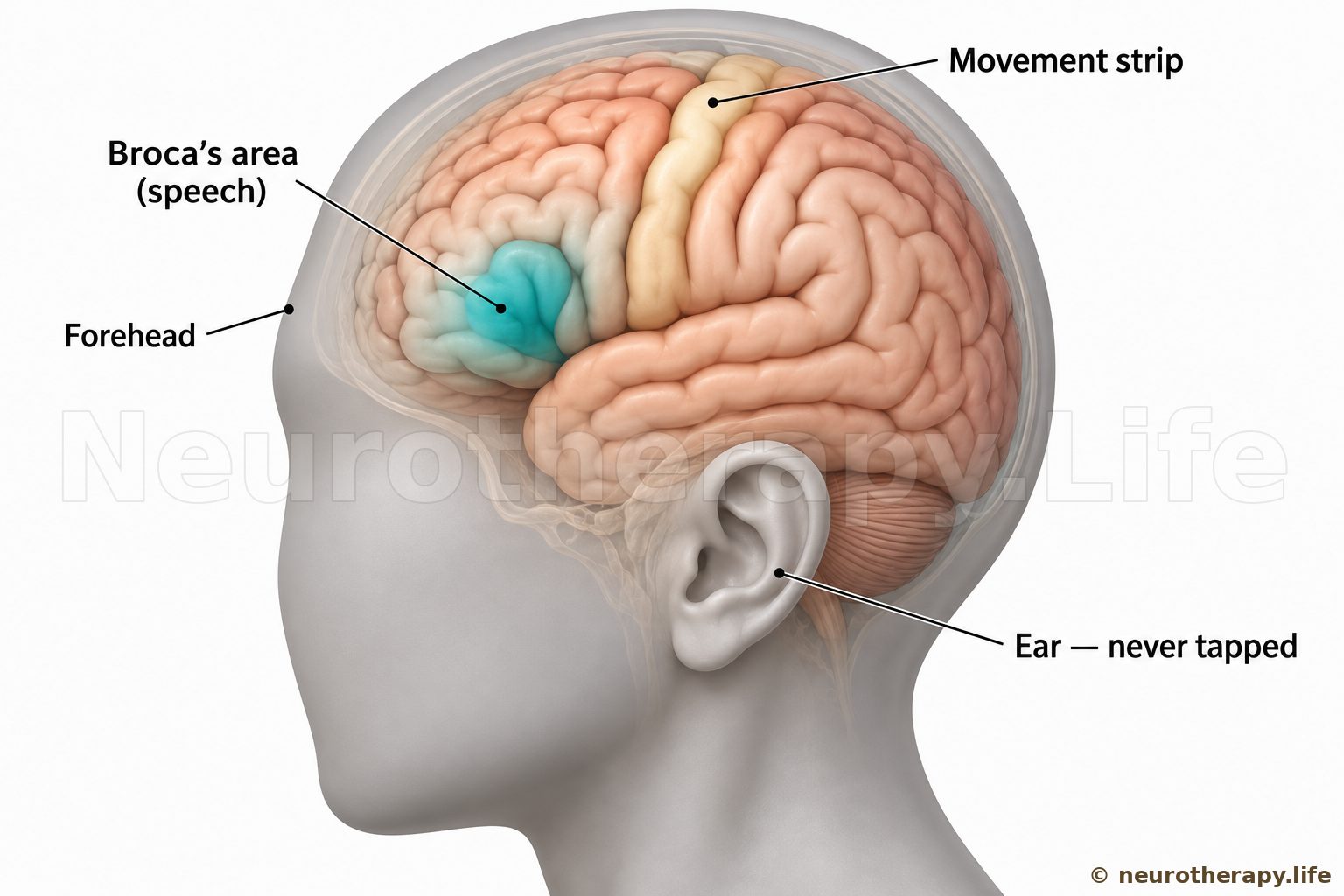
The teaching says it increases the circulation of blood inside the brain and is excellent for speech, paralysis and other diseases of the brain. For a patient whose speech is impaired, it is given especially on the left side of the forehead, to stimulate Broca's area — the part of the brain that controls the speaking of words.
The side crosses. Left side of the head for speech; for a patient who has difficulty moving the left hand or leg, the right side of the head.
Broca's area, the speech centre, lies on the left side of the brain — the reason Hammering for speech is given on the left of the forehead.
Where it is given
Where is Hammering given?
PositionSitting
Body areaAll round the head and the forehead, through a cloth — never the ear; the side chosen by the problem
You sit on a chair with a soft cotton cloth or towel laid on the forehead. The cloth is part of the treatment: it spreads each tap, keeps the hair out of the way, and keeps nails off the skin.
The tapping runs all round the head — but never over the ear. For speech, it is given especially on the left side of the forehead; for others, over the whole forehead; and for weakness of the left limbs, on the right side of the head.
How it is given
How is Hammering given?
How this point is given — the tool, the pressure, the count and the exact movement — is deliberately not described here. A demonstration video for this point is being prepared; until it is on this page, learn the method hands-on from a trained Neurotherapist before giving it. Please do not give any point from a written description alone: a point given in the wrong place or the wrong way can do harm.
Never onThe ear
SideLeft for speech; right for a weak left limb
The exact technique is taught hands-on in the Neurotherapy (LMNT) course. See the course →
What it does
What does Hammering do?
The teaching says Hammering increases the circulation of blood inside the brain. Body science confirms the layout it relies on: speech production sits in Broca's area on the left side of the brain in most people, and each side of the brain moves the opposite side of the body — which is why the side crosses.
Is used for speech that has become unclear, especially after paralysis.
Is used in paralysis and other diseases of the brain.
Works on the scalp and forehead over the brain regions chosen by the problem.
Organs it reaches
Brain — Broca's area for speech, and the movement areas for the limbs.
Ears — Kept clear — a tap over the ear can tear the eardrum.
Skin — The scalp and forehead receive the taps through a cloth.
Its family
Which points are given with Hammering?
Hammering belongs to the seated points of the head and face.
Speech Point — Hammering for speech above the left temple, to stimulate Broca's area.
The ear is never struck. A tap over the ear-hole drives a pulse of air onto the eardrum, and that is how a drum is torn. Ears
The nails never touch the patient — this matters most on thin or elderly skin and for patients on blood-thinning tablets.
Withheld after a recent head injury, over a plate, a shunt or any known defect in the skull, and where fits are poorly controlled. Epilepsy (fits)
Sudden face droop, an arm that will not hold up, or speech gone thick is a stroke emergency — call an ambulance at once; it is not a session. How to tell a patient to see a doctor
A patient who cannot flinch has lost the only alarm the technique relies on; a family member watches the face. Children get light treatment. Neurotherapy (LMNT) works alongside medical care. Lighter formulas for children, the elderly and the weak
Common questions
Does it hurt?
It should not. The tapping is light and goes through a soft cloth; it should feel like gentle drumming.
Why the left side of the forehead for speech?
Because in most people the speech area of the brain, Broca's area, lies on the left side.
My left arm is weak. Which side will be tapped?
The right side of the head. Each side of the brain moves the opposite side of the body, so the side crosses.
Surprising facts
1The man who could say one word
In the 1860s the French surgeon Paul Broca studied a patient who understood speech but could say little more than one syllable, 'tan'. After the man died, Broca found damage low at the front of the left side of his brain — the first evidence of a speech centre.
Source: Dronkers NF et al. Paul Broca's historic cases. Brain 2007;130(5):1432–1441.
2Wired in reverse
The nerve fibres carrying movement commands cross to the other side low in the brainstem, so the left brain moves the right hand and the right brain the left.
High-resolution MRI of the preserved brains of Broca's two famous patients confirmed damage in the left frontal lobe, and showed it reached deeper than Broca could see — supporting the left side of the brain as the seat of speech production. It is about the brain, not about Hammering itself.
This page explains what a Neurotherapy (LMNT) treatment is for; it is not a self-treatment guide and does not diagnose. Neurotherapy (LMNT) works alongside your medical care — keep taking the medicines your doctor prescribed.
Ready to begin?
Send COURSE for course details, or your name, age and health issue for a consultation.