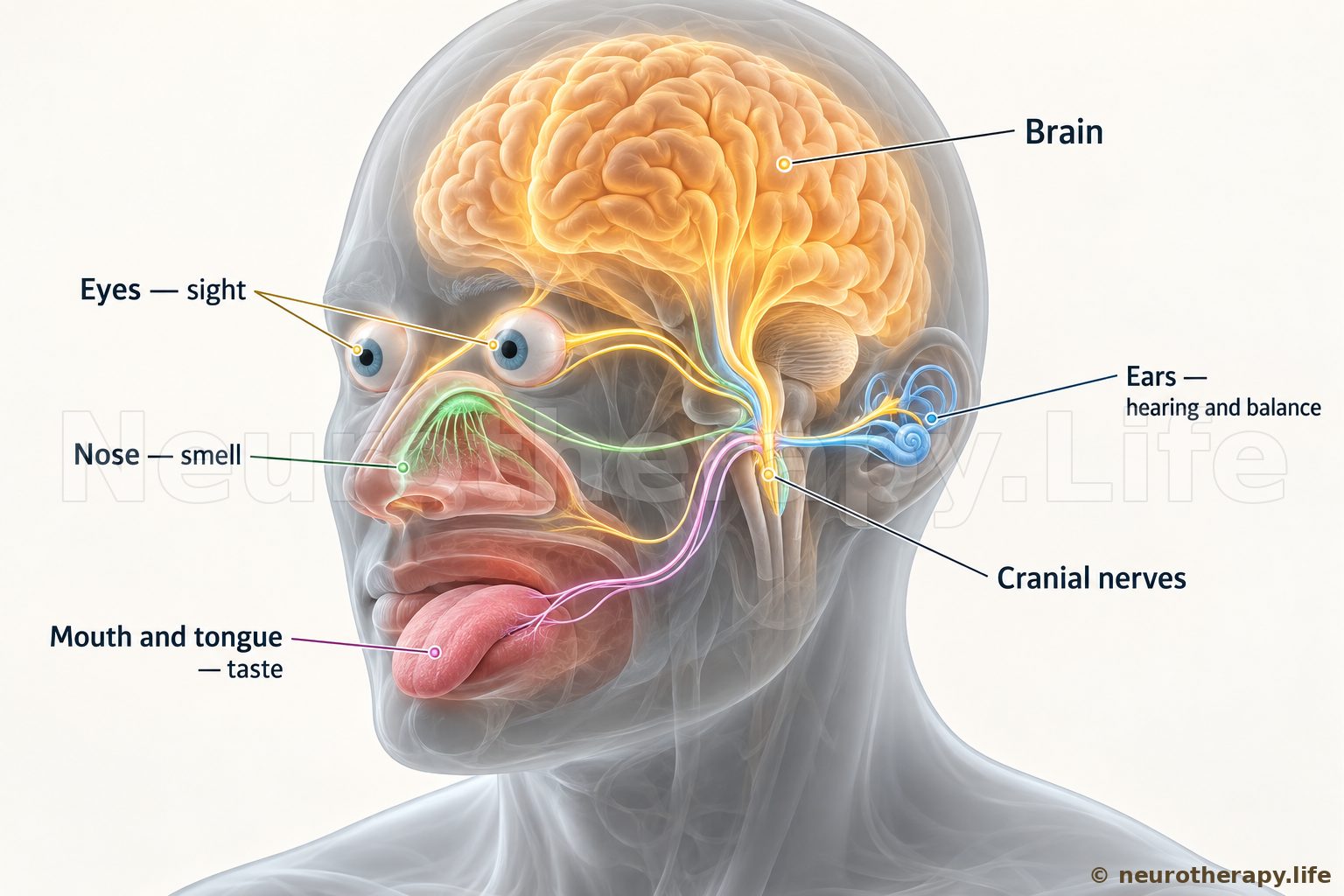
Your eyes, ears, nose and mouth are the body's windows on the world. They sit within a hand's span of the brain, are wired to it by most of its twelve cranial nerves, and work as a team — your eyes even help you hear. In LMNT teaching the Medulla treatment is numbered to match those same twelve nerves.
Overview
What are the sense organs?
The sense organs are the parts of the body that catch information from the world: light for the eyes, sound and movement for the ears, smells for the nose, tastes and textures for the mouth. The skin, which feels touch, heat and pain, is a sense organ too and has its own page.
Each organ turns one kind of energy into electrical nerve signals. The cranial nerves — twelve pairs that leave the brain directly — carry those signals a short distance to the brain, which builds them into what you see, hear, smell and taste.
Problems with the senses are very common. The World Health Organization estimates that at least 2.2 billion people have a vision problem and about 1.5 billion live with some hearing loss — and a large part of both could be prevented or treated.
Four sense organs in the head, each a few centimetres from the brain and wired straight into it.
Function
What do the sense organs do?
Every sense works in three steps. A special receptor cell catches one kind of signal — light, pressure waves, a scent or a taste molecule. It turns that into an electrical message. A nerve carries the message to a receiving area of the brain, which recognises it and joins it with the other senses and with memory.
Sight: the eyes judge shape, colour, movement and distance.
Hearing and balance: the ears catch sound and sense how the head moves.
Smell: the nose detects thousands of scents and warns of smoke, gas and spoiled food.
Taste: the mouth senses sweet, sour, salty, bitter and savoury, and with smell makes flavour.
Protection: blinking, tears, sneezing, coughing and spitting out bad food all start in these organs.
Communication: we speak with the mouth and listen with the ears, and read faces with the eyes.
How do the sense organs work with other systems?
Nervous system and brain — Every sense is wired to the brain; the cranial nerves and brainstem are their switchboard.
Digestive system — Seeing, smelling and tasting food start saliva and stomach juices even before the first bite.
Lungs and breathing — The nose and sinuses are also the start of the airways.
Skin — Touch, heat, cold and pain are sensed by the skin, the body's largest sense organ.
Heart, blood and circulation — The retina and the inner ear need a rich, steady blood supply; high sugar and high blood pressure harm both.
Muscular system — Tiny muscles aim the eyes, tune the ear bones, move the tongue and power chewing.
Every sense has three parts: an organ with receptor cells, a nerve pathway, and a receiving area in the brain.
The receptor cells
Rods and cones — Light cells in the retina of the eye.
Hair cells — In the inner ear; they bend with sound waves in the cochlea and with fluid movement in the balance organs.
Smell cells — Nerve cells in the roof of the nose that catch scent molecules; they are renewed throughout life.
Taste cells — Grouped in taste buds on the tongue, palate and throat.
Touch and pain endings — In the skin, the lining of the mouth and nose, and the cornea — the most sensitive surface of the body.
The wiring: the cranial nerves
Twelve pairs of nerves leave the brain directly. Nearly all of them serve the eyes, ears, nose or mouth — and the LMNT Medulla treatment uses the same numbers, (1) to (12).
I Olfactory — Smell.
II Optic — Sight.
III, IV and VI — Move the eyes, lift the lid and adjust the pupil and lens.
V Trigeminal — Feeling in the face, eyes, nose, sinuses, teeth and tongue; the chewing muscles.
VII Facial — Facial expression, tears, some saliva, and taste from the front of the tongue.
VIII Vestibulocochlear — Hearing and balance.
IX Glossopharyngeal and X Vagus — Taste from the back of the tongue, swallowing, the throat, the voice and the middle ear.
XII Hypoglossal — Moves the tongue.
The brain's receiving areas
Visual cortex — At the very back of the head (Brodmann's areas 17 and 18) — the area the LMNT ghisai rubs over.
Auditory cortex — In the temporal lobes at the sides of the brain, above the ears.
Smell areas — On the underside of the brain, closely linked with memory and emotion.
Taste area — Deep in the fold between the frontal and temporal lobes (the insula).
Brainstem and cerebellum — Handle reflexes — blinking, swallowing, keeping the gaze steady — and use balance signals to steady movement.
The journey
You see it
A ripe mango's colour reaches the retina; the brain recognises it and the mouth begins to water before you touch it.
You smell it
Scent molecules rise to the roof of the nose; the signal goes straight to the brain's smell and memory areas.
You bite and chew
The teeth and jaw break it up; the ear even hears the chewing through the bones of the skull.
You taste it
Taste buds report sweet and sour; saliva starts digesting its starch.
You know its flavour
Smell rising from the back of the mouth joins the taste — together they make 'mango'.
You swallow
The tongue pushes the food back, the palate closes off the nose, and the throat takes over.
Where are the sense organs located?
Four of the sense organs are packed into the front and sides of the head: the eyes in their bony sockets, the ears deep in the temporal bones, the nose in the centre of the face and the mouth below it. All lie within a few centimetres of the brain, so their messages have only a short way to travel.
They are also connected to each other: tears drain into the nose, the ears open into the back of the nose, the sinuses surround the eyes and nose, and the nose and mouth share the throat. A problem in one often shows up in another.
In LMNT teaching, most treatments for these organs are given with the patient seated — Medulla below the ears, and the face, jaw, ear and sinus points — because they share one position and one set of landmarks.
From outside you see only small parts of them: the front sixth of each eyeball, the ear flaps, the outer nose and the lips and teeth. The working parts — the retina, the cochlea, the smell area and most taste buds — are tiny and hidden.
Inside, they are lined with moist, delicate tissue — the tear film, the lining of the nose and sinuses, the lining of the mouth — which is why they are so easily irritated by smoke, dust and infection.
How big are the sense organs?
They are small: each eyeball is about 24 mm across, the cochlea is the size of a pea, the smell area covers only a few square centimetres, and the stirrup bone of the ear is about 3 mm long.
Yet they hold enormous numbers of receptors: about 92 million rods and 4.6 million cones in each retina, about 15,000 hair cells in each cochlea, millions of smell cells and a few thousand taste buds.
Conditions and disorders
What conditions and disorders affect the sense organs?
The sense organs can be affected by infection and allergy, by wear and ageing, by problems with their nerves, or by illnesses elsewhere in the body such as diabetes, high blood pressure and stroke.
What are common signs of a problem with the senses?
Blurred, double or lost vision
Hearing less, ringing in the ears, or giddiness
Loss of smell or taste
Red, painful or watering eyes; a blocked or running nose
Pain in the face, teeth, jaw or ear
Difficulty chewing, swallowing or speaking
What tests check the sense organs?
Eye examination — Vision chart, eye pressure and a look at the retina.
Hearing test (audiometry) — Beeps through headphones map each ear's hearing.
Balance tests — Head-position tests and eye-movement recordings.
Nasal endoscopy and smell tests — A thin camera in the nose; scratch-and-sniff cards.
Dental examination — Teeth, gums and the lining of the mouth.
Cranial nerve examination — A doctor tests each nerve at the bedside — eye movements, facial strength, hearing, swallowing and tongue movement.
MRI or CT scan — When a nerve, the brain or the sinuses need to be seen.
How are problems of the senses treated?
Glasses, hearing aids and implants — Correct or boost sight and hearing — often the simplest and biggest help.
Medicines and drops — For infection, allergy, glaucoma and inflammation, as prescribed.
Surgery — Cataract surgery, ear and sinus surgery, and dental treatment.
Therapy and training — Balance exercises, smell training, and speech and swallowing therapy.
Treating the cause — Controlling sugar and blood pressure and stopping tobacco protect every sense.
Neurotherapy (LMNT)
LMNT teaching reaches the sense organs through their nerves. The Medulla treatment — counted strokes with the thumbs from behind the ears down the side of the neck — is numbered to match the twelve cranial nerves: (1) for smell, (2) for sight, (3), (4) and (6) for eye movements, (5) for feeling in the face, eyes, nose, sinuses and teeth, (7) for the face, tears and taste, (8) for hearing and balance, (9) and (10) for swallowing, the throat and the voice, and (12) for the tongue. The finding chooses the number, and a job shared by two nerves needs both numbers. Around this the teaching adds a set of gentle seated points for the face — for the eyes, tears, sinuses, ears, teeth and jaw — and a handful of daily rules about bathing, sleeping and eating that protect the senses between visits. Guruji marked some of these numbers with a question mark, meaning 'my own thinking, for others to research'.
Points
Medulla — The Medulla treatment below the ears; the count, (1) to (12), is matched to the cranial nerve being treated. Usually × 3 with a rest of a minute and a half.
(2) Medulla — The optic-nerve count: seeing little, the retina, and — followed by Brodmann's area ghisai — the eyes and speech.
(8) Medulla — The hearing-and-balance count: deafness, ringing, vertigo, 'all problems of the ear'.
“Wherever there is a question mark, it is an indication that this is my own thinking, on which other people can now do research.”
— Dr. Lajpatrai Mehra
“I am yet to understand the human body. My knowledge is hardly the tip of the iceberg. Neurotherapy (LMNT) is just in its infancy. There is a long way to go.”
— Dr. Lajpatrai Mehra
“This is a matter of experience.”
— Dr. Lajpatrai Mehra
Never do this
Emergency — call 108/112: sudden loss of vision, a drooping face, slurred speech, weakness of an arm or leg, or sudden severe giddiness with any of these. These can be a stroke. Paralysis and stroke
Same day to a doctor: a red, painful eye with blurred vision; sudden hearing loss in one ear; facial pain with fever or swelling round the eye; a swollen face or jaw with toothache and fever. How to tell a patient to see a doctor
Around the face: short nails, a soft cloth near the eye, never any pressure on the eyeball, and nothing pushed into the ear. In Hammering the ear is never struck.
Glaucoma drops, hearing aids, dental treatment and cataract surgery are never replaced by points; points are given alongside them.
A mouth ulcer, patch or lump that has not healed in three weeks must be shown to a doctor or dentist. Mouth ulcers
The Medulla count is the treatment: a different number is a different treatment, not a stronger or weaker one. Only a trained therapist chooses the number, after examining you that day. Medulla, the graded series
Cancer: if the person has cancer, (10) Pan, Thymus, Pit, Lu + Sh, Rt. Ov / Lt. Ov and (30) Medulla are never given — the therapist changes the plan.
Keep taking the medicines, drops and treatments your doctor prescribed, and never stop or change them on your own. Neurotherapy (LMNT) works alongside your medical care, never instead of it.
Care
How can I keep my senses healthy?
Many of the cells that let you see and hear cannot be replaced, so protecting them — and checking them regularly — matters for life.
Have your eyes and ears checked
A full eye check every year or two after 40, yearly with diabetes, and a hearing test if family say you do not hear.
Protect from noise and injury
Keep headphones low, protect ears near loud noise, and wear protective glasses for dangerous work and around firecrackers.
Keep things out of the ears
Guruji's rules: never clean out the wax, pour the first mug of bath water on the head and keep it off the ears, and blow the nose with both nostrils open.
Rest the eyes the right way
Look away from screens often, send children outdoors, and at night cover the eyes with a cloth, not an arm.
Chew well and care for the mouth
Chew food well so saliva can do its work, brush twice a day, and see a dentist regularly.
Stop tobacco and control sugar and pressure
Tobacco harms the mouth, nose and eyes; high sugar and blood pressure damage the retina and inner ear.
Common questions
Do we really have only five senses?
No — five is the old count. Besides sight, hearing, smell, taste and touch, the body senses balance, the position of its limbs, heat and cold, pain, hunger and thirst, and more.
Why does a smell bring back memories so strongly?
Smell signals go almost directly to brain areas that handle memory and emotion, without the relay stop that the other senses pass through. So a scent can recall a place or a person in an instant.
Do the senses weaken with age?
Often, yes: reading glasses after 40, high-pitched hearing fades, and smell and taste slowly dull. Much of this can be helped with glasses, hearing aids and treating the cause — and it is worth doing, because good senses protect against falls, loneliness and memory loss.
Why does an LMNT therapist treat my neck for an eye or ear problem?
Because LMNT teaching works through the nerves: the Medulla treatment below the ears is numbered to match the cranial nerves that serve each sense organ. The number is chosen after examining you that day — different numbers are different treatments.
Can I lose a sense suddenly?
Yes, and it is an emergency. Sudden loss of vision, hearing, speech or balance can come from a stroke, a detached retina, sudden nerve deafness or acute glaucoma. Get help the same day — often the same hour.
What should I ask my doctor or therapist?
How often should my eyes, ears and teeth be checked at my age?
Could my diabetes, blood pressure or medicines be affecting my senses?
Which sudden changes mean I should come back at once?
Would glasses, a hearing aid or therapy help me now?
(To the therapist) Which cranial nerve and which Medulla number are you working on, and what did you find that chose it?
Surprising facts
1You have far more than five senses
Sight, hearing, smell, taste and touch are only the famous five. Your body also senses balance, the position of every joint, heat, cold, pain, a full bladder and more — each with its own receptors.
Source: Purves, Neuroscience — somatic and special senses; proprioception and the vestibular sense.
2Almost every cranial nerve works for your face's senses
Of the twelve pairs of cranial nerves, all but one — the eleventh, which moves neck and shoulder muscles — have work in the eyes, ears, nose, mouth or throat. LMNT teaching numbers its Medulla treatment (1) to (12) to match them.
Source: Gray's Anatomy — the cranial nerves; LMNT senses/eyes/ears/nose/mouth.md §37.27 (Medulla number ↔ cranial nerve index).
3You see with the back of your head
The eyes are at the front, but the brain's main seeing area is at the very back of the head. A blow to the back of the head can make you 'see stars', and a stroke there can take away sight in healthy eyes. LMNT teaching rubs exactly this area after (2) Medulla.
Source: Purves, Neuroscience — primary visual cortex (Brodmann area 17) in the occipital lobe; LMNT §31.14 and Brodmann's area 17 & 18 ghisai.
4Smell takes a shortcut to memory
Sight, hearing, taste and touch all stop at a relay station deep in the brain, the thalamus, before reaching the thinking surface. Smell goes almost straight to areas for emotion and memory — which is why a whiff of something can bring back childhood in an instant.
Source: Purves, Neuroscience; Kandel, Principles of Neural Science — olfactory projections to piriform cortex and amygdala without an obligatory thalamic relay.
5Your eyes help you hear
In a famous experiment, people watched a face saying 'ga' while hearing 'ba' — and most heard 'da'. The brain blends what the eyes see of the lips with what the ears hear. That is why a noisy room is easier when you can see the speaker's face.
A baby in the womb begins to respond to sound from around the fifth month of pregnancy, and by birth already knows its mother's voice. That is why newborn hearing screening can be done in the first days of life.
7Losing a sense is extremely common — and often preventable
The World Health Organization counts at least 2.2 billion people with a vision problem and about 1.5 billion with some hearing loss. At least a billion of the vision problems could have been prevented or have not yet been treated — often with glasses or a cataract operation.
Source: WHO, World report on vision (2019); WHO, World report on hearing (2021).
Yoga
Ṣaṇmukhī Mudrā — closing the six gates Ṣaṇmukhī Mudrā
Benefits
Shuts out sight and sound for a few breaths, giving the senses a rest and turning the attention inward.
A calm, quiet practice; many people find it settles the mind.
How to do it
Sit comfortably with a straight back and raise the elbows to the sides.
Rest the thumbs on the ear flaps, the index fingers lightly on the closed eyelids, and the middle fingers beside the nostrils.
Rest the ring fingers above and the little fingers below the closed lips.
Breathe slowly through the nose for 5 to 10 breaths, listening inward.
Release the hands slowly and open the eyes.
Take care
Never press on the eyeballs — the fingers only rest on the lids. Do not close the nostrils completely or hold the breath. Skip it with an eye or ear infection or after eye or ear surgery.
Siṃhāsana — the lion pose Siṃhāsana
Benefits
Stretches the tongue, jaw, face and throat muscles.
Releases tension held in the face and jaw; many people find it lifts the mood.
How to do it
Kneel and sit back on the heels (or sit on a chair), palms on the knees with the fingers spread.
Breathe in through the nose.
Open the mouth wide, stretch the tongue out and down, and breathe out steadily with a soft 'haa'.
Relax the face, and repeat 3 to 5 times.
Take care
Skip it with jaw-joint pain or a jaw that locks, soon after dental work, or with a sore throat. Use a chair if kneeling hurts the knees. Keep the breath soft, not forced.
Test yourself
Research
Strong evidence
When people watched lips saying one sound while hearing another, most heard a third sound in between — showing that the brain combines sight and hearing to understand speech.
The WHO's World Report on Vision estimates that at least 2.2 billion people have a near or distance vision impairment, of whom at least 1 billion have a problem that could have been prevented or has yet to be addressed.
Testing unborn babies' responses to sound showed that hearing begins to work from about 19 to 20 weeks of pregnancy and becomes sharper through the last months.
This page explains how the body works; it does not diagnose. Neurotherapy (LMNT) works alongside your medical care — keep taking the medicines your doctor prescribed, and see a doctor for any new or severe symptom.
Ready to begin?
Send COURSE for course details, or your name, age and health issue for a consultation.