Seated Treatments II: The Face, Jaw, Ear and Sinuses
With the patient still seated, Neurotherapy (LMNT) moves up onto the back of the head, the shoulder and the face: points for speech and vision, the shoulder, facial palsy, teeth and jaw, the eyes, the sinuses, headache and the ears. On the face the patient can see the hands coming, so every touch is announced first.
Overview
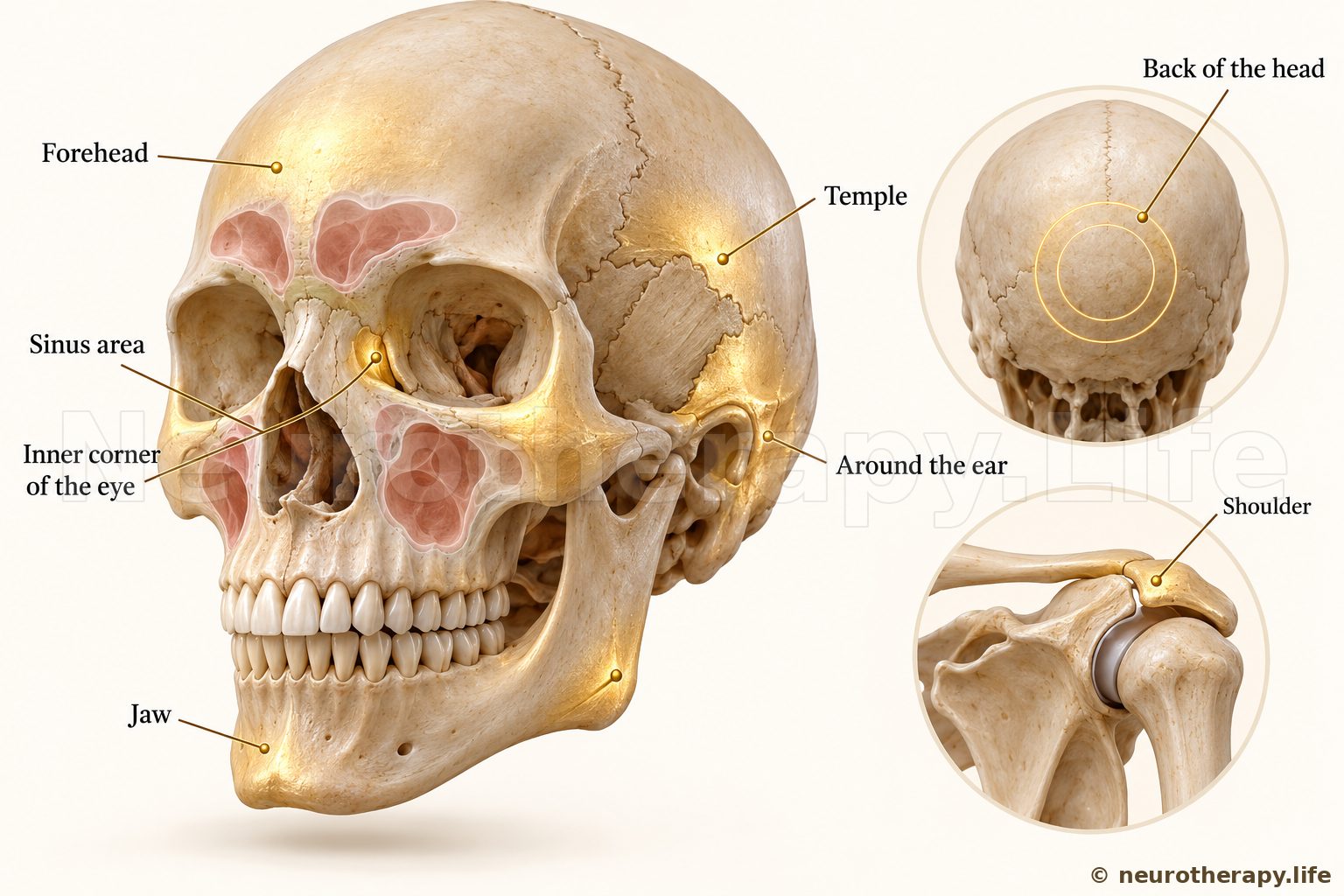
With the patient still seated, Neurotherapy (LMNT) moves up onto the back of the head, the shoulder and the face: points for speech and vision, the shoulder, facial palsy, teeth and jaw, the eyes, the sinuses, headache and the ears. On the face the patient can see the hands coming, so every touch is announced first.
The face adds five rules
Everything from the first seated group still applies: a firm chair, feet flat, back supported, the permission to lay a very ill or very weak patient down, and the rule of glide, never thrust. The front of the neck is never pressed. The face then adds five rules of its own, because until now the patient could not see the hands — on the face they are watched, and a face that has not been warned braces.
- Tell the patient before touching the face — every time, and before each new area.
- The nails never touch the patient; on the face the soft pads work, never the tips.
- Clear the face first: spectacles off, jewellery removed or worked around, kajal and powder wiped away.
- The steadying hand only steadies: it never pulls, pushes or turns the head.
- The hair is a limit: the skin underneath is stimulated, but the hair is never pulled or damaged.
The back of the head and the forehead
Brodmann's Area 17 & 18 Ghisai is a rub with the edge of the thumb over the back of the head, just above the neck, until the muscles under the skin relax — without pulling the hair. It is used for troubles of the brain, the eyes and speech. A century ago an anatomist numbered more than forty regions of the brain's outer layer by their job; areas 17 and 18, at the back, help the brain recognise what the eye sees. They lie inside the skull, so the thumb does not reach them; what it does reach is a scalp supplied by nerves from the top of the neck.
Hammering is light tapping all round the head with a special hammer, or with the finger pads, through a soft cotton cloth laid on the forehead. The ear is never struck, and the nails never touch. It is used for speech, paralysis and other diseases of the brain; where speech is impaired, it is given especially on the left side of the forehead, over the speech area of the brain (Broca's area). It is withheld after a recent head injury, over a skull plate or shunt, and where fits are poorly controlled.
The shoulder: Shivaji
For Shivaji the patient places one palm on their own forehead and lets the shoulder go loose. This lifts the shoulder blade so its lower corner swings clear of the ribs. The therapist then works with the base of the palm in slow clockwise circles over a widening area: around the shoulder joint and the side of the chest, along the shoulder blade, and down both sides of the spine in the middle and lower back. It relaxes the shoulder and neck muscles and is used for frozen shoulder (a stiff, painful shoulder) and neck pain.
One warning comes first. Pressure or pain in the chest, including pain between the shoulder blades, in someone with heart risk is an emergency and not a shoulder problem: nothing is given and the patient is sent the same day.
The face: facial palsy, teeth, jaw and eyes
The Bell's Palsy or Facial Point is given with the soft part of both thumbs, gently drawing the tissue of the face from the side that still works across to the weak side, and finishing up at the side behind the hairline. The direction is decided once for each patient and written on the card as a symbol, so that every therapist works the same way. A teaching case shows why: one therapist drew the right way, a stand-in drew the opposite way for four days, and the patient felt her face was being pushed down and stopped coming — until the arrow was drawn on her card.
A face that has newly fallen is a medical emergency until a doctor has seen it, the same day, before anything is given. Early medical treatment matters here (see the research below). Teeth Points are taught to the patient to press on the painful side, on and off through the day, and Jaw Points are given by the therapist near the angle of the jaw; both are comfort while the dentist is arranged, never a replacement. The Lacrimal Point is a gentle press at the inner corner of the eye through a soft handkerchief, used for dry eyes and constantly watering eyes.
The source credits the Lacrimal Point with correcting glaucoma too, and that needs a correction said plainly. Glaucoma is damage to the nerve of the eye, usually from raised pressure inside the eyeball; it is not a tear-duct problem, and the sight it takes does not come back. A patient with glaucoma keeps their drops and their eye appointments. This point is given alongside the eye doctor, never instead.
Sinus Point and Satnam
The Sinus Point is one continuous circuit of thumb sweeps from in front: from beside the nose out across the cheeks, up the sides of the nose, along the eyebrows to the outer corners of the eyes, and back. The sinuses are air spaces deep inside the bones of the face, and no thumb can drain them; but the circuit passes directly over the small holes where the nerves of the face come out of the bone. Facial pain with fever, thick discharge, swelling around the eye or any change in vision is sent to a doctor the same day.
Satnam is the headache treatment. The therapist stands behind, the patient's head resting against the therapist's body, and draws the tissue in one unbroken line: from the centre of the brow up toward the hair, out along the eyebrows to the temples, and along the edge of the skull bone back to the neck, without letting go on the way. This follows a real sheet of tissue that covers the whole skull. Because it depends on a head supported from behind, Satnam cannot be given to oneself. The exact method is taught hands-on in the course.
The ears
Ear Points are given with the forehead lightly steadied, left ear first and then the right: gentle downward strokes behind the ear and on the cheek in front of it, a press of the small flap in front of the ear-hole, and a press at the rim. When the flap is pressed and released, hearing feels sharper for a few moments — this is because the canal briefly closes and opens, and nothing lasting should be promised. Nothing ever goes into the ear canal. A discharging, painful or recently operated ear, or one with a known hole in the eardrum, is not treated.
Key points
- The seated rules and the front-of-neck rule still apply; the face adds five more, starting with telling the patient before every touch.
- Brodmann's Area 17 & 18 Ghisai and Hammering work the back of the head and forehead for brain, eye and speech troubles.
- The facial point always runs from the working side to the weak side, and the direction is written on the card.
- New facial weakness, toothache with swelling, and eye problems are seen by the right doctor first; these points work alongside.
- Satnam, the headache treatment, is one unbroken draw from brow to neck and cannot be given to oneself.
- In Ear Points nothing enters the ear canal, and the brief sharpening of hearing is not a lasting change.
Topics in this guide
Go deeper
Bell's Palsy
The Bell's Palsy or Facial Point
Satnam
Satnam — the headache treatment
Sinus Point
The Sinus Point circuit
Ear Points
Ear Points, and the ears that are not treated
Shivaji
Shivaji for the stiff shoulder
Hammering
Hammering for speech and the brain
Seated Treatments I: The Back of the Head and the Neck
Seated I — the back of the head and the neck
Cranial Nerve and Brain Formulas
Formulas for the cranial nerves and brain
Bell's palsy
Bell's palsy (facial palsy)
Headache and migraine
Headache and migraine
Safety: when it is held back
- New weakness of one side of the face is seen by a doctor the same day, before anything is given. Note the time it started. Ask every session: can you close that eye? Bell's palsy
- A face that fell together with weakness of an arm or leg, slurred speech, confusion or loss of vision is a possible stroke: send immediately. Paralysis and stroke
- Hammering: the ear is never struck; withhold after a recent head injury, over a skull plate or shunt, and where fits are poorly controlled. Epilepsy (fits)
- Toothache with facial swelling, fever, a jaw that will not open, or difficulty swallowing goes to the dentist or doctor today. Toothache (tooth, gum and jaw pain)
- Glaucoma patients keep their drops and appointments. Never press the eyeball; do not treat a red, painful eye, sudden loss of vision, or an eye after injury or recent surgery. Eye problems
- Facial pain with fever, thick discharge, swelling around the eye or a change in vision is sent the same day; a sudden or first-ever severe headache is assessed, not rubbed. Sinusitis, blocked nose and cold
- Nothing goes into the ear canal. Sudden hearing loss in one ear is an urgent referral; giddiness with unsteadiness, double vision or slurred speech is an emergency. Hearing loss (deafness)
- Chest pain, including pain between the shoulder blades, in someone with heart risk is an emergency, not a shoulder problem. Angina (chest pain from the heart)
Guruji says
“Looking at the patient, whichever of the two is appropriate should be written on the sign card, so that the therapist knows from which side it is to be done and no mistake occurs.”
Common questions
Why do you keep telling me what you are about to do?
Because your face is the one part of you that watches the hands coming. If you expect the touch, the muscles stay soft and the treatment works better; if not, you brace, and the therapist ends up working against you.
My mouth has gone crooked since this morning. Can you fix it today?
Not today. A face that changes suddenly must be seen by a doctor the same day, because some causes are treatable only in the first hours. Write down when you noticed it, go now, and come back afterwards.
If I press the teeth point, do I still need the dentist?
Yes. The point is something you can do at night when nothing is open, and it may take the edge off. It does not touch the reason the tooth hurts.
You pressed my ear and I could hear better. Will that last?
No. Pressing the little flap closes the ear for a moment, and when it is released everything sounds sharper by comparison. If your hearing is really reduced, get it properly tested.
Test yourself
Research
- Strong evidence
A large randomised trial in 496 people with Bell's palsy found that a steroid tablet started early raised the chance of full recovery: about 83 in 100 had recovered at three months with it, against about 64 in 100 without it. An antiviral tablet alone did not help. This is why a newly fallen face is sent to a doctor the same day.
Explore more
Organs
Body systems
Diseases
Points
Formulas
Topics
Read more
This page explains what a Neurotherapy (LMNT) treatment is for; it is not a self-treatment guide and does not diagnose. Neurotherapy (LMNT) works alongside your medical care — keep taking the medicines your doctor prescribed.