Also called: Teeth point, Points for pain of the teeth, दांतों के दर्द के लिए पॉइंट्स
Teeth Points are Neurotherapy (LMNT) points on the side of the head and face, used to increase the blood flow in the teeth and jaws so that their pain settles. The therapist first gives the right Heparin treatment, then shows the patient where the points are, on the same side as the painful teeth.
Overview
What are the Teeth Points?
Teeth Points are a small set of points on the face and the side of the head that answer pain in the teeth. Neurotherapy (LMNT) teaching says they increase the circulation of blood in the teeth or the jaws, from which the pain comes to an end.
The upper teeth and the lower teeth have their own points, and the points are always worked on the same side as the painful teeth.
They are unusual in two ways. They are the only physical point that comes with a prerequisite: the appropriate Heparin treatment, chosen for the patient's body, is given before them. And they are a point the therapist shows the patient, so that the patient can use them through the day.
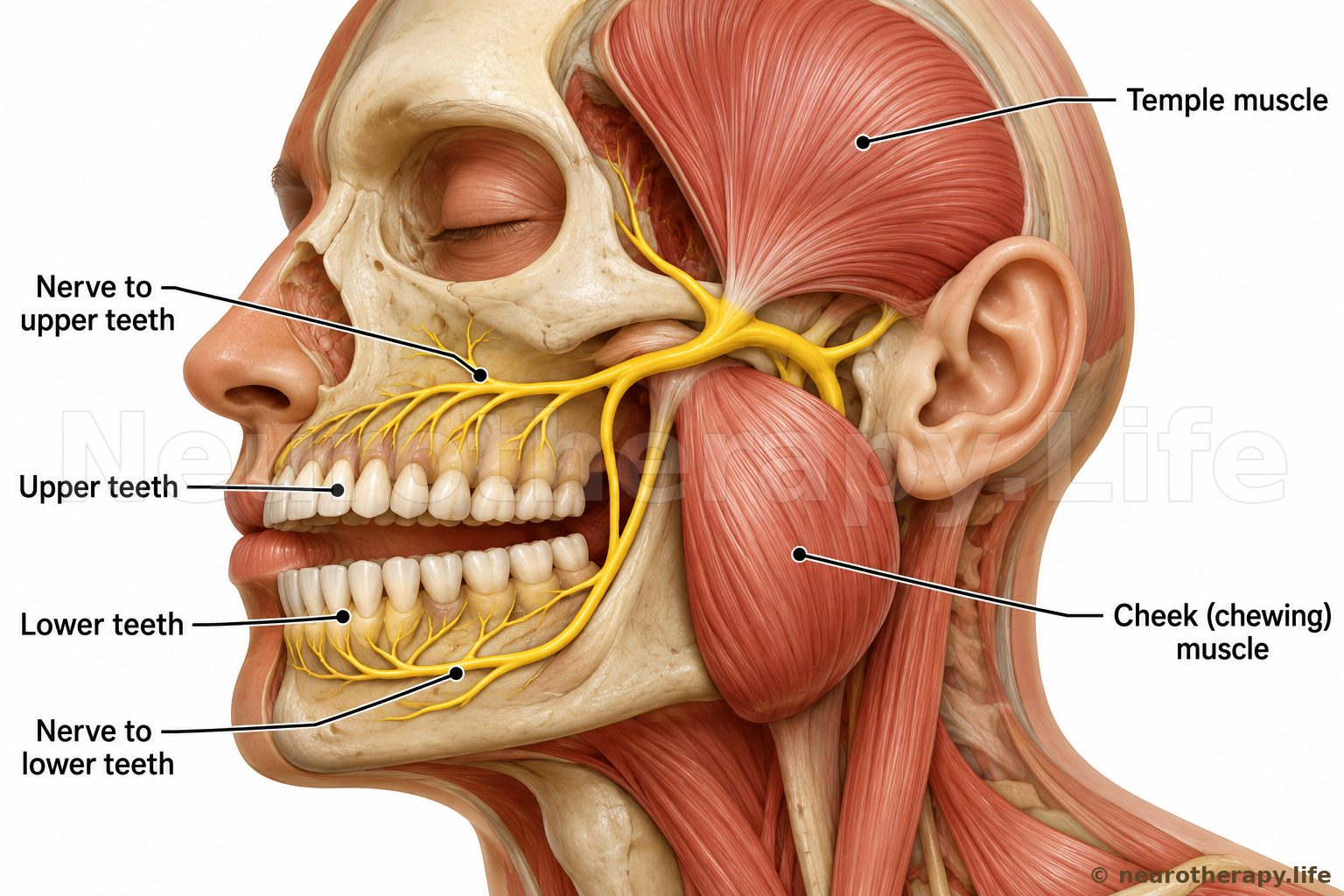
The upper and lower teeth are served by different branches of the face's great nerve — one reason each has its own points.
Where it is given
Where are the Teeth Points?
PositionSitting
Body areaUpper teeth: above the ear and below the eye. Lower teeth: below the chin and the jaw. Same side as the pain.
You sit comfortably. For the upper teeth, the points are above the ear — where the temple muscle can be felt moving when you clench your teeth — and below the eyes. For the lower teeth, they are below the chin and below the jaw.
Within these areas, the point is wherever tenderness is felt. They are used only on the side where the teeth hurt.
How it is given
How are the Teeth Points given?
How this point is given — the tool, the pressure, the count and the exact movement — is deliberately not described here. A demonstration video for this point is being prepared; until it is on this page, learn the method hands-on from a trained Neurotherapist before giving it. Please do not give any point from a written description alone: a point given in the wrong place or the wrong way can do harm.
Which sideThe same side as the painful teeth
The exact technique is taught hands-on in the Neurotherapy (LMNT) course. See the course →
What it does
What do the Teeth Points do in the body?
Neurotherapy (LMNT) teaching says the Teeth Points increase the circulation of blood in the teeth or the jaws, from which the pain comes to an end. Body science adds a useful fact: the temple and chewing muscles share their nerve with the lower teeth, and pain from a tight, clenching jaw muscle is very often felt as toothache.
Increases the circulation of blood in the teeth and the jaws.
Eases pain in the upper teeth, through the points above the ear and below the eye.
Eases pain in the lower teeth, through the points below the chin and the jaw.
Organs it reaches
Mouth — The teeth and gums whose pain the points answer.
Trigeminal neuralgiaThe teeth share their nerve with the face — any face pain needs a proper diagnosis first.
Safety: when it is held back
The appropriate Heparin treatment, chosen for the patient's body, is given first. A card that reads 'Teeth Points' alone is missing a line. The River: Heparin and the Heparin Formulas
Toothache with swelling of the face or jaw, fever, pus, or difficulty opening the mouth, swallowing or breathing needs a dentist or doctor urgently — an infection there can spread fast. How to tell a patient to see a doctor
Jaw pain that comes with chest pain, breathlessness or sweating may be the heart, not the teeth — stop and get emergency help. Angina (chest pain from the heart)
New weakness of one side of the face is assessed by a doctor the same day, before anything is given. Bell's palsy
Yes — this is a point the therapist shows the patient, after first giving the right Heparin treatment. Use them on and off through the day, on the painful side, and see your dentist as well.
Why is a point above my ear used for a toothache?
Because the temple muscle above the ear is a chewing muscle. It shares its nerve with the teeth, and when it is tight its pain is often felt as toothache.
Will this fix a cavity or an infection?
No. Teeth Points are used to ease pain. A cavity, a broken tooth or an infection needs a dentist.
Why only on one side?
The teaching is clear: treat on the same side as the side on which the teeth hurt.
Surprising facts
1Jaw muscle pain poses as toothache
Tight chewing muscles — the temple muscle and the cheek muscle over the jaw — commonly send their pain to the teeth, so a person may be sure a tooth is bad when the teeth are healthy.
Source: Okeson JP. Management of Temporomandibular Disorders and Occlusion, 8th ed. Elsevier, 2019 — referred pain from masticatory muscles.
2One nerve, three branches
The trigeminal nerve splits into three branches. The middle branch serves the upper teeth and the lower branch serves the lower teeth and the chewing muscles — which is why upper and lower teeth have separate points.
Source: Standring S (ed.). Gray's Anatomy, 41st ed. Elsevier, 2016 — the trigeminal nerve.
3The jaw can bite hard
The cheek muscle over the jaw is, for its size, one of the strongest muscles in the body; the back teeth can bite with a force of several hundred newtons.
Source: Standring S (ed.). Gray's Anatomy, 41st ed. — masseter and bite force.
This page explains what a Neurotherapy (LMNT) treatment is for; it is not a self-treatment guide and does not diagnose. Neurotherapy (LMNT) works alongside your medical care — keep taking the medicines your doctor prescribed.
Ready to begin?
Send COURSE for course details, or your name, age and health issue for a consultation.