Also called: Facial Point, Facial point, चेहरे का पॉइंट, फ़ेशियल पॉइंट
The Bell's Palsy point, also called the facial point, is a gentle drawing treatment given over the face of a seated patient whose face has dropped on one side. It always begins from the side that still works, and the direction is written on the card so that every therapist works the same way.
Overview
What is the Bell's Palsy point?
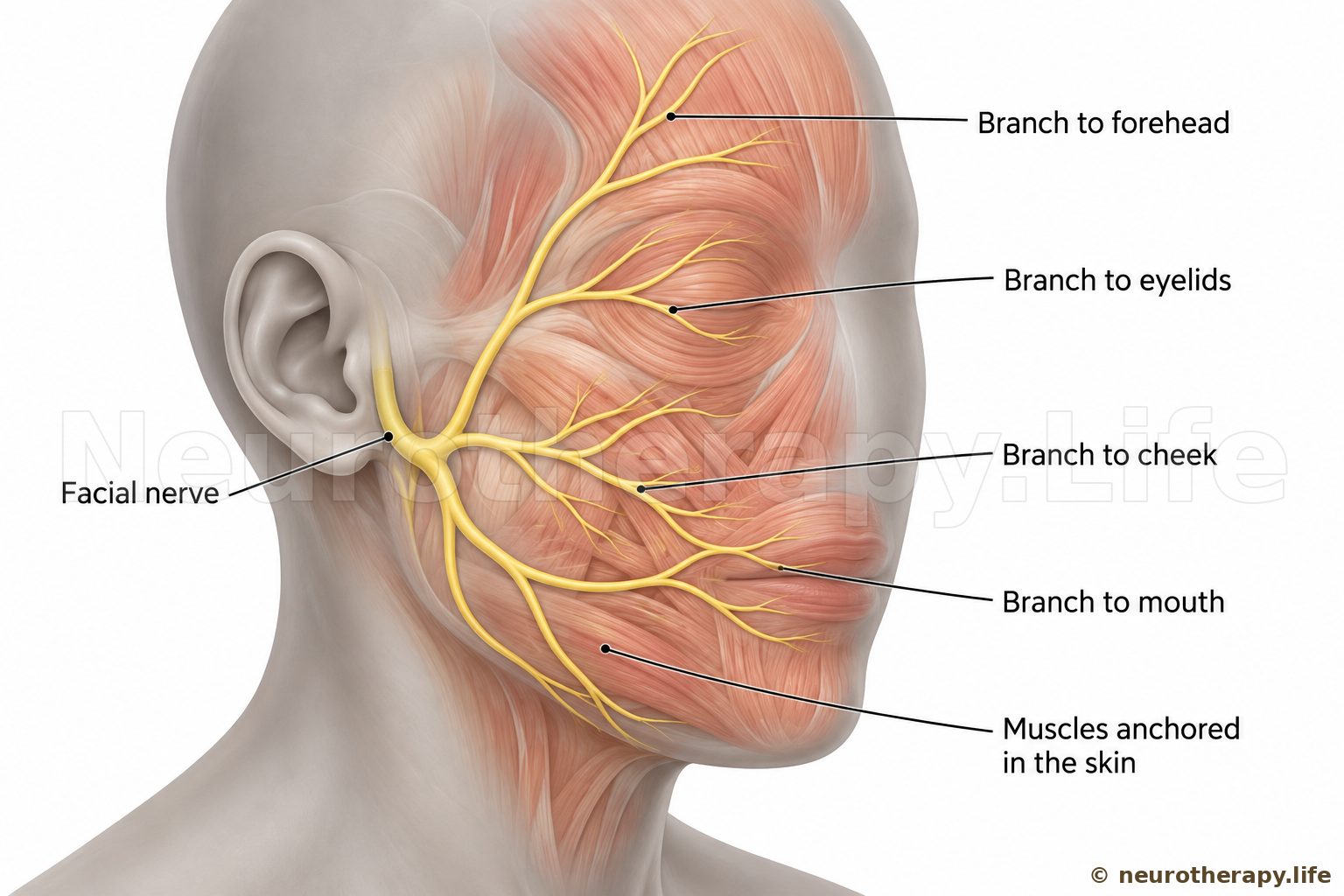
Bell's palsy is a sudden weakness of one side of the face. It happens when the facial nerve — the nerve that tells the face muscles to move — gets swollen and stops working well. The person cannot smile evenly, the corner of the mouth droops, and often the eye on that side will not close.
In Neurotherapy (LMNT), the treatment named for this problem is the Bell's Palsy point, also simply called the facial point. Guruji's teaching says it is for a person whose mouth is twisted to one side, who cannot smile properly or cannot close the eye fully, and that such people benefit greatly from it.
It is a physical point: it works on the soft tissue of the face itself. The face is the one place in the body where muscles are anchored into the skin rather than onto bone, so a slow, careful draw over the skin really moves the muscle beneath it.
The facial nerve fans out across one half of the face. When it swells, that half loses its movement.
Where it is given
Where and in which position is it given?
PositionSitting
Body areaThe whole face, from the working side across to the weak side, finishing behind the hairline
The patient sits on a firm, straight-backed chair, relaxed, with the face clear of hair. If the patient is very ill or very weak, the facial point may also be given lying down.
The area is the whole face, from cheek to cheek and up to the temple behind the hairline. The work begins on the side that opens properly — the side where the eye still closes, the brow still lifts and the mouth still pulls — and travels across to the weak side, finishing up at the side of the head behind the hair.
The direction is written on the patient's card as one of two symbols — eye-marks with arrows pointing right, or pointing left — so that the next therapist works the same way and no mistake occurs.
How it is given
How is it given?
How this point is given — the tool, the pressure, the count and the exact movement — is deliberately not described here. A demonstration video for this point is being prepared; until it is on this page, learn the method hands-on from a trained Neurotherapist before giving it. Please do not give any point from a written description alone: a point given in the wrong place or the wrong way can do harm.
Feels likeA slow, gentle pull of the skin across the face
The exact technique is taught hands-on in the Neurotherapy (LMNT) course. See the course →
What it does
What does it do in the body?
The facial point works directly on the muscles of expression. Because these thin muscles are woven into the skin, drawing the skin loads and moves the muscle bellies beneath it, keeping a still half-face supple while the nerve recovers.
Helps keep the weak muscles of the face supple and moving.
Draws the dropped tissue back toward its place, from the strong side across to the weak one.
Patients with a twisted mouth or an eye that will not close have reported benefit, alongside the doctor's treatment.
Organs it reaches
Cranial nerves — The facial nerve is the seventh of the twelve cranial nerves.
Muscles — The thin muscles of expression, anchored in the skin.
Eyes — The eyelid muscle that closes the eye is run by the same nerve.
Mouth — The muscles around the lips and the corner of the mouth.
Its family
Which points sit beside it?
The facial point belongs to the seated face group, and a plan for a dropped face usually draws on more than one treatment.
Medulla — The seated chemical point at the nape; a numbered Medulla is named in the plan for Bell's palsy.
Jaw Points — Work near the jaw bone on both cheeks.
Teeth Points — Comfort points for tooth pain, on the same side as the pain.
Satnam — A seated draw over the forehead and temples.
The Heparin formula headed by Medulla is named in the plan for Bell's palsy.
Safety: when it is held back
A face that has newly fallen is a medical emergency until a doctor has seen it. New weakness of one side of the face is seen by a doctor the same day, before anything is given. How to tell a patient to see a doctor
Send immediately if the face fell together with weakness of an arm or leg, slurred speech, sudden confusion or loss of vision; if there is severe pain in or behind the ear, blisters in the ear or on the palate, or fever. These can be signs of a stroke or another serious illness. Paralysis and stroke
An eye that will not close dries out, and a dried eye surface can ulcerate and scar. Keep using the eye ointment and night cover the doctor gives, and ask at every session whether the eye closes. Eyelid problems (drooping or not closing)
Neurotherapy (LMNT) works alongside the doctor's treatment. Keep taking the tablets and drops you have been given.
Guruji says
“Looking at the patient, whichever of the two is appropriate should be written on the sign card, so that the therapist knows from which side it is to be done and no mistake occurs.”
— Dr. Lajpatrai Mehra
A teaching case
Teaching case: the arrow nobody drew
A teaching case, put together from several camps: a schoolteacher whose face had dropped was seen by a doctor the same day and came for Neurotherapy (LMNT) alongside her medicines. In the first week she was treated from the working side, as taught. When a different therapist took over and drew from the weak side, she felt her face was being pushed further down and stopped coming. Once the direction was drawn on her card as a symbol, the hands went the same way every time.
A composite case written to teach the reasoning — not one patient’s file.
Common questions
Should I go to a doctor first?
Yes, always, and the same day. A new facial droop can be a stroke, which needs urgent care. Neurotherapy (LMNT) comes beside the doctor's treatment, never in place of it.
Why does the therapist start on my good side?
Because the draw carries tissue from the side that still works across to the side that has dropped. Starting on the weak side would push the dropped side further down.
Does it hurt?
It should not. It is a slow, gentle pull with the soft pads of the thumbs, with no nails and no scratching. Tell the therapist at once if anything is uncomfortable.
My eye does not close. What should I do?
Protect it as your doctor advised — eye drops or ointment by day and a cover at night. An eye left open can dry and be damaged. The therapist will ask about it every session.
Surprising facts
1Muscles tied to skin
Most muscles pull on bone. The muscles of facial expression are different: many of them attach into the skin itself, which is how they can wrinkle a brow or lift a lip.
Source: Standard anatomy: Gray's Anatomy (41st ed.), muscles of facial expression.
2A nerve in a narrow tunnel
On its way to the face, the facial nerve travels through a long, narrow bony canal inside the skull. When the nerve swells, there is little room to spare — one reason it stops working so suddenly.
Source: Standard anatomy of the facial canal in the temporal bone (Gray's Anatomy); StatPearls, Bell Palsy.
3The forehead clue
In a palsy of the facial nerve itself, the forehead on that side usually stops moving too. In a stroke the forehead is often spared, because the upper face gets signals from both halves of the brain. It is a useful clue for sending fast — never a way to rule a stroke out.
Source: Standard clinical neurology (upper vs lower motor neuron facial weakness); StatPearls, Bell Palsy.
4Most faces come back
With proper medical care, most people with Bell's palsy recover much or all of their facial movement over weeks to months.
Source: NHS / NINDS patient information on Bell's palsy.
This page explains what a Neurotherapy (LMNT) treatment is for; it is not a self-treatment guide and does not diagnose. Neurotherapy (LMNT) works alongside your medical care — keep taking the medicines your doctor prescribed.
Ready to begin?
Send COURSE for course details, or your name, age and health issue for a consultation.