Also called: Ear point, कान के पॉइंट, कान का पॉइंट
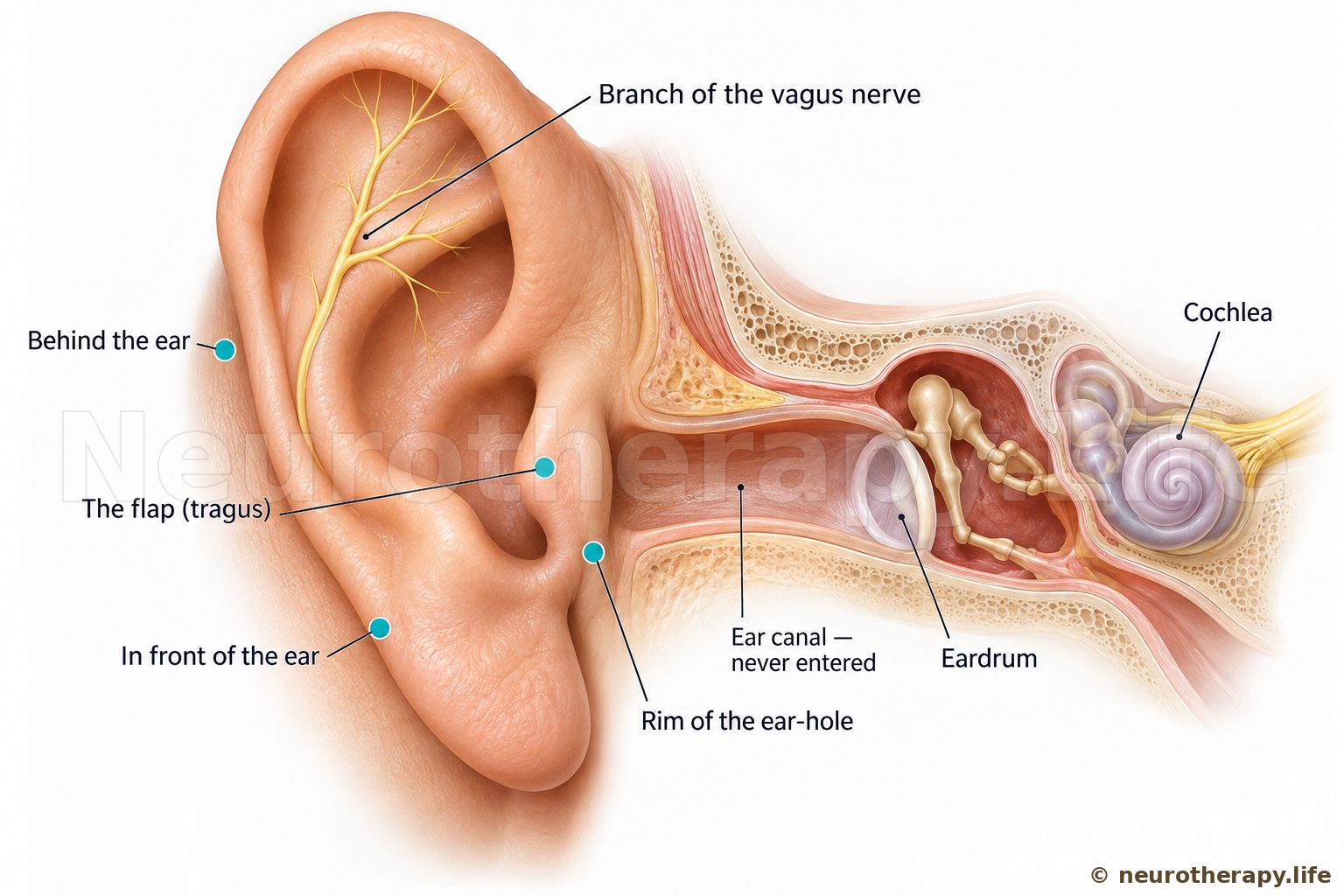
Ear Points are a seated Neurotherapy (LMNT) treatment given around the outer ear — behind it, in front of it, and at the small flap and rim of the ear-hole. They are given for reduced hearing, deafness and other problems of the ear, and nothing ever goes inside the ear canal.
Overview
What are the Ear Points?
Ear Points belong to the seated group of treatments for the head and face. They work at four small stations around the outside of the ear, on both ears. Their written symbol is two small ear outlines with dots and arrows.
The source gives their purpose plainly: they are given for reduced hearing, deafness and all problems of the ear; they stimulate the nerves around the ear and aim to increase the capacity to hear.
The anatomy here is remarkable. The skin of the outer ear is the only patch of skin on the body that gets a branch of the vagus nerve — the long 'wandering' nerve that runs the body's quiet background work, like slowing the heart and moving the gut.
The four Ear Point stations lie on the outside of the ear. The canal itself is never entered.
Where it is given
Where are the Ear Points given?
PositionSitting
Body areaAround the outer ear on both sides — behind it, in front of it, the flap and the rim of the ear-hole
You sit well back on a firm chair. The therapist stands beside you and rests one hand lightly on your forehead, only to keep your head still — it never pushes or levers. A very ill or very weak patient may be treated lying down instead.
The four stations are all on the outside of the ear: the soft skin behind the ear; the skin of the cheek just in front of the ear-hole; the small springy flap of cartilage in front of the hole; and the rim of the hole. Both ears are treated.
How it is given
How are the Ear Points given?
How this point is given — the tool, the pressure, the count and the exact movement — is deliberately not described here. A demonstration video for this point is being prepared; until it is on this page, learn the method hands-on from a trained Neurotherapist before giving it. Please do not give any point from a written description alone: a point given in the wrong place or the wrong way can do harm.
The exact technique is taught hands-on in the Neurotherapy (LMNT) course. See the course →
What it does
What do the Ear Points do?
The source says they stimulate the nerves around the ear and increase the capacity to hear. It is honest about the one effect a patient notices at once — and about what it does not mean.
Stimulate the nerves of the skin around the ear, including the branch of the vagus nerve that reaches the outer ear.
Given for reduced hearing, deafness and other problems of the ear.
Pressing the flap gives a few moments of clearer hearing. The reason is simple: the flap closes the canal while held and opens it when released. It is not a change in the hearing organ, and nothing lasting should be promised from it.
Organs it reaches
Ears — The outer ear, where all four stations lie.
Vagus nerve — Sends one small branch to the skin of the outer ear.
Cranial nerves — Several head nerves share the skin around the ear.
Its family
Which points are its neighbours?
Ear Points close the seated group for the head and face.
Bell's Palsy — The facial point, worked across the face from the side that moves well.
Jaw Points — Stations along the jaw, close to the ear.
EaracheOnly once the cause is known — a painful or discharging ear is not treated at the points.
Safety: when it is held back
Nothing goes into the ear canal — not a finger, a nail, a cotton bud or any instrument.
Ears that are not treated: a discharging ear; a painful ear; an ear operated on recently; an ear with a known hole in the eardrum. Grommets or a hearing aid must be removed or considered first. Earache
Hearing lost suddenly in one ear is an urgent referral to an ear specialist — not a treatment on the chair. Hearing loss (deafness)
Giddiness with unsteadiness, double vision, slurred speech or weakness is not an ear complaint at all — it is an emergency. How to tell a patient to see a doctor
The hand on the forehead only steadies; it never levers the head. Nails are short and never touch the skin.
I heard better right after the treatment. Is my deafness cured?
What you felt was real and short-lived: pressing the flap closes the canal and releasing it opens it, so for a few moments sound seems sharper by contrast. If your hearing is genuinely reduced, it needs to be tested.
Will anything be put in my ear?
No. All four stations are on the outside of the ear. Nothing enters the canal.
Why do I cough when my ear is cleaned?
A small branch of the vagus nerve reaches the ear canal. In some people it is wired closely to the cough reflex, so touching the canal feels to the brain like something in the throat. It is harmless.
Can I have it if I wear a hearing aid?
Yes, after the hearing aid is taken out. Your hearing aid and your doctor's care continue as before.
Surprising facts
1The cough in your ear
The ear branch of the vagus nerve (Arnold's nerve) can trigger a cough when the ear canal is touched — the 'ear-cough reflex', found in a small share of people.
Source: Tekdemir I et al., A clinico-anatomic study of the auricular branch of the vagus nerve and Arnold's ear-cough reflex, Surg Radiol Anat 1998;20:253–257.
2Hearing loss is very common
More than 1.5 billion people worldwide live with some degree of hearing loss, and many of them have never had their hearing tested.
Source: World Health Organization, World Report on Hearing, 2021.
3The smallest bone in your body
Behind the eardrum sits the stapes, the stirrup bone — about 3 millimetres long, the smallest bone in the human body.
This page explains what a Neurotherapy (LMNT) treatment is for; it is not a self-treatment guide and does not diagnose. Neurotherapy (LMNT) works alongside your medical care — keep taking the medicines your doctor prescribed.
Ready to begin?
Send COURSE for course details, or your name, age and health issue for a consultation.