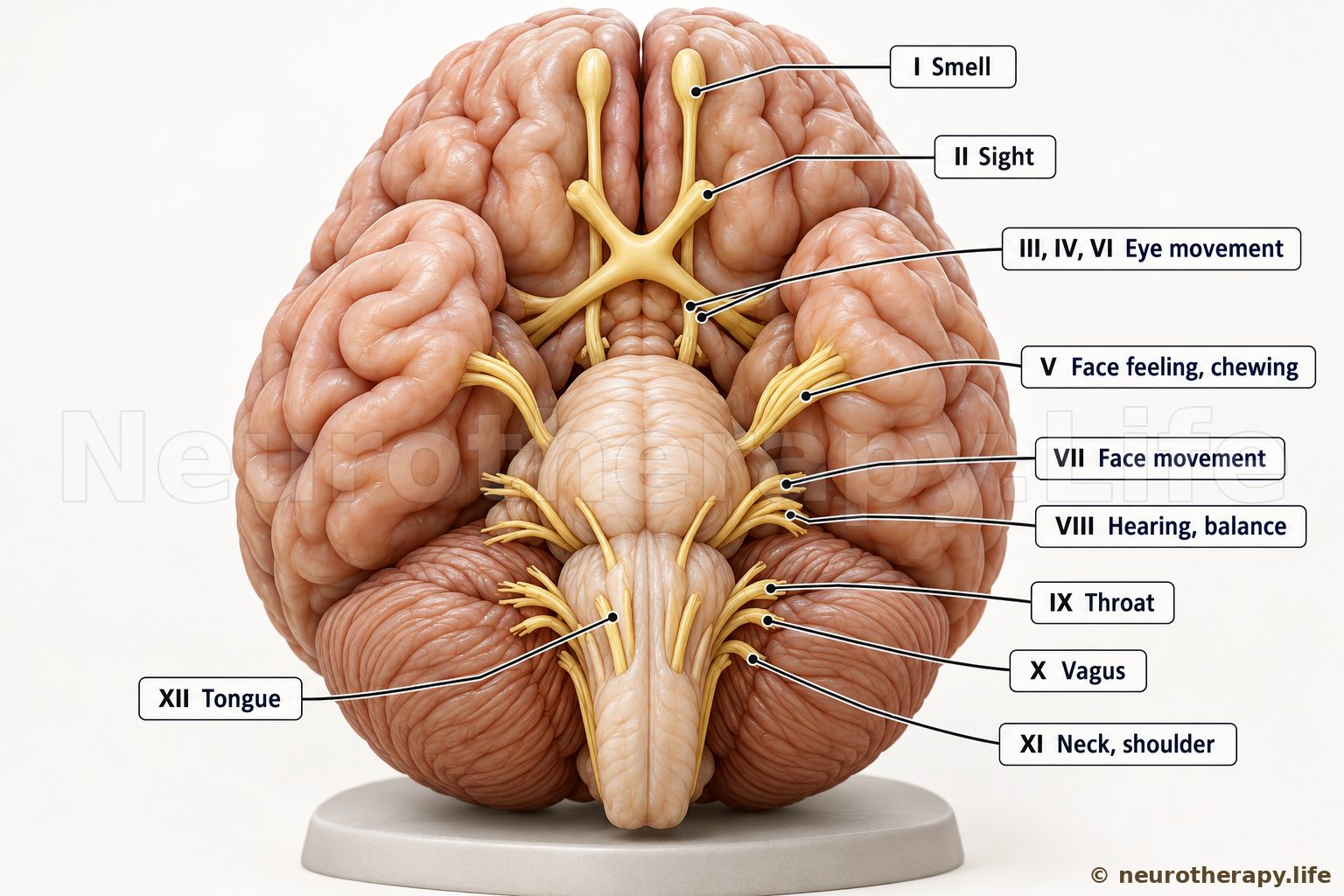
Twelve pairs of nerves that leave the brain directly, through small holes in the skull, to serve smell, sight, the eyes, the face, hearing and balance, the throat, the voice, the tongue and the shoulders — and one that wanders all the way to the belly.
Overview
What are the cranial nerves?
'Cranial' comes from cranium, the bony box of the skull. A cranial nerve is simply a nerve that leaves the brain inside that box, instead of leaving the spinal cord lower down.
There are twelve pairs — twelve on the left and twelve on the right. They are numbered with Roman numerals, I to XII, in the order they leave the underside of the brain from front to back. So the first is the nerve of smell and the twelfth is the nerve of the tongue.
Some carry only sensation, some only movement, and some both. Four of them also carry 'rest-and-digest' signals to glands and organs.
In LMNT, the number matters twice. The Medulla treatment given at a count of (1) to (12) is taught to do the work of the cranial nerve of that same number. As LMNT puts it, the number is an address.
Twelve pairs, numbered front to back along the base of the brain: the number is an address.
Function
What do the cranial nerves do?
Think of twelve pairs of messengers, each with its own errand. Most stay in the head and neck. Three are long — the second reaches deep into the brain from the eye, the fifth spreads over the whole face, and the tenth leaves the skull and does not stop until it reaches the gut.
Smell (I) and sight (II).
Moving the eyes, lifting the eyelid and adjusting the pupil and lens (III, IV, VI).
Feeling in the face, eyes, nose, mouth and teeth, and the muscles of chewing (V).
Facial expression, closing the eyes, tears, some saliva, and taste from the front of the tongue (VII).
Hearing and balance (VIII).
Swallowing, taste from the back of the tongue, and the sensors that watch blood pressure and oxygen in the neck (IX).
The voice box, swallowing, and 'rest-and-digest' control of the heart, lungs and gut (X).
Turning the head and shrugging the shoulders (XI), and moving the tongue (XII).
How do the cranial nerves work with other organs?
Brain — They are the brain's own direct lines — no stop in the spinal cord.
Medulla (brainstem) — Nerves IX to XII start from the medulla; V to VIII from the pons just above it.
Eyes — Four of the twelve serve the eyes: II for sight, III, IV and VI for movement.
Ears — VIII hears and balances; V, VII, IX and X share the outer and middle ear.
Nose — I carries smell; V carries touch and irritation inside the nose — the start of a sneeze.
Mouth — V, VII, IX, X and XII together handle taste, saliva, chewing, the tongue and swallowing.
Vagus nerve — The tenth cranial nerve has its own page — the longest of the twelve.
Anatomy
What are the twelve cranial nerves?
Here they are in order, in three groups of four, with the LMNT Medulla count that is taught to index each one.
I–IV: smell, sight and the eye muscles
I — Olfactory · (1) Medulla — Smell. Tiny fibres pass through a thin sieve of bone at the roof of the nose straight into the brain.
II — Optic · (2) Medulla — Sight. The two optic nerves partly cross just in front of the pituitary gland, so each side of the brain sees half the world.
III — Oculomotor · (3) Medulla — Moves four of the six eye muscles, lifts the upper eyelid, narrows the pupil and focuses the lens.
IV — Trochlear · (4) Medulla — One muscle, the superior oblique, which helps turn the eye downward — the look you use going down stairs.
V–VIII: the face, the eye's outward turn and the ear
V — Trigeminal · (5) Medulla — The largest. Three branches carry feeling from the forehead, cheek and jaw, including the eyes, nose, teeth and gums, and it drives the chewing muscles.
VI — Abducens · (6) Medulla — One muscle that turns the eye outward.
VII — Facial · (7) Medulla — All the muscles of expression, closing the eyes, tears, two pairs of saliva glands, taste from the front two-thirds of the tongue, and a tiny muscle that damps loud sound in the ear.
VIII — Vestibulocochlear · (8) Medulla — Two jobs in one bundle: hearing from the snail-shaped cochlea, and balance from the three fluid loops beside it.
IX–XII: the throat, the voice, the neck and the tongue
IX — Glossopharyngeal · (9) Medulla — Feeling in the throat and tonsils, taste from the back third of the tongue, the parotid saliva gland, and the blood-pressure and oxygen sensors in the neck.
X — Vagus · (10) Medulla — The voice box and throat muscles, and 'rest-and-digest' signals to the heart, lungs and most of the gut.
XI — Accessory · (11) Medulla — Two big muscles that turn the head and shrug and steady the shoulder. No sensation.
XII — Hypoglossal · (12) Medulla — The muscles of the tongue, for speech, chewing and swallowing.
Where they start
I and II — the forebrain — Smell and sight nerves are really outgrowths of the brain itself.
III and IV — the midbrain — The top of the brainstem.
V to VIII — the pons — The middle of the brainstem.
IX to XII — the medulla — The lowest part of the brainstem; most of XI's fibres come from the top of the spinal cord.
Where are the cranial nerves located?
They leave the underside of the brain and brainstem and pass out of the skull through small holes in its floor. From there they go straight to the places they serve.
Most stay in the head: in the eye sockets, the face, the ears, the nose and the mouth. IX, X, XI and XII come out low at the back of the skull, beside the top of the neck; only the vagus travels on down into the chest and belly.
In LMNT, the treatments for all twelve are given at the same place — behind the ears and down the sides of the neck — and the count, not the place, decides which nerve is meant.
Like other nerves, they are whitish, shiny cords. They vary a great deal: the smell fibres are hair-fine threads, the optic nerve is a firm cable about 3–4 mm thick, the trigeminal is broad and flat, and the trochlear is the thinnest of all.
Each emerges as a pair, left and right, lying almost mirror-perfect on either side of the brainstem.
How big are the cranial nerves?
The olfactory fibres are the shortest, crossing only a thin plate of bone. The optic nerve is about 4–5 cm long from the eye to where the two nerves cross, and about 3–4 mm thick.
The trigeminal is the largest. The vagus is by far the longest, running from the base of the skull through the neck and chest into the abdomen.
Conditions and disorders
What conditions affect the cranial nerves?
A cranial nerve can be pressed, inflamed, infected, starved of blood (as in diabetes) or damaged by a stroke in the brainstem. Because each nerve has one clear job, the symptom often points to the nerve.
Smell and the eyes (I–IV, VI)
Loss of smell (anosmia)Loss of smell with a clear nose — nerve I; people often do not notice it.
Double vision (diplopia)When III, IV or VI is weak, the two eyes point differently and images double.
Motor neuron diseaseWhen it reaches the brainstem, speech and swallowing weaken.
What are the signs of a cranial nerve problem?
Loss of smell or taste
Double vision, blurred vision or loss of sight
A drooping eyelid or a pupil that looks different from the other
Drooping of one side of the face, or an eye that will not close
Numbness or sharp pain in the face
Hearing loss, ringing in the ears or a spinning feeling
A hoarse or weak voice
Choking or coughing when swallowing
Slurred speech or trouble moving the tongue
Weakness turning the head or shrugging a shoulder
How do doctors check the cranial nerves?
Cranial nerve examination — A quick bedside check of all twelve: smell, sight, eye movements, pupils, face feeling and movement, hearing, gag, voice, tongue and shoulder shrug.
Eye examination — Visual acuity, visual fields and a look at the optic nerve at the back of the eye.
Hearing and balance tests — Audiometry and balance tests for nerve VIII.
MRI scan — Shows the brainstem, the nerves and anything pressing on them.
Swallow study — An X-ray video or thin camera to check that food goes down the right way.
Blood and nerve tests — Sugar, antibodies (for myasthenia), and nerve conduction studies of the face.
How are cranial nerve problems treated?
Early steroids for Bell's palsy — A short course started within 72 hours improves recovery of the face.
Medicines for nerve pain — Specific medicines control trigeminal neuralgia.
Eye protection — Drops, ointment and taping at night protect an eye that cannot close.
Hearing aids and balance exercises — For nerve deafness and vertigo.
Speech and swallowing therapy — Exercises and safe-swallow techniques.
Treating the cause — Controlling sugar, treating infection, or surgery to relieve pressure on a nerve.
Neurotherapy (LMNT)
LMNT's teaching on the cranial nerves rests on one sentence, offered openly as a discovery rather than a deduction: every cranial nerve can be stimulated by the Medulla treatment of that same number. It was reached by trying the treatments on many patients and recording what happened, and the teaching itself says it may seem unbelievable to medical science. Three rules go with every cranial-nerve treatment: (15) Medulla is given first, to supply acetylcholine, the messenger of the automatic nerves; each treatment is given three times, one and a half minutes apart; and the side is written every time, because left and right are opposite instructions — left opens, right closes. The complaint is matched to the nerve by asking one more question: with trouble swallowing, if taste has gone the teaching gives (9) Medulla; if the voice is heavy, (10) Medulla.
Points
Medulla — One place — behind the ears and down the sides of the neck — and the count selects the nerve. The odd counts (1), (3), (5), (7), (9) and (11) are taught in the cranial-nerve index: (1) smell, (3) eyelid, pupil and most eye movement, (5) the face, sinuses, teeth and most coughs, (7) facial expression, Bell's palsy and tears, (9) throat, swallowing and hiccups, (11) the neck and shoulder.
(15) Medulla — Given before every cranial-nerve Medulla: supply the messenger, then stimulate.
(2) Medulla — The second nerve: sight, the neurons of the retina, balance and posture.
(4) Medulla — The fourth nerve: listed in the index for double vision linked to that nerve; also the clockwise member given with T1/T2.
(6) Medulla — The sixth nerve: the eye that will not turn outward; also LMNT's hypothalamus treatment.
(8) Medulla — The eighth nerve: deafness, ringing in the ears and vertigo; given 'for all problems of the ear'.
(10) Medulla — The tenth nerve: hoarseness and the voice box; certain rows (a narrowed food pipe, widening the voice box) are (10) Left Medulla only.
(12) Medulla — The twelfth nerve: the tongue, a voice that has gone, thick speech.
SWT — Paired with Medulla for the polarity rule: (15) Left Medulla with Left Swt opens a narrowed passage; (15) Right Medulla with Right Swt closes a slack one.
Bell's Palsy — Seated; both thumbs draw the face from the working side across to the other, for the mouth pulled to one side.
Ear Points — Four stations at the ear, left ear first, for reduced hearing and ear problems.
Vocal Point — Cupped palms stroke the throat muscles outward and backward, for hoarseness or a voice that will not come.
“Wherever there is a question mark, it is an indication that this is my own thinking, on which other people can now do research.”
— Dr. Lajpatrai Mehra
“This is exactly how it should be. And this itself is the secret of Neurotherapy (LMNT)'s success.”
— Dr. Lajpatrai Mehra
“The patient has to try it for himself and see. Every single thing will not have the same effect on every person.”
— Dr. Lajpatrai Mehra
Never do this
Emergency: a drooping face with a weak arm or slurred speech is a stroke until proved otherwise — call an ambulance (108/112); do not assume it is Bell's palsy. A sudden drooping eyelid or double vision with a severe headache is also an emergency.
See a doctor within a day or two for sudden one-sided face weakness (steroids work best within 72 hours) or sudden hearing loss in one ear. Protect an eye that cannot close. Bell's palsy
The side is part of the treatment. Left and right Medulla are opposite instructions — left opens, right closes — so the side is written every time. The starred rows of the index are (10) Left Medulla only. (10) Medulla
(10) Medulla is not given when stomach acid is raised, in diabetes or in cancer; in heart disease only (10) Left Medulla is given. Every formula containing it carries these bars. (10) Medulla
The count is the treatment: a Medulla given at the wrong number is a different treatment, not a weaker one. (15) Medulla goes first, and each cranial-nerve Medulla is given three times, one and a half minutes apart. (15) Medulla
(6) Medulla is not given to 13–20-year-olds who come to increase height unless there is a special need; (8) Medulla is not given in high blood pressure or inflammation. (6) Medulla
Keep taking the medicines your doctor prescribed, exactly as told. Neurotherapy (LMNT) works alongside your medical care, never instead of it.
Care
How can I keep my cranial nerves healthy?
These nerves serve your senses, so caring for them means caring for your eyes, ears, nose and mouth — and acting fast when something changes suddenly.
Control sugar and blood pressure
Diabetes can starve the eye-movement nerves and cause sudden double vision.
Protect your hearing
Keep headphone volume moderate and avoid long exposure to loud noise.
Do not smoke
Smoking dulls smell and taste.
Get the chickenpox and shingles advice
Ask your doctor about vaccination; shingles near the eye can harm sight.
Eat slowly and sit upright
It gives the swallowing nerves time to close the airway.
Keep vitamin B12 up
Low B12 can harm the optic nerve and other nerves.
Act fast on sudden changes
Sudden loss of sight, hearing, face movement or speech needs a doctor the same day.
Common questions
Why are there twelve pairs, and why are they numbered?
Anatomists numbered them in the order they leave the underside of the brain, from front to back. Each number has a left and a right nerve, which matters when only one side of the face or one eye is affected.
Will my face recover from Bell's palsy?
Most people recover fully or almost fully, usually over weeks to a few months. Starting steroids within 72 hours improves the chances. Protect the eye until it can close again.
Why does food taste of nothing when I have a cold?
The tongue tastes only sweet, sour, salty, bitter and savoury. Most of what we call flavour is smell, carried by nerve I from the back of the nose. A blocked nose cuts it off.
Which cranial nerve is the longest, and which is the largest?
The vagus (X) is the longest, reaching the abdomen. The trigeminal (V) is the largest, spreading over the whole face.
Does (7) Medulla press on the facial nerve?
No. All the Medulla treatments are given at the same place behind the ears and down the neck, and no thumb reaches the brainstem. LMNT teaches that the count selects the nerve, a finding it offers openly as a discovery from its own practice.
What should I ask my doctor or therapist?
Which cranial nerve is affected, and what could be causing it?
Do I need an MRI, an eye check or a hearing test?
How long should recovery take, and what should I do meanwhile to protect my eye or my swallowing?
Could diabetes or blood pressure be part of the cause?
(To your therapist) Which Medulla number and which side are on my card, and why?
(To your therapist) Are any Medulla numbers barred for me because of my heart, sugar or blood pressure?
Surprising facts
1Smell skips the brain's reception desk
Almost every sense is first sent to a relay station deep in the brain, the thalamus. Smell is the exception: nerve I carries it straight into old brain areas for memory and emotion. That is why a smell from childhood can bring back a whole scene before you can even name it.
Source: Shepherd GM. Perception without a thalamus: how does olfaction do it? Neuron 2005;46(2):166–168; LMNT sec. 37.1
2Two nerves for just one muscle each
Of the six muscles that aim each eye, nerve III runs four. Nerves IV and VI — two of only twelve — are each spent on a single muscle. The fourth is also the thinnest cranial nerve and the only one to leave the back of the brainstem.
Source: Gray's Anatomy — extraocular muscle innervation; trochlear nerve (thinnest; dorsal exit from the brainstem)
3The optic nerve is really part of the brain
The optic nerve and the retina grow out of the brain itself before birth. So the optic nerve is wrapped like the brain and can be hit by brain diseases such as multiple sclerosis. A doctor looking into your eye is looking at a piece of your brain.
Source: Standard neuroanatomy and embryology (Gray's; Kandel) — optic nerve as a CNS tract with meningeal sheaths
4Taste that travels through your ear
Taste from the front of your tongue first travels inside a branch of the fifth nerve, then crosses the middle ear in a thin thread called the chorda tympani before joining the seventh nerve. Some people notice a change in taste after ear surgery for this reason. LMNT likewise gives both (5) and (7) Medulla for problems of taste.
Source: Gray's Anatomy — chorda tympani (VII) travelling with the lingual nerve (V3); LMNT sec. 37.12
5A nerve that climbs in and climbs out
Most of the eleventh nerve begins in the top of the spinal cord in the neck. It climbs up through the large opening into the skull, then turns and leaves again through a hole beside it, to reach the neck and shoulder muscles.
Source: Gray's Anatomy — spinal accessory nerve course (foramen magnum in, jugular foramen out)
6There may be a thirteenth
The standard list has twelve pairs, but a tiny nerve runs beside the smell nerve from the nose into the brain. Some anatomists call it 'cranial nerve zero', the terminal nerve. Its job in adults is still not fully understood.
Bell's palsy looks frightening, with half the face suddenly still. But in a large trial, about nine in ten people given prednisolone early had fully recovered by nine months — which is why early care matters.
Source: Sullivan FM et al. N Engl J Med 2007;357:1598–1607 (94% recovery at 9 months with early prednisolone vs 81% without)
Yoga
Simhāsana — the lion pose Simhāsana
Benefits
Stretches the tongue, jaw, face and throat muscles — work for nerves V, VII and XII
A playful way to release tension held in the face
Often used in facial exercise routines after the face has weakened, with the doctor's agreement
How to do it
Kneel and sit back on your heels, or sit on a chair.
Place your hands on your knees with the fingers spread wide.
Breathe in through the nose.
Open the mouth wide, stretch the tongue out and down, and breathe out steadily with a soft 'haa'.
Relax and repeat 3 to 5 times.
Take care
Keep it gentle if your jaw clicks or hurts. Kneeling may be hard on sore knees — use a chair. In Bell's palsy, check with your doctor before starting face exercises.
Netra Vyāyāma — eye movements Netra Vyāyāma
Benefits
Takes the eyes through the full range run by nerves III, IV and VI
A useful break for eyes tired from screens
Ends with palming, which many people find soothing
How to do it
Sit upright with the head still, looking straight ahead.
Move only the eyes up and down 5 times, then side to side 5 times.
Look to each diagonal corner 5 times, then make 3 slow circles each way.
Rub the palms warm and rest them lightly over the closed eyes for 30 seconds.
Take care
Move slowly and stop if you feel dizzy or sick. Avoid it soon after eye surgery. New double vision, or double vision that appears during the exercise, needs a doctor's check.
Śītalī — the cooling breath Śītalī Prāṇāyāma
Benefits
Uses the tongue and the sensation of cool air — nerves V and XII at work
Many people find it cooling and calming on hot days
If the tongue cannot roll, the same breath can be taken through the teeth (Sītkārī)
How to do it
Sit upright and relax the shoulders.
Roll the sides of the tongue up into a tube and put it slightly out of the mouth.
Breathe in slowly through the tube, feeling the cool air.
Close the mouth and breathe out gently through the nose. Repeat 8 to 10 times.
Take care
Avoid it in cold weather, with a cold or cough, with asthma triggered by cold air, or with low blood pressure. Do not practise it in dusty or polluted air.
Watch
How to Give 4 Medulla, Raman & T1 T2 in Neurotherapy | LMNT Cervical, Shoulder pain & Numbness
This video shows the right way to give (4) Medulla, Raman and the T1–T2 point for neck and shoulder pain and numbness.
Stop Vomiting in 1 Minute | उल्टी रोकने का सबसे तेज़ इलाज (15 Medulla) | @neurotherapylife
A short self-help demonstration for vomiting, including travel sickness: a finger strokes straight down the Medulla line just beside and below the ear, 30 strokes on the left and 30 on the right — (15) Medulla — with a one-minute gap, repeated two or three times. Talc or a little oil is used so the skin is not rubbed raw.
LMNT teaching lists (8) Medulla — not (15) — for giddiness with nausea and vomiting, and the first point it gives for nausea and vomiting is Gas Only. Vomiting with blood, severe belly pain, a stiff neck or signs of losing water needs a doctor first.
बिना दवा गहरी नींद कैसे पाएं? | LMNT Serotonin Treatment for Sleep Disorders | Insomnia Root Cause
Shows the Serotonin treatment for sleep: (8) Medulla below the ears, 1 Gas 'I' at six points on the shin, (6) Adr on the upper back, and gentle massage behind the knees and at the back of the head. It is given to support deep, natural sleep.
Note: (8) Medulla is not given in high BP, inflammation or cancer; (6) Adr is not given in high BP, diabetes, cancer or HIV.
भयंकर Migraine और सिरदर्द से तुरंत आराम | Migraine Pain Relief | 15 Medulla & Head Massage Point
Shows (15) Medulla four times below both ears, a fingertip head massage in lines from the forehead to the back of the head, and gentle circles between the eyebrows. It is shared as self-care for relief in migraine and headache.
Note: the video gives (15) Medulla; the LMNT migraine treatment uses (5) Medulla. Follow your therapist's plan.
M HAPARIN FORMULA
A demo of the M. Heparin formula — the Heparin formula headed by Medulla ((6) Medulla, (8) Pan, (7) Liv, (8) Chest Only) — used for neck and shoulder pain and for headache that keeps coming back.
Test yourself
Research
Strong evidence
A large trial in Bell's palsy: starting prednisolone within 72 hours raised full recovery of the face at nine months to about 94%, compared with about 81% without it.
This page explains how the body works; it does not diagnose. Neurotherapy (LMNT) works alongside your medical care — keep taking the medicines your doctor prescribed, and see a doctor for any new or severe symptom.
Ready to begin?
Send COURSE for course details, or your name, age and health issue for a consultation.