1Seven bones, eight nerves
The neck has seven vertebrae but eight pairs of cervical nerves. The first pair leaves above the first vertebra, so the numbering never quite lines up.
Source: Gray's Anatomy, 41st ed., spinal nerves.
Also called: Medulla clockwise with T1/T2, 4 Medulla clockwise, Medulla clockwise + T1/T2 + Raman
(4) Medulla clockwise with T1/T2 is the seated Medulla treatment for the neck and everything wired through it — neck pain, the arm from shoulder to fingertips, and some chest and upper-diaphragm pains. It is the only member of the Medulla family given with a stated direction of the hand, and Raman is added to it only after a check.
The Medulla family is a graded series of treatments given at the back of the neck, below the ears. Each number names a different treatment with its own job. (4) Medulla clockwise is the one member worked with a circular, clockwise action of the hand — a different hand action, not just a direction added to the ordinary (4) Medulla.
It is joined to T1/T2 — the first two bones of the upper back, just below the bump at the base of the neck. Together they reach the nerves of the neck: the upper group (C1–C4) and the lower group (C5–C8) that runs down the whole arm.
A third part, Raman, may be added — but only when the ring fingers of both hands are painful, and only after the two kidney points, Liv° and Mu°, have been checked. That check decides the side.
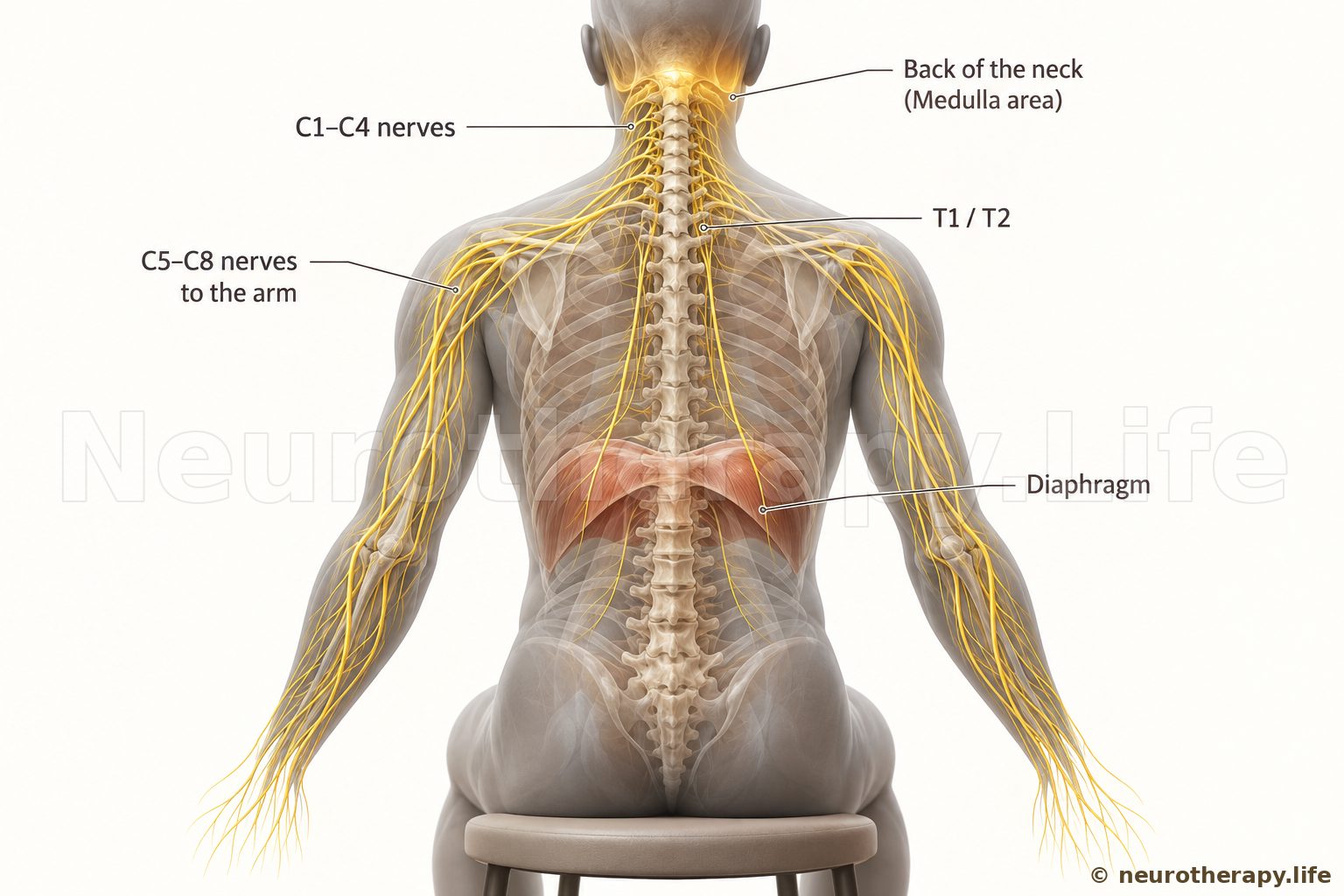
(4) Medulla clockwise + T1/T2
Listed here as a set, with what each part contributes. The exact hand action, direction and method are taught hands-on in the Neurotherapy (LMNT) course. This page lists the points of the formula and what each one contributes; it does not describe how any point is given. For the method, watch the demonstration video of each point on its own page and learn hands-on from a trained Neurotherapist. Please do not give a formula from a written description alone.
The (4) form of the Medulla point at the back of the neck, here worked clockwise on the neck muscles from the ear towards the shoulder. Credited with the neck's own nerve territories.
The station at the first two bones of the upper back. Credited with easing right and left chest pain.
A lift of the shoulder muscles from behind, added only when both ring fingers hurt and only after the kidney-point check. It is written as Raman, Right Raman or Left Raman.
The left kidney point. Checked before Raman — more pain here points to Left Raman.
The right kidney point. Checked before Raman — pain here points to Right Raman.
Position: Seated throughout, upright on a stool or chair.
The exact technique is taught hands-on in the Neurotherapy (LMNT) course. See the course →
The neck is a crowded junction. Nerves leaving the upper neck help supply the chest wall and the diaphragm; nerves leaving the lower neck form the cords that run down the whole arm. LMNT teaching reasons that working the neck muscles and the top of the upper back reaches pains along these roads.
Raman has a strong effect on the acid–alkali balance: it lowers acid, so alkali rises. That is why it is never simply added. If a patient whose pain is at Liv° (the alkali side) is given Raman without checking, the pain can quickly get much worse, because stiff, painful muscles are a sign of rising alkali.
So the check comes before the hands start: pain at Mu° or in the left ring finger points to Left Raman; pain at Liv° or in the right ring finger points to Right Raman; equal pain, both sides. A check made after the hands are moving is not a check.
It closes the graded Medulla series and opens two bigger treatments.
It is chosen from the patient's findings, after any red-flag signs have been sent to a doctor. LMNT teaching links it with these situations.
No. LMNT teaching is clear that 'clockwise' is a different hand action, not just a direction. Ordinary (4) Medulla is a different treatment. The difference is taught hands-on in the course.
In LMNT teaching, pain in the middle joint of the ring finger is a quick reading of the acid–alkali balance, and pain in both ring fingers is read as a possible sign of RA. It decides whether Raman is added, and on which side.
LMNT teaching credits it with pains of the whole arm, from the shoulder to the fingers, because their nerves leave from the lower neck. Results vary, and numbness or weakness should also be checked by a doctor.
The neck is a delicate area and the Raman check needs a trained hand. This page explains what the treatment is; it is given by a trained therapist.
The neck has seven vertebrae but eight pairs of cervical nerves. The first pair leaves above the first vertebra, so the numbering never quite lines up.
Source: Gray's Anatomy, 41st ed., spinal nerves.
The phrenic nerve, which drives the diaphragm with every breath, comes from the neck nerves C3, C4 and C5. That is why a neck problem can show up as a hiccup or a pain at the shoulder tip.
Source: Gray's Anatomy, 41st ed., phrenic nerve.
The nerves C5 to T1 weave into the brachial plexus, a braided cable that supplies every muscle and patch of skin from the shoulder to the fingertips.
Source: Gray's Anatomy, 41st ed., brachial plexus.
The bump at the base of your neck is usually the seventh neck vertebra, called vertebra prominens. Just below it lie T1 and T2.
Source: Gray's Anatomy, 41st ed., cervical vertebrae.

This video shows the right way to give (4) Medulla, Raman and the T1–T2 point for neck and shoulder pain and numbness.
This page explains what a Neurotherapy (LMNT) treatment is for; it is not a self-treatment guide and does not diagnose. Neurotherapy (LMNT) works alongside your medical care — keep taking the medicines your doctor prescribed.
Send COURSE for course details, or your name, age and health issue for a consultation.