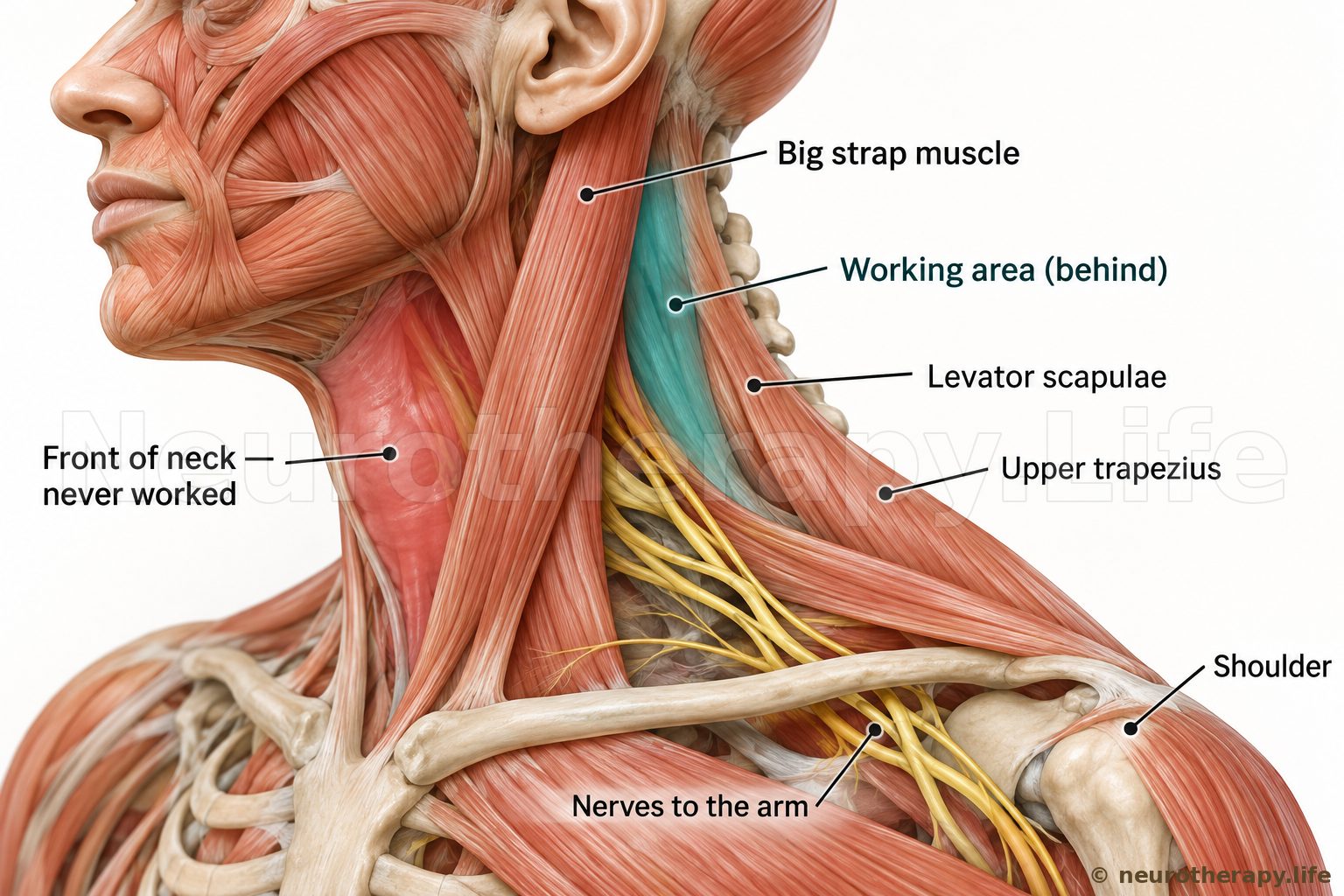
Neck Clockwise is a seated Neurotherapy (LMNT) treatment in which the gathered fingers circle clockwise over the muscles at the side of the neck, from below the ear down towards the shoulder. It is the hand action behind (4) Medulla clockwise, used in neck, chest and arm pain, and it always stays behind the big strap muscle of the neck.
Overview
What is Neck Clockwise?
Neck Clockwise is a physical point: it is named for a movement of the hand, not for a gland or a chemical. The therapist gathers the fingers together into one broad, soft pad and turns it in small clockwise circles on the muscles at the side of the neck, travelling down from the ear towards the shoulder.
Its own entry gives no separate list of uses. Its importance comes from where it is used: the same clockwise action, given at the count of the Medulla, makes (4) Medulla clockwise — the one member of the Medulla family with a stated direction. Four ordinary downward strokes are (4) Medulla; they are not (4) Medulla clockwise.
Through (4) Medulla clockwise, this action is credited with the neck's own territories: the upper neck nerves, linked to pain in the chest, the upper diaphragm and the spleen region, and the lower neck nerves, which carry the whole arm from the shoulder to the fingertips.
Neck Clockwise works only behind the big strap muscle; the front of the neck is never worked.
Where it is given
Where is Neck Clockwise given?
PositionSitting
Body areaSide and back of the neck, below the ear down to the shoulder — behind the big strap muscle
You sit well back on a firm, flat chair, feet flat on the floor, back supported and hands loose in your lap. The therapist stands at your left side. A patient who is very ill or very weak may receive it lying down instead.
The circles cover the muscles at the side and back of the neck, from just below the ear down to the shoulder — the left side first, then across to the right. They stay behind the big strap muscle that runs from behind the ear to the collarbone; its front border is a fence that is never crossed.
How it is given
How is Neck Clockwise given?
How this point is given — the tool, the pressure, the count and the exact movement — is deliberately not described here. Watch the demonstration video on this page, and learn the method hands-on from a trained Neurotherapist before giving it. Please do not give any point from a written description alone: a point given in the wrong place or the wrong way can do harm.
Feels likeA slow, soothing circling of the neck muscles
The exact technique is taught hands-on in the Neurotherapy (LMNT) course. See the course →
What it does
What does Neck Clockwise do?
Its own entry does not state a use. What the teaching credits is (4) Medulla clockwise, the treatment built on this action, given seated with the station at T1/T2 below it. Body science confirms that the nerves of the neck do supply the diaphragm, the shoulder and the whole arm; how circling the neck muscles helps them is the therapy's own explanation, from clinical experience.
Pain linked to the upper neck nerves: pain in the right and left chest, pain of the upper diaphragm, spleen pain, and pain of the upper neck bones.
Pain linked to the lower neck nerves: pain of the arm, elbow, wrist, hand, palm and fingers.
Relaxes the muscles at the side of the neck and the muscle that lifts the shoulder blade.
Organs it reaches
Neck — The muscles at the side and back of the neck.
Muscles — The strap muscle and the muscle that lifts the shoulder blade.
Spinal cord — The neck nerves that leave the cord for the chest wall, diaphragm and arm.
Its family
Which treatments are close to Neck Clockwise?
It belongs to the seated group worked at the neck, under the same safety rule.
Medulla — The thumb glide down the neck below the ears; at its count, the clockwise action makes (4) Medulla clockwise.
Thoracic T1/T2 — The station at the base of the neck given right after it in (4) Medulla clockwise.
Raman — The shoulder lift added only when both ring fingers are painful, after Liv° and Mu° are checked.
Neck Ghisai — The fuller four-stage rubbing of the neck, given when the neck itself is painful.
Necklace — The string of presses along the base of the skull, from ear to ear.
What it is used for
What is Neck Clockwise used for?
Always as part of (4) Medulla clockwise and its formulas, after the neck has been screened.
Neck, shoulder and arm
Cervical spondylosisPain of the neck bones and the arm pain that travels from them.
Carpal tunnel syndromeNamed in the Angina / Athero treatment, which opens with (4) Medulla clockwise.
Follows it on day three when pain returns and Mu° is no longer painful.
Safety: when it is held back
The front of the neck is never worked. The circles stay behind the big strap muscle; in front of it lie the great artery to the brain and its pressure sensors. Neck
Glide, never thrust: no jerk, twist, pull or turning of the head. Dizziness, greying of vision, nausea or light-headedness ends the treatment for the day. Vertigo and giddiness
Nothing is given at the neck, and a doctor is seen the same day, for a first-ever sudden headache, new neck pain with headache, any new change in vision, speech, balance or walking, numbness of the face or a limb, or a hot, swollen or lumpy neck. How to tell a patient to see a doctor
Light contact only in thin bones, long steroid use, blood-thinning tablets, a bleeding disorder, or cancer that may involve bone. Clumsy hands, a clumsy walk and new bladder urgency together mean no pressure at the neck until a doctor has assessed it. Osteoporosis
The very ill, the very weak and the frail elderly receive it lying down, with less pressure. Children receive light treatment. Frail and elderly patients (gentle care)
Chest pain is a doctor's question first. In heart disease, this treatment is support alongside your cardiologist's care; keep taking your medicines. Heart attack (myocardial infarction)
A teaching case
Teaching case: the gentle treatment that should not have been given
A teaching case, put together from several patients: a man in his fifties came with his first-ever headache at the back of the head, which began suddenly while lifting a heavy shutter, a stiff neck, and an eyelid that had begun to droop. Nothing was given at the neck — no Medulla, no Neck Clockwise, no Necklace. He was sent the same day with a note, and imaging found a tear in a neck artery. Weeks later, with his doctor's agreement, the work began far from the neck, and the seated neck points came last and lightest.
A composite case written to teach the reasoning — not one patient’s file.
Common questions
Is Neck Clockwise a neck massage?
It looks like one, but it is a set Neurotherapy (LMNT) action with a direction, a side order and a place in specific formulas — and a firm rule about where the hand must not go.
Why do I feel it in my ear or jaw?
A nerve crosses the strap muscle on its way up to the ear, so circling there can send a feeling into the ear lobe or the angle of the jaw. That is normal; dizziness is not, and should be said at once.
I felt dizzy during it. Should the therapist press more lightly?
No — the treatment stops for the day, and the hand placement is checked. If it happens again with the hand correctly placed, you are screened by a doctor before any more neck work.
Can it be given to someone who cannot sit?
Yes. The whole seated group may be given lying down to anyone very ill or very weak, from the same landmarks and with less pressure.
Surprising facts
1The diaphragm is wired from the neck
The breathing muscle sits at the bottom of the chest, yet its nerve leaves the spinal cord high in the neck. That is why irritation under the diaphragm can be felt as pain at the tip of the shoulder.
Source: Gray's Anatomy, 41st ed. (phrenic nerve).
2The arm's nerves start in the neck
Every nerve of the arm and hand comes from the lower neck and the top of the chest, through a braid of nerves that passes behind the collarbone. A pinched root in the neck can be felt as numbness in a finger.
Where the great neck artery forks, its wall carries sensors that read blood pressure. Firm pressure there can slow the heart and drop the pressure suddenly — one reason the front of the neck is never worked.
Source: Guyton & Hall, Medical Physiology, 14th ed. (carotid baroreceptors).
Watch
How to Give 4 Medulla, Raman & T1 T2 in Neurotherapy | LMNT Cervical, Shoulder pain & Numbness
This video shows the right way to give (4) Medulla, Raman and the T1–T2 point for neck and shoulder pain and numbness.
This page explains what a Neurotherapy (LMNT) treatment is for; it is not a self-treatment guide and does not diagnose. Neurotherapy (LMNT) works alongside your medical care — keep taking the medicines your doctor prescribed.
Ready to begin?
Send COURSE for course details, or your name, age and health issue for a consultation.