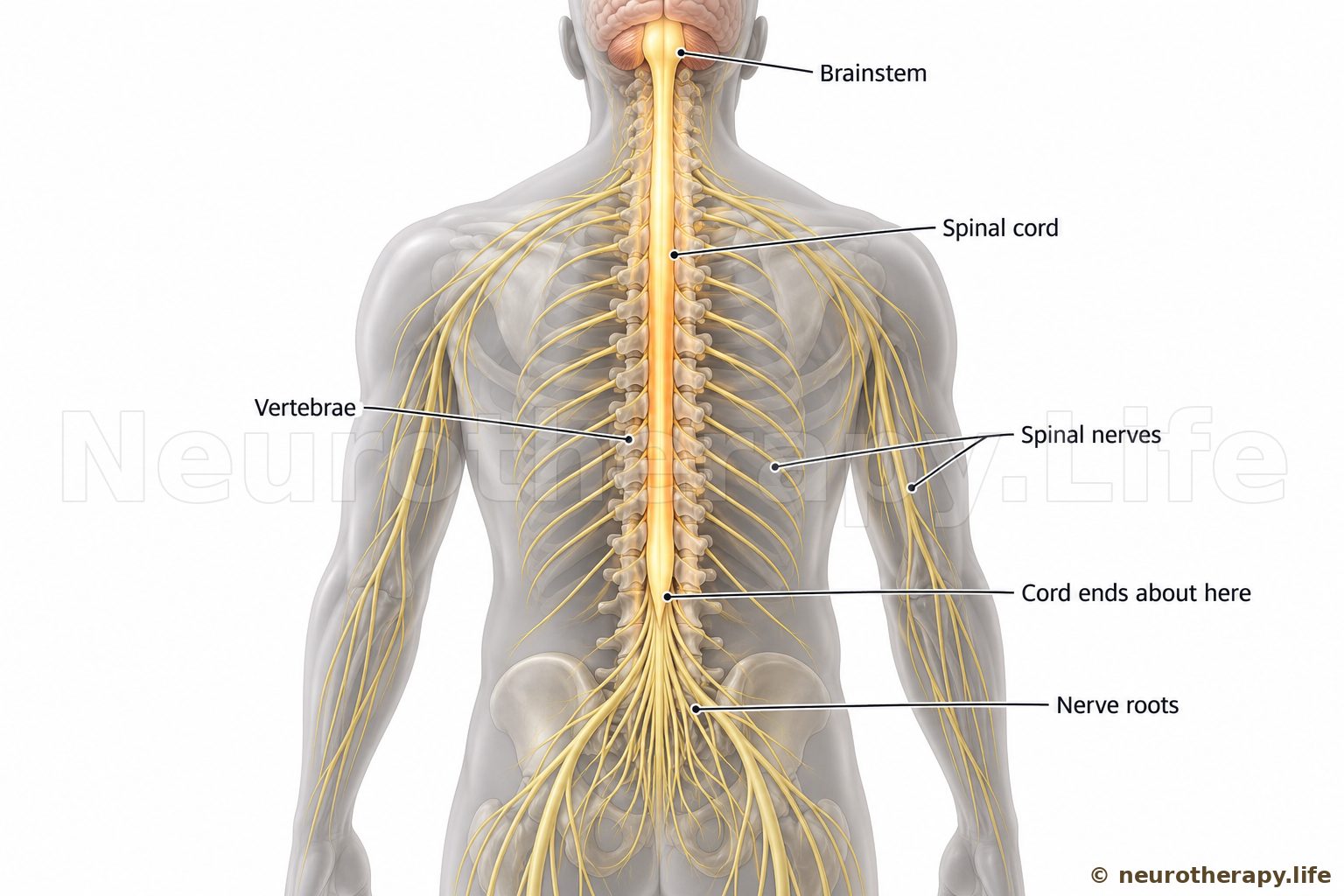
A soft, finger-thick cable of nerve tissue, about 45 cm long, running inside your backbone. It carries every message between the brain and the body below the neck, and runs quick reflexes all by itself.
Overview
What is the spinal cord?
The spinal cord is the long bundle of nerve tissue that continues down from the brainstem. Together with the brain it forms the central nervous system.
It is not the same as the spine. The spine (backbone) is the column of bones; the spinal cord is the soft cable protected inside its tunnel.
Thirty-one pairs of spinal nerves leave it, one pair through each gap between two vertebrae. They carry touch and pain in, and orders to muscles and organs out — for everything below the jaw.
That is why LMNT spends so much of its time on the back: the thirty-one gates of the body's wiring all lie in that bony corridor.
The spinal cord runs inside the backbone and gives off a pair of nerves at every level.
Function
What does the spinal cord do?
Picture a national highway with a small police post at every town. Most traffic travels the whole way between the capital (the brain) and the towns (the body). But each post can also act on its own — stopping trouble at once without waiting for orders from the capital. Those local actions are reflexes.
Carrying reports up: touch, pain, heat, cold and the sense of where your limbs are travel up the cord to the brain.
Carrying orders down: every voluntary movement below the neck travels down the cord to the muscles.
Reflexes: the knee jerk and pulling away from a flame are handled in the cord in a fraction of a second.
Rhythm of walking: circuits in the cord help produce the steady left–right rhythm of the legs.
Automatic control: the 'fight-or-flight' nerves leave the chest and upper-back part of the cord; bladder, bowel and sexual function are run from its lowest part.
Turning pain up or down: the first relay for pain in the cord can be dampened by rubbing, pressure and signals coming down from the brain.
Muscle tone and posture: a steady background signal keeps muscles ready and the body upright.
How does the spinal cord work with other organs?
Brain — Its partner at the top: the cord carries the brain's orders down and the body's reports up.
Medulla (brainstem) — The cord begins where the medulla ends, at the base of the skull.
Spine — The backbone is its armour; each vertebra has a ring of bone around the cord.
Muscles — Every muscle of the trunk and limbs is driven by nerve cells in the cord.
Bladder — The lowest part of the cord and its nerves control holding and emptying urine.
Bowel — The same low nerves (S2–S4) control the last part of the bowel and the back passage.
Lungs and breathing — Nerves from the neck part of the cord (C3–C5) drive the diaphragm, the main breathing muscle.
Skin — Each spinal nerve serves its own strip of skin, called a dermatome.
Anatomy
What are the parts of the spinal cord?
The cord is named in levels, like the backbone around it, and has an inside, roots and protective layers.
Levels from top to bottom
Cervical (neck) — 8 pairs — Serve the neck, arms and hands, and the diaphragm (from C3–C5). The cord is thicker here because of the arm nerves.
Thoracic (chest) — 12 pairs — Serve the chest and belly wall, and send out the 'fight-or-flight' nerves to the organs.
Lumbar (low back) — 5 pairs — Serve the hips and legs. The cord thickens again here for the leg nerves.
Sacral — 5 pairs — Serve the buttocks, the back of the legs, the bladder, the bowel and sexual function.
Coccygeal — 1 pair — A tiny pair near the tail bone.
Cone and 'horse's tail' — The cord ends in a cone at about the first or second lumbar vertebra. Below it, a spray of nerve roots, the cauda equina, runs on down the canal.
Inside the cord
Cut across, the cord shows a grey, butterfly-shaped core inside a white outer layer.
Back horns (dorsal horns) — Receive touch, pain and temperature signals — the first relay for pain.
Front horns (ventral horns) — Hold the motor nerve cells that drive the muscles.
Side horns — In the chest and upper low-back levels, they hold the cells of the 'fight-or-flight' nerves.
White matter tracts — Insulated bundles running up (sensation) and down (movement orders), like lanes of a highway.
Central canal — A tiny channel down the middle, continuous with the brain's fluid spaces.
Roots and spinal nerves
Sensory (back) root — Brings signals in. It has a small swelling, the root ganglion, holding the sensory cell bodies — where the chickenpox virus can hide for years.
Motor (front) root — Takes orders out to the muscles.
Spinal nerve — The two roots join and leave the canal through a small window between two vertebrae, then split into branches to the front and the back of the body.
Dermatomes — Each nerve supplies a strip of skin. Doctors map numbness onto these strips to find which level is affected.
Protection and blood supply
The vertebral canal — The tunnel formed by the rings of the stacked vertebrae.
Discs and ligaments — Cushions between the vertebrae and strong bands that hold the column together.
Meninges and fluid — The same three wrappings as the brain, with clear fluid around the cord.
Spinal arteries — One artery down the front and two down the back, topped up by small branches along the way.
Where is the spinal cord located?
Run your fingers down the middle of your back: the bumps are the back spurs of the vertebrae. The spinal cord lies in the tunnel just in front of them, a few centimetres deep.
It starts at the large opening at the base of the skull and ends at about the level of the first or second lumbar vertebra — roughly at the level of your lowest ribs at the back, well above the belt line.
Below that, the canal holds only floating nerve roots. That is why doctors take a sample of spinal fluid lower down, in the low back, where the needle cannot touch the cord.
It is a soft, glistening, whitish rope, slightly flattened from front to back. It bulges at the neck and in the low back, where the nerves to the arms and legs leave, and tapers to a point at its lower end.
Fine rootlets fan out from both sides along its length. Below its tip, the long roots hang down together, which is why anatomists named them the 'horse's tail'.
How big is the spinal cord?
In an adult it is about 45 cm long in men and about 43 cm in women — much shorter than the backbone, which is about 70 cm.
It is about 1 cm across — roughly the thickness of your little finger — a little wider at the neck and low-back bulges. It weighs only about 35 grams.
Conditions and disorders
What conditions affect the spinal cord?
The cord can be injured, squeezed by the bones around it, inflamed, infected, or formed incompletely before birth. Nearby nerve roots can also be pressed, which is far more common.
Pressure on the cord or its roots
Cervical spondylosisWear in the neck can press on nerve roots, or on the cord itself, causing clumsy hands and an unsteady walk.
SciaticaA pressed root in the low back sends pain down the leg; the cord itself ends higher up.
Low back painUsually from muscles, joints or discs; rarely a sign of nerve root or cord trouble.
Urinary problemsLeaking or difficulty passing urine can come from the low cord and its nerves.
Bed-wettingIn children, the bladder–nerve control from the low cord is still maturing.
What are the signs of a spinal cord problem?
Numbness or tingling in both hands or both legs
Clumsy hands — trouble with buttons, coins or writing
An unsteady, stiff or wide-based walk
Weakness in the legs or arms
New trouble holding, starting or controlling urine or stool
Numbness in the seat or between the legs
A band-like pain or tightness around the chest or belly
Back pain with fever, weight loss, or pain that wakes you at night
How do doctors check the spinal cord?
Neurological examination — Reflexes, strength, and a map of where feeling changes on the skin, to find the level affected.
MRI of the spine — The best picture of the cord, discs, roots and any swelling or pressure.
X-ray and CT — Show the bones — fractures, slipped vertebrae and bony spurs.
Nerve conduction study and EMG — Help tell a root or nerve problem from a cord problem.
Lumbar puncture — A sample of spinal fluid, taken below the end of the cord, for infection or inflammation.
Blood tests — Vitamin B12, copper, sugar and signs of infection or inflammation.
How are spinal cord problems treated?
Emergency care after injury — Keeping the spine still, scans, and sometimes urgent surgery to stabilise the bones and relieve pressure.
Surgery for compression — To free a cord or root squeezed by a disc, bone spur or growth.
Medicines — For pain, muscle spasm, inflammation, infection or immune disease such as MS, depending on the cause.
Physiotherapy and rehabilitation — Strength, balance and walking training, and help with daily tasks.
Bladder and bowel programmes — Timed routines, and sometimes catheters, to keep the kidneys and skin safe.
Aids and adaptations — Braces, walkers or wheelchairs, and home changes for independence.
Neurotherapy (LMNT)
LMNT works on the back more than almost anywhere else, and the reason is the spinal cord. Guruji's reasoning, set out when the Star formulas were built, runs in four steps: a message from the brain must reach the organs through the thirty-one pairs of spinal nerves; if a road is obstructed there is a traffic jam; so if the beads of the spine are out of line, the message will not arrive at the right time or in the right way; and so the road is cleared with the Round Arrow. The teaching is honest about its limits: no hand reaches the cord or the nerve chain in front of the spine. What steady, firm, repeated pressure beside the spine does reliably is reduce how much pain a person feels, locally and further away — a real effect at a real site, with no claim that a bone was moved.
Points
Beside the Spine — First and middle fingers straddle the spine, pressing down and inward from the neck to L5 and back up to C7 — aimed at the 31 pairs of spinal nerves and the muscles they serve.
Round Arrow — The thumb edge runs down the right side of the beads to L5 and up the left side without lifting, pressure falling on the side of each bead.
On the Spine — The thumb edge rides the beads from the neck to L5 and back to T1, where there is slight unevenness between them.
Organ Clearance — Light open-hand strokes over and around the whole spine, up-and-down and then side-to-side.
Sudhakar — The muscles around all the vertebrae of the back are moved and set back in place; for neck, back and all pains.
Dorsal — A light, counted glide over the beads at the nape; the teaching warns that heavy pressure there is on almost bare bone.
Motor Neuron Point — Heels placed one by one either side of the C7–T1 joint, over the thickest part of the cord in the neck, where the nerves of the arm leave. The name is anatomical; it is not a treatment for motor neurone disease.
JJ⁺¹ — Waist to knee, in three graded rounds, for nerve trouble around L1–L2–L3.
JJ⁺² — Below the knee to the ankle, for nerve trouble around L4–L5–S1.
Sciatica Point — Light pressure either side of L5, then the heel down the painful leg from hip to heel.
(2) S4 – S5 — Pressure either side of the lowest sacral beads — the region of the sacral nerves that serve the last stretch of the bowel.
(3) ONS (3) Gal (4) Ku (20) Round Arrow — set the navel, take the pain out of Gal, stimulate the pineal, then clear the road along the spine so the message can arrive.
“When a patient comes to you for treatment, it should be of least importance to us that he should be cured within the shortest possible time. We are neither interested in competing with anyone, nor in setting up a record. Nor do we claim our treatments to produce magical results. But there should be only one thought which should certainly be kept foremost in our minds, and that is: No such treatment may be given, knowingly or otherwise, which will worsen a patient's condition, even by a fraction of one percent.”
— Dr. Lajpatrai Mehra
“Whenever there is an obstruction or blockage in the blood circulation of any part of the body, then pain or numbness is felt in that part.”
— Dr. Lajpatrai Mehra
“Whether or not the patient gets immediate benefit from our treatment, let no harm reach him through our carelessness — attend to this.”
— Dr. Lajpatrai Mehra
Never do this
Emergency: after a fall, accident or dive with neck or back pain, numbness, tingling or weakness, do not move the person or their neck. Call an ambulance (108/112) and keep the head and neck still.
Hospital today, no treatment: numbness in the seat or between the legs, new trouble starting, holding or leaking urine or stool, or weakness or shooting pain in both legs. The nerve bundle at the base of the spine may be crushed. Low back
Clumsy hands, an unsteady walk and new bladder urgency together are how a squeezed spinal cord announces itself. No hands-on work at the neck until a doctor has assessed it. Neck
Back pain in anyone ever treated for cancer, pain that wakes from sleep, band-like pain, back pain with fever or sweats, or weight falling off without trying: no pressure on the spine — the person is sent to a doctor the same day. Cancer care: Neurotherapy (LMNT) support
Thin bones, long steroid use, a bone broken from a small knock, or a sudden pain after a fall in an older person: light contact only, no jerks and no body weight until an X-ray and a doctor have cleared it. Shukla is not given in osteoporosis. Osteoporosis
Katka and Motor neuron point are the most forceful treatments and are used only after much thought: four pillows, a three-finger gap at the throat checked by hand, and only a mild jerk. At the neck the rule is always: glide, never thrust. Katka
In diabetes, the full Round Arrow is not given; it is given only as far as L1–L5. Round Arrow
(2) S4–S5 is not given to people who pass too much urine, and (4) Ku is not given during menstruation. (2) S4 – S5
Keep taking the medicines your doctor prescribed, exactly as told. Neurotherapy (LMNT) works alongside your medical care, never instead of it.
Care
How can I keep my spinal cord healthy?
Protect the bones around it, keep the back strong, and feed the nerves well.
Lift with your legs
Bend the knees, keep the load close, and do not twist while lifting.
Strengthen your back and belly
Regular walking and gentle core exercises support the spine.
Mind your posture
Keep screens at eye level and get up to move every 30–40 minutes.
Protect your neck
Seat belt, helmet, and never dive into shallow or unknown water.
Folic acid before pregnancy
Taking folic acid before and in early pregnancy greatly lowers the risk of spina bifida.
Keep vitamin B12 up
A long shortage can damage the cord's sensory lanes; vegetarians may need a check.
Do not ignore numbness
Numbness in both hands or legs, or a change in walking, needs a doctor's check.
Stop smoking
Smoking starves the discs of blood and speeds their wear.
Common questions
Is the spinal cord the same as the spine?
No. The spine is the column of 33 bones (some fused) that protects the cord. The spinal cord is the soft nerve cable inside it.
Does a 'slipped disc' press on the spinal cord?
In the low back, usually not — the cord ends higher up, so a disc there presses on a nerve root, causing sciatica. In the neck, a large disc or bone spur can press on the cord itself, which is more serious.
Can the spinal cord heal after an injury?
Nerve fibres in the cord regrow very little, so severe injuries often leave lasting effects. But swelling settles over weeks, and many people with partial injuries regain a good deal of function with rehabilitation.
Why is a spinal fluid test done in the low back?
Because the cord stops at about the first or second lumbar vertebra. Below that, the needle meets only fluid and loose nerve roots, which move aside.
Is it harmful to crack my own neck or back?
Occasional gentle stretching is fine, but forceful twisting of the neck can, rarely, injure the arteries that run through the neck bones. LMNT's own rule at the neck is 'glide, never thrust'.
Does Neurotherapy (LMNT) press on the spinal cord?
No. The cord lies deep inside the bony canal. LMNT's spinal points press beside and along the beads — on the muscles and the small nerve branches that reach the skin and back muscles — and the teaching says plainly that no hand reaches the cord.
What should I ask my doctor or therapist?
Is the problem in the spinal cord itself, a nerve root, or the bones and muscles around it?
Do I need an MRI, and which level should it cover?
Which warning signs mean I must go to hospital the same day?
Which exercises are safe for my back and neck, and which should I avoid?
(To your therapist) With my bones, diabetes or neck findings, which spinal points are barred for me?
(To your therapist) Will you check my calves and my walking before treating my legs?
Surprising facts
1Your spinal cord is shorter than your spine
In a newborn baby the cord reaches much lower down the spine. As a child grows, the backbone grows faster than the cord, so in an adult the cord ends at about the level of the lowest ribs — and the nerve roots have to travel down inside the canal to reach their exits.
Source: Gray's Anatomy — conus medullaris at L1–L2 in adults, lower (about L3) at birth; differential growth of cord and vertebral column
2Eight nerves, seven bones
Your neck has seven vertebrae but eight pairs of spinal nerves. The first pair leaves above the first bone, and the eighth squeezes out below the seventh. Lower down, each nerve is named after the bone just above it.
Source: Gray's Anatomy — cervical spinal nerves C1–C8 and their exits
3C3, 4, 5 keep the diaphragm alive
Medical students learn this rhyme because the nerve to the main breathing muscle comes from the neck — the third, fourth and fifth neck levels. That is why an injury high in the neck can stop breathing, while one lower down may not.
Source: Gray's Anatomy — phrenic nerve (C3–C5)
4The knee jerk never reaches your brain
When a doctor taps below your kneecap, a stretch signal travels to the cord and straight back to the thigh muscle, which kicks. It takes only a few hundredths of a second, and the brain hears about it afterwards.
Source: Guyton & Hall — the stretch (patellar) reflex, a monosynaptic spinal reflex
5The cord keeps its own rhythm
Circuits in the spinal cord can produce the alternating left–right rhythm of stepping on their own. This was shown clearly in animals, and there are signs of similar circuits in people. The brain starts, steers and stops the walk.
Source: Kiehn O. Nat Rev Neurosci 2016;17(4):224–238 (spinal locomotor circuits / central pattern generators)
6A virus that sleeps for decades beside the cord
After childhood chickenpox, the virus hides in the small nerve knots beside the spinal cord. Decades later it can wake and travel down a single nerve, making the painful stripe of shingles on one side of the body — the shape of one nerve's strip of skin.
The spinal cord forms in the first four weeks of pregnancy, often before a woman knows she is pregnant. A large trial showed that folic acid taken before and around conception prevented about seven in ten cases of spina bifida and related defects.
Source: MRC Vitamin Study Research Group. Lancet 1991;338:131–137 (72% protective effect)
8Why a heart attack can hurt in the arm
Nerves from the heart enter the spinal cord at the same upper-chest levels as nerves from the chest wall and inner arm. The cord cannot always tell who sent the message, so heart pain is often felt in the chest, jaw or left arm. LMNT teaching uses this same fact to explain why its angina treatment begins at the neck and the T1/T2 beads.
Source: Guyton & Hall — referred pain (convergence in the dorsal horn); LMNT sec. 35.22
Yoga
Marjaryāsana–Bitilāsana — cat and cow Marjaryāsana–Bitilāsana
Benefits
Moves each level of the spine gently through its range
A kind warm-up for a stiff back in the morning
Links slow breathing with slow movement
How to do it
Come onto your hands and knees, hands under the shoulders and knees under the hips.
Breathing out, round your back up towards the ceiling and let the head drop gently.
Breathing in, let the belly sink a little and lift the head and tailbone gently.
Move slowly between the two, 8 to 10 times.
Take care
Keep the movement small and pain-free. Put a folded blanket under sore knees. Avoid it after a recent back or neck injury, with a known unstable spine, or if it brings on pain or numbness down a leg or arm.
Bhujaṅgāsana — the low cobra Bhujaṅgāsana
Benefits
Strengthens the muscles along the spine
A gentle counter-stretch for people who sit bent forward all day
Opens the chest for easier breathing
How to do it
Lie on your front with legs together and forehead on the mat.
Place your palms beside your chest, elbows close to the body.
Breathing in, lift the head and upper chest a few centimetres, using the back more than the arms.
Hold for 3–5 breaths, lower slowly, and repeat 3 times.
Take care
Stop if it causes back pain or pain down the leg. Avoid it in pregnancy, after abdominal surgery, with a hernia, or with a slipped vertebra (spondylolisthesis) unless your doctor agrees.
Makarāsana — the crocodile rest Makarāsana
Benefits
A restful position for a tired back
Breathing against the floor makes the belly breath easy to feel
A natural pause after the cobra
How to do it
Lie on your front with your legs comfortably apart, heels turned in.
Fold your arms in front and rest your forehead or chin on them.
Close your eyes and breathe slowly, feeling the belly press into the floor.
Rest for 2–5 minutes.
Take care
Skip it in later pregnancy. If lying face down strains your neck, turn the head to one side on the arms and change sides halfway.
Watch
FOR BACK PAIN - L1 TO L5, S1 - JJ+1 JJ+2
Shows JJ⁺¹ along the thighs and JJ⁺² just below the knees, given lying down with light jerks and pressure that rises over three rounds. JJ⁺¹ is for nerve trouble near L1–L3 and JJ⁺² for L4–L5–S1 in back pain.
FOR BACK PAIN - L1 TO L5, S1 - JJ+1 JJ+2 SITTING POSITION
Shows JJ⁺¹ along the thighs and JJ⁺² just below the knees with the patient sitting, using light jerks and pressure that rises over three rounds, then a gentle calf massage. JJ⁺¹ is for nerve trouble near L1–L3 and JJ⁺² for L4–L5–S1 in back pain.
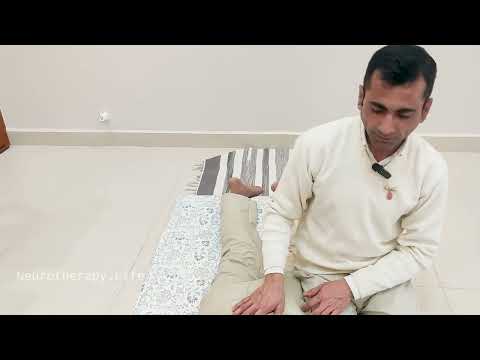
How to Give 4 Medulla, Raman & T1 T2 in Neurotherapy | LMNT Cervical, Shoulder pain & Numbness
This video shows the right way to give (4) Medulla, Raman and the T1–T2 point for neck and shoulder pain and numbness.
ORGAN CLEARANCE
A short Hindi demonstration of Organ Clearance: the patient lies face down on two pillows, and the therapist's open hands work over the whole back in overlapping strokes — first up and down, then side to side — twice each, leaving no area out.
Test yourself
Research
Strong evidence
A landmark trial: folic acid taken before and around conception prevented about 72% of neural tube defects such as spina bifida.
A clinical review of degenerative cervical myelopathy — the spinal cord squeezed by wear in the neck — and its early signs: clumsy hands, unsteady walking and bladder changes.
This page explains how the body works; it does not diagnose. Neurotherapy (LMNT) works alongside your medical care — keep taking the medicines your doctor prescribed, and see a doctor for any new or severe symptom.
Ready to begin?
Send COURSE for course details, or your name, age and health issue for a consultation.