Ankylosing spondylitis (bamboo spine)
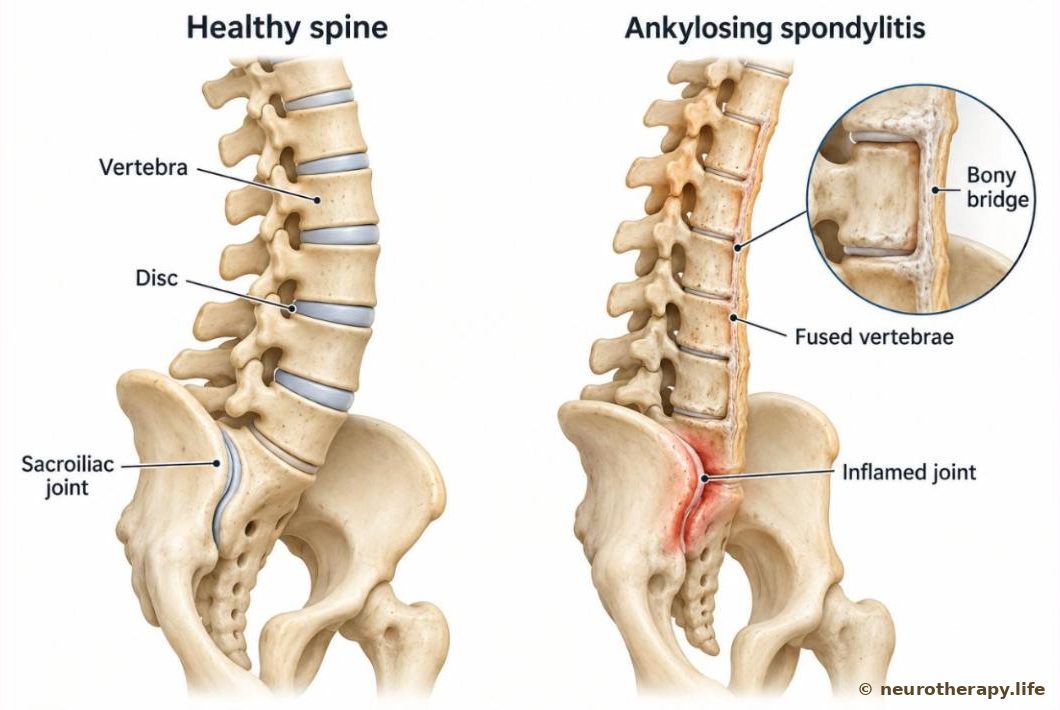
Ankylosing spondylitis is a long-term inflammation of the spine and the joints where the spine meets the pelvis. Over years, some spinal bones can grow together, making the back stiff.
- Symptoms usually begin between the ages of 15 and 30, and it is more common in men
- More than 8 in 10 people with it carry a gene called HLA-B27
- But about 8 in every 100 people carry HLA-B27, and most of them never get the disease
Source: MedlinePlus (US National Library of Medicine); NHS
What is Ankylosing spondylitis (bamboo spine)?
Ankylosing spondylitis (AS) is a kind of arthritis of the spine. Inflammation — swelling from the body's own defence system — settles between the spinal bones and in the sacroiliac joints, where the spine joins the pelvis.
It is a long-term condition that comes and goes in flares. In some people, over many years, the body lays down new bone at the edges of the spinal bones until they join. Doctors then call it “bamboo spine”. Nobody knows exactly what starts it; genes and the environment both play a part.
What are the symptoms?
- Pain and stiffness in the low back or buttocks, worse at night or after sitting for long
- Stiffness that eases with movement and exercise, not with rest
- Pain and swelling in other joints, such as the hips, shoulders or knees
- Deep tiredness
- A painful red eye with blurred vision or dislike of bright light
- Over years, a stiff back that stoops forward, and difficulty taking a deep breath
What causes it, and who is more likely to get it?
Genes and family
- The HLA-B27 gene
- A parent, brother or sister with AS
The immune system
- The body's defence system turns on the joints of the spine
- Something in the environment, such as an infection, may set it off
Conditions that travel with it
- Psoriasis
- Inflammation of the bowel (Crohn's disease, ulcerative colitis)
Who gets it
- Young adults — it usually starts before 45
- Men more often than women
How is it found?
There is no single test for AS. A doctor, usually a rheumatologist (a joint specialist), puts together your story, your family history, an examination and some tests.
Blood tests
Look for signs of inflammation, and may check for the HLA-B27 gene.
X-ray
Shows the changes AS makes in the sacroiliac joints and the spine — including bony bridges.
MRI
Can show inflammation early, before the X-ray changes.
A neurotherapist reads your reports for one word above all: is the spine already fused? That changes how the hands work. The therapist also checks the pain points Liv° and Mu°, asks about the stools — hard constipation and undigested food are common here — and asks whether any doctor has said your body is attacking itself.
How Neurotherapy (LMNT) sees Ankylosing spondylitis (bamboo spine)
Guruji's teaching places bamboo spine on the acid side, in a family of its own: diseases where calcium is laid down where it should not be — between the bones or the joints. Spur, a bone growing outward, belongs to the same family. So the work is never to add calcium to bone here; it is to set right digestion, calm the inflammation and ease the constipation that so often comes with it.
How LMNT reads bamboo spine
- Digestionundigested food — Guruji lists bamboo spine among the diseases where it is found
- Calcium handlingthe raw materials do not reach where they are needed, and calcium goes astray
- Depositscalcium settles between the spinal bones
- Bridgesthe bones grow bridges between themselves until the column is one piece
- A brittle columna fused spine has lost its give, and the bone itself becomes brittle
A fused spine does not unfuse. Neurotherapy (LMNT) aims to support comfort, digestion and movement alongside the care of your rheumatologist, never to replace it — and to add nothing that would push more calcium into bone.
Whether or not the patient gets immediate benefit from our treatment, let no harm reach him through our carelessness — attend to this.
Neurotherapy (LMNT) treatment for Ankylosing spondylitis (bamboo spine), step by step
Examine first
The therapist checks Liv° and Mu°, asks about the stools and any pain above and to the left of the navel, reads the X-ray or MRI report, and asks about diabetes and blood pressure — both change the plan.
Digestion and the bowel
Where undigested food is found, the UDF work comes first. For the hard constipation of bamboo spine, Const is given when that pain above and to the left of the navel is found.
Calm the inflammation
(6) Adr, usually as three treatments, is given in LMNT for any disease whose name ends in “-itis”, and in autoimmune disease. Where Mu° is painful, A. Heparin or the Anil Sharma treatment may be chosen.
The calcium-deposit order
LMNT has a complete order written for calcium deposited between the joints. It is given as one whole order — never spliced with another — and the card records which one was given.
Gentle hands, daily movement
No thrust, no forcing, no attempt to bend what has fused. Keep up the exercises and stretches your doctor or physiotherapist has given you — movement matters in AS.
Points and formulas used
(6) Adr × 3 treatments
Aimed at the adrenal cortex, which makes the body's own inflammation-calming hormone — given for any “-itis”, including ankylosing spondylitis.
Works through
Open →A. Heparin (acid)
The Heparin formula with the Acid point — for pain at Mu° with signs of acid; bamboo spine is on its list.
Works through
Open →Anil Sharma treatment
For joint pain from acid when Mu° alone is clearly painful — bamboo spine and spondylitis are on its list.
Works through
Open →Calcium-deposit order, version II
A complete order for calcium deposited between the joints or in the tissues, ending with the adrenal point.
Open →Never do this
- Thrd and Thrd 'P' are never given in bamboo spine — both push more calcium into bone, and the disease would increase. Thrd 'P'
- A fused spine is brittle, not strong. No thrust, no forcing, no attempt to restore a movement that has fused. Spine
- (6) Adr — also inside A. Heparin and the Anil Sharma treatment — is not given in high blood pressure, septicaemia or HIV. The Anil Sharma treatment contains Pit, which is not given in diabetes. (6) Adr
- AS is an autoimmune disease, so VTF (Mild) is not given — it provokes the white cells that are already attacking the body. VTF (Mild)
- See a doctor today for any new neck pain, a change in the way you walk or new clumsiness of the hands; for back pain after even a small fall; or for a painful red eye with blurred vision. Numbness between the legs or loss of bladder or bowel control needs hospital at once.
- Cancer: if the person has cancer, (10) Pan, Thymus, Pit, Lu + Sh, Rt. Ov / Lt. Ov and (30) Medulla are never given — the therapist changes the plan.
- AS is looked after by a rheumatologist for life. Keep taking the medicines your doctor prescribed. Neurotherapy (LMNT) works alongside your medical care, never instead of it.
Watch

A short Hindi podcast conversation with a senior neurotherapist: what ankylosing spondylitis is, who gets it, its symptoms and complications such as bamboo spine and eye inflammation, and how Neurotherapy (LMNT) looks at it through acid–alkali balance and the parathyroid.
The talk calls Neurotherapy (LMNT) an “alternative medicine”. In LMNT teaching it works alongside your rheumatologist's care, never instead of it — keep your medicines and your exercises.
A short talk on what ankylosing spondylitis is and how Neurotherapy (LMNT) looks at it.
From Ayurveda and the kitchen
Test yourself
What research says
- Strong evidence
A review of 14 trials with 1,579 people found that exercise programmes probably ease pain and help daily function a little in AS, compared with no exercise. Harms were rarely reported. It supports keeping up regular movement.
No clinical trial of Neurotherapy (LMNT) in ankylosing spondylitis has been published yet. Improvements reported by neurotherapists are clinical observations.
For you
Young adults with long-lasting back pain
Back pain that is worse after rest and better with movement, starting before 45, is worth showing to a doctor — early diagnosis matters.
People with a fused spine
The bone is brittle. Protect yourself from falls, and tell every therapist about your reports before any hands-on work.
People with psoriasis or bowel inflammation
These travel with AS. Tell your therapist — the stools and the skin both guide the plan.
This page explains; it does not diagnose. Neurotherapy (LMNT) works alongside your medical care — keep taking the medicines your doctor prescribed, and see a doctor for any new or severe symptom.