About five litres of living fluid that carries oxygen, food, heat and defence to every cell. Your body makes around two million new red cells every second — and in Guruji's teaching, blood is safe only while it keeps moving.
Overview
What is blood?
Blood is the red fluid that flows through your heart and blood vessels. It looks like a simple liquid, but it is really a living tissue: a pale yellow fluid called plasma, carrying billions of cells — red cells, white cells and platelets.
An adult has about 5 litres of it. Blood cells are made in the bone marrow, the soft tissue inside bones, and are replaced all the time — a red cell lives about 120 days, a platelet only about a week.
In LMNT teaching the amount of blood is fixed and shared among all the organs, so an organ that goes short for long enough falls ill. The raw materials for new blood — protein, iron, vitamin B₁₂ and folic acid — come from digestion, which is why the digestion is looked at first.
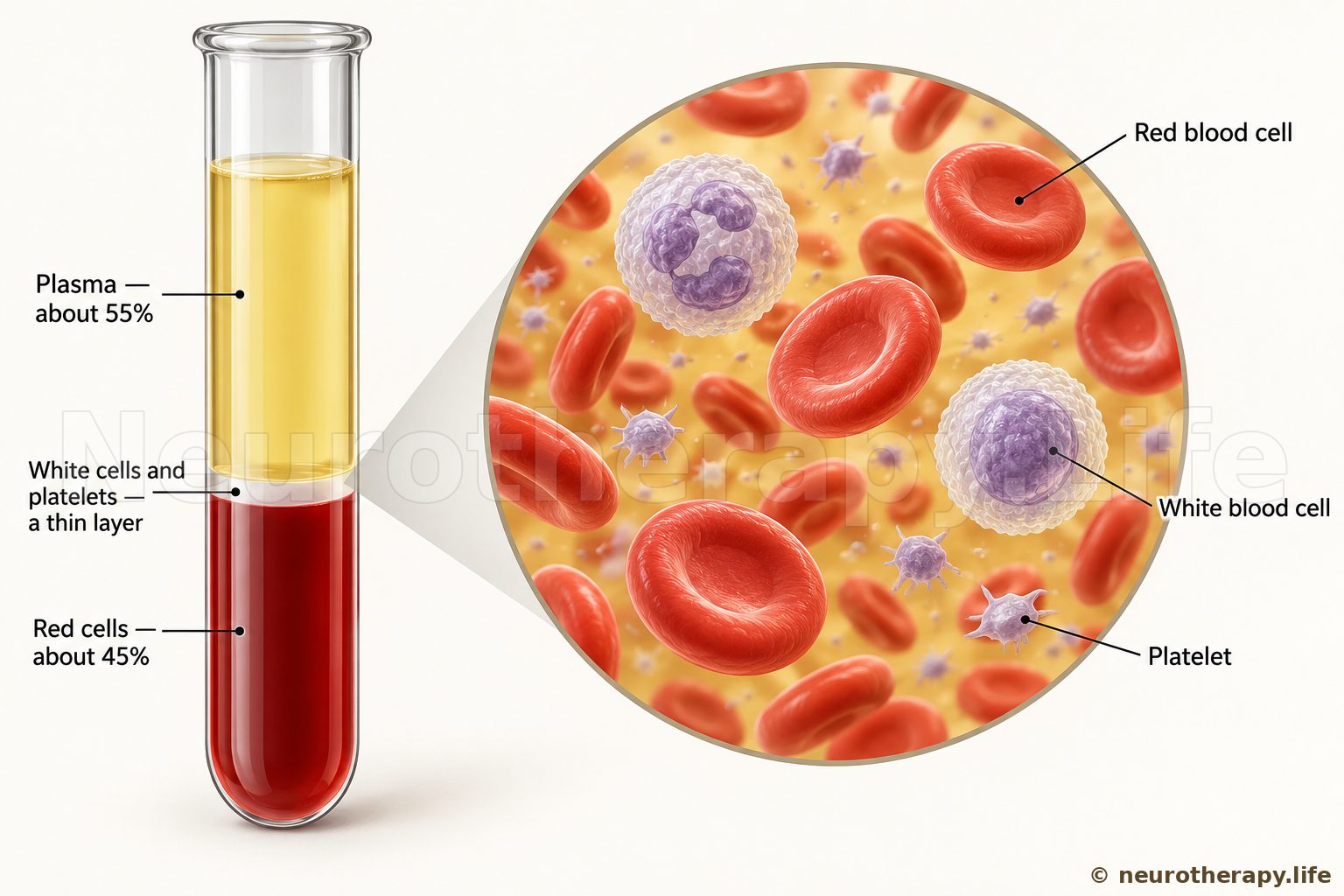
Blood is a fluid with cells in it: plasma on top, a thin layer of white cells and platelets, and red cells at the bottom.
Function
What does blood do?
Blood is the body's carrier, guard and repair crew. It moves things between the organs, fights germs, seals leaks and keeps the body's chemistry steady.
Carries oxygen from the lungs to every cell, bound to haemoglobin in the red cells.
Carries carbon dioxide back to the lungs to be breathed out.
Carries sugar, fats, amino acids, vitamins, minerals and hormones.
Takes waste such as urea to the kidneys and liver to be cleared.
Fights infection with white cells and antibodies.
Seals cuts by clotting, and later dissolves the clot.
Spreads heat and keeps the body's acid–alkali balance within a narrow range.
A vessel is hurt
A cut or a blow breaks a small vessel. The vessel wall tightens to slow the leak.
Platelets rush in
Platelets stick to the broken edge and release clotting chemicals. (LMNT teaching calls the key one thrombokinase.)
Prothrombin becomes thrombin
With calcium present, these chemicals turn prothrombin — a protein made by the liver — into thrombin.
A net of fibrin
Thrombin turns fibrinogen, another liver protein, into threads of fibrin. The threads form a net that traps red cells — that is the clot.
The clot is taken apart
Over the next day or so, a chemical called tPA from the vessel lining turns plasminogen inside the clot into plasmin, which digests the fibrin.
Moving blood stays liquid
Heparin and other natural anti-clotting chemicals stop clots forming inside healthy, flowing vessels.
How does blood work with other organs?
Heart — The heart keeps blood moving — and moving blood does not clot.
Lungs — Blood loads oxygen and drops carbon dioxide in the lungs; LMNT teaching adds that the lungs make much of the body's heparin.
Liver — The liver makes the clotting proteins and albumin, and clears worn-out red cells.
Kidneys — The kidneys filter the blood, balance its water, salt and acid, and send erythropoietin to call for more red cells.
Spleen — The spleen filters the blood and removes old or damaged red cells.
Digestive system — Digestion supplies the iron, protein, vitamin B₁₂ and folic acid that new blood is built from.
Lymph and immunity — Many white cells live and work in the lymph nodes and spleen as well as in the blood.
A little over half of blood is plasma; the rest is cells. Each part has its own job and its own lifespan.
Plasma — the liquid
Water — About 90% of plasma.
Proteins — Albumin holds water inside the vessels; globulins include antibodies; fibrinogen and prothrombin are for clotting. The liver makes most of them.
Salts and dissolved substances — Sodium, potassium, calcium, bicarbonate, sugar, fats, hormones and waste such as urea.
Red blood cells
The oxygen carriers — by far the most numerous cells in the body.
Shape — A flexible disc, thinner in the middle, like a doughnut without a hole — shaped to bend through narrow capillaries.
Haemoglobin — The iron-containing protein that picks up oxygen in the lungs and gives it away in the tissues. It makes blood red.
No nucleus — A mature red cell has no nucleus, which leaves more room for haemoglobin — but it also cannot repair itself.
Lifespan — About 120 days, after which it is removed, mostly in the spleen and liver, and its iron is used again.
White blood cells
Five main kinds, each with its own job in defence.
Neutrophils — The most common; the first to arrive and swallow bacteria.
Lymphocytes — Make antibodies and remember germs met before.
Monocytes — Large cells that move into tissues and clear up debris.
Eosinophils — Fight parasites and take part in allergy and asthma.
Basophils — The rarest; carry histamine and heparin.
Platelets
What they are — Tiny fragments pinched off from large cells in the bone marrow; they live about 7–10 days.
What they do — Plug small leaks in vessel walls and start the clotting chain.
Where blood is made and recycled
Bone marrow — Makes all the blood cells. In adults the busiest marrow is in the hip bones, breastbone, spine, ribs and skull.
Kidneys — Sense when oxygen is short and release erythropoietin, the hormone that tells the marrow to make more red cells.
Spleen and liver — Remove red cells about 120 days old, keep the iron, and turn the rest of the haemoglobin into bilirubin for the bile.
Blood groups
ABO groups — A, B, AB or O, depending on the markers on the red cells.
Rh factor — Positive or negative. It matters for transfusions and in pregnancy.
Where is blood found?
Blood is everywhere inside you, but always inside the heart and blood vessels. Only fluid and white cells leave the capillaries into the tissues; red cells stay inside.
It is made inside the bones. In a child almost every bone makes blood; in an adult most is made in the flat bones — the hips, breastbone, spine, ribs and skull. At any moment about two-thirds of it is resting in the veins, and the spleen and liver hold small reserves.
LMNT teaching adds that the liver and lungs hold blood that can be brought into circulation when needed — the liver can give up to about 450 mL.
Blood is red and a little thicker than water. Blood rich in oxygen, fresh from the lungs, is bright cherry-red; blood returning in the veins is a darker red. It is never blue.
Left to stand in a tube with a chemical that stops clotting, it settles into three layers: straw-yellow plasma on top (about 55%), a thin whitish layer of white cells and platelets, and packed red cells below (about 45% — the haematocrit).
How much blood is there, and how many cells?
An adult has about 5 litres of blood, roughly 7% of body weight. A newborn baby has only about a quarter of a litre.
One microlitre — a drop far smaller than a pinhead — holds about 4–6 million red cells, 4,000–11,000 white cells and 150,000–450,000 platelets.
A red cell is about 7.5 thousandths of a millimetre across. Haemoglobin is usually about 13–17 g/dL in men and 12–15 g/dL in women; the WHO calls it anaemia below 13 in men, 12 in women and 11 in pregnancy.
Conditions and disorders
What conditions and disorders affect the blood?
Blood problems can mean too few or too many cells, cells that do not work, clotting that fails or goes too far, infection, or a chemistry that drifts too acid or too alkaline.
Too little haemoglobin
AnaemiaToo few red cells or too little haemoglobin — tiredness, pallor, breathlessness.
High blood pressureSalt and water held in the body raise the blood volume and the pressure.
What are common signs of a blood problem?
Tiredness and weakness that rest does not fix
Pale skin, pale inner eyelids, pale nails
Breathlessness or a pounding heart on effort
Dizziness, especially on standing or after heavy bleeding
Easy bruising, bleeding gums or nose, or periods that will not stop
Frequent infections or fevers
Tingling or numbness in the hands and feet (possible B₁₂ shortage)
What tests check the blood?
Complete blood count (CBC) — Haemoglobin, red cells, white cells and platelets, and the size of the red cells.
Peripheral smear — A drop of blood looked at under a microscope for the shape of the cells.
Iron studies (ferritin) — Show how much iron the body has in store.
Vitamin B₁₂ and folate — For anaemia with large red cells, or tingling and numbness.
Clotting tests (PT/INR, aPTT) — How long blood takes to clot; also used to adjust blood-thinning medicines.
Blood group and cross-match — Before any transfusion, and in pregnancy.
Blood sugar, HbA1c, lipids, ESR and CRP — Sugar and fats in the blood, and markers of inflammation.
How are blood problems treated?
Finding the cause — Anaemia is a sign, not a final answer — blood loss, diet, absorption, worms and other illness are checked.
Iron, B₁₂ and folic acid — Tablets or injections, as the doctor advises.
Blood transfusion — For severe anaemia or serious blood loss.
Clotting medicines — Blood thinners to prevent clots; other medicines or platelets to stop bleeding.
Specialist care — Blood cancers and serious marrow diseases are treated by a haematologist.
Neurotherapy (LMNT)
LMNT teaching begins with a law of nature: blood is safe while it keeps moving fast, but wherever it stops or slows it begins to set. That protects us from bleeding to death after a blow — yet a clot forming inside a vessel is just as dangerous. So the body makes heparin, its own anti-clotting chemical: about 85% of it, the teaching says, in the mast cells of the liver and the lungs, the two places where the body deliberately slows its own blood. The teaching lays out the clot in three lines — prothrombin with calcium and thrombokinase gives thrombin; thrombin with fibrinogen gives fibrin; fibrin with broken blood cells gives a clot — and notes that if an ingredient is missing, even a small injury bleeds on and a woman's periods may not stop. A clot already formed is opened by plasmin after about 24 hours. The Heparin formulas work on the pancreas, liver and lungs to support both jobs. LMNT also separates the blood's acidity from the stomach's acid: several acids are dissolved in the blood — amino, uric, lactic, carbonic, folic and keto acids — and the kidneys balance them by sending out bicarbonate. This is support alongside a doctor's care, never a replacement for tests, transfusion or medicine.
Points
Mu° — The left kidney point. In chronic diseases it is given to make erythropoietin, which stimulates the bone marrow to make red blood cells. Not stimulated in kidney failure or kidney cancer.
For pressure that fell suddenly after about half a litre of blood was lost — accident, miscarriage, operation or very heavy periods — once the bleeding has stopped.
“This matter is to be publicised as widely as possible: that the cord should not be cut until the child itself has cried properly for some time.”
— Dr. Lajpatrai Mehra
“Whenever there is an obstruction or blockage in the blood circulation of any part of the body, then pain or numbness is felt in that part.”
— Dr. Lajpatrai Mehra
“No other drink can be a substitute for water.”
— Dr. Lajpatrai Mehra
Never do this
Bleeding that will not stop, vomiting blood, black or bloody stools, or fainting with cold, pale, sweaty skin — go to hospital at once or call 108/112. A person who is still bleeding is a patient for a hospital, not for a mat.
Heavy periods, easy bruising, or small cuts that bleed for hours need a doctor to find out why — stopping a bleed without knowing its cause is only a delay. How to tell a patient to see a doctor
See a doctor first for anaemia in a man or in a woman past menopause, weight loss without trying, or breathlessness or chest pain at rest. Anaemia
Tingling, numbness, unsteadiness or memory change means a B₁₂ blood test now — nerve damage from B₁₂ shortage may not fully recover if left. The Folic acid formula is not given alone for months without asking about B₁₂. Folic acid formula
No Heparin formula while a wound is open, nor while a menstrual flow is heavy. Heparin formulas lower the diastolic pressure, so in low blood pressure they are given only after careful thought. P. Heparin (plasmin)
Pressure that fell suddenly after blood loss is not given the Vasopressin formula; Angiotensin No. 2 is given only after the bleeding has been stopped. Angiotensin No. 2
If you take a blood thinner, tell your therapist — and never stop or change it on your own.
A newborn who is not breathing needs help to breathe within the first minute — dry, warm, rub the back, and if needed bag-and-mask breathing. Leaving the cord alone never means waiting with a baby that is not breathing.
Cancer: if the person has cancer, (10) Pan, Thymus, Pit, Lu + Sh, Rt. Ov / Lt. Ov and (30) Medulla are never given — the therapist changes the plan.
Keep taking the medicines your doctor prescribed. Neurotherapy (LMNT) works alongside your medical care, never instead of it.
Care
How can I keep my blood healthy?
Good blood is built from good digestion, and kept moving by an active body.
Eat iron with vitamin C
Dals, rajma, chana, green leafy vegetables, jaggery and dates give iron; a squeeze of lemon or a fruit with the meal helps it absorb.
Keep tea away from meals
Tea and coffee with a meal reduce iron absorption — have them an hour or more apart.
Mind vitamin B₁₂
B₁₂ comes only from animal foods such as milk, curd, paneer and eggs. Vegetarians and older people are more often short — ask your doctor about a test.
Bathe first, eat after
Guruji's rule: leave at least 45 minutes between a cold bath and breakfast. After a bath the blood stays at the skin until the body warms up, and food eaten then is digested less.
Drink water through the day
Little and often rather than a lot at once — the same rule is given to new mothers who are feeding a baby.
Treat worms and heavy periods
Both slowly drain blood. Children should be de-wormed as advised, and heavy periods deserve a doctor's check.
Give blood if you can
Healthy adults can donate every few months; one donation can help several patients.
Common questions
How long do red blood cells live?
About 120 days. Then the spleen and liver remove them, keep the iron and reuse it. Your marrow makes around two million new ones every second to keep up.
Why do some women feel dizzy for days after heavy periods?
Losing a lot of blood lowers both the blood volume and the haemoglobin. Lying down, there is enough oxygen for the heart and lungs; on starting work, the brain gets too little and she feels giddy. LMNT teaching describes exactly this picture. Heavy periods should be checked by a doctor.
Is it safe to donate blood?
For healthy adults, yes. The body replaces the fluid within a day or two and the red cells over a few weeks. In India men can usually donate every three months and women every four; the blood bank checks your haemoglobin first.
Do beetroot and pomegranate increase blood?
They are healthy foods but not strong sources of iron. Dals, chana, green leafy vegetables and jaggery, eaten with lemon or fruit, do more. The most important step is to find why the haemoglobin is low.
Why does blood clot, and why is a clot sometimes dangerous?
Clotting seals a cut so we do not bleed to death. But a clot forming inside a vessel can block it — in the heart, brain, lungs or legs. That is why the body also makes heparin and plasmin to keep flowing blood liquid and open old clots.
What should I ask my doctor or therapist?
What is my haemoglobin, and what should it be?
If I am anaemic, what is the cause — iron, B₁₂, folate, blood loss or something else?
Should my ferritin and B₁₂ be checked?
How long should I take iron tablets, and when will you recheck?
(To the therapist) I take a blood thinner — which formulas are not right for me?
Surprising facts
1Most of your cells are red blood cells
Of the roughly 30 trillion human cells in your body, about 25 trillion are red blood cells — around 84% by number. By weight they are a small share, because each one is tiny.
Source: Sender R, Fuchs S, Milo R. PLoS Biology 2016;14(8):e1002533 — about 3.0 × 10¹³ human cells, of which about 2.5 × 10¹³ are red blood cells (~84%).
2Two million new red cells every second
To replace 25 trillion red cells that each last about 120 days, your bone marrow must make roughly 2 million new ones every second — around 200 billion a day — without you ever feeling it.
Source: Arithmetic from Sender et al. 2016 (2.5 × 10¹³ RBC) and a 120-day lifespan (Guyton & Hall): 2.5 × 10¹³ ÷ (120 × 86,400 s) ≈ 2.4 million/s.
3A red cell throws away its own nucleus
As a red cell matures, it pushes out its nucleus to make room for haemoglobin — about 270 million molecules of it, each able to carry four oxygen molecules. Without a nucleus it cannot repair itself, which is one reason it lasts only about 120 days.
Source: Guyton & Hall — mature erythrocytes lack a nucleus; ~120-day lifespan. ~270 million haemoglobin molecules per red cell is the standard haematology figure (e.g., Hoffbrand's Essential Haematology).
4Heparin was named after the liver
In 1916 a medical student, Jay McLean, found a substance that stopped blood clotting in extracts of dog liver. It was named heparin, from 'hepar', the Greek word for liver. LMNT teaching makes the liver — with the lungs — the main home of the body's own heparin.
Source: Wardrop D, Keeling D. The story of the discovery of heparin and warfarin. Br J Haematol 2008;141(6):757–763. LMNT: blood.md / lungs.md §33.3, wiki_db §33.1.
5Your blood is kept just slightly alkaline
Healthy blood stays between pH 7.35 and 7.45 — a very narrow band on the alkaline side of neutral. Your lungs (by breathing out carbon dioxide) and your kidneys (by sending out bicarbonate and acid) adjust it every minute. That balance is the ground on which LMNT's acid and alkali teaching stands.
Source: Guyton & Hall — normal arterial pH 7.4 (range about 7.35–7.45); respiratory and renal regulation of acid–base balance. LMNT: respiratory.md §8.7 (acids dissolved in the blood; kidneys send bicarbonate).
6Losing a third quickly is life-threatening
A healthy adult can lose half a litre — a blood donation — with little trouble. Losing about 30–40% quickly, around 1.5–2 litres, can cause shock. LMNT teaching gives the same line at about 35%, and explains the body's first defence: angiotensin II, which squeezes the arteries to hold the pressure up.
Source: ATLS classification of haemorrhage (Class III ≈ 30–40% blood volume loss); Guyton & Hall on the renin–angiotensin response. LMNT: blood.md §35.12.
7Waiting to clamp the cord gives a baby extra blood
Guruji asked that a newborn's cord not be cut until the baby has cried and the blood in the cord has stopped moving. Modern studies agree that waiting at least a minute lets extra blood flow from the placenta into the baby — raising its haemoglobin and iron stores for months — and the WHO recommends delayed clamping. A baby who is not breathing is always helped to breathe first.
Source: McDonald SJ et al. Cochrane Database Syst Rev 2013;(7):CD004074; WHO recommendation on delayed umbilical cord clamping (2014). LMNT: blood.md §40.11.
8Blood groups were found only in 1901
Before 1901, transfusions often killed the patient and no one knew why. That year Karl Landsteiner showed that people's blood falls into groups — now A, B, AB and O — that can clash when mixed. The discovery made safe transfusion possible and won him the Nobel Prize in 1930.
Source: Landsteiner K. Wiener klinische Wochenschrift 1901;14:1132–1134; Nobel Prize in Physiology or Medicine 1930 (nobelprize.org).
A day in the life of your blood
~200 billionnew red cells made
~100 billionnew platelets made
~7,000 Lof blood pumped through the heart
~1,400trips round the body at rest
7.35–7.45the narrow pH band kept all day
120days — the life of one red cell
Yoga
Vajrāsana after meals Vajrāsana
Benefits
Guruji's teaching names it as the good way to sit for twenty minutes after eating.
Keeps you still while the gut takes its larger share of blood to digest — and digestion supplies the iron, protein and vitamins new blood is made from.
Encourages an upright, relaxed posture and calm breathing.
How to do it
Fold a blanket on the floor and kneel on it with your knees together.
Let the big toes touch and the heels part slightly; sit back onto your heels.
Keep the back straight and rest your hands on your thighs.
Breathe normally. Start with 5 minutes and build up to 20 minutes after meals.
To come out, lean forward onto your hands and straighten one leg at a time.
Take care
Sit on a chair instead if you have knee or ankle pain or a recent knee injury. If you are anaemic, stand up slowly afterwards — dizziness on standing is common.
Alternate-nostril breathing, slow and easy Nāḍī Śodhana (Anuloma-Viloma)
Benefits
Calm, full breathing helps the blood load oxygen and clear carbon dioxide.
Settles the mind and eases the stress response.
Gentle enough for tired or anaemic people, sitting on a chair if needed.
How to do it
Sit comfortably with a straight back, on the floor or on a chair.
Close the right nostril with the thumb and breathe in slowly through the left.
Close the left nostril with a finger, open the right, and breathe out slowly.
Breathe in through the right, switch, and breathe out through the left. That is one round.
Continue for 5–10 minutes, keeping the out-breath a little longer than the in-breath.
Take care
Never hold the breath or force it. If you feel dizzy or breathless, stop and breathe normally. Breathlessness at rest with a low haemoglobin needs a doctor, not breathing practice.
Watch
Vitamin B12 Treatment in Neurotherapy | LMNT Formula for Anaemia, RBC & Nerve Health
Shows the Vitamin B12 treatment: (3) Gal and (7) Liv on the thigh and forearm, then (8) Left Parkhoo at the left hip with the patient lying on their side. It is given to support the body's absorption of vitamin B12.
P HAPARIN FORMULA
Shows the P. Heparin formula: (8) Pan at the top of the thighs, (7) Liv on the thigh and forearm, and (8) Chest Only with the palms on the chest. In the video it is given as the last part of the Angina treatment, to support circulation.
LOW BP DUE TO HEADY BLEEDING DURING PERIODS
A demonstration of the Angiotensin No. 2 formula — (7) Liv, (7) Mu° and (6) Lu + Sh — for low blood pressure that comes on suddenly after very heavy bleeding in a period.
The video suggests using the formula at the moment of fainting. In LMNT teaching, a person who is still bleeding, cold, pale or fainting is taken to hospital first; this formula is for after the bleeding has been stopped. Lu + Sh is not given in cancer.
Test yourself
Research
Strong evidence
A careful recount of the cells in a typical adult found about 30 trillion human cells, of which about 84% are red blood cells.
Pooling trials in healthy full-term babies showed that clamping the cord later (after about a minute) gave higher haemoglobin soon after birth and better iron stores for months, with no rise in bleeding for the mother.
This page explains how the body works; it does not diagnose. Neurotherapy (LMNT) works alongside your medical care — keep taking the medicines your doctor prescribed, and see a doctor for any new or severe symptom.
Ready to begin?
Send COURSE for course details, or your name, age and health issue for a consultation.