1One of the tightest numbers in the body
Healthy blood stays between about pH 7.35 and 7.45. Sugar and salt swing far more than this through an ordinary day.
Source: Guyton & Hall, Textbook of Medical Physiology, 14th ed., acid–base regulation.
Also called: Acid point, (1) Acid, (2) Acid, एसिड पॉइंट
Acid is a Neurotherapy (LMNT) point given while you lie on your side, along the outer thigh from the waist to the knee. It is used to reduce the symptoms of too much acid in the body, and it is given only when the left kidney point, Mu°, is found tender that day.
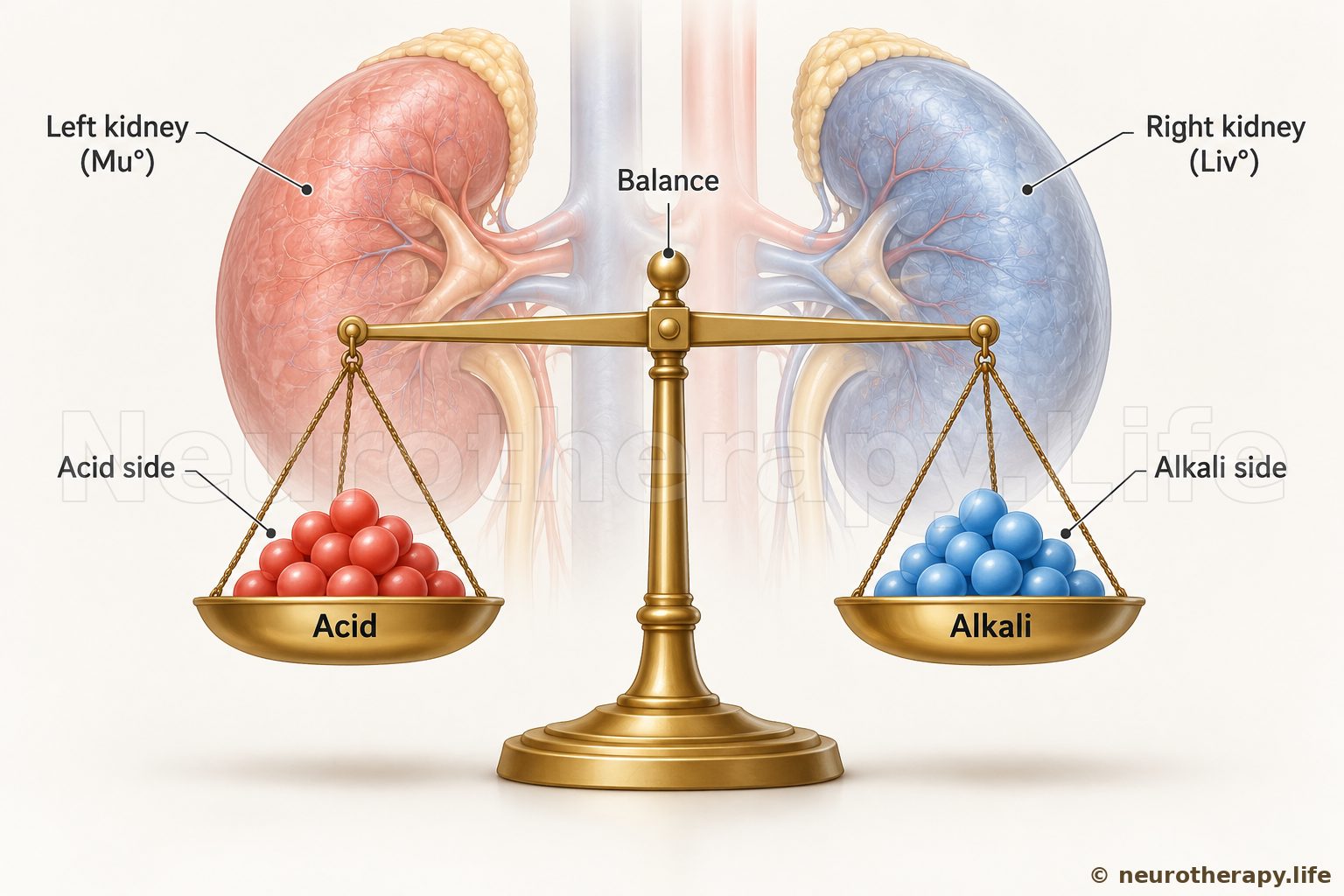
Neurotherapy (LMNT) sorts many illnesses into two directions, or 'two kingdoms': acid and alkali. A body on the acid side tends to feel dry, hot and tight — constipation, piles, dry skin, low spirits. The Acid point is named for that direction: the teaching says it reduces the symptoms of acid forming in the blood.
Acid is a chemical point: it is named for what it aims to change, not for the place it is given. It works as a pair with Mu°, the left kidney point, which the teaching also says reduces the acid of the blood. Its mirror on the other side of the chemistry is the Fluid or Alkali point.
It comes in two named forms, (1) Acid and (2) Acid, and it sits at the heart of the Acid Treatment Formula (ATF), the main formula for acidosis — a state in which the body leans too far to the acid side.
You lie on your right side with the left shoulder rolled a little outward. The lower leg stays straight and long; the upper leg is bent and rests on pillows so that the knee is level with the waist, with a pillow under your head.
Acid is given on the outer side of the lower thigh — the one lying along the mat — running from the waist down to the knee. This surprises students: the leg carefully placed on pillows is not the one worked. It is simply moved out of the way so the lower thigh is free.
Under the skin here runs a broad, tough band of fibrous tissue down the outside of the thigh, over a large muscle and the thigh bone. It is one of the most pressure-sensitive places on the body, which is why this point is handled with special care.
How this point is given — the tool, the pressure, the count and the exact movement — is deliberately not described here. Watch the demonstration video on this page, and learn the method hands-on from a trained Neurotherapist before giving it. Please do not give any point from a written description alone: a point given in the wrong place or the wrong way can do harm.
The exact technique is taught hands-on in the Neurotherapy (LMNT) course. See the course →
In LMNT teaching, Acid reduces the symptoms of acid forming in the blood and eases the organs of the left side. Body science agrees that the blood's acid–alkali balance is guarded very tightly by buffers, the lungs and the kidneys. How a press on the thigh reaches that balance is the therapy's own explanation, offered from long clinical experience; what is well known is that a short, strong sensation in one place quietens pain elsewhere for a while.
Acid belongs to the acid–alkali account of the therapy. Its partners and its mirror are read together before it is given.
Acid is never chosen from a disease name alone. The deciding finding is made by hand on the day: more pain at Mu°, and little or none at Liv°.
The Acid Treatment Formula in its usual form, ending with Adr — the form most people benefit from.
The ATF form ending with Thymus + Chest — for injury, infection, boils, or a new itch or allergy along with Mu° pain.
ATF form (b) with the sweat-gland point added and Adr deliberately left out.
The lighter form of the Acid formula.
The older, heavier form of the Acid formula.
A stripped Acid formula recorded for one patient in coma whose kidneys had failed — Mu° was left out.
“If there is no pain in Mu°, then Acid treatment is not to be given!”
A teaching case from a camp: a low-spirited woman with severe pain at Mu° was given the Acid treatment and felt so much better that people called it a miracle. The next day she asked for 'the same again', and it was given without any examination. Within minutes pain spread through her whole body — the acid had fallen too far, and the tender point had moved to Liv°. One alkali-side treatment settled her, and the lesson was written for good: check Mu° before every Acid treatment.
A composite case written to teach the reasoning — not one patient’s file.The outer thigh has a tough fibrous band pressed against bone, so there is little room for the tissue to give. That is why the press is kept very short and you are told before it starts.
Only after the therapist checks Mu° again. If the acid has already come down, the same treatment can push you too far the other way and cause pain.
The body holds blood pH in a very narrow band. Neurotherapy (LMNT) speaks of the 'acid picture' — dryness, constipation, burning, low spirits — and uses Acid to ease those symptoms. It works alongside your doctor's care, not instead of it.
No. Acid is not given when there are loose motions.
Healthy blood stays between about pH 7.35 and 7.45. Sugar and salt swing far more than this through an ordinary day.
Source: Guyton & Hall, Textbook of Medical Physiology, 14th ed., acid–base regulation.
Buffers in the blood act in seconds, the lungs blow off acid as carbon dioxide within minutes, and the kidneys do the slow adjusting over hours and days.
Source: Guyton & Hall, Textbook of Medical Physiology, 14th ed.
The iliotibial band is a long, flat strap of tough tissue running down the outside of the thigh from the hip to just below the knee. It is why the outer thigh feels so firm — and so tender when pressed.
Source: Gray's Anatomy, 41st ed., fascia lata and iliotibial tract.
Breathing fast blows off carbon dioxide and tips the blood briefly toward alkali — which is why an anxious person who over-breathes gets tingling fingers.
Source: Guyton & Hall, Textbook of Medical Physiology, 14th ed., respiratory regulation of acid–base balance.

Shows the Acid Treatment formula step by step: (8) Pan, (3) Gal, (5) Mu°, 3 Acid on the side of the right thigh, (4) Chest Only, and (6) Adr on the upper back, given without breaks. It is used to support the body's acid–alkali balance when acid is raised.
Note: the Acid Treatment formula is given only when the Mu° point is tender, and (6) Adr is not given in high BP, diabetes, cancer or HIV — the therapist checks first.

A step-by-step demonstration, in Hindi, of a treatment for periods that come early: (4) Spl, (4) Mu, (4) Lt. Ov., (4) Mu° and (2) Acid, with where each point lies and how the pressure is counted.
This point set is not the one in LMNT teaching, which links early periods to a thyroid working less and heavy flow to acidosis. Ovary points are not given to teenagers or in cancer.
This page explains what a Neurotherapy (LMNT) treatment is for; it is not a self-treatment guide and does not diagnose. Neurotherapy (LMNT) works alongside your medical care — keep taking the medicines your doctor prescribed.
Send COURSE for course details, or your name, age and health issue for a consultation.