Mu° pain (examination sign)
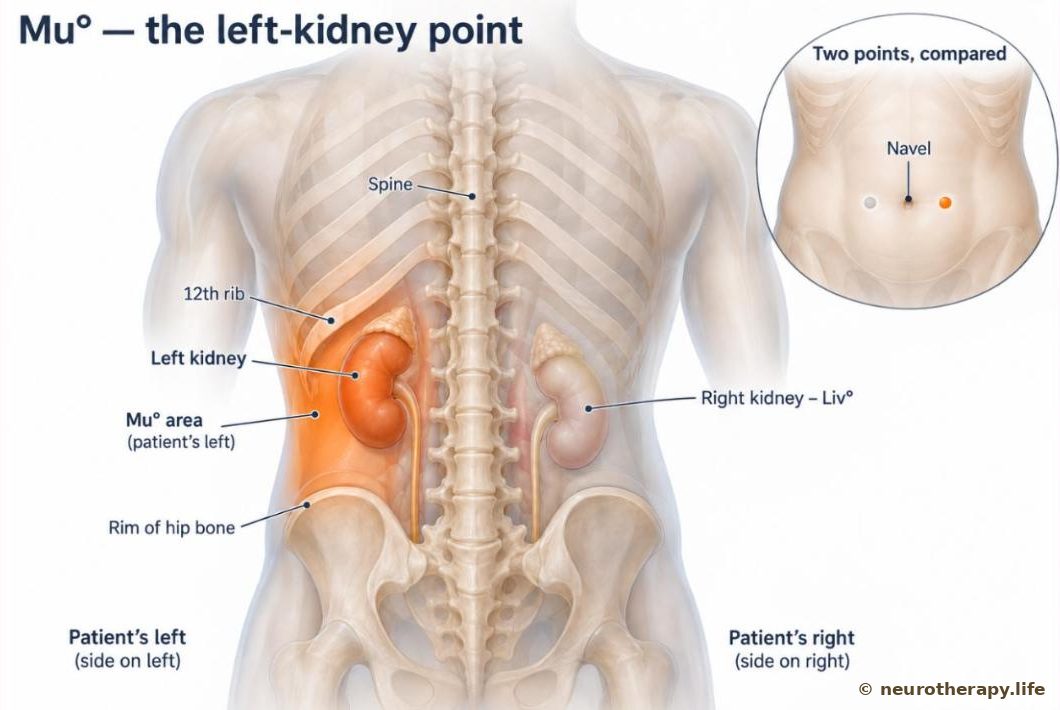
Mu° is one of the two key examination points of LMNT — the left-kidney point. When it hurts more than its partner Liv°, the therapist reads the body as leaning to the acid side that day, and plans the treatment from that.
- Flank pain is felt on one side of the body, between the upper belly and the back
- The kidneys lie either side of the spine, between the T12 and L3 vertebrae
- About 20% of the blood the heart pumps goes to the kidneys
Source: MedlinePlus (Flank pain); StatPearls (Garza & Leslie, 2025)
What is Mu° pain (examination sign)?
Mu° (say “Mu zero”) is not a disease. It is a pain point that a neurotherapist presses during the examination — the point LMNT links with the left kidney. On the back it lies in the left flank, between the last rib and the rim of the hip bone; in front it is checked beside the navel on the left.
Guruji divided the body's troubles into two directions: the acid side and the alkali side. Pain at Mu° — more than at its partner Liv°, the right-kidney point — places a person on the acid side that day. In LMNT this acid side is linked to too little water in the body and the blood. It is a hand reading, not a blood test, and it is different from medical acidosis, which is a hospital matter.
What are the symptoms?
- Pain when Mu° is pressed, sharper than at Liv° — and often at the Acid point and in the ring finger of the left hand
- Drinking little water; very hard stools and constipation
- Yellow urine, often with burning; a blocked nose; a dry cough or hard yellow mucus
- Dry, scaly or itchy skin and dry hair
- In women, periods that last longer than 4 days or are heavy
- Complaints mainly on the left side of the body, such as a stiff left shoulder
What causes it, and who is more likely to get it?
What LMNT links with the acid side
- Too little water in the body and the blood
- Age — the acid side is most common up to about 30 to 35 years
Complaints often seen with it
Other reasons for pain in the left flank (medical)
- Kidney stones or a kidney infection
- Spine problems, such as arthritis or disc disease
- Muscle spasm, bowel trouble, or shingles
How is it found?
Mu° pain is found by the therapist's hand, not by a machine. But pain in the flank can also come from the kidney, the spine or the bowel, so a doctor's check is needed when the pain is new, strong or does not settle.
Urine test
A urine test and urine culture look for blood, infection or signs of a stone.
Blood tests
Kidney and liver function tests show whether these organs are part of the problem.
Ultrasound or CT scan
Pictures of the belly and kidneys, and sometimes an X-ray of the low back, to find a stone, a swelling or a spine problem.
The therapist presses Mu° and Liv° and writes a grade for each — for example Mu° ⁺⁺⁺. The rule is simple: no strong pain at Mu°, no Acid Treatment Formula. And the check is repeated every single day, because the direction can change.
How Neurotherapy (LMNT) sees Mu° pain (examination sign)
In LMNT, Mu° is a compass, not a label. It tells the therapist which way the body is leaning today. The treatment follows the compass, not the name of the complaint — two people with knee pain may go home with different treatments, because one is sore at Mu° and the other at Liv°.
From a tender Mu° to the plan
- Press bothMu° and Liv° are pressed and graded side by side
- Mu° is sharperthe body leans to the acid side today
- Look for companyhard stools, yellow urine, dry skin, long periods, left-sided complaints
- ATFthe Acid Treatment Formula, ending with the left chest
- Check againonce Mu° has settled, the plan moves on to other treatments
LMNT teaching says the left chest eases the pain of Mu° and the right chest eases the pain of Liv°. That is why the Acid Treatment Formula ends on the left chest, and why the order of the two sides matters.
If there is no pain in Mu°, then Acid treatment is not to be given!
Neurotherapy (LMNT) treatment for Mu° pain (examination sign), step by step
Examine first
The therapist presses Mu° and Liv° and grades both, checks the Acid point, and asks about water, stools, urine, periods and every medicine and report.
Only a tender Mu° opens the door
Where there is more pain at Mu° — and only then — the Acid Treatment Formula is given. A report, a name or a guess is not enough.
Choose the form
Form (a) is the usual one. Form (b), which ends on Thymus + Chest, is chosen when there is also an injury, a viral or bacterial infection, pimples or boils, or a recent itch, allergy or skin trouble.
If Mu° is still sore
In LMNT, if pain remains at Mu° after Ku, the Round Arrow is given as needed until the Mu° pain clears.
Re-examine every day
Mu° and Liv° are compared again at every visit. When the Mu° pain has gone, other treatments suited to the person follow.
Points and formulas used
ATF, form (a)
The Acid Treatment Formula — (8) Pan (1) Gal (3) Mu° (1) Acid (4) Lt. Ch. Only (6) Adr; helps the body ease the acid side, given only when Mu° is more tender than Liv°.
Works through
Open →Never do this
- Check Mu° against Liv° before every treatment. Never give ATF on the alkali side (more pain at Liv°), and never give ALTF on the acid side. No strong pain at Mu°, no ATF. Mu°
- Diabetes: Thymus is not given, so ATF form (b) is not used — the one exception in LMNT teaching is a person for whom Adr did not suit, and the therapist writes down that decision. In diabetes the medicines stay exactly as the doctor set them, and sugar is checked. Diabetes
- Ku is not given to women during their periods or to people with low blood pressure — tell the therapist about both before the session. (4) Ku
- Flank pain with high fever, chills, vomiting, or red or brown urine needs a doctor the same day. Pain that goes on without explanation should also be checked.
- Cancer: if the person has cancer, (10) Pan, Thymus, Pit, Lu + Sh, Rt. Ov / Lt. Ov and (30) Medulla are never given — the therapist changes the plan.
- Keep taking the medicines your doctor prescribed. Neurotherapy (LMNT) works alongside your medical care, never instead of it.
Watch

Dr. Diwakar Shukla shows students where the Mu° point lies and how it is pressed, both to examine the body and as part of treatment.

Shows the Acid Treatment formula step by step: (8) Pan, (3) Gal, (5) Mu°, 3 Acid on the side of the right thigh, (4) Chest Only, and (6) Adr on the upper back, given without breaks. It is used to support the body's acid–alkali balance when acid is raised.
Note: the Acid Treatment formula is given only when the Mu° point is tender, and (6) Adr is not given in high BP, diabetes, cancer or HIV — the therapist checks first.

An overview of LMNT's diagnostic pain points — the places around the navel that the therapist presses to read the body before choosing a treatment.
How Mu° is found and pressed, the Acid Treatment Formula, and the diagnostic pain points around the navel.
From practice
The tailor who came about her knees
A teaching case — a composite from practice, not one patient's file
58 years · eleven years of knee and low back pain, and “gas from morning to night”
- What was found
- Tender at Const, at Pan and at Mu° — the Mu° pain the sharper of the pair. A coated tongue, and undigested food in the stool, admitted only on the third question. An old knee X-ray changed nothing; a recent blood count showing mild anaemia did, because it spoke of what she was absorbing.
- What was done
- Not a knee treatment. The sharper Mu° set the direction, and the undigested food set ten days of treatment without a break. She was told honestly, at the start, that an eleven-year problem would take many months. Two rules only: finish the night meal two hours before bed, and no water in the middle of meals. Hunger and sleep improved within days; the digestive work went on beyond day ten, and the knees were not touched.
- What it teaches
- The formula was chosen from Mu° and the whole picture, not from the complaint she walked in with. An honest timescale, given on the first day, is part of the treatment.
From Ayurveda and the kitchen
Test yourself
What research says
- Strong evidence
Pain from an inner organ is often felt far from the organ, on the body wall. The main explanation is that nerves from the organ and from the surface meet on the same nerve cells in the spinal cord.
- Strong evidence
The kidneys lie either side of the spine between the T12 and L3 vertebrae, and receive about 20% of the heart's output — which is why kidney trouble is felt in the flank.
Garza FA, Leslie SW. Anatomy, Abdomen and Pelvis: Kidneys. StatPearls. 2025.
No clinical trial of Neurotherapy (LMNT) examination or treatment at Mu° has been published yet. Improvements reported by neurotherapists are clinical observations.
For you
Younger adults
In LMNT the acid side is most common up to about 30 to 35 years. Drink water properly through the day.
Women
Periods that run longer than 4 days are read in LMNT as an acid-side sign. Any new change in your periods should also be checked by a doctor. Tell the therapist if your period has started.
People with diabetes
Say so at every visit. Thymus is not given, and your sugar medicines stay exactly as your doctor set them.
This page explains; it does not diagnose. Neurotherapy (LMNT) works alongside your medical care — keep taking the medicines your doctor prescribed, and see a doctor for any new or severe symptom.