1Five bones fused into one
The sacrum begins as five separate vertebrae that fuse into one triangular bone during the late teens and twenties.
Source: Gray's Anatomy, 41st ed., sacrum.
Also called: Ku, Kundali, Old Ku, Ku-Old, कुंडली
(4) Ku, the old Kundali, is a Neurotherapy (LMNT) treatment given face down at the very end of the spine. It is used to reduce alkali and to ease spasticity and stiffness in the joints, and it is never given during menstruation or to people with low blood pressure.
Ku is short for Kundali. At the very end of the spine — the sacrum and tail bone — the therapy gives two quite different kinds of Ku. One is (½) Ku, a single long hold whose written seconds decide its purpose. The other is Ku, the old Kundali, written as (4) Ku. They are not two strengths of one thing; they are separate treatments at one site, and a card asking for one is not satisfied by the other.
(4) Ku is used to reduce alkali — one of the two chemical directions the therapy reads in every patient — and to reduce spasticity and stiffness in the joints. It is one of the oldest members of the joint-pain formulas: it sits inside the very first Star formula, and was later brought back on purpose into the Alkaline Star.
The teaching notes honestly that the old Ku can bring pain at Mu° in some people — which means it increases acid, that is, it reduces alkali. In a patient leaning to acid that is a side-effect; in a patient leaning to alkali it is the very reason to choose it.
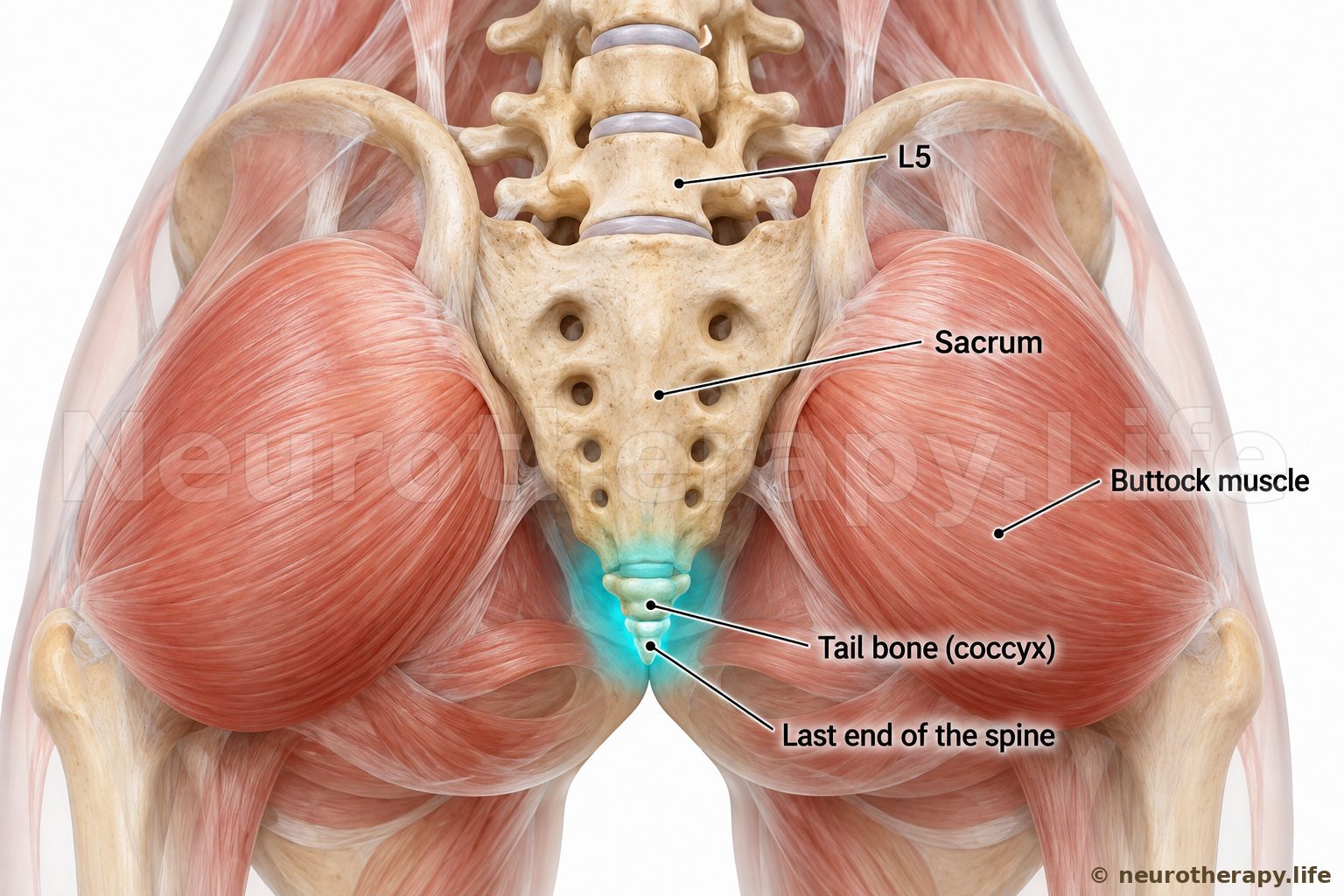
You lie face down with one and a half pillows under the chest, and your heels are turned to face each other. The therapist sits between your feet.
The treatment is given on the last end of the spinal column — the lower sacrum and tail bone.
How this point is given — the tool, the pressure, the count and the exact movement — is deliberately not described here. A demonstration video for this point is being prepared; until it is on this page, learn the method hands-on from a trained Neurotherapist before giving it. Please do not give any point from a written description alone: a point given in the wrong place or the wrong way can do harm.
The number written before a point's name is not a strength setting. Each numbered form is a separate named treatment with its own method and timing, taught hands-on in the course.
The exact technique is taught hands-on in the Neurotherapy (LMNT) course. See the course →
The teaching gives (4) Ku two purposes: to reduce alkali, and to reduce spasticity and stiffness in the joints. In the first Star formula it was also written to stimulate the pineal gland. Body science confirms the sacrum carries strong ligaments, the great buttock muscle, and nearby nerves that govern bladder and bowel — interesting anatomy, but a long way short of a demonstrated mechanism for these effects, which come from the therapy's clinical experience.
Each (½) Ku is one single hold at the same site, and its written time names a separate treatment with its own purpose. Two shorter holds never make one longer one.
It is chosen from the patient's findings — above all the direction, acid or alkali — and only after its two bars are checked.
The first Star formula, for old joint pain with pain at Gal and a bad stomach.
For joint pain with pain in both ring fingers and Liv° sore, or more pain in the right ring finger — the old Ku brought back on purpose.
A teaching case, put together from several patients: a woman in her forties had stiff hands and knees every morning, on a clear alkaline picture. Her blood pressure was checked lying and standing first — it was normal, which is what allowed Ku at all — and her tablets were left as they were. After a few sessions Mu° grew sorer, exactly as the teaching expects; Round Arrow was added until it cleared, and her morning stiffness eased over the following weeks.
A composite case written to teach the reasoning — not one patient’s file.No. They are given at the same place but are separate treatments with separate purposes. (½) Ku is one timed hold; the old Ku is a series of presses.
Because Ku is not given during menstruation. Neither this nor low blood pressure shows on a patient lying face down, so the therapist asks.
It is expected in some people: the old Ku can bring pain at Mu°. The therapist checks Mu° after Ku and gives Round Arrow until it clears.
No — Ku has its own counting rule, and reading it as four is a well-known mistake. The number names the treatment; how it is counted is taught in the course.
The sacrum begins as five separate vertebrae that fuse into one triangular bone during the late teens and twenties.
Source: Gray's Anatomy, 41st ed., sacrum.
The coccyx, or tail bone, is the remnant of a tail. It still anchors several pelvic-floor muscles and ligaments, and takes weight when we lean back to sit.
Source: Gray's Anatomy, 41st ed., coccyx.
The sacral nerves leaving through small holes in the sacrum control the bladder, the bowel and the pelvic floor.
Source: Gray's Anatomy, 41st ed., sacral plexus.
This page explains what a Neurotherapy (LMNT) treatment is for; it is not a self-treatment guide and does not diagnose. Neurotherapy (LMNT) works alongside your medical care — keep taking the medicines your doctor prescribed.
Send COURSE for course details, or your name, age and health issue for a consultation.