1The biggest crew
Neutrophils make up roughly half to two-thirds of all white blood cells in an adult.
Source: Standard haematology reference ranges (e.g. Guyton & Hall, Textbook of Medical Physiology, 14th ed.)
Also called: Half Ku 20, Half Kundali 20, Half Kundli 20, हाफ़ कुंडली 20
(½) Ku – 20 secs is the form of the half Ku that is named for the neutrophils, the white blood cells that fight infection first. It is given as a single steady press at the very end of the spine while you lie face down, and it runs through the undigested-food (UDF) and infection work of Neurotherapy (LMNT).
Ku is short for Kundali, a treatment given over the sacrum — the broad, triangular bone at the base of the spine. It comes in two kinds. The old Kundali, written like (4) Ku, is a series of presses. The half Ku, written (½) Ku, is one single, steady press. The 'half' is simply the name of this way of giving it; it does not mean half a dose.
The half Ku has a whole family of forms, and the timing written in each name is part of that form's identity. Each form is credited with a different target. This one, (½) Ku – 20 secs, is named for the neutrophils — the most common white blood cells, the body's first responders to germs.
In LMNT teaching it is given to fight infection, to raise the white cells, red cells and monocytes, and to correct infection or inflammation in the intestines of people who have had undigested food (UDF) for many years. It entered the UDF formulas, as Guruji's teaching says, to increase the body's immunity.
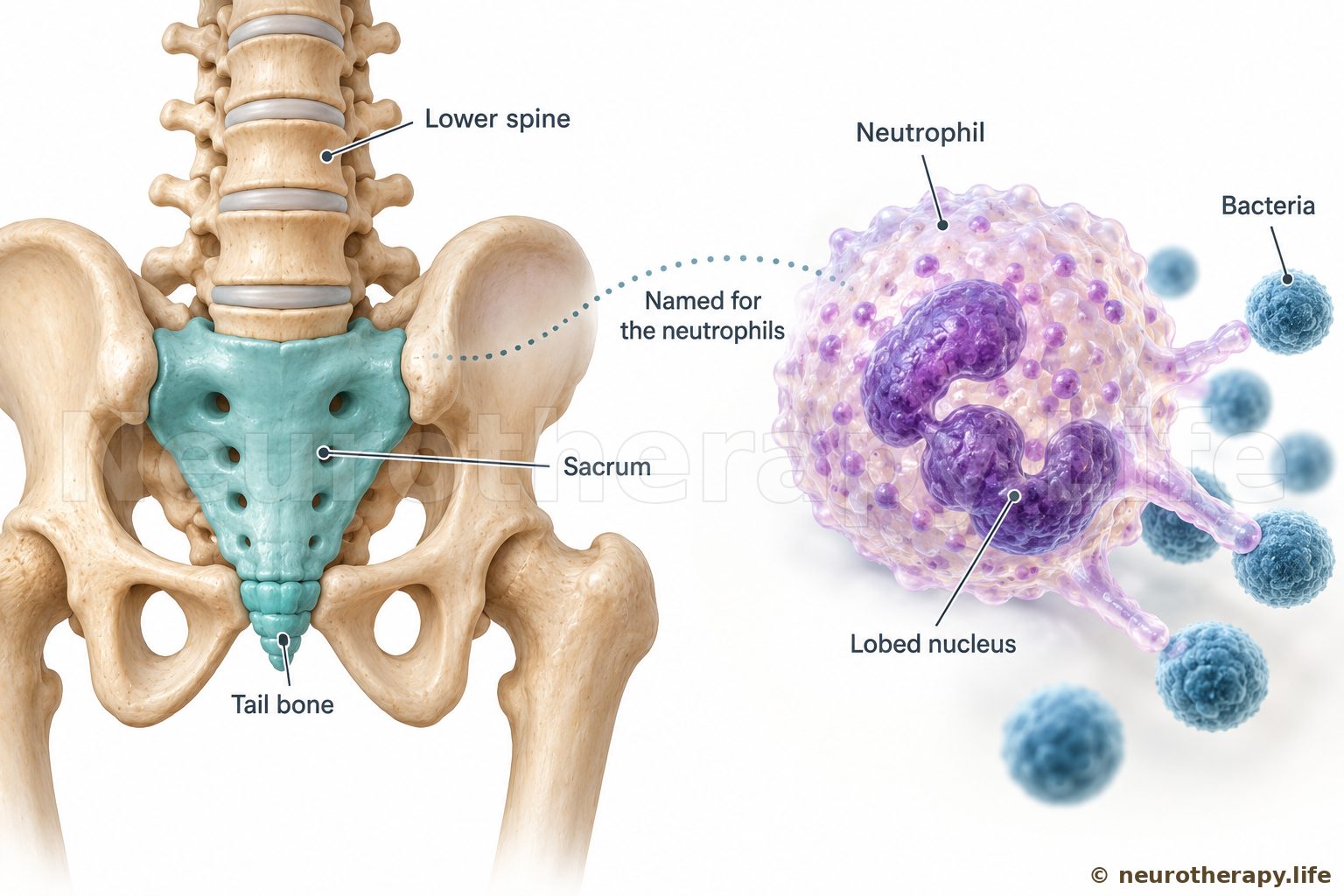
You lie face down with pillows under the chest, and the therapist sits at your feet. The press lands on the last end of the spinal column — the lower sacrum, just above the tail bone, in the midline.
This is the same place for every form of Ku. What changes from one form to another is the form named on the card, never the spot.
How this point is given — the tool, the pressure, the count and the exact movement — is deliberately not described here. Watch the demonstration video on this page, and learn the method hands-on from a trained Neurotherapist before giving it. Please do not give any point from a written description alone: a point given in the wrong place or the wrong way can do harm.
The number written before a point's name is not a strength setting. Each numbered form is a separate named treatment with its own method and timing, taught hands-on in the course.
The exact technique is taught hands-on in the Neurotherapy (LMNT) course. See the course →
LMNT teaches that this form works on the white cells, and that the four short half-Ku forms together reduce the effects of both inflammation and infection. These are the therapy's own clinical observations.
Every Ku form is given at the same place; each has its own name and its own purpose, and they are never merged.
It is used on its own and as part of formulas. Neurotherapy (LMNT) works alongside your medical care.
Where Ku first came into the UDF line, to increase immunity.
The shortest UDF treatment — none of it on the abdomen.
The general-purpose UDF formula.
For pain at Gas, B₁₂ and folic acid, with constipation.
The UDF formula for infection or inflammation.
Inside its hormone part — to make the hormones.
One of the four white-cell forms in the long formula for old diseases.
No. In LMNT the half is the name of the manoeuvre — one single press — not half a count.
It is a steady press of normal strength over the base of the spine. Most people feel firm pressure; tell the therapist at once if it is uncomfortable.
LMNT added it to the UDF formulas to increase the body's immunity, and uses it for infection or inflammation in the intestines after years of UDF.
No. A real infection needs a doctor. Neurotherapy (LMNT) is given alongside medical care, never instead of it.
Neutrophils make up roughly half to two-thirds of all white blood cells in an adult.
Source: Standard haematology reference ranges (e.g. Guyton & Hall, Textbook of Medical Physiology, 14th ed.)
Your bone marrow makes on the order of a hundred billion neutrophils every day, because each one lives only a short time in the blood.
Source: Summers C, et al. Neutrophil kinetics in health and disease. Trends in Immunology. 2010;31(8):318–324.
Pus is largely made of dead neutrophils that have fought germs at the site of an infection.
Source: General immunology texts (e.g. Janeway's Immunobiology)
The sacrum starts life as five separate vertebrae that fuse into one solid bone by early adulthood.
Source: Gray's Anatomy, 41st ed.

A step-by-step demo of the full UDF (undigested food) treatment: 15 Medulla, Parkhoo at both hips, Half Kundli, 10 Medulla with 1 Gas Only and 1 Gas 'I', then the Gal, Spleen, Liver and Mucus points and Ajay Normal on the thighs and forearms. It is given to support digestion when food passes through undigested.
A plain-language summary of how the body's innate (inborn) defences, including white blood cells that swallow and digest germs, work together with the adaptive immune system. It explains the body science behind the cells this form is named for; it does not test Neurotherapy (LMNT).
This page explains what a Neurotherapy (LMNT) treatment is for; it is not a self-treatment guide and does not diagnose. Neurotherapy (LMNT) works alongside your medical care — keep taking the medicines your doctor prescribed.
Send COURSE for course details, or your name, age and health issue for a consultation.