1Older than it looks
Many adults have small calcium deposits in the pineal gland, sometimes called 'brain sand', that show up on scans.
Source: Standard neuroradiology and neuroanatomy texts (e.g. Gray's Anatomy, 41st ed.)
Also called: Half Ku 60, Half Ku 80, Half Kundali 60 / 80, हाफ़ कुंडली 60 / 80
(½) Ku – 60 secs and (½) Ku – 80 secs are the two longest forms of the half Ku. Like the 40 form, they are given at the very end of the spine to stimulate the pineal gland — and the teaching says plainly that research on them is continuing.
Ku — Kundali — is given over the sacrum, the triangular bone at the base of the spine. The half Ku is a single steady press, and its named forms are credited with different targets. These two longest forms also stimulate the pineal gland, the small gland in the middle of the brain that makes melatonin.
What is known is stated exactly: they reach the same gland as the 40 form, and what the longer forms add has not yet been settled. Research on them is continuing. A therapist who uses them is expected to say so to the patient and to write down what is seen.
Along with the 40 form, they are listed among the treatments used to reduce alkalosis.
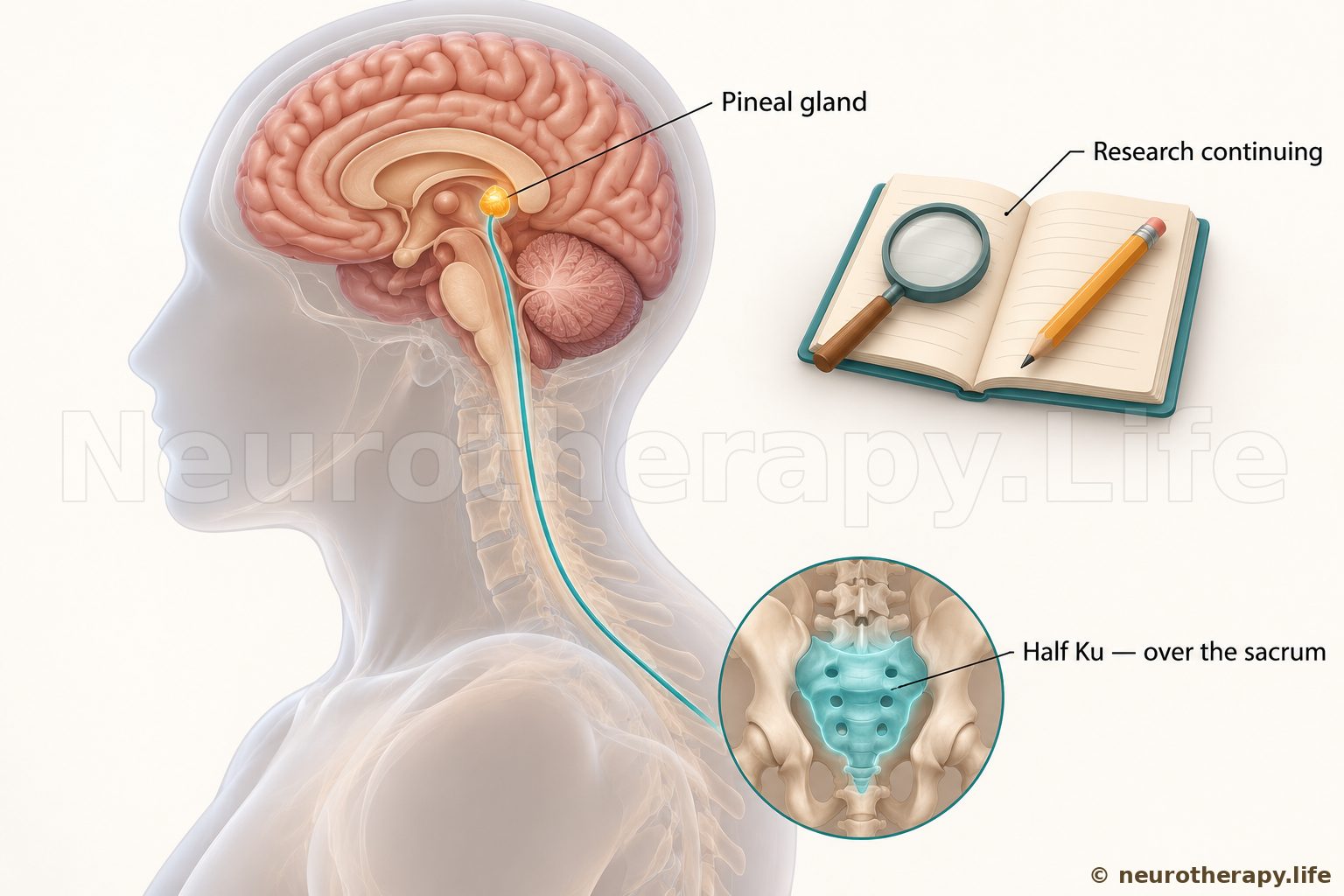
Face down with pillows under the chest, the therapist at your feet. The press lands on the last end of the spinal column — the lower sacrum, just above the tail bone, in the midline — the same spot as every Ku form.
How this point is given — the tool, the pressure, the count and the exact movement — is deliberately not described here. A demonstration video for this point is being prepared; until it is on this page, learn the method hands-on from a trained Neurotherapist before giving it. Please do not give any point from a written description alone: a point given in the wrong place or the wrong way can do harm.
The number written before a point's name is not a strength setting. Each numbered form is a separate named treatment with its own method and timing, taught hands-on in the course.
The exact technique is taught hands-on in the Neurotherapy (LMNT) course. See the course →
LMNT says only this much, and this page says no more.
They extend the pineal forms of the half Ku.
Use is limited to what is written. Neurotherapy (LMNT) works alongside your medical care.
“Wherever there is a question mark, it is an indication that this is my own thinking, on which other people can now do research.”
That is not known. They reach the same gland, and what the extra time adds is still being researched.
Because the therapy marks its own unfinished work openly, and an honest mark is more useful to you than a confident guess.
A trained therapist, from your findings — and they should tell you that these forms are still under study.
Many adults have small calcium deposits in the pineal gland, sometimes called 'brain sand', that show up on scans.
Source: Standard neuroradiology and neuroanatomy texts (e.g. Gray's Anatomy, 41st ed.)
Light reaching the eyes signals the brain's master clock, which turns melatonin production down.
Source: Ilahi S, Beriwal N, Ilahi TB. Physiology, Pineal Gland. StatPearls. 2023.
The whole pineal gland weighs about a tenth of a gram.
Source: Ilahi S, et al. Physiology, Pineal Gland. StatPearls. 2023.
A reference summary of the pineal gland and melatonin — how darkness raises it and light lowers it. Body science only; nothing has been published on these LMNT forms.
Ilahi S, Beriwal N, Ilahi TB. Physiology, Pineal Gland. StatPearls. 2023.
This page explains what a Neurotherapy (LMNT) treatment is for; it is not a self-treatment guide and does not diagnose. Neurotherapy (LMNT) works alongside your medical care — keep taking the medicines your doctor prescribed.
Send COURSE for course details, or your name, age and health issue for a consultation.