Also called: Half Ku 13, Half Kundali 13, Half Kundli 13, हाफ़ कुंडली 13
(½) Ku – 13 secs is the form of the half Ku named for the eosinophils, the white blood cells that rise in allergy and in parasite infections. It is one steady press at the very end of the spine, given lying face down, and it belongs to the infection and inflammation work of Neurotherapy (LMNT).
Overview
What is (½) Ku – 13 secs?
Ku — Kundali — is given over the sacrum, the triangular bone at the base of the spine. The half Ku is one single, steady press, and it comes in several named forms. The timing written in each name is the identity of that form, and each form is credited with a different target.
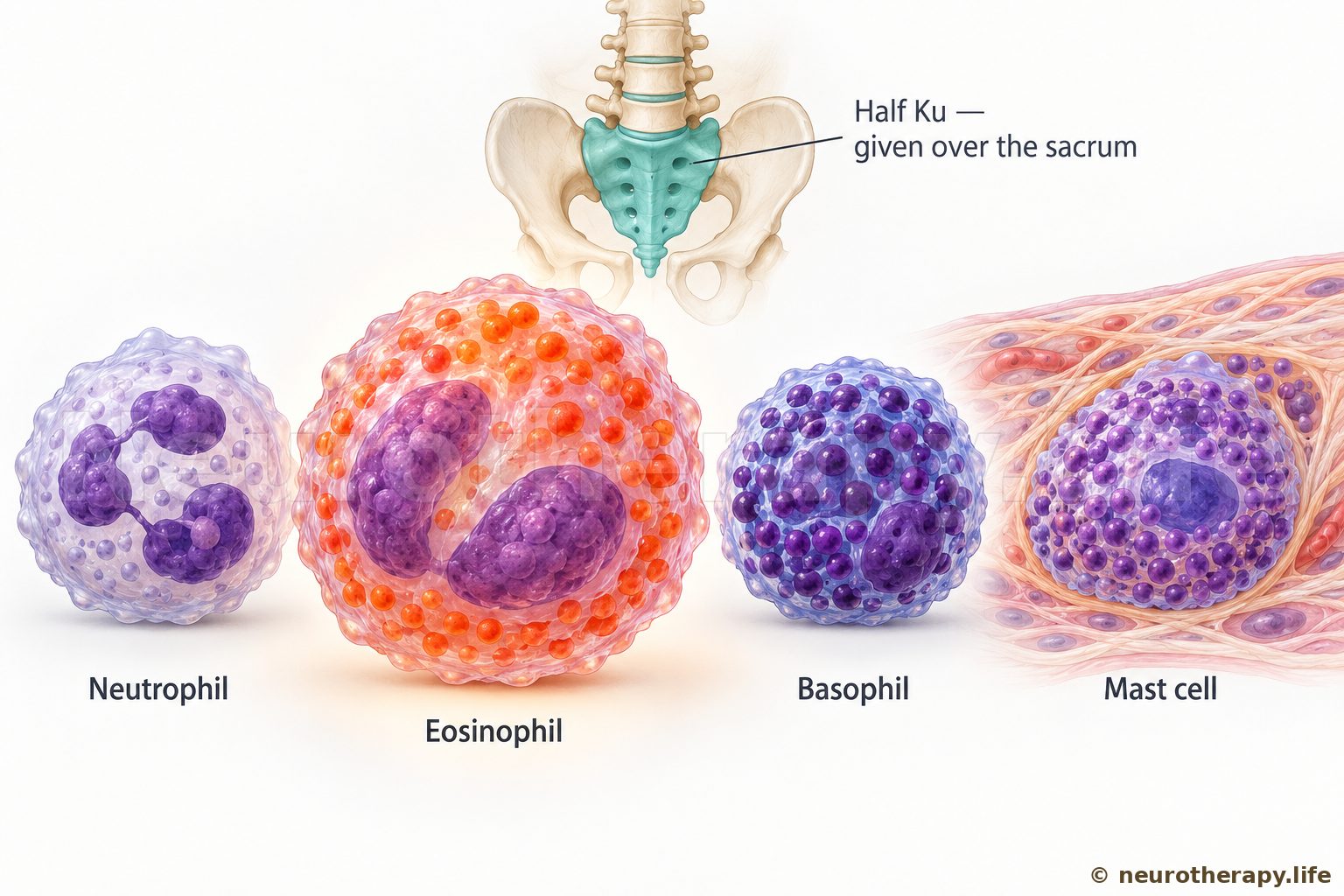
This form is named for the eosinophils. LMNT places it among four short half-Ku forms — named for neutrophils, eosinophils, basophils and mast cells — and teaches that these four together reduce the effects of both inflammation and infection.
What makes this family unusual is that it assigns a treatment to a cell rather than to a disease. That is a specific claim, and the therapy keeps it marked as its own observation.
Four short half-Ku forms, four white cells. This one is named for the eosinophil, with its orange-red granules.
Where it is given
Where is it given?
PositionLying face down
Body areaThe lower end of the spine — the sacrum, just above the tail bone, in the midline
You lie face down with pillows under the chest, and the therapist sits at your feet. The press lands on the last end of the spinal column — the lower sacrum, just above the tail bone, in the midline. Every Ku form is given at this same place.
How it is given
How is it given?
How this point is given — the tool, the pressure, the count and the exact movement — is deliberately not described here. A demonstration video for this point is being prepared; until it is on this page, learn the method hands-on from a trained Neurotherapist before giving it. Please do not give any point from a written description alone: a point given in the wrong place or the wrong way can do harm.
The number written before a point's name is not a strength setting. Each numbered form is a separate named treatment with its own method and timing, taught hands-on in the course.
The exact technique is taught hands-on in the Neurotherapy (LMNT) course. See the course →
What it does
What does it do?
In LMNT this form is given for the eosinophils, and with its three sister forms it is used to reduce the effects of inflammation and infection. These are the therapy's own clinical observations.
Named for the eosinophils.
One of the four white-cell forms in the Complement System formula, given for old diseases after a UDF formula.
For infection in a diabetic, it is named as one option in place of the viral formula.
If pain stays at Mu° after Ku, the Round Arrow is given as required until it clears. Round Arrow
In the Complement System formula, the three immunity-raising parts (Thymus, Lymph, Ton 'T') are left out in diabetes or any autoimmune disorder. Autoimmune disorders
“Wherever there is a question mark, it is an indication that this is my own thinking, on which other people can now do research.”
— Dr. Lajpatrai Mehra (Guruji)
Common questions
Is (½) Ku – 13 secs the same as giving the 20 form for less time?
No. In LMNT each timing is its own treatment with its own target. One form is never shortened or lengthened to make another.
Will I feel anything?
A firm, steady pressure at the base of the spine that is then released. Tell the therapist if it is uncomfortable.
Does it treat allergy directly?
LMNT names this form for the eosinophils and uses it within infection and inflammation work. Allergy has its own formulas, chosen by a therapist from your findings.
Surprising facts
1A small but busy crew
Eosinophils are usually only a few per cent of white blood cells, yet their numbers climb sharply in allergy and in worm infections.
Source: Rosenberg HF, Dyer KD, Foster PS. Eosinophils: changing perspectives in health and disease. Nature Reviews Immunology. 2013;13:9–22.
2Named after the dawn
They are called eosinophils because their granules take up eosin, a red-orange dye — and eosin is named after Eos, the Greek goddess of the dawn.
Source: Standard histology texts; Paul Ehrlich described the staining in 1879
3They live in tissues
Most eosinophils do not stay in the blood; they move into tissues such as the lining of the gut.
Source: Rosenberg HF, et al. Nature Reviews Immunology. 2013.
Test yourself
Research
Strong evidence
A plain-language summary of the body's inborn and learned defences, including the white blood cells that attack germs. It explains the body science behind the cells this family is named for; it does not test Neurotherapy (LMNT).
This page explains what a Neurotherapy (LMNT) treatment is for; it is not a self-treatment guide and does not diagnose. Neurotherapy (LMNT) works alongside your medical care — keep taking the medicines your doctor prescribed.
Ready to begin?
Send COURSE for course details, or your name, age and health issue for a consultation.