Also called: UDF formula for infection or inflammation, the inflammation UDF formula
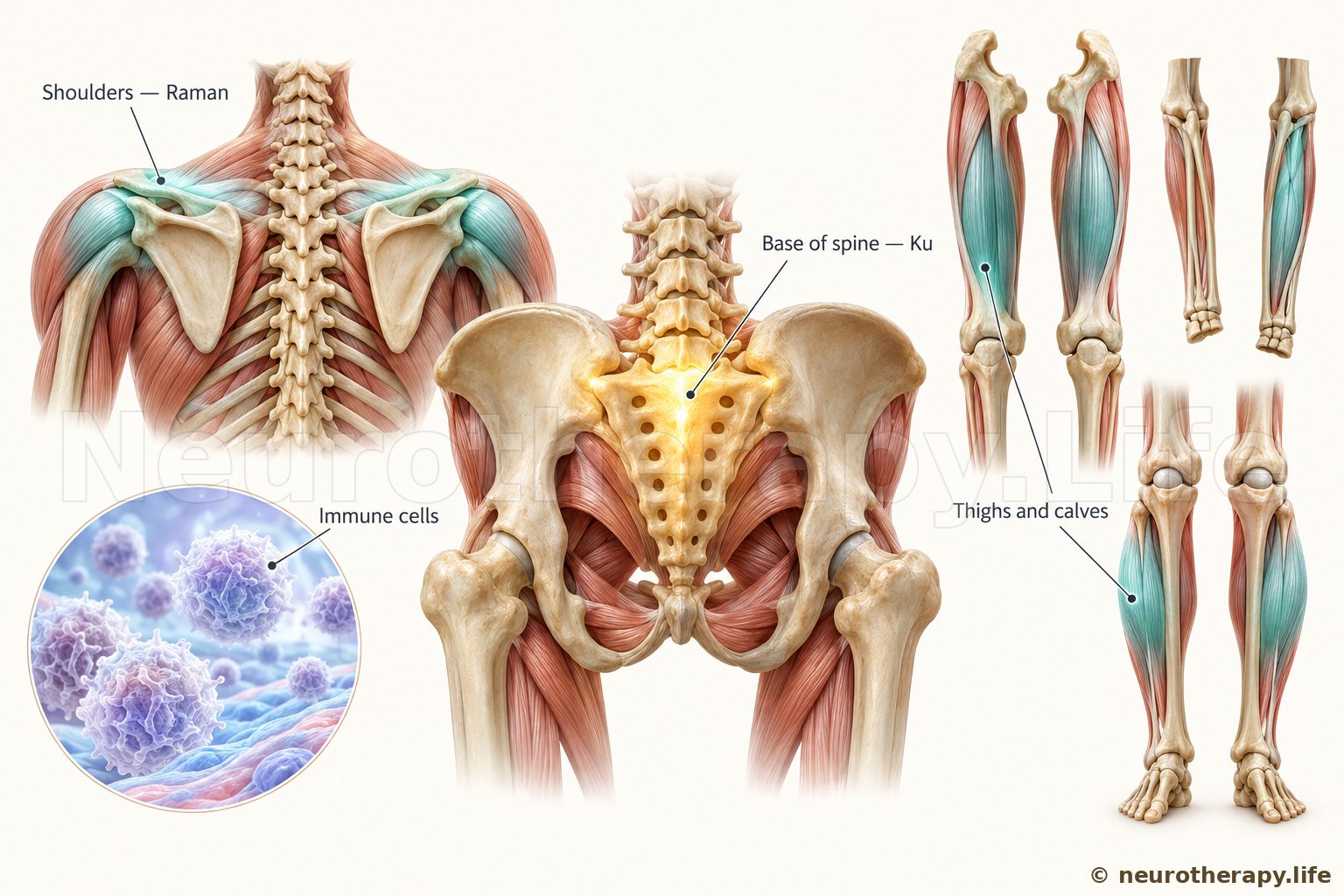
This is the member of the Neurotherapy (LMNT) UDF family chosen when undigested food in the stool comes with long, low-grade infection or inflammation. It opens with Raman instead of the usual neck treatment and leans most heavily on the sacral hold at the base of the spine.
Overview
What is the infection or inflammation UDF formula?
UDF means undigested food in the stool. In its seventh generation, the UDF family split into four formulas matched to the patient's tendencies. This one is written for patients who have infection or inflammation along with UDF.
Two things set it apart. It is the only formula of its group that opens on Raman — a seated treatment the teaching links with the peritoneum, the thin lining of the belly — and drops the usual opening on the neck. And it gives the sacral hold, Ku, over more sessions than any other formula of the UDF family.
The teaching reads that weighting plainly: here, the Ku is the treatment, and everything else is the UDF family's ordinary spine.
In this UDF formula the sacral hold at the base of the spine carries the main weight; Raman opens it and the usual UDF spine follows.
What it is for
What is this formula used for?
For undigested food in the stool together with infection or inflammation — the long, low, grumbling kind, in a patient otherwise well.
To support the body's own defences through the sacral hold, which the teaching links with infection and inflammation wherever they are in the body.
To set digestion and absorption right at the same time, through the compulsory UDF pair and the absorption closing.
Points it works through
Which points does this formula work through?
I (3) Raman Treatment · II (2) Rt. Parkhoo (2) Lt. Parkhoo · III (½) Ku – 20 sec. × 6 Treatments · IV (10) Medulla (1) Gas Only – 6 Pts (1) Gas 'I' – 6 Points · V (8) Pan (1) Gal (2) Liv – 3 Pts (1) Gas 'I' – 6 Pts
The formula has five parts: Raman, the hips, the sacral hold, the compulsory pair, and the Ajay Normal sequence. The points are listed here as a set, with what each contributes. The exact method is taught hands-on in the Neurotherapy (LMNT) course. This page lists the points of the formula and what each one contributes; it does not describe how any point is given. For the method, watch the demonstration video of each point on its own page and learn hands-on from a trained Neurotherapist. Please do not give a formula from a written description alone.
Position:Seated for Raman; lying on the side for the hips; face down (prone) for the sacral hold; seated for (10) Medulla; lying on the back (supine) for the rest.
The exact technique is taught hands-on in the Neurotherapy (LMNT) course. See the course →
How it works
How does this formula work?
The teaching holds that when someone has UDF, infection sets in in many organs, and that the sacral hold, Ku, helps put infection and inflammation right wherever they are. To explain it, Guruji studied the white blood cells and offered a theory, clearly called a theory.
Ku may rouse the monocytes, or the granulocytes, or — through the hypothalamus and pituitary — the hormone ACTH, which tells the adrenal glands to make cortisol and calm inflammation. In Guruji's words, which of these it does is the body's work to see. The teaching does not choose for it.
Around that Ku, the formula keeps the UDF spine: (10) Medulla with Gas Only, then the Ajay Normal sequence for absorption. Gas 'I' is given lightly at both points where it appears.
Its family
Which formulas are related to this one?
It is one of the four symptom-matched UDF formulas, and it shares its heavy Ku with the very first complete UDF treatments.
General UDF formula — The member written for everybody, when no special tendency is found.
Simplest UDF treatment — The shortest complete UDF treatment, built on the same heavy sacral hold, with nothing on the abdomen.
ITF — The Inflammation Treatment Formula — Neurotherapy (LMNT)'s main formula for inflammation.
Ajay Normal — The absorption sequence this formula closes with.
What it is used for
When is this formula used?
It is chosen when UDF comes with long-standing infection or inflammation in a patient well enough to be treated. It always works alongside medical care.
This formula is not a treatment for infection. Before it is given, there must be no fever, shaking chills, confusion, breathlessness, faintness on standing, spreading redness of the skin or hot swollen joint. If any is present, there is no session — the patient sees a doctor that hour. How to tell a patient to see a doctor
The sacral hold (Ku) is never given to a woman during her periods, nor to someone with low blood pressure. Because this formula gives Ku over many sessions, the first question is asked at every single one. Low blood pressure
(10) Medulla is never given in diabetes or in cancer. In heart patients it is never given on both sides — only (10) Left Medulla. (10) Medulla
Before Raman, the therapist checks the Liv° and Mu° points; if Liv° is painful and Mu° is not, Raman is not given without that check, because the pain can increase. Raman
Pan is not given in fits or seizures, nor in schizophrenia. Gal is not given in leukaemia, other diseases with a raised white cell count, or asthma. Pan
Keep taking the medicines your doctor prescribed, including any antibiotics. Neurotherapy (LMNT) works alongside your medical care, never instead of it.
Guruji says
“Whether it provokes the granulocytes, or the monocytes, or the ACTH — that is the body's work to see.”
— Dr. Lajpatrai Mehra
Common questions
I have an infection. Can this formula replace my antibiotics?
No. Despite its name, it is not a treatment for infection. It is used alongside medical care, for the long, low-grade kind of trouble in someone otherwise well. A serious infection needs a doctor at once.
What makes this different from the other UDF formulas?
It opens with Raman and drops the usual opening on the neck, and it gives the sacral hold over more sessions than any other UDF formula.
Why so much attention to the base of the spine?
The teaching attaches the sacral hold to infection and inflammation, and offers a theory that it rouses the white cells or the cortisol chain. It names these possibilities honestly as a theory.
Surprising facts
1Some immune cells live for years
Monocytes circulate in the blood for only a day or so, but once they settle in tissues as macrophages, some can live for months or even years.
Source: Guyton & Hall, Textbook of Medical Physiology, 14th ed. — the monocyte–macrophage system.
2Cortisol is the body's own anti-inflammatory
The steroid medicines doctors use against inflammation are copies of cortisol, the hormone the adrenal glands release when the pituitary sends ACTH.
Source: Coutinho AE, Chapman KE. The anti-inflammatory and immunosuppressive effects of glucocorticoids. Mol Cell Endocrinol. 2011;335(1):2–13.
3The spleen stores an emergency supply of monocytes
Research found a reservoir of monocytes held in the spleen that is sent out to sites of injury and inflammation when needed.
Source: Swirski FK, et al. Identification of splenic reservoir monocytes and their deployment to inflammatory sites. Science. 2009;325(5940):612–616.
Test yourself
Research
Strong evidence
This review explains how cortisol-like hormones (glucocorticoids), released through the pituitary–adrenal chain, damp down inflammation and immune activity — the body science behind the teaching's ACTH theory.
This page explains what a Neurotherapy (LMNT) treatment is for; it is not a self-treatment guide and does not diagnose. Neurotherapy (LMNT) works alongside your medical care — keep taking the medicines your doctor prescribed.
Ready to begin?
Send COURSE for course details, or your name, age and health issue for a consultation.