1About a litre a day
The pancreas pours roughly a litre of digestive juice into the gut every day.
Source: Guyton & Hall, Textbook of Medical Physiology (daily pancreatic secretion about 1,000 mL).
Also called: 8 Pan, Eight Pan, 8 पैन
(8) Pan is the everyday form of the Pan point, aimed at the pancreas's digestive enzymes and its sodium bicarbonate, which cools stomach acid. It is used for poor appetite, indigestion and stomach ulcer, and it opens more formulas than any other point — the Normal treatment and the whole Heparin family among them.
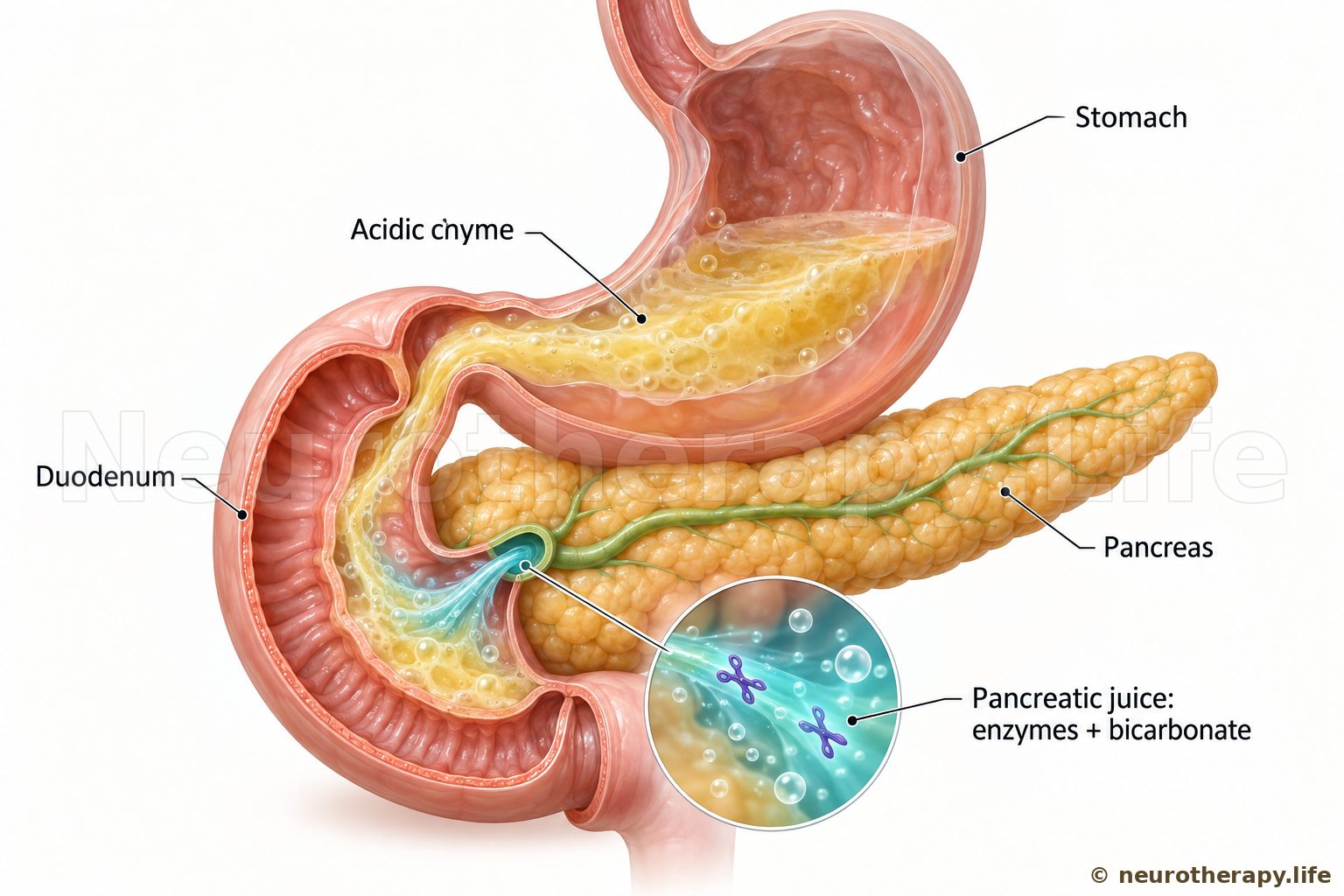
The pancreas has two jobs. One is hormones for blood sugar. The other — and the one (8) Pan is aimed at — is digestion. The pancreas pours a juice into the first part of the small intestine (the duodenum) that holds enzymes, proteins that break down fat, protein and starch, and bicarbonate, a natural alkali.
Food leaves the stomach as a sour, acidic mash called chyme. In the teaching, (8) Pan is given so that the bicarbonate calms that acid, and so that the enzymes are there to finish the digestion.
(8) Pan is the form you will meet most often. The very first formula of the therapy, the Normal treatment, opens with it, and so do the Heparin formulas, the Genes formulas and many treatments for the stomach.
You lie flat on your back, with one pillow under both thighs and nothing under the head or the waist. (8) Pan is given on the front of both thighs together, in the middle of each thigh, just below the crease where the thigh meets the hip.
This is exactly the same spot as every other form of Pan. The place does not change from one number to the next — only the treatment does. The middle of the thigh is chosen on purpose: further inward lies the groin, where the main artery, vein and nerve of the leg run close under the skin.
Why the thigh, when the pancreas lies deep in the belly? The Neurotherapy (LMNT) map works by a crossing rule: pressure on the legs answers pains above the navel. The point is named for what it is meant to move, not for the place it is given on.
How this point is given — the tool, the pressure, the count and the exact movement — is deliberately not described here. Watch the demonstration video on this page, and learn the method hands-on from a trained Neurotherapist before giving it. Please do not give any point from a written description alone: a point given in the wrong place or the wrong way can do harm.
The number written before a point's name is not a strength setting. Each numbered form is a separate named treatment with its own method and timing, taught hands-on in the course.
The exact technique is taught hands-on in the Neurotherapy (LMNT) course. See the course →
In Neurotherapy (LMNT) teaching, (8) Pan rouses the digestive side of the pancreas. Body science confirms what the pancreatic juice does; how a press on the thigh reaches the gland is the therapy's own explanation, offered from long clinical experience.
Every number of Pan is given at the same place, and each is its own treatment with its own uses and its own cautions. A caution written against one number does not travel to the others — but the general Pan cautions apply to all.
(8) Pan is used on its own and, far more often, as the opening step of a formula. The therapist checks the blocked list first.
The first formula ever made, for everyday stomach complaints — (8) Pan opens it.
The Normal line with Spl left out, for nourishment.
Normal and Ajay Normal given together as one treatment.
The reversed Normal, for loose motions.
The parent Heparin formula — pancreas, liver, lung. Can be given to all patients without a wound.
Heparin headed by Medulla — headache, brain disease, paralysis.
The acid branch of the Heparin family.
Heparin for night cramps and pain all over with weakness.
White discharge, uterus and prostate problems, low back pain.
The undigested-food treatment where Pan comes in for the pancreatic enzymes.
The Coma treatment, headed by (8) Pan.
“By Pan we stimulate the pancreas. Stimulating in different numbers produces different effects.”
Because digestion is the root of so much else in this therapy, and the pancreas is asked first. The Normal, Heparin and Genes formulas all open with it.
Not in the sense of a dose. Each number is a different treatment: (8) Pan for digestion, (2) Pan for somatostatin, (10) Pan for insulin.
Acidity is one of its named uses, usually within a formula chosen from your findings. Patients have reported relief. If you have black stools, vomiting of blood or severe pain, see a doctor first.
Not on its own. Pan raises alkali and is blocked in fits — but it may be given when it sits inside a Heparin formula. The therapist decides from your card.
The pancreas pours roughly a litre of digestive juice into the gut every day.
Source: Guyton & Hall, Textbook of Medical Physiology (daily pancreatic secretion about 1,000 mL).
Pancreatic juice is rich in bicarbonate — chemically the same family as baking soda — so it neutralises the acid that arrives from the stomach.
Source: Guyton & Hall, Textbook of Medical Physiology (secretin-stimulated bicarbonate secretion).
The pancreas makes its protein-cutting enzymes in an inactive form, switched on only in the intestine — otherwise they would digest the pancreas itself.
Source: Guyton & Hall, Textbook of Medical Physiology (trypsinogen activation by enterokinase).
Plasmin, which dissolves clots, and trypsin, which digests protein, belong to the same enzyme family — the resemblance Guruji reasoned from when he put Pan at the head of the Heparin formulas.
Source: Both are serine proteases with a trypsin-like fold (standard biochemistry, e.g. Lehninger Principles of Biochemistry).

A practical demo by Dr. Diwakar Shukla on how to give 1, 2 and 8 Pan — the pancreas point — to support a weak pancreas.

Shows how to find the Pan (pancreas) point in the fold at the top of both thighs, and how to give 1 Pan, 2 Pan, 2 Pan × 6 and 8 Pan with the feet, holding chairs for support. It is used to support the pancreas in diabetes and indigestion.

Shows the P. Heparin formula: (8) Pan at the top of the thighs, (7) Liv on the thigh and forearm, and (8) Chest Only with the palms on the chest. In the video it is given as the last part of the Angina treatment, to support circulation.
This page explains what a Neurotherapy (LMNT) treatment is for; it is not a self-treatment guide and does not diagnose. Neurotherapy (LMNT) works alongside your medical care — keep taking the medicines your doctor prescribed.
Send COURSE for course details, or your name, age and health issue for a consultation.