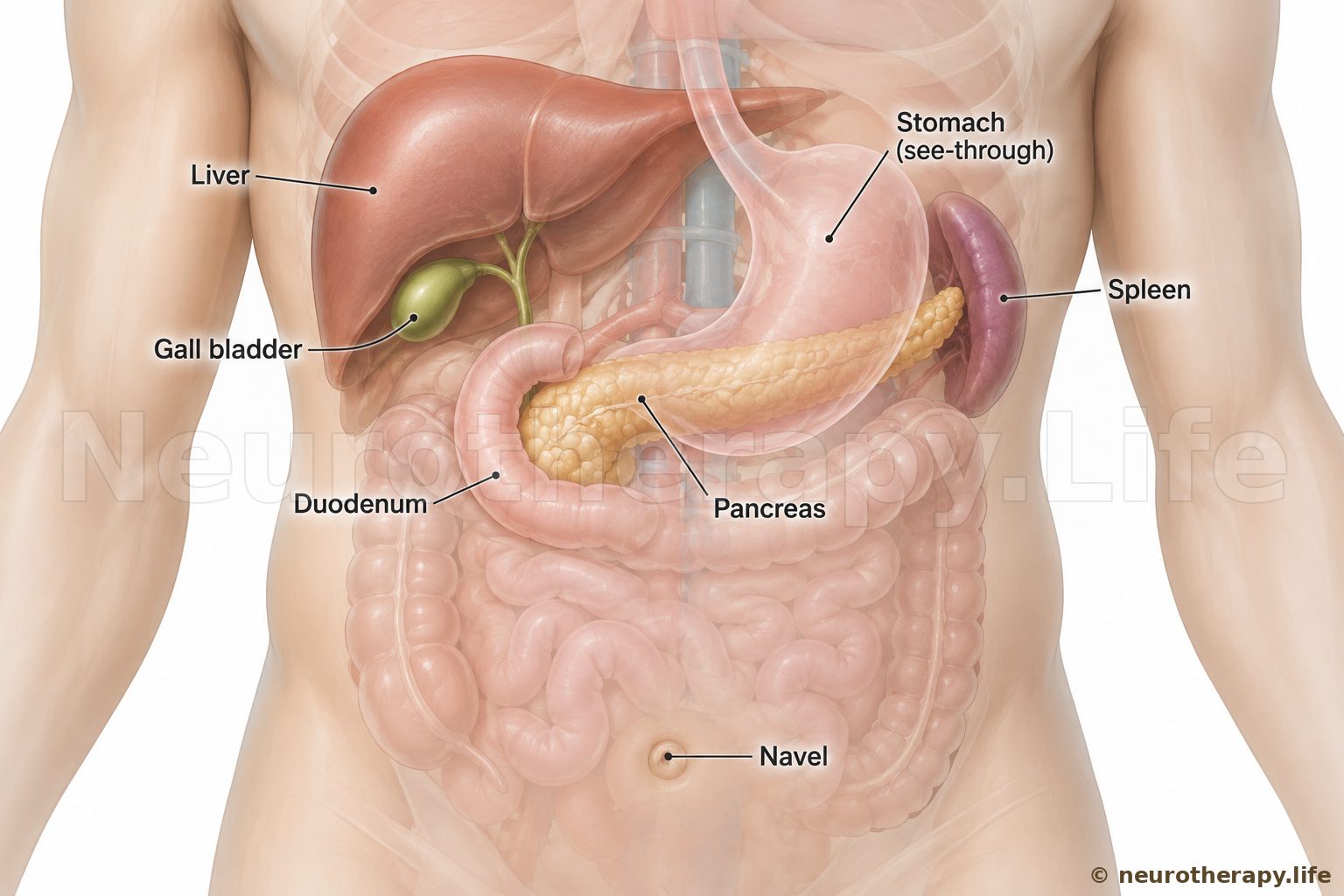
A long, soft gland hidden behind the stomach that does two jobs at once: it pours digestive juice into the intestine, and it releases insulin and glucagon into the blood to keep sugar steady. In Guruji's teaching, the number of presses given at the Pan point decides which of its chemicals is called for.
Overview
What is the pancreas?
Your pancreas is a long, flat, soft gland, about 15 cm long, lying deep in the upper belly behind the stomach, across the back wall of the abdomen. It belongs to two body systems at once: the digestive system and the endocrine (hormone) system.
Nearly all of it makes pancreatic juice: enzymes that digest protein, fat and starch, and bicarbonate that neutralises stomach acid. Scattered through it are about a million tiny islands of cells, the islets of Langerhans, which make insulin, glucagon and other hormones that keep your blood sugar in a safe range.
In Guruji's teaching the pancreas and the liver are the body's two 'raw-materials works', and the pancreas carries the chief responsibility for digesting protein. Its point, Pan, is read at the pit of the stomach — the one front point where the named organ really does lie more or less behind the mark.
Hidden behind the stomach: the pancreas lies across the back of the upper belly, from the duodenum to the spleen.
Function
What does the pancreas do?
The pancreas works in two directions. Its juice goes out through a duct into the intestine; its hormones go straight into the blood.
Makes about 1 to 1.5 litres of pancreatic juice a day.
Its enzymes digest protein (trypsin and chymotrypsin), fat (lipase) and starch (amylase).
Its bicarbonate neutralises the acid coming from the stomach, so the intestine's enzymes can work.
Insulin, from the beta cells, lowers blood sugar by helping cells take it in and store it.
Glucagon, from the alpha cells, raises blood sugar between meals by telling the liver to release it.
Somatostatin, from the delta cells, acts as a brake on other hormones and on digestive juices.
The vagus nerve starts it
The sight and smell of food send signals down the vagus nerve, and the pancreas begins to make juice before the meal arrives.
Acid calls for bicarbonate
When acid from the stomach reaches the duodenum, the hormone secretin tells the pancreas to send a watery juice rich in bicarbonate.
Fat and protein call for enzymes
Fat and protein release the hormone CCK, which calls for juice rich in enzymes — and squeezes the gall bladder at the same time.
Enzymes switch on in the gut
The enzymes travel in a safe, inactive form. In the duodenum an enzyme of the gut lining switches trypsin on, and trypsin switches on the rest.
Sugar rises, insulin follows
As digested sugar enters the blood, beta cells in the islets sense it and release insulin within minutes.
Between meals, glucagon
When sugar falls, alpha cells release glucagon, and the liver lets out stored sugar to keep the brain supplied.
How does the pancreas work with other organs?
Stomach — Sends acid chyme that the pancreas's bicarbonate neutralises.
Intestines — Receive the juice; their hormones, secretin and CCK, tell the pancreas what to send.
Gall bladder — Shares the same small opening into the duodenum, and answers the same signal, CCK.
Liver — The main target of insulin and glucagon, which tell it to store sugar or release it.
Vagus nerve — Starts the flow of juice and fine-tunes the release of insulin.
Spleen — Its tail reaches the spleen, and the spleen's vein runs along the back of the pancreas.
From right to left the pancreas has a head, a neck, a body and a tail. Inside, one main duct runs its whole length, and two kinds of tissue do its two jobs.
Regions
Head — The widest part, nestled in the C-shaped curve of the duodenum on the right. The bile duct passes through it.
Neck — A short, narrow part in front of the great veins.
Body — Crosses the back wall in front of the spine and the great artery, the aorta, at about the first lumbar vertebra.
Tail — The thin left end, reaching up to the spleen.
Ducts
Main pancreatic duct — Runs from tail to head, collecting juice from thousands of small branches.
Shared opening — It joins the common bile duct at the ampulla of Vater, and both open into the duodenum through one small doorway.
Accessory duct — Many people have a second, smaller duct that opens a little higher up.
Two kinds of tissue
Acinar cells — Grape-like clusters that make the digestive enzymes — about 98% of the gland.
Duct cells — Line the small ducts and add the bicarbonate.
Islets of Langerhans — Tiny islands of hormone cells — beta cells (insulin), alpha cells (glucagon) and delta cells (somatostatin) — making up only 1–2% of the gland.
Where is the pancreas located?
The pancreas lies deep in the upper belly, behind the stomach, stretched across the back wall at about the level of the first lumbar vertebra. It sits in front of the spine, the aorta and the great vein; its head lies in the curve of the duodenum on the right, and its tail touches the spleen on the left, above the left kidney.
Because it lies so deep, pancreas pain is often felt in the upper middle of the belly and goes straight through to the back.
In LMNT, the Pan point is at the pit of the stomach — the soft dip at the bottom of the breastbone where the rib margins meet. On the back chart, 'pain of pancreas' is shown in the middle of the back beside the spine. In treatment, Pan is given on both thighs at once, just below the hip crease, and — unlike other thigh points — it does not travel down the leg.
It is soft, pale pinkish-yellow and lumpy, like a long, flattened bunch of tiny grapes. Its shape is often compared to a tadpole or a fish lying on its side: a broad head on the right tapering to a thin tail on the left.
Unlike the liver, it has no tough outer capsule, which is one reason inflammation can spread from it quickly.
How big is the pancreas?
An adult pancreas is about 12 to 15 cm long and weighs roughly 70 to 100 g — about as much as a small banana.
Its islets, though they number around a million, together weigh only a gram or two.
Conditions and disorders
What conditions and disorders affect the pancreas?
Because it has two jobs, the pancreas can fail in two ways: in its hormones, which leads to diabetes, or in its digestive juice, which leads to pain and poor digestion.
Blood sugar
DiabetesToo little insulin (type 1) or insulin that works poorly and beta cells that tire (type 2).
ObesityExtra weight makes insulin work less well and raises the risk of type 2 diabetes.
Digestion
Abdominal painPancreatitis — inflammation of the pancreas — causes severe upper belly pain that goes through to the back.
Great thirst, passing a lot of urine, tiredness and weight loss — signs of high blood sugar
Severe pain in the upper middle belly going through to the back, often with vomiting — an emergency
Pale, greasy, bad-smelling stools that float and are hard to flush
Weight loss even while eating normally
Yellow eyes or skin without pain, or new diabetes after 50 with weight loss — see a doctor soon
In people on diabetes medicines: shaking, sweating or confusion when sugar drops too low
What tests check the pancreas?
Blood sugar and HbA1c — Fasting and after-meal sugar, and HbA1c, which shows the average over about three months.
Amylase and lipase — Blood levels of pancreatic enzymes rise sharply in pancreatitis.
Stool elastase — Shows whether the pancreas is making enough digestive enzymes.
C-peptide and antibody tests — Help tell type 1 from type 2 diabetes.
Ultrasound, CT or MRI — Pictures of the gland, its duct and nearby stones.
Endoscopic ultrasound — An ultrasound probe on an endoscope looks at the pancreas closely from inside the stomach.
How are pancreas problems treated?
Food, activity and weight — The foundation of type 2 diabetes care — and they can delay or prevent it in people at risk.
Diabetes medicines and insulin — Tablets and injections lower blood sugar; people with type 1 diabetes need insulin every day for life.
Hospital care for pancreatitis — Fluids through a drip, pain relief and close watching; the cause, such as gallstones or alcohol, is then dealt with.
Enzyme capsules — Taken with meals when the pancreas cannot make enough digestive enzymes.
Stopping alcohol and tobacco — Both are major causes of pancreatitis, and smoking raises the risk of pancreatic cancer.
Surgery — For some tumours, and for complications of long-standing pancreatitis.
Neurotherapy (LMNT)
Guruji's teaching treats the pancreas as a gland whose many chemicals can be called for one at a time, by the count of presses. It is given at the Pan point — both thighs together, just below the hip crease — with every press exactly six seconds, at exactly the same place, and with the weight equal on both feet. (2) Pan is written for somatostatin, 'to stop anything hyper'. (4) Pan is for glucagon, for weakness from lack of sugar, and for appetite and height in small children. (8) Pan is for the digestive enzymes and for sodium bicarbonate, which calms stomach acid — it is the first step of the Normal formula. (10) Pan is for insulin, given to diabetic patients to help maintain their sugar. (18) Pan is written to reduce prolactin in women. Pan also opens every Heparin formula, and here the teaching shows its reasoning openly: plasmin, the enzyme that dissolves clots, resembles trypsin, the pancreas's protein enzyme — so 'perhaps' the pancreas makes it too. The teaching keeps its two 'perhaps' and several question marks beside its own (10) Pan claims, marking them as its own thinking still to be tested. This work goes alongside diabetes care from your doctor — never in place of insulin or tablets.
Points
Pan — Both soles at once, mid-thigh just below the hip crease; six seconds, released, repeated at the same spot. For the pain just below the breastbone found in diseases of the pancreas.
(2) Pan — Somatostatin — written to stop anything 'hyper'. Exactly six seconds; not for children being treated for height.
(4) Pan — Glucagon — for weakness from lack of sugar, and appetite and height in small children. Not in diabetes, because it raises blood sugar.
(8) Pan — The digestive enzymes and sodium bicarbonate — for appetite, indigestion and stomach ulcer. The first step of Normal and of every Heparin formula.
(10) Pan — Insulin — given to diabetic patients to help maintain their sugar. Never given in cancer.
(18) Pan — The highest count — written to reduce prolactin in women.
Gas Only — Because (10) Medulla is barred in diabetes, the basic treatment for diabetics uses Gas Only on its own for the stomach.
“Wherever there is a question mark, it is an indication that this is my own thinking, on which other people can now do research.”
— Dr. Lajpatrai Mehra
“No such treatment may be given, knowingly or otherwise, which will worsen a patient's condition, even by a fraction of one percent.”
— Dr. Lajpatrai Mehra
“It is not enough that one eats proteins. The important thing is to digest them.”
— Dr. Lajpatrai Mehra
Never do this
Never stop, skip or change insulin or diabetes tablets because of Neurotherapy (LMNT). Check your sugar as your doctor advises, and tell both your doctor and your therapist about any low-sugar spells. Diabetes
(4) Pan is not given in diabetes — it raises the blood sugar. (10) Medulla is also barred in diabetes. (4) Pan
Pan of any count is not given in fits, convulsions or seizures, because it increases alkali — except inside a Heparin formula. It is not given in schizophrenia. Pan
(2) Pan is not given to children who are short or are being treated to increase height, because it stops growth hormone; (4) or (10) Pan may be given instead. (2) Pan
In cancer, (10) Pan is never given. (2) Pan must be held for exactly six seconds: the teaching warns that a longer hold acts like (4) Pan, which must be avoided in cancer. Cancer care: Neurotherapy (LMNT) support
Pan does not travel: every press falls at the same spot, weight equal on both feet, in the middle of the thigh. Drifting inward towards the groin puts pressure on the leg's main artery and nerve. The digestive points on the thighs, arms and calves
Emergency — call 108/112: severe upper belly pain going through to the back with vomiting; or, in diabetes, vomiting with very high sugar, drowsiness or fast, deep breathing. Very low sugar with confusion needs sugar by mouth at once if the person can swallow, and urgent help. How to tell a patient to see a doctor
See a doctor soon for yellow eyes or skin without pain, weight loss you cannot explain, pale greasy stools, or new diabetes after the age of 50.
Care
How can I keep my pancreas healthy?
Most of what protects the pancreas is what protects the whole body: weight, movement, and going easy on alcohol and tobacco.
Keep a healthy weight and move every day
In a large trial, people at high risk who lost a little weight and walked regularly cut their chance of type 2 diabetes by more than half.
Choose whole foods
Vegetables, dal, whole grains and fruit; fewer sugary drinks, sweets and refined flour.
Go easy on alcohol
Heavy drinking is one of the two commonest causes of pancreatitis.
Don't smoke
Smoking raises the risk of both pancreatitis and pancreatic cancer.
Deal with gallstones that cause pain
Gallstones are the other common cause of pancreatitis.
Check your sugar
From about age 35 — or earlier if you are overweight or diabetes runs in your family — have your blood sugar checked regularly.
Chew well and eat calmly
Well-chewed food gives the pancreas's enzymes a far larger surface to work on.
Common questions
Is the pancreas part of digestion or part of the hormone system?
Both. About 98% of it makes digestive juice that flows through a duct into the intestine. The islets, only 1–2% of the gland, release insulin and glucagon straight into the blood.
What is the difference between type 1 and type 2 diabetes?
In type 1, the body's own defences destroy the beta cells, so almost no insulin is made; it usually starts young and always needs insulin. In type 2, the body stops responding well to insulin and the beta cells gradually tire; it is linked to weight, inactivity and family history, and is managed with lifestyle, tablets and sometimes insulin.
Does eating sugar cause diabetes?
Not directly. Type 1 is not caused by diet. Type 2 is driven mainly by extra weight, inactivity and genes — but sugary drinks add to the risk, so cutting them helps.
Can a person live without a pancreas?
Yes, with care. After the whole pancreas is removed, a person needs insulin injections for life and enzyme capsules with every meal.
Why does the number of presses on Pan matter so much?
In Guruji's teaching, different counts of the same point call for different chemicals: (2) Pan for somatostatin, (4) for glucagon, (8) for the digestive enzymes, (10) for insulin. So the count is treated like a dose. That is also why the six seconds are exact — the teaching warns that holding (2) Pan too long makes it act like (4).
Can Neurotherapy (LMNT) replace my insulin?
No. Insulin and diabetes medicines must be continued exactly as your doctor prescribes. LMNT work is given alongside, and any change in your medicines is your doctor's decision alone.
What should I ask my doctor or therapist?
What are my fasting sugar and HbA1c, and what targets should I aim for?
How do I recognise and treat low sugar?
Is my belly pain possibly from the pancreas, and do I need a blood test or scan?
Could pale, greasy stools mean I need enzyme capsules?
How much weight should I lose, and how active should I be?
For my therapist: is Pan tender, which Pan counts are right for me, and which are blocked because of my diabetes or other conditions?
Surprising facts
1Two organs in one
About 98% of the pancreas is a digestive gland that sends juice down a duct. Hidden inside it, making up only 1–2% of its weight, are about a million islets that make hormones — a completely different job, done by a completely different kind of cell.
Source: In't Veld P, Marichal M. Microscopic anatomy of the human islet of Langerhans. Adv Exp Med Biol 2010;654:1–19 — about 1 million islets, 1–2% of pancreatic mass
2Insulin turned a death sentence into a daily injection
Before 1922, type 1 diabetes was fatal within months or a few years. In Toronto, Frederick Banting and Charles Best extracted insulin in 1921, and in January 1922 a 14-year-old boy, Leonard Thompson, became the first person treated. Banting and John Macleod received the Nobel Prize in 1923.
Source: The Nobel Prize in Physiology or Medicine 1923 (nobelprize.org); Banting FG et al., Can Med Assoc J 1922;12:141–146
3Its name means 'all flesh'
'Pancreas' comes from the Greek pan (all) and kreas (flesh) — probably because, unlike most organs, it contains no bone, cartilage or hard fibre at all.
Source: Oxford English Dictionary / Online Etymology Dictionary, 'pancreas' (Greek pankreas: pan 'all' + kreas 'flesh')
4It keeps its knives in their sheaths
The pancreas makes enzymes strong enough to digest meat — so why doesn't it digest itself? It makes them in a switched-off form and releases them with an inhibitor. Only in the intestine does an enzyme of the gut lining switch trypsin on. When enzymes switch on too early, inside the gland, the result is pancreatitis.
Source: Whitcomb DC, Lowe ME. Human pancreatic digestive enzymes. Dig Dis Sci 2007;52:1–17; Guyton & Hall (trypsin inhibitor, enterokinase)
5It makes its own baking soda
Pancreatic juice is rich in bicarbonate — the same chemical as baking soda — which turns the stomach's acid meal alkaline within moments of reaching the intestine. LMNT's (8) Pan is written for exactly this 'sodium bicarbonate', to calm the acid.
Source: Guyton & Hall, Medical Physiology (pancreatic bicarbonate secretion, stimulated by secretin). LMNT: wiki_db 25.3-1 and 27.2
6Insulin was the first protein ever fully decoded
In the early 1950s the British chemist Frederick Sanger worked out the exact order of every building block in insulin — the first protein ever sequenced. It won him the 1958 Nobel Prize in Chemistry.
Source: The Nobel Prize in Chemistry 1958 — Frederick Sanger, 'for his work on the structure of proteins, especially that of insulin' (nobelprize.org)
7Human insulin was the first medicine made by bacteria
For sixty years insulin came from the pancreases of cattle and pigs. In 1982 human insulin made by genetically engineered bacteria was approved — the first medicine of its kind.
Source: US FDA approval of human insulin (Humulin), October 1982; Johnson IS, Science 1983;219:632–637 ('Human insulin from recombinant DNA technology')
8A gram or two of islets runs your blood sugar
All the islets in your pancreas together weigh only about a gram or two, yet they keep blood sugar within a narrow range through every meal, fast and run — releasing insulin in pulses every few minutes.
Source: In't Veld & Marichal 2010 (islet mass about 1–2 g in adults); Guyton & Hall (pulsatile insulin secretion)
A day in the life of your pancreas
1–1.5 Lof pancreatic juice made
~8the pH of its juice — mildly alkaline
~1 millionislets at work
every few minutesa pulse of insulin into the blood
~98%of the gland busy with digestion
Yoga
Maṇḍūkāsana — the frog pose Maṇḍūkāsana
Benefits
Widely taught in India for the upper belly, where the fists press gently on the area in front of the pancreas.
Stretches the back and hips, and strengthens the thighs.
Part of a regular yoga practice, which in trials has modestly improved blood sugar control in type 2 diabetes.
How to do it
On an empty stomach, sit on your heels as in vajrāsana.
Make two fists and place them against the upper belly, just below the ribs, knuckles touching.
Breathing out, bend forward slowly from the hips, keeping the back long and the head up.
Hold for a few comfortable breaths, then come up slowly while breathing in. Repeat 3 times.
Take care
Never after meals. Avoid in pregnancy, with a hernia or peptic ulcer, after recent belly surgery, with pancreatitis or belly pain, with knee problems, or with a back problem that dislikes bending. People with high blood pressure or heart disease should not strain or hold the breath.
Paścimottānāsana — the seated forward bend Paścimottānāsana
Benefits
Gently folds and compresses the belly, and stretches the back of the legs and the spine.
A calming, inward-turning pose.
Traditionally taught among the poses for the belly organs.
How to do it
On an empty stomach, sit with both legs straight in front, back tall.
Breathing in, lift the arms and lengthen the spine.
Breathing out, fold forward from the hips and rest the hands on the shins or feet — wherever they reach easily.
Stay for 5 slow breaths without pulling, then come up slowly.
Take care
Bend the knees if the back of the legs is tight. Avoid with a slipped disc or severe back pain, in pregnancy, with a hernia, after recent belly surgery, or during belly pain.
Bhrāmarī — the humming-bee breath Bhrāmarī prāṇāyāma
Benefits
Slows the breath and calms the mind — helpful when stress pushes blood sugar and eating habits off course.
Needs no bending or pressure on the belly, so it suits almost everyone.
Can be done at any time of day, even after a meal.
How to do it
Sit comfortably with a straight back and relaxed shoulders.
Gently press the ear flaps closed with your index fingers.
Breathe in slowly through the nose.
Breathe out slowly, making a soft, steady humming sound like a bee.
Repeat 5–7 times, then sit quietly for a minute.
Take care
Keep the pressure on the ears very light. Skip it with an ear infection. Stop if you feel dizzy.
Watch
How to Give 1, 2, and 8 PAN Point in Neurotherapy | Practical Demo for Students - Dr. Diwakar Shukla
A practical demo by Dr. Diwakar Shukla on how to give 1, 2 and 8 Pan — the pancreas point — to support a weak pancreas.
Pancreas (Pan) Point का सही तरीका और Location | Self Practice - LMNT Neurotherapy Training
Shows how to give yourself the Pan (pancreas) point in the fold at the top of the thighs: 8 Pan, 2 Pan, and 2 Pan × 6 with a one-minute gap, counting so that each press lasts six seconds.
AJAY NORMAL FORMULA
A demonstration of the Ajay Normal formula: (8) Pan, (3) Gal, (7) Liv and (6) Gas 'I' at the three-point form — the Normal formula with Spl left out.
P HAPARIN FORMULA
Shows the P. Heparin formula: (8) Pan at the top of the thighs, (7) Liv on the thigh and forearm, and (8) Chest Only with the palms on the chest. In the video it is given as the last part of the Angina treatment, to support circulation.
Test yourself
Research
Strong evidence
In a large trial of people at high risk, a lifestyle programme — modest weight loss and about 150 minutes of activity a week — cut new cases of type 2 diabetes by 58%, more than a standard medicine did.
A review of the pancreas's digestive enzymes: how they are made in an inactive form, switched on in the intestine, and what happens when this safety system fails.
A close look at the human islet: about a million islets, together only 1–2% of the pancreas, each a mixture of insulin, glucagon and somatostatin cells richly supplied with blood.
This page explains how the body works; it does not diagnose. Neurotherapy (LMNT) works alongside your medical care — keep taking the medicines your doctor prescribed, and see a doctor for any new or severe symptom.
Ready to begin?
Send COURSE for course details, or your name, age and health issue for a consultation.