A butterfly-shaped gland at the front of your neck sets the speed of every cell in your body. It is the only part of you that truly needs iodine, it keeps two to three months of hormone in store, and in Guruji's teaching it is the 'chief mistrī' — the master craftsman the other organs wait for.
Overview
What is the thyroid?
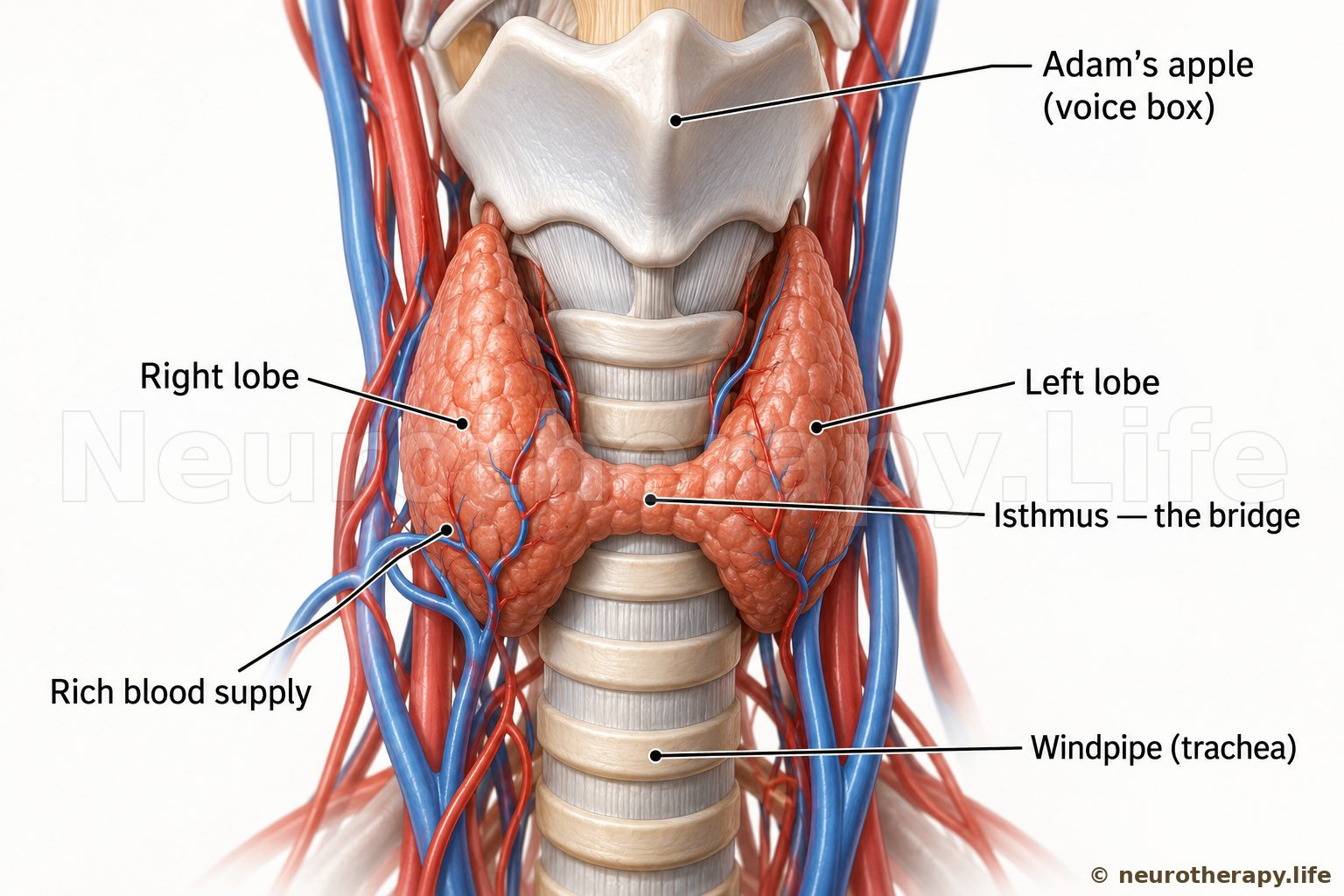
The thyroid is a small, butterfly-shaped gland at the front of your neck, just below the Adam's apple, wrapped around the windpipe. It makes two hormones, T4 (thyroxine) and T3, that set your metabolism — how fast your body burns fuel, makes heat and does its daily work. It also makes calcitonin, a hormone linked with calcium.
The thyroid takes its orders from the pituitary gland in the head, through a messenger called TSH. To make its hormones it needs iodine from food — which is why salt in India is iodised.
Thyroid problems are very common. An estimate from Indian studies puts the number of people with thyroid disease in India at about 4 crore, and women are affected five to eight times more often than men. Many people do not know, because the early signs are easy to blame on age, stress or a busy life. A simple blood test finds it.
The thyroid: two lobes joined by a bridge, hugging the windpipe just below the Adam's apple.
Function
What does the thyroid do?
Almost every cell in the body has a receiving point for thyroid hormone. When the hormone arrives, the cell speeds up: it burns more fuel, uses more oxygen and makes more heat. Too little hormone and everything slows down; too much and everything races.
Sets the body's metabolism and helps keep body temperature steady.
Affects the heart — how fast and how strongly it beats.
Keeps the gut moving; a slow thyroid means slow bowels.
Is essential for a baby's brain to develop, and for a child to grow.
Helps keep periods regular and supports fertility and pregnancy.
Keeps skin and hair healthy, and helps control cholesterol.
Iodine comes in
Iodine from salt, milk, eggs or fish is absorbed in the gut and carried in the blood.
The thyroid traps it
Thyroid cells pull iodine out of the blood and concentrate it many times over.
Iodine meets tyrosine
Iodine is joined to tyrosine — an amino acid that comes from digested protein — on a large storage protein called thyroglobulin.
Stored for later
The finished hormone is kept inside tiny hollow balls (follicles) — enough for about two to three months.
Released on order
When TSH from the pituitary arrives, the thyroid releases mostly T4, with a little T3.
Switched on in the tissues
The liver, kidneys and other tissues turn T4 into the stronger T3. When there is enough, the pituitary sends less TSH.
How does the thyroid work with other organs?
Pituitary gland — Sends TSH, the order to work. A high TSH means the thyroid is not answering well.
Heart — Thyroid hormone speeds the heart; too much can bring palpitations, too little a slow pulse.
Intestines — It keeps the bowel moving and the digestive juices flowing.
Parathyroid glands — The four parathyroids sit on the back of the thyroid; both take part in the calcium story.
Liver — Turns much of T4 into active T3, and clears cholesterol faster when thyroid hormone is enough.
Adrenal glands — In LMNT teaching the adrenal tends to slow the thyroid, so Adr is ideally given before Thrd.
Glands and hormones — The thyroid is one of the main glands of the hormone system.
Anatomy
What are the parts of the thyroid?
The thyroid has two lobes and a bridge on the outside, and millions of tiny storage balls on the inside.
The outer shape
Right and left lobes — The two 'wings' of the butterfly, one on each side of the windpipe.
Isthmus — A narrow bridge of gland tissue that crosses the front of the windpipe and joins the two lobes.
Pyramidal lobe — In some people a small finger of tissue rises upward from the bridge. It is a normal variation.
Capsule — A thin covering that wraps the gland and fixes it to the windpipe and voice box — which is why the thyroid moves up when you swallow.
Inside the gland
Follicles — Millions of tiny hollow balls, each lined by a single layer of thyroid cells that make the hormone.
Colloid — The thick, jelly-like store inside each follicle, full of thyroglobulin carrying the hormone.
C cells — Scattered cells between the follicles that make calcitonin.
Nerves and vessels nearby
Thyroid arteries and veins — Two pairs of arteries feed the gland generously; it is one of the best blood-supplied tissues for its size.
Voice nerves — The recurrent laryngeal nerves, branches of the vagus nerve, run just behind the thyroid to the voice box. Surgeons protect them carefully.
Parathyroid glands — Usually four tiny glands on the back of the thyroid lobes, with a separate job: blood calcium.
Where is the thyroid located?
The thyroid lies at the front of the lower neck, below the voice box and above the notch at the top of the breastbone. Its two lobes rest on either side of the windpipe, and the bridge crosses in front of it.
Because it is tied to the windpipe and voice box, the thyroid moves up and down when you swallow. Doctors use this: they ask you to sip water while they watch or feel the neck. The food pipe lies behind the windpipe, and the spine behind that.
In LMNT, Thrd is given right here, at the hollow of the throat, with broad flat palms and the lightest push. Thrd 'P' is a different point altogether — it is given on the left arm.
A healthy thyroid is soft, smooth and reddish-brown, shaped like a butterfly or a letter H. Its rich blood supply gives it a deep colour.
Normally you cannot see it, and it is hard to feel. A visible swelling at the front of the neck is called a goitre. Small lumps inside the gland (nodules) are very common, and most are harmless — but any new lump should be checked by a doctor.
How big is the thyroid?
An adult thyroid weighs about 15–25 grams. Each lobe is about 5 cm long, 2–3 cm wide and about 2 cm thick; the bridge between them is only about 1–2 cm across.
It is often a little larger in women, and it can grow slightly during pregnancy. It releases roughly a tenth of a milligram of hormone a day — a tiny amount that runs the whole body.
Conditions and disorders
What conditions and disorders affect the thyroid?
The thyroid can make too little hormone (hypothyroidism — most often from Hashimoto's disease, in which the immune system slowly damages the gland), or too much (hyperthyroidism — most often Graves' disease). It can also swell (goitre), grow lumps (nodules), or, rarely, develop cancer, which usually has a good outlook when treated. Iodine shortage, once very common in India, still causes goitre in some places.
When the thyroid runs slow
HypothyroidismToo little thyroid hormone: tiredness, weight gain, feeling cold, dry skin, hair fall, slow bowels.
InfertilityThyroid problems can make it harder to conceive; it is one of the first tests done.
Pregnancy careThe baby depends on the mother's thyroid hormone in early pregnancy, so the dose is often adjusted.
Mind, eyes and immunity
Depression (extreme sadness)Low mood and slowed thinking can come from a slow thyroid; anxiety and restlessness from an overactive one.
Eye problemsGraves' disease can swell the tissues behind the eyes, making them bulge and feel gritty and dry.
Autoimmune disordersBoth Hashimoto's and Graves' disease are autoimmune — the body's defence turns on the thyroid.
What are common signs of a thyroid problem?
Slow: tiredness, feeling cold, weight gain, constipation, dry skin, hair fall, heavy periods, low mood
Fast: weight loss despite eating well, feeling hot and sweaty, racing heart, shaky hands, anxiety, loose motions
A swelling or lump at the front of the neck
A hoarse voice, or difficulty swallowing or breathing, with a neck swelling
Bulging, gritty or red eyes
In children: slow growth, slow school progress, very hard constipation
What tests check the health of the thyroid?
TSH (thyroid-stimulating hormone) — The first test. High TSH usually means a slow thyroid; low TSH usually means an overactive one.
Free T4 and T3 — Measure the hormone itself, to see how far out of range it is.
Thyroid antibodies (anti-TPO) — Show whether the immune system is attacking the gland, as in Hashimoto's disease.
Ultrasound of the neck — Shows the size of the gland and any lumps.
Needle test (FNAC) — A thin needle takes a few cells from a lump to check it is harmless.
Newborn screening — A heel-prick blood test in the first days of life catches babies born with a slow thyroid.
How are thyroid conditions treated?
Thyroxine tablets — For a slow thyroid, a daily tablet of the hormone, with the dose set by TSH tests. It is usually taken on an empty stomach, 30–60 minutes before breakfast.
Anti-thyroid medicines — For an overactive thyroid, medicines that slow hormone making; other medicines calm the racing heart.
Radioactive iodine — A capsule or drink that the thyroid soaks up, slowly quietening an overactive gland.
Surgery — Removing part or all of the gland for a large goitre, some nodules or cancer; thyroxine is then taken for life.
Enough iodine — Iodised salt prevents iodine-shortage goitre; extra iodine pills are not needed by most people and can harm some.
Neurotherapy (LMNT)
In Guruji's teaching the thyroid is the 'chief mistrī' — the master craftsman without whose order the other workers do not get on — and all the functions of the digestive tract depend on it. The teaching links the two in both directions. The thyroid builds its hormones on tyrosine, which comes from digested protein; if digestion is poor the material runs short, T3 and T4 fall, and the pituitary 'shouts louder' — the raised TSH on the report. And a slow thyroid slows the bowel: less digestive juice, slower movement, more water drawn out of the stool, and hard constipation. So in LMNT a thyroid report is very often read as a report about the stomach, and digestion is set right first. When the gland work begins, the order matters: the adrenal tends to quieten the thyroid, so for a full result Adr is given before Thrd. Where turning the patient face down and back again would be hard, Thrd may come first — the teaching says openly that this compromise may need a day or two longer. This is support alongside your doctor's care and your thyroid tablet, never instead of them.
Points
Thrd — Given at the hollow of the throat: flats of both palms over two to three inches, a light push and release, twice in one movement. The patient is warned a cough may come.
(4) Thrd — The teaching uses it to raise metabolism and body temperature; for constipation from a slow thyroid; and for falling asleep while sitting in the day. Not in heart patients, asthma, bamboo spine or spur.
(2) Thrd — Given in place of (4) Thrd in heart patients, because a raised metabolism would load the heart.
Thrd 'P' — A different point: the left arm, near the elbow then the shoulder, four six-second contacts making one. The teaching gives (4) Thrd 'P' with (4) Thrd to work through the pituitary's order to the thyroid.
ADR — Ideally given before Thrd, because the adrenal tends to slow the thyroid.
Const — Tenderness here, with Pan, and a bowel that moves every two or three days, tells the therapist to begin with digestion.
Mu° — The teaching links pain at Mu° with raised acid, loose muscles around the glands, and a gland that runs slow.
(6) Medulla — The teaching links it with the hypothalamus, whose releasing hormone starts the chain that ends in TSH.
(4) Spl (4) Const (4) Mu (4) Lt. Ov. (4) Mu° (4) Thrd (4) Adr — the left-side constipation formula, which stimulates the thyroid because a slow thyroid is one of the causes of long constipation.
Guruji reasoned that low blood calcium weakens the muscles around the glands and so slows the thyroid, and he gave this calcium formula in hypothyroidism. It is recorded as his own inference.
“It is not enough that one eats proteins. The important thing is to digest them.”
— Dr. Lajpatrai Mehra
“We cannot provoke the organs in an order of our own choosing.”
— Dr. Lajpatrai Mehra
“Whether or not the patient gets immediate benefit from our treatment, let no harm reach him through our carelessness — attend to this.”
— Dr. Lajpatrai Mehra
Never do this
Never stop, skip or change your thyroid tablet on your own — least of all in pregnancy, when the baby's brain depends on it. Take no new medicine in pregnancy without asking your doctor, and never stop one you have been given without asking the same doctor. Neurotherapy (LMNT) in pregnancy: what is held back, and the caution about medicines
See a doctor soon for a new or growing lump in the neck, a hoarse voice lasting more than three weeks, or difficulty swallowing or breathing. Nothing is pressed on such a neck until it has been checked. How to tell a patient to see a doctor
Emergency: a very fast or irregular heartbeat with high fever, confusion or great restlessness in someone with an overactive thyroid — call 108/112.
Thrd is given with broad flat palms, lightly, released at once — never a fingertip, never a dig, and never on a neck that is hot, swollen or tender. New neck pain with headache, or any change in vision or balance, ends the session. Thrd
(4) Thrd is not given to heart patients — (2) Thrd is given instead — and it is not given in asthma, where the teaching says the cough increases. (4) Thrd
Bamboo spine (ankylosing spondylitis), heel spur or any unwanted bone growth: Thrd and Thrd 'P' are not given, because the teaching says they lay more calcium into bone. Ankylosing spondylitis (bamboo spine)
A child with very hard constipation who is also slow at school should have a thyroid blood test. Treating the bowel does not replace finding a correctable cause. Constipation
Cancer: if the person has cancer, (10) Pan, Thymus, Pit, Lu + Sh, Rt. Ov / Lt. Ov and (30) Medulla are never given — the therapist changes the plan. Cancer care: Neurotherapy (LMNT) support
Care
How can I keep my thyroid healthy?
Most thyroid disease cannot be prevented, but it can be caught early and managed well.
Use iodised salt
Adults need about 150 micrograms of iodine a day, and iodised salt is the easiest way to get it. Keep total salt under 5 grams a day.
Take your tablet the right way
Take thyroxine at the same time each day on an empty stomach, and keep calcium or iron tablets about four hours away from it.
Recheck after any change
After a dose change, TSH is usually rechecked in about 6–8 weeks, because the hormone takes that long to settle.
Check before and during pregnancy
If you are planning a baby or are pregnant, ask for a TSH test — especially if thyroid disease runs in the family.
Eat and digest your protein
Guruji's teaching is that the thyroid builds its hormone on tyrosine from digested protein. Eat sitting down, chew well, and sit quietly for twenty minutes after meals.
Do a neck check
Stand at a mirror, tip your head back a little, sip water and watch the lower front of your neck as you swallow. Show a doctor any bulge or lump.
Common questions
Is thyroid disease only a women's problem?
No, but women are affected five to eight times more often, especially after pregnancy and around menopause. Men and children can have it too.
Can I eat cabbage, cauliflower and soya?
Yes, in normal cooked amounts, as long as you get enough iodine. Only very large raw amounts might affect the thyroid. Soya can reduce thyroxine absorption, so keep it away from the time you take your tablet.
Will I need thyroid tablets for life?
Often, yes — especially in Hashimoto's disease or after surgery. Some short-lived problems, such as after pregnancy, settle by themselves. Your doctor decides, based on repeat tests.
Why does a slow thyroid cause constipation?
Thyroid hormone keeps the bowel muscles moving and the digestive juices flowing. When it is low, stool moves slowly, more water is drawn out of it, and it becomes dry and hard. Guruji's teaching says that is why the thyroid is stimulated in the treatment of long constipation.
Can Neurotherapy (LMNT) be taken with thyroid tablets?
Yes — LMNT is given alongside medical care, never instead of it. Keep taking your tablet, keep your repeat tests, and let your own doctor decide any change in dose. Tell the therapist about heart trouble, asthma, spur or bamboo spine, because they change which thyroid points are given.
What is the difference between Thrd and Thrd 'P'?
They are two different treatments. Thrd is given at the hollow of the throat with both palms, as a light push released at once. Thrd 'P' is given on the left arm, near the elbow and shoulder, in six-second contacts. The teaching aims Thrd 'P' at the pituitary.
What should I ask my doctor or therapist?
What are my TSH and free T4 results, and what range should they be in for me?
Is my thyroid problem caused by my immune system?
How and when should I take my tablet, and what should I keep away from it?
When should my blood be checked again?
Does this lump in my neck need an ultrasound or a needle test?
(To the therapist) Which thyroid points are right for me, and which are blocked because of my other conditions?
Surprising facts
1It rides up every time you swallow
The thyroid is tied to the windpipe and voice box by a sheet of tissue, so it rises and falls with every swallow. That is why a doctor examining your neck hands you a glass of water — a thyroid lump moves up with the swallow.
Source: Gray's Anatomy (pretracheal fascia binds the thyroid to the larynx and trachea); standard clinical examination of the thyroid.
2It keeps a two-to-three-month store
Most glands release what they make almost at once. The thyroid is different: it keeps its hormone packed inside the jelly of its follicles, outside the cells — enough to supply the body's normal needs for about two to three months.
Source: Guyton & Hall, Textbook of Medical Physiology — storage of thyroglobulin (sufficient for 2–3 months).
3A pinch of iodine protects millions of brains
Without iodine the thyroid cannot make its hormone, and a baby's brain cannot develop fully. The WHO calls iodine deficiency the world's most common preventable cause of brain damage. India began adding iodine to salt through a national programme started in 1962 — one of the simplest public-health wins there is.
Source: WHO, iodine deficiency disorders; Zimmermann MB, Jooste PL, Pandav CS. Lancet 2008;372:1251–1262; National Goitre Control Programme (1962), now NIDDCP, Ministry of Health and Family Welfare.
4It sends out a parcel, not the finished gift
About nine-tenths of what the thyroid releases is T4, which is mostly a carrier form. Tissues such as the liver and kidneys snip off one iodine atom to turn it into T3, which is about three to four times stronger. So a healthy liver and kidney are part of a healthy thyroid system.
Source: Guyton & Hall, Textbook of Medical Physiology — about 93% of secreted hormone is T4; T3 about four times as potent; peripheral deiodination.
5Women are five to eight times more likely to be affected
Thyroid disease is far more common in women than in men, and it often starts after pregnancy or around menopause. That is why tiredness and weight change in a woman deserve a thyroid test rather than a shrug.
Source: American Thyroid Association, 'General information / press room' (women five to eight times more likely than men to have thyroid problems).
6It is named after a shield
In 1656 the English doctor Thomas Wharton named the gland 'thyroid', after the shield-shaped cartilage just above it — from the Greek thyreos, a large door-shaped shield. The gland is a butterfly; its name is a shield.
Source: Wharton T. Adenographia (1656); history of anatomy — naming after the thyroid cartilage.
7A heel-prick at birth can save a child's mind
About one baby in every 2,000 to 4,000 is born with a thyroid that does not work well. Most look normal at birth. Found by a heel-prick blood test in the first days and treated with a daily tablet, these children grow up with normal intelligence. Missed, the brain can be permanently harmed. Guruji's teaching, too, says the thyroid drives the brain's development in the first year of life.
T4 lasts about a week in the blood, so it takes about six weeks for a new dose to settle. That is why doctors usually wait six to eight weeks before rechecking TSH — and why changing the dose every few days on your own does more harm than good.
Source: Jonklaas J, et al. Guidelines for the treatment of hypothyroidism (American Thyroid Association). Thyroid 2014;24(12):1670–1751 (T4 half-life about 7 days; recheck TSH after 6–8 weeks).
A day in the life of your thyroid
~150 µgof iodine needed by an adult
~0.1 mgof T4 released
~9 in 10parts of its output are T4, the rest T3
~7 dayshow long T4 lasts in the blood (half-life)
2–3 monthsof hormone kept in store
15–25 gthe weight of the whole gland
Yoga
Setu Bandhāsana — the bridge Setu Bandhāsana
Benefits
Gently opens the front of the chest and throat while the neck rests on the mat.
Strengthens the back, hips and thighs, which helps with the tiredness and stiffness of a slow thyroid.
A safer choice than the shoulder stand for most beginners.
How to do it
Lie on your back with knees bent and feet flat, hip-width apart, close to the hips.
Keep the arms by your sides, palms down.
Breathe in and slowly lift the hips until the body makes a slope from knees to shoulders.
Hold for 3 to 5 easy breaths without turning the head.
Breathe out and lower the back slowly, one bead at a time. Repeat 3 times.
Take care
Never turn the head while the hips are up. Avoid it with neck injury, recent back or abdominal surgery, or late pregnancy. The shoulder stand and headstand, sometimes suggested for the thyroid, put weight on the neck and are not for beginners, people with neck problems or high blood pressure. No pose treats thyroid disease — keep taking your tablet.
Bhujaṅgāsana — the cobra Bhujaṅgāsana
Benefits
Stretches the front of the chest and neck and strengthens the back.
Counters the forward slump of long desk and phone use.
How to do it
Lie face down, legs together, forehead on the mat.
Place the palms under the shoulders, elbows close to the body.
Breathe in and slowly lift the head and chest, using the back more than the arms.
Keep the elbows bent and the neck long; look forward, not up.
Hold for 3 to 5 breaths, then lower slowly. Repeat 3 times.
Take care
Do not throw the head back. Avoid it in pregnancy, after recent abdominal surgery, or with a painful back that gets worse on bending backwards.
Ujjāyī — the gentle throat breath Ujjāyī prāṇāyāma
Benefits
Slows and lengthens the breath, which calms the body.
Draws gentle attention to the throat without any pressure on it.
How to do it
Sit comfortably with a straight back.
Close the mouth and breathe in slowly through the nose, slightly narrowing the back of the throat so the breath makes a soft sound, like distant waves.
Breathe out slowly through the nose with the same soft sound.
Keep the breath smooth and unforced for 3 to 5 minutes.
Take care
Keep it soft; never strain the throat or hold the breath. Stop if you feel light-headed. People with high blood pressure or heart disease should skip breath-holding and fast breathing practices unless their doctor agrees.
Watch
Hypothyroidism के लिए LMNT Neurotherapy Treatment | Step-by-Step Training in Hindi |
A step-by-step training demo of a hypothyroidism formula: Half Kundli for 40 seconds on the edge of a chair, (6) Medulla on both sides of the neck, 4 Thyroid-P near the elbow and shoulder, and 4 Thyroid at the base of the neck. It is given in one go, without gaps, to support a slow thyroid.
Note: LMNT teaching gives Thrd with the flat of the palm, never a fingertip, and no neck work with goitre. Keep taking your thyroid tablet.
ESTROGEN FORMULA - LMNT Neurotherapy
A demonstration of the oestrogen formula: (½) Ku for 40 seconds, (6) Medulla, (4) Thrd 'P', (4) Thrd and (6) Lt. Ov.
Ku is not given during the period or with low blood pressure; ovary points are not given to teenagers or in cancer.
DELAY MENSUS - LMNT Neurotherapy
A demonstration, in Hindi, of two treatments for late periods: first (6) Medulla, (4) Thrd 'P' and (6) Lt. Ov.; then P. Heparin, (8) Pan, (7) Liv and (8) Ch. Only.
LMNT teaching gives (4) Thrd 'P' followed by (6) Rt. Ov. or (6) Lt. Ov., and names Rt. Ov. (progesterone) for bringing on a late period. No Heparin formula is ever given while the flow is heavy.
Test yourself
Research
Strong evidence
A major review of iodine deficiency: it harms the thyroid and a baby's developing brain, and iodised salt is the proven, low-cost way to prevent it.
The American Thyroid Association's guidelines for treating a slow thyroid: how thyroxine is taken, why TSH is rechecked after about six to eight weeks, and how the dose is adjusted.
A review of babies born with a slow thyroid: how common it is, why newborn screening matters, and how early treatment protects normal brain development.
This page explains how the body works; it does not diagnose. Neurotherapy (LMNT) works alongside your medical care — keep taking the medicines your doctor prescribed, and see a doctor for any new or severe symptom.
Ready to begin?
Send COURSE for course details, or your name, age and health issue for a consultation.