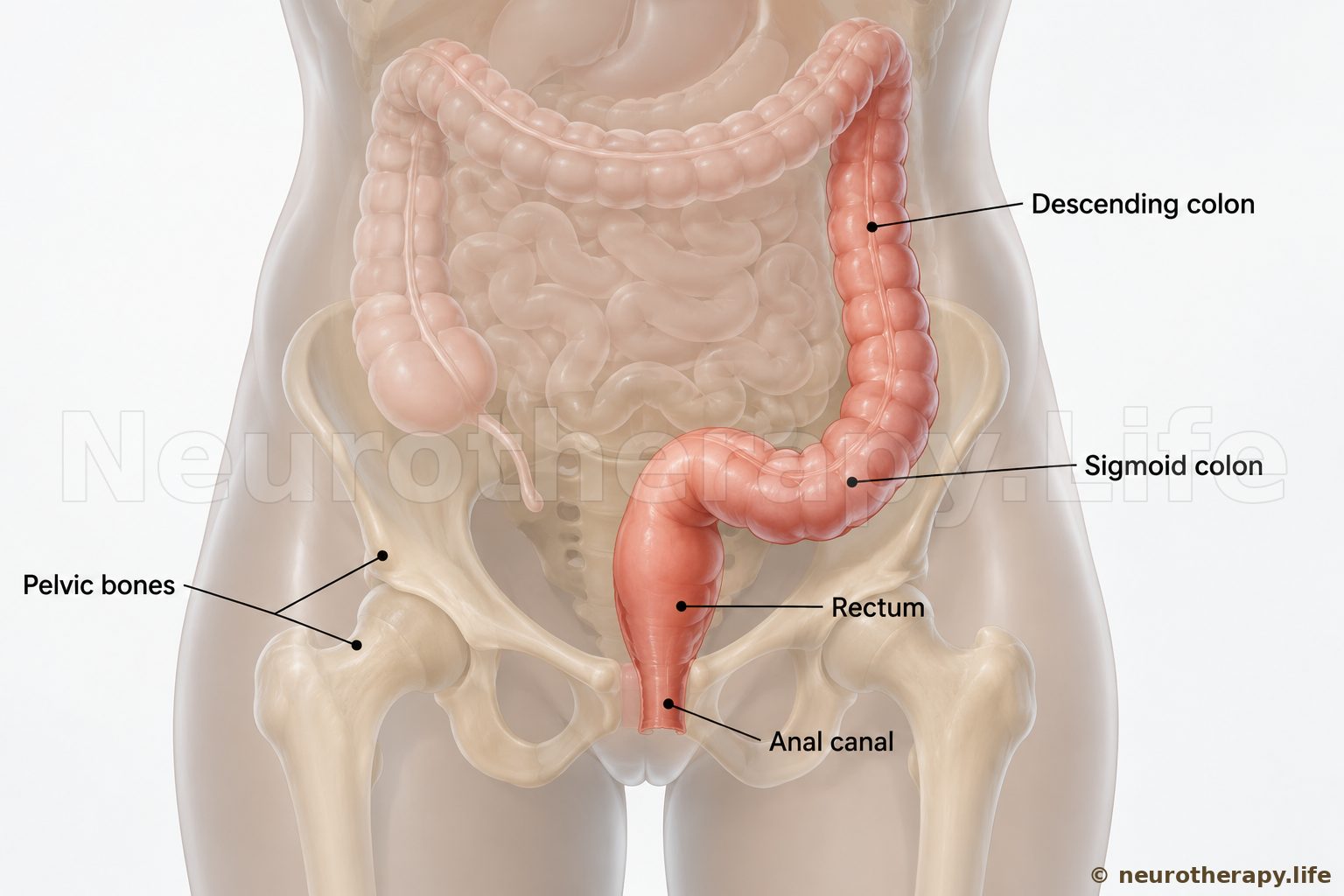
The last stretch of the gut, the muscles that hold on and let go — and the stool itself, which is the body's daily report card. In Guruji's teaching the stool is read closely, because patients almost always call their motions 'normal'.
Overview
What is the bowel?
'Bowel' is the everyday word for the intestines, and especially for their last part: the large intestine, the rectum and the anus. A 'bowel movement' — a motion — is the passing of stool through them.
This page is about that last stretch and about the stool itself: how it is stored, how you hold on and let go, what is normal, and what the shape and colour of a stool can tell you.
In Neurotherapy (LMNT) the stool is a daily finding. The therapist asks about it every day, reads its form on a chart, and — when a treatment slows the bowel on purpose — watches for the day the stool is formed, so that the bowel can be given its speed back.
The bowel's last stretch: the sigmoid colon, the rectum that stores stool, and the short anal canal.
Function
What does the bowel do?
By the time leftovers reach the end of the gut, the useful parts and most of the water have been taken. The bowel's job is to store what remains, tell you when it is time, and let it out only when you choose.
Stores stool in the rectum until a convenient time.
Senses filling: stretch in the rectum wall gives the urge to go.
Senses what is arriving — the lining at the top of the anal canal can tell gas from liquid or solid.
Holds on: two ring muscles and a muscle sling keep the exit closed.
Empties when you choose: the rectum squeezes, the rings relax and the stool passes.
Reports on the whole gut: how often you go, and the form and colour of the stool, reflect how the whole digestive system is working.
A mass movement
A few times a day — often after a meal — a strong wave pushes stool from the colon into the rectum. This after-meal push is called the gastrocolic reflex.
The urge
The rectum stretches, and nerves send the message 'time to go'.
The inner ring opens by itself
The internal sphincter relaxes automatically, so the lining can 'sample' what has arrived.
You decide
If it is not the right moment, you tighten the outer ring and the urge fades for a while.
Letting go
At the toilet the outer ring and the muscle sling relax, the rectum squeezes, and a gentle push from the belly helps — without hard straining.
How does the bowel work with other organs?
Intestines — The colon above decides how much water is left in the stool: the slower the journey, the drier the stool.
Liver — Bile from the liver gives stool its brown colour; a pale stool can mean bile is not arriving.
Spinal cord — Nerves from the lowest part of the spinal cord (the sacral nerves) run the urge, the rings and the emptying.
Muscular system — The pelvic floor muscles form the sling that holds the bowel closed.
Kidneys and urinary system — The bowel and bladder share the same pelvic floor and sacral nerves; LMNT's Triangle for Piles is also used for control of urine.
Thyroid — A slow thyroid slows the bowel and is a common hidden cause of constipation.
Anatomy
What are the parts of the bowel?
The last few bends of the large intestine, a short muscular exit, and the muscles that guard it.
The last stretch of the tube
Sigmoid colon — An S-shaped bend in the lower left of the belly, where stool waits before moving into the rectum.
Rectum — A stretchy chamber about 12–15 cm long that stores stool and senses when it is full.
Anal canal and anus — The short exit passage, about 3–4 cm long, ending at the opening.
The muscles that hold on and let go
Internal anal sphincter — An inner ring of smooth muscle that stays closed without your thinking about it.
External anal sphincter — An outer ring of muscle you control — the one you squeeze to 'hold on'.
Puborectalis sling — Part of the pelvic floor that loops behind the rectum and pulls it forward into a bend. The bend helps hold stool in; it straightens when you squat or relax.
Inside the anal canal
Anal cushions — Soft pads full of blood vessels that help seal the exit. Everyone has them; when they swell and slip down they are called piles.
The dentate line — A wavy line inside the canal. Above it the lining has few pain nerves; below it the skin is very sensitive — which is why a small tear (fissure) hurts so much, while internal piles may bleed without pain.
Where is the bowel located?
The sigmoid colon lies in the lower left of the belly. The rectum runs down the middle of the pelvis, in front of the sacrum and tailbone, and behind the bladder (and, in women, behind the uterus). The anal canal passes through the pelvic floor to the outside.
On LMNT's front chart, Const — the constipation point — lies in the left upper quarter of the belly, and Dys — the loose-motion point — in the right upper quarter. Tenderness at Mu°, in the left flank between the last rib and the hip bone, goes with hard stools and too little water in LMNT teaching.
Inside, the rectum is lined with a smooth, pink, moist layer with a few curved shelves across it. The anal canal is narrower, with lengthwise folds in its upper part and ordinary skin at its lower end.
A healthy stool is usually medium to dark brown, soft and formed — like a smooth sausage — and passes without pain or long straining.
How big is the bowel, and how much does it pass?
The rectum is about 12–15 cm long and the anal canal about 3–4 cm. The sigmoid colon is roughly 40 cm long, though this varies a lot.
An adult passes, on average, a little over 100 g of stool a day, and about three-quarters of it is water. People who eat more fibre pass more.
Anything from three times a day to three times a week can be normal for a healthy adult. A change from your own usual pattern matters more than the number.
Conditions and disorders
What conditions and disorders affect the bowel?
Bowel problems are very common and often not talked about. Many are mild and respond to water, fibre and habit; a few need a doctor quickly.
Too slow or too fast
ConstipationHard stools, straining, or going less often than usual.
Piles (haemorrhoids) and fissureSwollen anal cushions or a painful tear (fissure) — LMNT reads piles, fissure, fistula and prolapse as one family behind hard constipation.
Rectal prolapseThe rectum slipping down and out through the anus.
AcidosisThe body tipping towards acid; hard stools are one of its LMNT signs.
AlkalosisThe body tipping towards alkali; soft, frequent stools are one of its LMNT signs.
What are common signs of a bowel problem?
Straining, or sitting for a long time on the toilet
A feeling that something is left behind after going
Hard lumps, or watery stools, most days
Pain, burning or itching at the anus
Mucus in the stool, or leaking of stool or wind
Bright red blood on the paper — often piles, but always worth a check
Black, tarry stool; pale, clay-coloured stool with dark urine; or a lasting change in habit — see a doctor
What tests check the bowel?
Stool tests — Check for germs, worms, hidden blood (FIT or occult blood test) and inflammation.
Examination and proctoscopy — A doctor looks at the anus and, with a short tube, at the lower rectum — the usual check for piles and fissures.
Colonoscopy or sigmoidoscopy — A thin, flexible camera looks at the whole colon or its last part.
Blood tests — Blood count for anaemia, thyroid tests for a slow bowel, and salts after heavy loose motions.
A stool chart — Doctors and LMNT therapists alike use a seven-picture chart of stool forms, so a patient can point instead of describe.
How are bowel problems treated?
Water, fibre and routine — Enough water through the day, more fibre, regular meals and an unhurried toilet habit.
Toilet posture — Squatting, or raising the feet on a small stool when sitting, straightens the exit and reduces straining.
Fluids and ORS — In loose motions, replacing water and salts comes first.
Medicines — Short courses of laxatives or anti-diarrhoea medicines, anti-worm tablets, or antibiotics for some infections, as a doctor advises.
Treatment for piles and fissures — Soothing creams, warm sitz baths, banding, or surgery when needed.
Pelvic floor retraining — For some people who strain or leak, guided exercises (biofeedback) teach the muscles to relax or tighten at the right time.
Neurotherapy (LMNT)
In Guruji's teaching the stool is the readout of the whole digestion, and the first rule is that a patient's word 'normal' settles nothing. People do not like to talk about stools, and many believe soft or frequent motions are healthy. So the therapist asks set questions in a fixed order — how often, hard or soft, once or more than once — and shows a chart of seven stool forms to point at. Hard lumps belong, in LMNT teaching, to the acid side, with tenderness at Mu°; soft, frequent, semi-solid stools belong to the alkali side, with tenderness at Liv°, and often with undigested food. Colour is read too: brown means bile is arriving. For loose motions, several LMNT treatments slow the bowel on purpose — the Ulta Normal formula, born when Guruji noticed that reversing the Normal order reliably slowed the bowel, and the APR treatments chosen by counting the motions. Each carries its own exit: ask about the motions every day, and once the stool is formed, stop and give the bowel its speed back with Normal, NAN or FAN for at least a day. This is support alongside a doctor's care, never instead of it.
Points
Const — Constipation point, left upper quarter of the belly; given with the feet one after the other on the right thigh. Not given when the motions are loose.
Dys — Dysentery point, right upper quarter; given with both feet on the left thigh for ordinary loose motions — recorded as almost never used. Not in constipation.
Mu — For the middle of the descending colon and to increase lubrication, so the stool moves on easily.
Mu° — Checked in the left flank; pain here goes with hard stools and too little water.
Liv° — Checked in the right flank; pain here goes with soft stools and the alkali side.
(6) Swt — To slow the movement of the intestines in loose motions (through the adrenal medulla).
(6) Adr — In the APR treatments for inflammation of the bowel — but never with low immunity or high blood pressure.
Triangle for Piles — Heels at S5, S3 and S1, one upward jerk each: for piles, fissure, fistula and rectal prolapse, and for control of urine.
(2) S4 – S5 — The opposite of the Triangle: relaxes the rings of the bladder, uterus and anus; reaches the descending colon.
TF — Toe Fingers; in children with ordinary loose motions the order is reversed — from the little toe of the right foot.
Gas 'I' — The small intestine; part of the undigested-food work that the stool reports on.
(8) Pan (1) Spl (1) Gal (1) Mu – 3 points (1) Liv – 3 points — the Normal order reversed and underlined, for soft motions two or three times a day. Stopped as soon as the stool is formed.
“If there is no pain in Mu°, then Acid treatment is not to be given!”
— Dr. Lajpatrai Mehra, Chandigarh camp, 2001
“The coming of UDF is itself a chief cause of the coming of the great diseases.”
— Dr. Lajpatrai Mehra
Never do this
Before any treatment for many loose motions, check for drying out first: is the person passing urine, is the mouth dry, are they dizzy on standing? With that many motions, water matters more than any formula.
(6) Adr is not given when immunity is low (septicaemia, HIV, cancer) or when blood pressure is high. Ask both questions — including about BP tablets — before writing it. (6) Adr
Treatments that slow the bowel (Ulta Normal, APR) are short courses. Ask about the motions every day; once the stool is formed, stop and give Normal, NAN or FAN for at least one day, or constipation can follow. Ulta Normal
Const is not given while the motions are loose, and Dys is not given in constipation. Const
The Triangle for Piles is not given to those passing little urine; (2) S4–S5 is not given to those passing too much urine. Triangle for Piles
A child with loose motions who is drowsy, passing blood, feverish, not drinking or not passing urine needs a doctor and fluids today — not a session.
See a doctor the same day for black, tarry stool; blood in the stool; or a pale, clay-coloured stool with dark urine or yellow eyes. Keep taking prescribed medicines.
Care
How can I keep my bowel healthy?
Most of a healthy bowel is built by daily habit — and water comes first.
Drink water — not only other drinks
Tea and other drinks do not replace water. Drink in small amounts at set times between meals rather than all at once.
Eat roughage every day
Vegetables, fruit with the skin, dal and whole grains keep stools soft and bulky.
Keep a regular time
Many people find the urge comes after breakfast. Give yourself unhurried time then.
Don't hold back the urge
Putting it off again and again lets the stool dry and harden.
Squat, or raise your feet
On a western toilet, a small stool under the feet brings the knees above the hips and eases passing.
Don't strain or sit for long
Breathe out gently rather than pushing hard, and leave the phone outside. Long straining feeds piles and fissures.
Look before you flush
Notice the form and colour now and then. Tell your therapist about food coming out as eaten; tell a doctor about blood, black or pale stools.
Common questions
How often should I pass stool?
Anywhere from three times a day to three times a week is usual for healthy adults. What matters more is a soft, formed stool passed without straining, and no sudden change from your own pattern.
My motions are soft and I go three times a day. Isn't that healthy?
It can be within the normal range. But in LMNT teaching, semi-solid stools passed several times a day point strongly to undigested food and weak digestion, so a therapist will ask more questions and look for food coming out as eaten.
What does the colour of my stool mean?
Brown comes from bile pigments and is normal. Green can follow green vegetables or fast transit. Pale or clay-coloured stool can mean bile is not arriving; black, tarry stool can mean bleeding high in the gut (iron tablets can also darken it); red can mean bleeding low down. The last three need a doctor.
Is squatting better than sitting on a toilet?
For many people, yes. Squatting straightens the bend at the end of the rectum, and small studies found people emptied faster and with less straining. A footstool on a western toilet gives much of the same benefit.
Why does my therapist ask about my motions every day?
Because some LMNT treatments for loose motions slow the bowel on purpose. The day the stool becomes formed, that treatment must stop and a formula that restores the bowel's normal speed is given for at least a day. Your answer decides when.
Why do some stools float?
Usually because of trapped gas from gut bacteria, not fat. A stool that is greasy, very smelly, hard to flush and comes with weight loss is different, and worth showing a doctor.
What should I ask my doctor or therapist?
Is my bowel pattern within the normal range for me?
Do I need a stool test, a check for hidden blood, or a colonoscopy?
Could my medicines — or my thyroid — be causing constipation or loose motions?
How much water should I drink, and at what times?
Is the bleeding I see from piles, or does it need more checking?
For my therapist: which stool form am I on the chart, and when will the loose-motion treatment be stopped?
Surprising facts
1There is a scientific chart of seven stool shapes
Doctors in Bristol, England, drew seven pictures of stool, from hard separate lumps (type 1) to watery (type 7). They showed that the form tracks how long food took to travel through the gut — better than counting how often a person goes. LMNT therapists use a seven-form chart in the same way.
Source: Lewis SJ, Heaton KW. Stool form scale as a useful guide to intestinal transit time. Scand J Gastroenterol 1997;32(9):920–924 (the Bristol Stool Form Scale)
2'Normal' covers a wide range
In a classic survey of two population groups, almost everyone went somewhere between three times a day and three times a week. That is why doctors look at a change in your own pattern, and at the form of the stool, more than at the count.
Source: Connell AM et al. Variation of bowel habit in two population samples. BMJ 1965;2(5470):1095–1099
3Stool is mostly water — and much of the rest is bacteria
About three-quarters of a typical stool is water. Of the solid part, a large share is bacteria, living and dead — not just leftover food.
Source: Rose C, Parker A, Jefferson B, Cartmell E. The characterization of feces and urine: a review of the literature. Crit Rev Environ Sci Technol 2015;45(17):1827–1879 — about 75% water; median wet mass about 128 g a day; bacteria a large fraction of the solids
4Stool is brown because of old red blood cells
When old red blood cells are broken down, their pigment becomes bilirubin, which the liver sends out in bile. Gut bacteria change it into a brown pigment, stercobilin. So a brown stool is a quiet report that bile is arriving — just as LMNT teaching reads it.
Source: Guyton & Hall, Textbook of Medical Physiology — bilirubin, urobilinogen and stercobilin
5Eating wakes up your bowel
When food enters the stomach, nerves and hormones trigger strong waves in the colon — the gastrocolic reflex. It is why many people, and most babies, feel the urge soon after a meal, especially breakfast.
Source: Guyton & Hall, Textbook of Medical Physiology — gastrocolic reflex and mass movements
6Squatting straightens the exit
A muscle sling keeps a bend at the end of the rectum to help you hold on. Squatting relaxes and straightens that bend. In one small study, people emptied in about 50 seconds squatting, against about two minutes sitting on a normal toilet, and felt they strained less.
Source: Sikirov D. Comparison of straining during defecation in three positions. Dig Dis Sci 2003;48(7):1201–1205 (28 volunteers)
7Floating stools are usually about gas, not fat
It was long thought that stools float because of fat. A careful study in 1972 showed that floating is mostly due to gas trapped inside the stool by gut bacteria.
Source: Levitt MD, Duane WC. Floating stools — flatus versus fat. N Engl J Med 1972;286(18):973–975
Your bowel in numbers
3/day – 3/weekthe usual healthy range
~128 gof stool a day (typical adult)
~75%of it water
7stool forms on the chart; 3–4 are ideal
1–3 daysfrom plate to toilet, usually
12–15 cmthe length of the rectum
Yoga
Malāsana — the deep squat Malāsana
Benefits
The same body shape as the traditional Indian toilet squat, which straightens the exit of the rectum.
Opens the hips and gently loosens the pelvic floor.
Keeps the ankles and knees used to squatting as we age.
How to do it
Stand with feet a little wider than hips, toes slightly out.
Bend the knees and lower the hips as far as comfortable, heels down (a folded blanket under the heels helps).
Join the palms and let the elbows rest against the inner knees; keep the back long.
Breathe slowly for 30–60 seconds, then come up slowly using your hands.
Take care
Skip it with knee or ankle injury, severe knee arthritis or after knee or hip surgery — use a footstool at the toilet instead. Avoid in late pregnancy unless your doctor agrees, and with active piles that bleed or hurt when squatting.
Vajrāsana — sitting on the heels after meals Vajrāsana
Benefits
Guruji's teaching names it as the good way to sit for twenty minutes after eating, instead of walking about.
A calm pause after the meal, when the gastrocolic reflex is waking the bowel.
Needs no movement of the belly, so it can be done soon after eating.
How to do it
Kneel on a folded blanket with knees together.
Sit back on your heels, big toes touching.
Keep your back straight, hands on your thighs.
Breathe normally for 5–10 minutes after the meal.
Take care
Skip it with knee or ankle injury, recent knee surgery or severe knee pain — sit quietly on a chair instead. A cushion between heels and seat eases strain.
Belly breathing — letting go without straining Udara śvasana (diaphragmatic breathing)
Benefits
Teaches the belly and pelvic floor to relax, which is what passing stool needs — not hard pushing.
A slow out-breath at the toilet can replace straining.
Calms the body; a tense, hurried body often holds back.
How to do it
Lie on your back with knees bent, or sit comfortably.
Place one hand on the chest and one on the belly.
Breathe in slowly through the nose so the belly hand rises.
Breathe out slowly through the mouth, letting the belly and the bottom soften. Continue for 5 minutes.
Take care
Keep it easy and never hold the breath. Stop if you feel dizzy. In late pregnancy, lie on your side or sit propped up.
Watch
Loose Motion / Dast ka Neurotherapy Ilaaj | Ulta Normal Treatment (LMNT)
A demonstration of the Ulta Normal formula for loose motions: (8) Pan on both thighs, then Spl before Gal and Mu before Liv — the Normal formula's order reversed to slow the bowel.
The video's counts ((3) Spl, (3) Gal, (5) Mu, (7) Liv) differ from LMNT teaching, which gives (1) Spl, (1) Gal, (1) Mu – 3 points and (1) Liv – 3 points. Ulta Normal is stopped as soon as the stool is formed, and the Normal formula is given for at least one day.
कमज़ोर पाचन और Gut Health का पक्का इलाज | LMNT Normal Treatment | @neurotherapylife
Shows the Normal treatment given with the feet: (8) Pan at the top of the thighs, then (3) Gal, (3) Spleen, (7) Liv and (5) Mucus on the thighs and forearms, without breaks. It is used to support digestion.
शरीर में Acid बढ़ जाए तो क्या करें? | Blood pH Balance Treatment | LMNT Acid Treatment Formula
Shows the Acid Treatment formula step by step: (8) Pan, (3) Gal, (5) Mu°, 3 Acid on the side of the right thigh, (4) Chest Only, and (6) Adr on the upper back, given without breaks. It is used to support the body's acid–alkali balance when acid is raised.
Note: the Acid Treatment formula is given only when the Mu° point is tender, and (6) Adr is not given in high BP, diabetes, cancer or HIV — the therapist checks first.
UDF (Anpacha Khaana) ka Neurotherapy Ilaaj | 40+ Bimariyon ki Jad | LMNT
A step-by-step demo of the full UDF (undigested food) treatment: 15 Medulla, Parkhoo at both hips, Half Kundli, 10 Medulla with 1 Gas Only and 1 Gas 'I', then the Gal, Spleen, Liver and Mucus points and Ajay Normal on the thighs and forearms. It is given to support digestion when food passes through undigested.
Test yourself
Research
Strong evidence
The Bristol team showed that a simple seven-picture scale of stool form reflects how fast food passes through the gut, making it a useful everyday tool.
A survey of two population groups found that almost everyone's bowel habit fell between three times a day and three times a week — the basis of today's 'normal range'.
This page explains how the body works; it does not diagnose. Neurotherapy (LMNT) works alongside your medical care — keep taking the medicines your doctor prescribed, and see a doctor for any new or severe symptom.
Ready to begin?
Send COURSE for course details, or your name, age and health issue for a consultation.