The Fire and the Ash: Undigested Food in the Stool
When a tomato skin, a coriander leaf or a whole grain of chana comes out in the stool looking just as it went in, the stomach is telling you its digestive power is low. In Neurotherapy (LMNT) this sign, called UDF, is one of the first things checked in every long-standing illness — and the digestion is set right first.
Overview
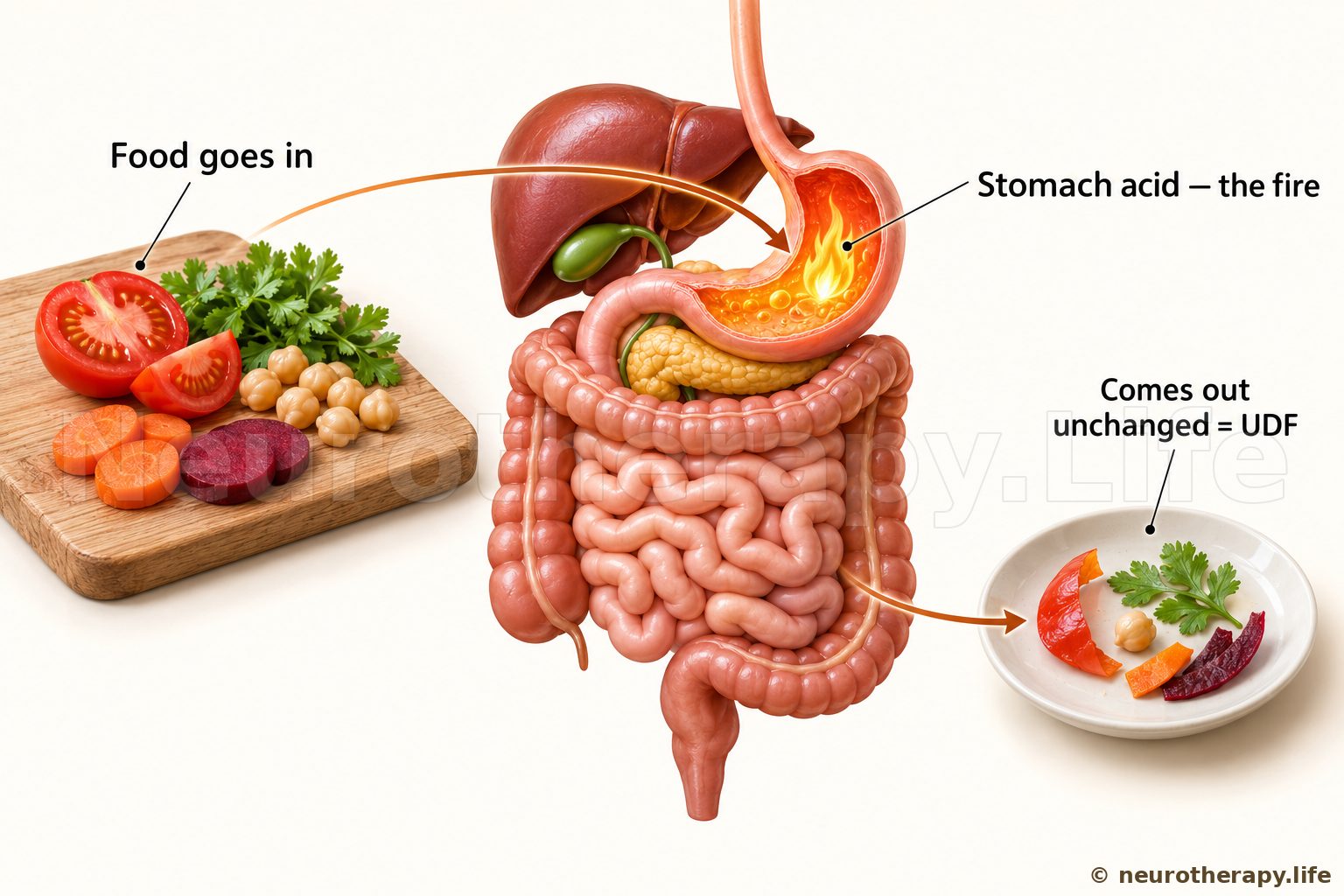
When a tomato skin, a coriander leaf or a whole grain of chana comes out in the stool looking just as it went in, the stomach is telling you its digestive power is low. In Neurotherapy (LMNT) this sign, called UDF, is one of the first things checked in every long-standing illness — and the digestion is set right first.
A sign patients see but never mention
UDF stands for Un-Digested Food in the stools. It means that some of what was eaten leaves the body in its original shape or colour. You can still recognise it as the thing it was when it went in.
Over six decades and more than one lakh patients, Guruji found a steady pattern. Almost every patient with an old, long-standing (chronic) disease, once asked properly, confirms seeing such food in the stool. UDF is not a disease in itself. It only shows that the body cannot digest what it eats. But if it is ignored, it later becomes the root of disease.
- Seeds or skins of tomato, brinjal or lady's finger (bhindi)
- Whole grains of chana, peas or groundnut
- Leaves of coriander, curry leaf, spinach (palak) or fenugreek (methi)
- Raw pieces of carrot or beetroot from a salad
- Mustard, cumin and other seeds from the tadka
Why nothing should come out looking like itself
Many people say undigested food simply means the food was not chewed well. Guruji did not accept this. Think of a hen: farmers mix marble powder into her feed so her eggshells come out strong. She has no teeth, yet she digests stone.
A healthy human stomach makes hydrochloric acid, a fierce acid that can work on almost anything. Chewed or not chewed, food should change in it. If a beetroot comes out still red, the stomach acid and the gut's enzymes (the chemicals that break food down) did not manage even to change its colour. They are not being made in the right amount or strength.
- It kills germs: no ordinary bacterium or virus that comes in with food survives a strong stomach acid.
- It lets pepsin work: pepsin, the enzyme that starts digesting protein, works only when the stomach is very acidic.
- It opens the gate to the liver: acid food entering the small intestine triggers the hormone secretin, which calls for bile to digest fats.
From a tomato skin to a disease
What do all the foods on the list share? They are all made of protein. When they come out whole, protein is not being digested. Digestion breaks protein into amino acids — think of them as loose bricks. The body uses these bricks to build every enzyme and almost every hormone (the chemical messengers made by glands).
So a weak stomach slowly starves every gland of its raw material. Worse, the digestive enzymes are proteins too, so poor digestion makes digestion poorer still. That is why a knee, a thyroid or the skin can suffer because of a stomach.
The three levels where digestion fails
Bad digestion is not one thing. Neurotherapy (LMNT) works on it at three levels, and there are several UDF treatments for patients of different types. They are read in the order in which digestion usually fails.
- The stomach: blood flow to the stomach is raised, so it makes more acid and pepsin. Signs include little hunger and pain at the Gas area.
- The helper organs and small intestine: blood flow to the gall bladder, liver, pancreas and small intestine is raised, so food is digested, absorbed and used properly. Signs include pain at Pan, Gal or Liv, lines on the tongue, and vitamin shortages that persist despite tablets.
- Immunity: the body's power to resist disease is raised, so germs that the acid should have killed are kept in check.
How the therapist finds it
Most patients answer “my motions are normal” to end an awkward talk, not because it is true. Many also believe soft, frequent stools are a sign of good health. So the therapist asks a fixed set of questions in an unhurried voice, ignores the first quick answer, and asks: “Have you looked at them lately?” The patient is then asked to watch for a few days, because UDF does not appear every day.
The stool answer is never used alone. It is matched with tenderness at the pain points around the navel, the B12 and folic acid points, the look of the tongue and, in women, the period history. Lines or scratches on the tongue suggest the intestine is not absorbing well — the tongue is called the mirror of the intestines. In a baby, milk vomited as milk rather than as curd suggests the stomach is not making its acid.
The rule: correct the digestion first
In any old disease, whatever its name, the UDF work comes first. It has been seen again and again that when undigested food stops coming, the patient's main complaint improves too — even before it is treated directly. After that, the treatments for the disease itself work better. The reason is simple: whatever you want the body to repair, the raw material comes from the stomach.
UDF is not a one-time fix. It comes back with habits and diet, so it is worth having it checked every four or five months. Patients usually notice the change in this order: hunger returns, motions become fewer, the food items disappear one by one, and the complaint they came for moves last.
- Do not drink water or cold drinks with food; drink water about half an hour after the meal.
- Eat only after you feel hungry.
- Prefer live food — sprouts, fresh seasonal fruit and salad — over heavy cooked food.
- After an overload, such as a wedding feast, a light day or two helps the body repair itself.
Key points
- UDF means food coming out in its own shape or colour — tomato skin, leaves, whole grains, raw salad, tadka seeds.
- It is not a disease, but ignored it becomes the root of disease.
- Strong stomach acid kills germs, lets pepsin digest protein and helps the liver send bile.
- Every gland builds its chemicals from digested protein, so a weak stomach weakens the whole body.
- Neurotherapy (LMNT) works at three levels: the stomach, the helper organs and small intestine, and immunity.
- In every old disease the digestion is corrected first.
- UDF returns with habits, so a check every four or five months is wise.
Topics in this guide
Go deeper
Clearing the Ash: The UDF Formulas
The UDF treatments and how they differ
What the Bowel Tells You: Constipation, Stool and Water
What the bowel tells you — constipation, stool and water
The Two Kingdoms: Acidic and Alkaline Bodies
Acid and alkali — the two directions a body leans
Taking a Patient's Story: The History That Cannot Mislead
How to ask questions a patient will answer honestly
The Body's Own Pharmacy: How the Body Makes and Balances Its Chemicals
How the body makes its own chemicals
Undigested food in stool (UDF)
Undigested food in the stool — the condition page
Stomach
The stomach and its acid
Gas Only
Gas Only — the stomach point
General UDF formula
The general UDF formula
Safety: when it is held back
- Never stop or cut down any medicine, including cancer treatment, because you are taking Neurotherapy (LMNT). It works alongside your doctor's care, never instead of it. Cancer care: Neurotherapy (LMNT) support
- A long fast is done only under a trained naturopath. Ask your doctor first if you have diabetes (especially on insulin or sugar tablets), are pregnant or breastfeeding, are frail or losing weight, have kidney or liver disease, or take medicine timed to meals. Children should not be put on a long fast. How to tell a patient to see a doctor
- See a doctor the same day if a child has any fever under three months of age, a rash that does not fade when pressed, drowsiness, a stiff neck, a fit, fast breathing, refuses all fluids, or fever beyond five days. Fever and viral fever
- A baby who vomits forcefully and often, is not gaining weight, brings up anything green or blood-stained, or becomes floppy, needs a doctor the same day.
- A belly that is rigid, very tender to the lightest touch, has a pulsing lump, or has sudden severe pain is a doctor's matter today, not a therapy session. Abdominal pain
- Blood in the stool, black tarry stool, or weight loss without trying always goes to a doctor first.
- Children, the elderly and the frail get light treatment, given with the hands. The Child, the Elder and the Frail: Neurotherapy (LMNT) for Delicate Bodies
Guruji says
“It is not enough that one eats proteins. The important thing is to digest them.”
Common questions
Everyone says undigested food in the stool is normal. Why does it matter?
Food that has gone through full digestion should not look like itself. It is not a disease, but it shows your digestive power is low — and your body repairs itself out of what digestion releases.
But I chew my food properly.
Good. It still matters less than you think. A healthy stomach acid should change food whether it was chewed or not — a hen has no teeth and still digests marble powder.
I came for my knees. Why work on my stomach first?
Because the knee is repaired out of the same materials as the rest of you, and those come from digestion. When digestion is short, the knee gets what is left. Set the digestion right first, and the knee work holds better.
Should I do a long fast?
Not without guidance. A long fast is a real step and does not suit everyone. It is done only under a trained naturopath, and only after your own doctor agrees if you have diabetes, kidney or liver disease, are pregnant, frail, or take medicines timed to meals.
My UDF cleared and came back months later. Did the treatment fail?
No. UDF returns with eating habits and lifestyle. That is why a check every four or five months is advised.
Watch

A podcast conversation on indigestion: its common signs, causes such as rushed meals, stress and some medicines, and how Neurotherapy (LMNT) looks at digestion through the body's acid–alkali balance. No points are demonstrated.
Test yourself
Explore more
Organs
Body systems
Diseases
Points
Formulas
Topics
Read more
This page explains what a Neurotherapy (LMNT) treatment is for; it is not a self-treatment guide and does not diagnose. Neurotherapy (LMNT) works alongside your medical care — keep taking the medicines your doctor prescribed.