Long-term conditions in which undigested food (UDF) is often found
Guruji observed undigested food in the stool of many patients with long-lasting conditions — joint and back pain, skin disease, thyroid trouble, osteoporosis, fits and more. Neurotherapy (LMNT)'s digestive work supports these patients alongside their doctor's treatment, never instead of it.
Overview
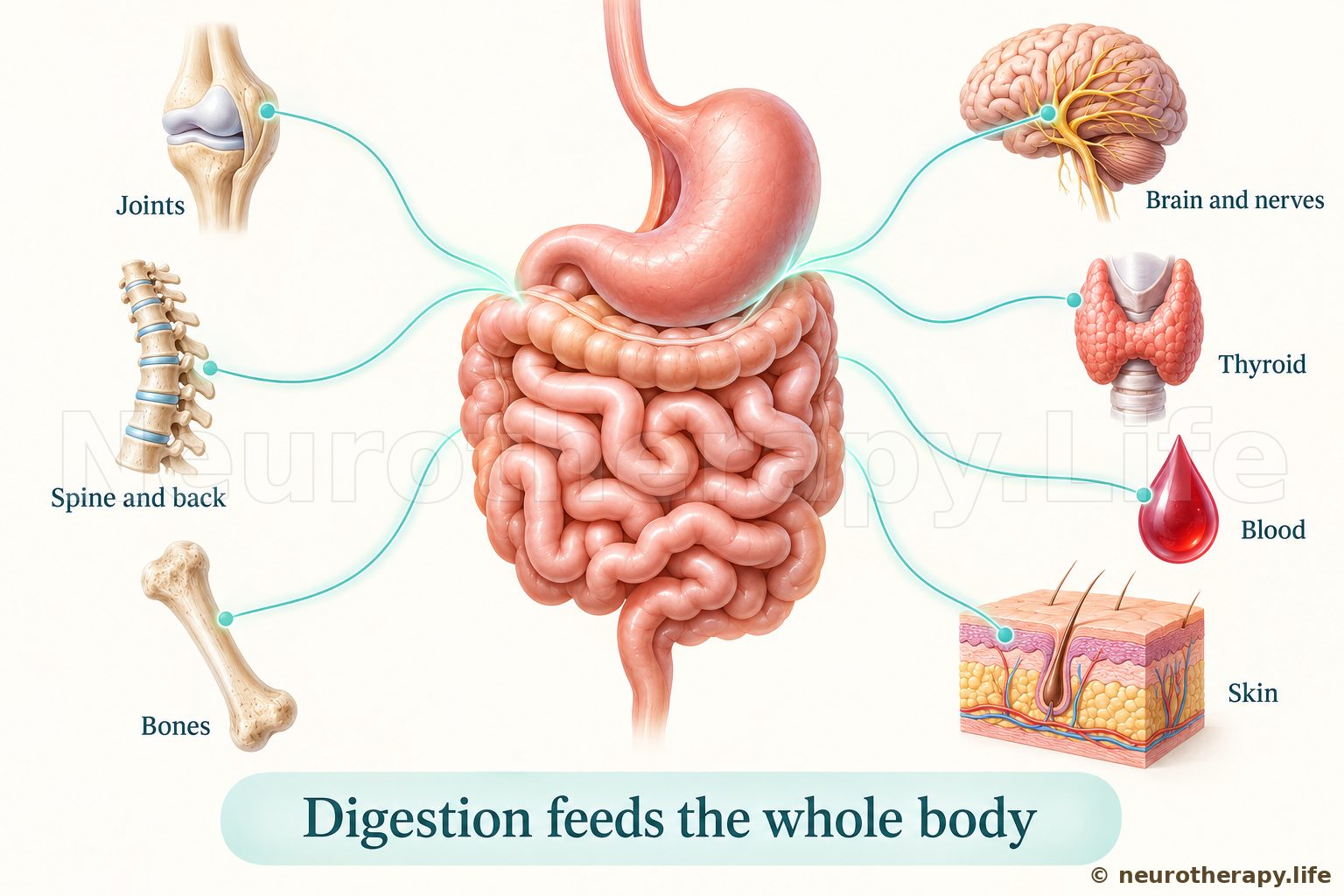
In his diary, Guruji wrote that undigested food (UDF) is one of the main causes of a long list of diseases. Among the conditions in which it is found are full-body pains, joint pains and chronic back ache with no known cause, rheumatoid arthritis, osteoarthritis and osteoporosis, bamboo spine (ankylosing spondylitis), bones becoming crooked, scoliosis (a sideways-curved spine), high blood pressure, under- and over-active thyroid, fits, stammering, Parkinson's disease, multiple sclerosis, depression, severe anaemia, lumps and lipomas, extreme tiredness, IBS, and skin disorders such as eczema and psoriasis.
Many of these carry the word ‘idiopathic’ in medicine, meaning the true cause is not known. The Neurotherapy (LMNT) reasoning is simple. When food is poorly digested, the body lacks the raw materials — such as amino acids from protein — that every gland, nerve, bone and immune cell needs. The UDF treatments aim to improve circulation to the digestive organs, so that those raw materials are made available again.
One practical lesson: most skin disorders come with loose stools and undigested food. So a therapist meeting eczema or psoriasis asks about the stool before asking about the cream. These are observations from practice; Neurotherapy (LMNT) supports digestion and does not claim to cure any of these diseases.
Key points
- Undigested food is often found in long-term pain, bone, skin, thyroid and nerve conditions.
- Poor digestion leaves the body short of the raw materials every organ needs.
- In skin disease, ask about the stool first.
- Neurotherapy (LMNT) supports alongside the specialist — never instead of them.
Go deeper
Undigested food in stool (UDF)
Undigested food in stool (UDF)
Psoriasis
Psoriasis
Rheumatoid arthritis (RA) and rheumatism
Rheumatoid arthritis
Osteoporosis
Osteoporosis
Ankylosing spondylitis (bamboo spine)
Ankylosing spondylitis (bamboo spine)
Comprehensive UDF treatment
The Comprehensive UDF treatment
The Fire and the Ash: Undigested Food in the Stool
Guide: The Fire and the Ash
Read the full guide
This topic is part of: The Fire and the Ash: Undigested Food in the Stool
Safety: when it is held back
- Never advise a patient to delay, reduce, refuse or stop the treatment their specialist recommends. A patient putting off treatment for a curable condition because of Neurotherapy (LMNT) is an absolute stop. Encourage every patient to tell their doctor they are receiving this treatment.
- Never apply direct pressure over a known tumour, or over bone known to be affected by one. Cancer care: Neurotherapy (LMNT) support
- (10) Medulla is never given in cancer and is avoided in diabetes, because it may raise blood sugar. In heart patients only (10) Left Medulla is given. In cancer, (10) Pan, Thymus, Pit, Lu + Sh, Rt. Ov. / Lt. Ov. and (30) Medulla are also never given. (10) Medulla
Guruji says
“Undigested food is one of the main causes for the following diseases.”
Watch

A step-by-step demo of the full UDF (undigested food) treatment: 15 Medulla, Parkhoo at both hips, Half Kundli, 10 Medulla with 1 Gas Only and 1 Gas 'I', then the Gal, Spleen, Liver and Mucus points and Ajay Normal on the thighs and forearms. It is given to support digestion when food passes through undigested.
This page explains what a Neurotherapy (LMNT) treatment is for; it is not a self-treatment guide and does not diagnose. Neurotherapy (LMNT) works alongside your medical care — keep taking the medicines your doctor prescribed.