What the Bowel Tells You: Constipation, Stool and Water
Constipation is not a disease but a signal that the large intestine is not doing its work. Neurotherapy (LMNT) reads the stool's form, the effort it costs and the water a person drinks, and works on the acid balance, the left side of the bowel, the thyroid and the gut lining.
Overview
Constipation is not a disease but a signal that the large intestine is not doing its work. Neurotherapy (LMNT) reads the stool's form, the effort it costs and the water a person drinks, and works on the acid balance, the left side of the bowel, the thyroid and the gut lining.
Constipation is a finding, not a disease
Constipation is only a symptom. It shows that the digestive tract is not working properly. The large intestine shows its fault in just two ways: very hard stools, or stools that are very soft (semi-solid) but not watery enough to be called diarrhoea. These look like opposite complaints, but they are one finding — the large intestine is not doing its job.
Which of the two a person shows tells the therapist which way the body is leaning. Hard stools usually come with tenderness at Mu° (the left kidney point) — the acidic side. Soft, frequent stools, or undigested food, usually come with tenderness at Liv° (the right kidney point) — the alkaline side. So the two commonest bowel complaints are corrected from opposite directions.
Why “normal” is not an answer
When a patient says “my motions are normal”, it is only an opinion. Often the person has never looked, believes frequent soft stools mean good health, or simply wants the topic closed. Normal bowel habit is a range — from about three times a day to about three times a week — so the number alone decides nothing.
What decides it is effort and feeling. A person is constipated when two or more of these are present for months: straining, hard or lumpy stool, a feeling that something is left behind, a sense of blockage, needing to help with the fingers, or fewer than three motions a week. To make the talk easy, the therapist shows a simple chart of seven stool forms, from hard lumps to watery, and asks the patient to point — “which one most days, and which on a bad day?”
Water in decides water out
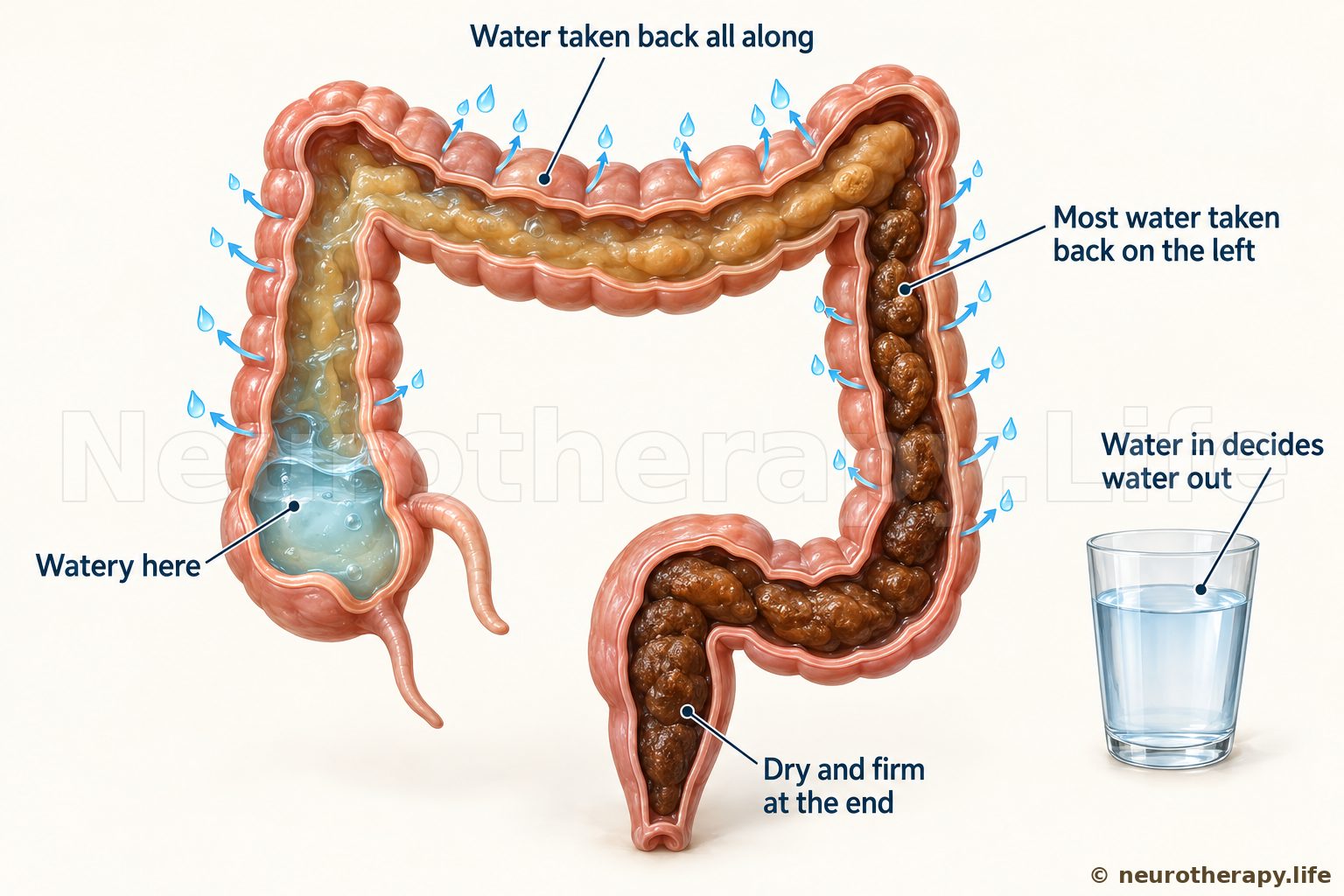
Food reaches the large intestine as a watery soup. All along its length, the colon takes water back, and most of it on the left side. A person loses roughly two litres of water a day through breath, sweat and urine, and must replace it with at least as much plain water.
When the body is short of water, it first closes its exits — the mouth goes dry, urine becomes dark and scanty, sweating falls, and the stool is squeezed dry. Tea, juice and buttermilk are good things, but here any drink with something in it is treated as food. As Guruji said, nothing can stand in for plain water.
The four causes, and who corrects each
Long-standing constipation is the sum of several faults, and each must be set right. Two of them only the patient can change; two the therapist's hands work on. Neurotherapy (LMNT) first works to reduce the acidity behind hard stools — but only when there is pain at Mu°. Then it raises blood flow to the left run of the large intestine, through points such as Spl, Const, Mu, Mu° and Lt.Ov. Spl is given here for the bowel lying beneath it, not for the spleen.
Two more causes sit deeper. The thyroid sets the pace of digestion; when it works too little, food moves slowly, more water is drawn out, and the stool dries — so the thyroid is stimulated too, and a blood test is wise. And long constipation inflames the gut lining, shown by pain at Mu; that inflammation must also settle, or relief stays incomplete. The exact points and method are taught hands-on in the course.
- Too little plain water — corrected by the patient: small amounts of water at regular times through the day.
- Too little roughage — corrected by the patient: plenty of vegetables and fresh fruit, with skins where possible.
- A sluggish large intestine from sitting all day or from age — worked on by the therapist.
- Too few digestive juices — the organs of digestion are worked on by the therapist.
Piles, fissure, fistula and prolapse: one family
Piles (bavasir — swollen veins at the anus), fissure (a tear in the skin at the opening), fistula (bhagandar — a small tunnel from the bowel to the skin) and prolapse of the rectum (the rectum slipping down out of place) are read here as one family. All are linked to acidity, and one chief cause is hard constipation. Neurotherapy (LMNT) sees them as the last link of a chain: too little water, a hard stool, a long sit and a hard push.
The same loose, slack muscles are behind other members of the family that are not in the bowel at all: prolapse of the uterus, hernia, varicose veins and low blood pressure. So when one member shows itself, the therapist looks for the constipation behind it — and for the water glass behind that.
Habits that help the bowel
Straining is not just uncomfortable. A long forced push presses on the veins and soft tissue at the anus and helps create piles, fissure and prolapse. Long hours in chairs, eating standing up, rushing out straight after meals and constant tension all slow digestion as well.
- Go when the urge comes — a held urge goes away and the stool dries while it waits.
- Sit a few minutes, not twenty; leave the phone and newspaper outside.
- On a Western seat, put a low stool under the feet so the knees come up above the hips.
- Do not push against a closed door — if it will not come easily, get up and try later.
- Eat something before leaving in the morning; the bowel naturally wakes after the first meal.
Key points
- Constipation is a symptom: the large intestine shows its fault as very hard or very soft stools.
- Hard stools lean to the acidic side (pain at Mu°); soft, frequent stools to the alkaline side (pain at Liv°).
- “Normal” is an opinion — effort, sensation and stool form tell the truth.
- Water in decides water out: tea and juice cannot replace plain water.
- Four causes — water, roughage, a sluggish colon, too few juices — two for the patient, two for the therapist.
- The thyroid and inflammation of the gut lining are also part of long constipation.
- Piles, fissure, fistula and prolapse are one family at the end of a chain that starts with too little water.
Topics in this guide
Go deeper
The Fire and the Ash: Undigested Food in the Stool
Undigested food in the stool, and why digestion comes first
The Two Kingdoms: Acidic and Alkaline Bodies
Acid and alkali — reading the two sides of the body
Correcting the Two Kingdoms: Acid and Alkali Formulas
How the two directions are corrected
Water and Salt: Kidney, Blood Pressure and Fluid Formulas
Water and salt in the body
Constipation
Constipation — the condition page
Piles (haemorrhoids) and fissure
Piles (haemorrhoids)
Const
Const — the constipation point
Triangle for Piles
The Triangle for Piles
Bowel
The bowel — the large intestine
Safety: when it is held back
- Blood from the back passage — even once, even a little on the paper — goes to a doctor first. Never assume it is only piles until a doctor has checked. Piles (haemorrhoids) and fissure
- A new change in bowel habit that lasts, especially after the age of forty, needs a doctor this week. How to tell a patient to see a doctor
- Black, tarry stool, or pale clay-coloured stool with dark urine or yellow eyes, is a doctor's matter today.
- The acid treatment is given only when there is pain at Mu°. Never ATF in alkalosis, never ALTF in acidosis. Correcting the Two Kingdoms: Acid and Alkali Formulas
- If the stool is soft yet still will not come out despite long straining, the fault is at the outlet muscles. Neurotherapy (LMNT) does not correct this — see a doctor for pelvic floor retraining.
- Do not stop a laxative powder you have taken for years on your own. As the bowel improves, ask the person who gave it whether you still need the same amount.
- Children and the frail get light treatment, given with the hands. The Child, the Elder and the Frail: Neurotherapy (LMNT) for Delicate Bodies
Guruji says
“No other drink can be a substitute for water.”
Common questions
I drink plenty — tea, buttermilk, juice. Is that not enough?
They are good things, but none of them is water. Here any drink with something in it is treated as food. Count the glasses of plain water you drank yesterday and start from that number.
Piles run in my family. Can anything be done?
Families also share the way they eat, sit and drink. Piles sit at the end of a chain — a hard stool, a long sit and a hard push. Those links can be changed, which is why working on the bowel helps more than treating the end alone.
Why is a thyroid test suggested for constipation?
Because a slow thyroid is a well-known cause of constipation. If it is low, your doctor can treat it, and the bowel work goes on alongside.
Why is Spl used for constipation? It is the spleen point.
Each point is named for the chief organ of its area, but it raises blood flow to all the organs there. Beside the spleen lies the bend where the large intestine turns down on the left.
What improves first?
Usually the effort falls first and the minutes on the toilet drop. Then the feeling of being finished returns, the stool form improves, the frequency settles, and the complaint you came for moves last.
Watch

An overview of LMNT's diagnostic pain points — the places around the navel that the therapist presses to read the body before choosing a treatment.

Dr. Diwakar Shukla shows students where the Mu° point lies and how it is pressed, both to examine the body and as part of treatment.
Test yourself
Explore more
Organs
Body systems
Diseases
Points
Formulas
Topics
Read more
This page explains what a Neurotherapy (LMNT) treatment is for; it is not a self-treatment guide and does not diagnose. Neurotherapy (LMNT) works alongside your medical care — keep taking the medicines your doctor prescribed.