Two fist-sized organs that clean your whole blood supply dozens of times a day, keep your water, salts and acid in balance, and make hormones for blood and bone. In Neurotherapy (LMNT) they are the first thing examined — under the code names Liv° and Mu°.
Overview
What are the kidneys?
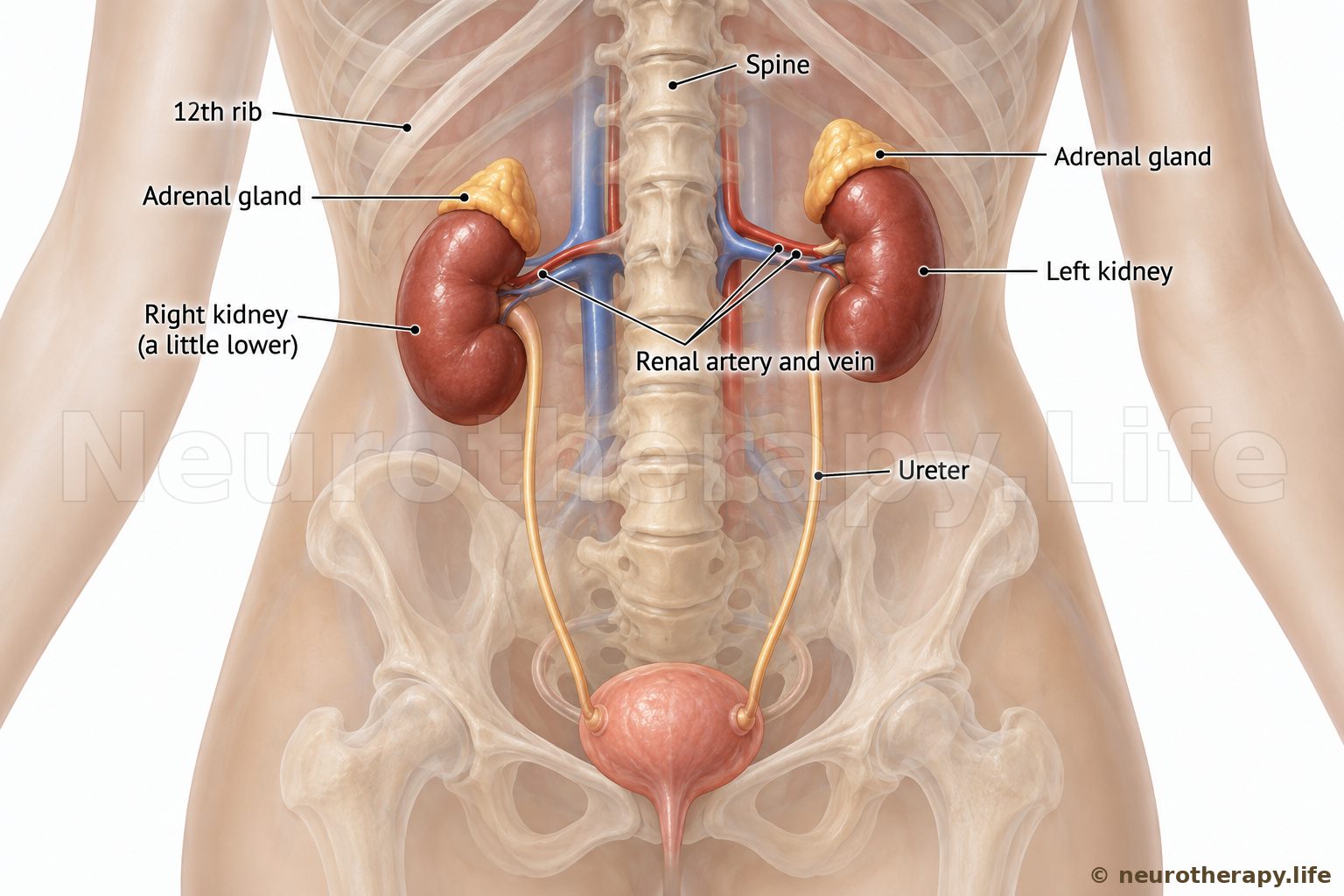
Your kidneys are two bean-shaped organs, each about the size of a fist, that sit at the back of your belly on either side of the spine, just under the lowest ribs. They are the main organs of the urinary system.
They filter the blood, remove waste and extra water as urine, and keep the body's salts, acid balance and blood pressure steady. They also make hormones: one that tells the bone marrow to make red blood cells, and the active form of vitamin D for strong bones.
In Neurotherapy (LMNT) the kidneys carry code names — Liv° for the right kidney and Mu° for the left — and gentle pressure at the two flanks is the first step of every examination. Guruji counted them, with the stomach and lungs, among the three organs that keep disease away.
The kidneys sit at the back, beside the spine and under the last ribs — the right one a little lower.
Function
What do the kidneys do?
The kidneys work in two steps. First they filter: a large volume of fluid is pressed out of the blood. Then they sort: almost all of it is taken back, and only what the body does not need leaves as urine.
Filter waste from the blood — urea from protein, creatinine from muscle, uric acid — and many medicines.
Keep the body's water right: concentrated urine when you are short of water, dilute when you drink a lot.
Balance sodium, potassium, calcium and phosphate.
Keep the blood's acid level steady by getting rid of acid and saving bicarbonate.
Help control blood pressure through salt and water, and through the hormone renin.
Make erythropoietin (EPO), which tells the bone marrow to make red blood cells.
Activate vitamin D, so the gut can absorb calcium for the bones.
Make some glucose during long fasting.
Blood comes in
The renal artery brings about a fifth of all the blood the heart pumps.
Filter
In about a million tiny filters (glomeruli) per kidney, water and small molecules are pressed out; cells and proteins stay in the blood.
Take back
Along each tubule, water, sugar, salts and bicarbonate are taken back as the body needs them.
Add and fine-tune
Some wastes, acid and extra potassium are added; hormones set the final amount of water and salt.
Send it on
The finished urine collects in the renal pelvis and flows down the ureter to the bladder.
How do the kidneys work with other organs?
Heart — The heart sends the kidneys about a fifth of its output; the kidneys in turn help set the blood pressure the heart pumps against.
Adrenal glands — They sit on top of the kidneys; their hormone aldosterone tells the kidneys to hold salt and water.
Liver — The liver makes urea for the kidneys to remove, and angiotensinogen, the starting material of the blood-pressure hormone chain.
Lungs — An enzyme in the lungs completes that chain; lungs and kidneys also share the work of acid balance.
Pituitary gland — Its water-holding hormone (ADH) tells the kidneys how much water to save.
Blood — Kidney EPO keeps red blood cells coming; failing kidneys often cause anaemia.
Bladder — The kidneys make urine; the bladder stores it until you choose to empty it.
From the outside in: a protective wrapping, an outer and an inner layer of tissue, a collecting funnel — and, too small to see, about a million filtering units.
Outside
Renal capsule — A thin, tough, shiny skin wrapped tightly around each kidney.
Fat and fascia — A cushion of fat and a sheet of tissue that hold the kidney in place and protect it.
Hilum — The notch on the inner side where the renal artery enters and the renal vein and ureter leave.
Inside
Cortex — The outer layer, where the filters sit.
Medulla — The inner layer, arranged as cone-shaped pyramids of tiny tubes that concentrate the urine.
Calyces and renal pelvis — Cup-shaped collecting spaces that join into a funnel leading to the ureter.
The nephron — the working unit
Each kidney has around a million nephrons, though the number varies a lot from person to person.
Glomerulus — A tiny ball of blood capillaries that acts as the filter.
Bowman's capsule — The cup around the glomerulus that catches the filtered fluid.
Tubule and loop of Henle — A long, looping tube that takes back what the body needs and concentrates the rest.
Collecting duct — Where hormones set the final amount of water saved before urine leaves.
Hormone makers
Renin-making cells — Cells beside each filter that release renin when blood flow or pressure in the kidney falls, starting a chain that raises blood pressure.
EPO-making cells — Cells that sense low oxygen and make erythropoietin to raise red blood cell production.
Vitamin D activation — Tubule cells complete the last step that turns vitamin D into its active form.
Where are the kidneys located?
The kidneys lie against the back wall of the belly, behind the lining of the abdomen, one on each side of the spine. They stretch roughly from the twelfth thoracic to the third lumbar vertebra, and the lowest ribs shield their upper parts.
The right kidney usually sits a little lower than the left, because the large liver lies above it. An adrenal gland sits on top of each kidney like a cap.
LMNT examines the kidneys at the flanks — the soft place between the last rib and the rim of the hip bone — pressing gently and horizontally: Liv° on the right, Mu° on the left. The code names come from the front: the right kidney lies straight behind the Liv point beside the navel, the left kidney behind Mu.
Each kidney is shaped like a large bean or a cashew, reddish-brown, firm and smooth, with a shiny covering. Its inner edge has a notch where the vessels and the ureter join.
Cut open, it shows a paler outer rim and darker, striped cone-shapes inside, all draining into a white funnel at the centre.
How big are the kidneys?
Each adult kidney is about 10–12 cm long, 5–7 cm wide and about 3 cm thick — about the size of a fist — and weighs about 120–170 g. Together they are well under 1% of body weight.
Yet they receive about a fifth of all the blood the heart pumps — around a litre a minute — and filter about 180 litres of fluid a day.
Conditions and disorders
What conditions and disorders affect the kidneys?
Kidney disease is common and often silent: a person can lose a large part of kidney function before feeling ill. That is why people with diabetes or high blood pressure are advised to have their kidneys checked regularly.
Disease of the kidney itself
Kidney diseaseKidneys that filter less well, short-term or long-term, up to kidney failure.
Kidney stonesCrystals that form in the kidney; severe pain when they move.
Low back painKidney Clear is listed for low back pain; Liv° and Mu° ease pain in the right and left back.
What are signs of a kidney problem?
Often none at all in the early stages — only tests show it
Swelling of the ankles, feet or around the eyes
Foamy urine, or passing much less urine than usual
Tiredness, itching, poor appetite or nausea (later stages)
Blood pressure that is hard to control
Pain in the side or back below the ribs, especially with fever
Blood in the urine, or severe wave-like pain in the side — see a doctor the same day
What tests check the kidneys?
Creatinine and eGFR — A blood test; eGFR estimates how many millilitres of blood the kidneys filter each minute.
Urine albumin (ACR) — Protein leaking into the urine is an early sign of kidney damage.
Urine test — Looks for blood, protein, sugar, crystals and infection.
Blood salts and urea — Potassium, sodium, bicarbonate and urea show how well the kidneys are balancing the blood.
Ultrasound or CT — Show the size and shape of the kidneys, stones, cysts and blockages.
Kidney biopsy — A tiny sample taken with a needle, when the cause of damage needs to be known.
How are kidney problems treated?
Controlling blood sugar and pressure — The most important way to slow kidney damage, often with medicines that also protect the kidneys.
Diet — Less salt, and the right amount of protein, potassium and water as your doctor or dietitian advises.
Treating anaemia and bone changes — EPO injections, iron and active vitamin D when the kidneys can no longer make enough.
Stone treatment — Fluids and pain relief for small stones; shock-wave or telescope procedures for larger ones.
Dialysis — When the kidneys fail, a machine or a fluid exchange in the belly does the filtering.
Kidney transplant — A kidney from a living or deceased donor; one working kidney is enough.
Specialist care — A nephrologist (kidney doctor) or urologist looks after long-term kidney conditions.
Neurotherapy (LMNT)
In Neurotherapy (LMNT) the kidneys are handled with particular thought. Their code names, Liv° and Mu°, spare an anxious patient the word 'kidney' and tell the therapist where to look: each kidney lies straight behind the front point it is named after. Tenderness at the two flanks is the first thing checked, and in LMNT teaching it sorts a patient into one of two families — Liv°, the right kidney, reduces alkali in the blood (and so is used when blood pressure is high), while Mu°, the left kidney, reduces acid (and so is used when it is low), and in chronic illness is given to help make the red-cell hormone erythropoietin. The Kidney Clear formula stimulates both kidneys and then adds Chest Only and the Round Arrow, because stimulating the kidneys alone could upset some patients' acid–alkali balance. It comes in four graded strengths, chosen by the patient's condition that day, starting low in the chronic, the elderly and the frail; its reversed form, Ulta Kidney Clear, is for days when the body leans the other way. Guruji also reasoned that a kidney starved of blood releases renin and raises the diastolic pressure, and used the Angiotensin No. 2 formula — liver, left kidney, then lungs — for pressure that falls suddenly after blood loss. Where the kidneys have failed, the kidney points are withheld altogether. LMNT uses no medicines and never tells a patient to stop theirs.
Points
Liv° — The right kidney: single point, contact high near the shoulder. Stimulates the right kidney; in LMNT teaching reduces alkali and eases right-sided back pain; for right kidney stones.
Mu° — The left kidney: stimulates it; in LMNT teaching reduces acid and eases left-sided back pain; given in chronic disease to help make erythropoietin; for left kidney stones.
Ch. Only — Chest Only: the soles glide from chest to shoulders — the first balancing step after the kidney points.
Round Arrow — Down the right side of the spine to L5, round, and up the left — the second balancing step.
Liv — The liver point, distinct from Liv°: in kidney failure the liver point is given to support erythropoietin while the kidney points are withheld.
(2) Pan — With (10) Pan, given in LMNT teaching to increase urine in kidney failure, uraemia and nephrotic syndrome. Held exactly six seconds.
(10) Pan — (10) Pan × 3 treatments was observed to help swelling from the heart or the kidneys, before Kidney Clear.
Lu + Sh — The lung step of Angiotensin No. 2 — the lungs complete the blood-pressure hormone chain.
Folded Legs — Pressure on the bladder that, in LMNT teaching, greatly increases blood flow to the kidneys and takes out the pain of Liv° and Mu°.
(20) Medulla — For dopamine; one of dopamine's jobs is to increase blood flow in the kidneys. Whether it helps kidney problems is left as an open question for research.
Mu° before Liv°, Round Arrow before Ch. Only — for right kidney stone, more pain at Liv°, loose motions, morning swelling, weeping skin, or high BP. Limited time only.
“If the stomach, the lungs and the kidneys work properly, then disease simply cannot come.”
— Dr. Lajpatrai Mehra
“Whether or not the patient gets immediate benefit from our treatment, let no harm reach him through our carelessness — attend to this.”
— Dr. Lajpatrai Mehra
“Wherever there is a question mark, it is an indication that this is my own thinking, on which other people can now do research.”
— Dr. Lajpatrai Mehra
Never do this
In kidney failure or kidney cancer, the kidney points Liv° and Mu° are never stimulated — so no Kidney Clear. (10) Medulla and the Chole treatment are not given in kidney failure. Liv°
If there is pain only at Liv°, Mu° is not given. Mu°
Never in kidney disorders: Th, Th + Ch, Spl, Lymph, Armpits, Ton 'P' and Ton 'T'. Ch. Only is not given in lung cancer. Th + Ch
In Angiotensin No. 2 and ADK, Lu + Sh is not given with high blood pressure or heart disease, and (20) Medulla is not given in heart disorders or high blood pressure. ADK
Begin low: in the chronic, the elderly and the frail, start with grade I (Mild Kidney Clear). Ulta Kidney Clear is for a few days only; then the Normal formula brings the body back. Mild Kidney Clear
No firm pressure on a tender flank, and none at all over a transplanted kidney, a recent biopsy, or a tube or stent.
Go to hospital the same day for very little or no urine, breathlessness, swelling with confusion or drowsiness, blood in the urine, fever with loin pain, or severe wave-like pain in the side. Never stop or skip dialysis, and never stop blood-pressure tablets without the prescribing doctor.
Care
How can I keep my kidneys healthy?
Most kidney damage builds slowly from things we can check and control.
Know your numbers
If you have diabetes, high blood pressure, heart disease or a family history of kidney disease, ask for a yearly creatinine/eGFR and urine albumin test.
Drink water, not only other drinks
Enough water, spread through the day, helps prevent stones. If you have kidney or heart disease, follow your doctor's limit.
Cut down on salt
Less salt eases blood pressure and the kidneys' workload.
Keep sugar and pressure in range
These are the two biggest threats to the kidneys; take prescribed medicines regularly.
Be careful with painkillers and remedies
Frequent use of some painkillers, and some unregulated herbal or metal-containing remedies, can harm the kidneys. Ask before taking them regularly.
Stay active and at a healthy weight
Regular activity helps control blood pressure and sugar.
Don't smoke
Smoking damages the blood vessels that feed the kidneys.
Common questions
Can I live with one kidney?
Yes. One healthy kidney can do the work of two; after one is removed, the other grows a little and takes up the load. Long-term studies of kidney donors found they lived as long as similar people with two kidneys. Regular checks of blood pressure and kidney function are advised.
What do creatinine and eGFR mean?
Creatinine is a waste made by muscles; the kidneys clear it. When the kidneys filter less, it rises in the blood. eGFR is a number worked out from creatinine, age and sex that estimates how much blood the kidneys filter each minute — roughly, the higher the better. A raised creatinine is not a disease in itself; it is a report that the filter is not clearing.
Does drinking lots of water clean my kidneys?
Enough water helps prevent stones and urine infections, and Guruji's advice was that no other drink replaces water. But more is not always better, and people with heart or advanced kidney disease may need to drink less. Pale urine is a good everyday guide.
Why are my kidneys linked to my blood pressure?
Kidneys control how much salt and water stay in the body, and when their own blood flow drops they release renin, which tightens blood vessels and raises pressure. So kidney disease can raise blood pressure, and high blood pressure damages the kidneys. LMNT teaching reads a raised lower (diastolic) figure as the kidney 'shouting' for more blood.
Can Neurotherapy (LMNT) replace dialysis or my kidney medicines?
No. LMNT uses no medicines and never tells a patient to stop theirs. In kidney failure the kidney points are not given at all. Any change to dialysis or medicines is decided only by your kidney doctor.
Is my back pain coming from my kidneys?
Kidney pain is usually felt in the side or back just below the ribs, often on one side, and may come with fever, urinary symptoms or wave-like pain from a stone. Ordinary back pain is usually lower and changes with movement. If in doubt — and always with fever or blood in the urine — see a doctor.
What should I ask my doctor or therapist?
What are my creatinine, eGFR and urine albumin, and how have they changed?
What blood pressure and blood sugar should I aim for?
How much water and salt should I have each day?
Are any of my medicines or supplements hard on my kidneys?
For my therapist: which is tender today, Liv° or Mu°, and which grade of Kidney Clear — or Ulta — are you giving, and why?
For my therapist: is any treatment barred for me because of my kidney report?
Surprising facts
1Less than 1% of your weight, a fifth of your blood
Together your kidneys weigh only about 300 g, yet at rest they receive about a fifth of all the blood your heart pumps — more than a litre every minute. No other organ that size gets so much.
Source: Guyton & Hall, Textbook of Medical Physiology — renal blood flow about 1,100 mL/min, about 22% of cardiac output; kidneys about 0.4% of body weight
2Your kidneys clean all your blood about 60 times a day
They filter about 180 litres of fluid a day. Since the liquid part of your blood (plasma) is only about 3 litres, the whole of it passes through the filters around sixty times every day.
Source: Guyton & Hall — GFR about 180 L/day; the entire plasma volume filtered and processed about 60 times each day
3You may have 200,000 — or 2 million — filters per kidney
The 'one million nephrons per kidney' you often read is an average. Careful counts show a huge range, from about 200,000 to more than 2.5 million, set largely before birth. People born with fewer may be more at risk of high blood pressure and kidney disease later.
Source: Bertram JF et al. Human nephron number: implications for health and disease. Pediatr Nephrol 2011;26(9):1529–1533
4One kidney is enough
After a kidney is donated, the remaining one grows and takes on more work. A long study of more than 3,000 donors found they lived as long as similar people with two kidneys.
Source: Ibrahim HN et al. Long-term consequences of kidney donation. N Engl J Med 2009;360(5):459–469
5The first successful organ transplant was a kidney
In December 1954, in Boston, surgeons moved a kidney from one identical twin to his brother, and it worked for years. The lead surgeon, Joseph Murray, later shared the Nobel Prize for this work.
Source: Nobel Prize in Physiology or Medicine 1990 (Joseph E. Murray) — first successful human kidney transplant, between identical twins, Boston, 23 December 1954
6Your kidneys make the hormone that makes your blood
When oxygen in the blood runs low, special kidney cells release erythropoietin (EPO), which tells the bone marrow to make more red blood cells. That is why people with failing kidneys so often become anaemic.
Source: Guyton & Hall — erythropoietin, about 90% made in the kidneys; anaemia of chronic kidney disease
7The liver pushes the right kidney down
The right kidney usually sits about half a vertebra lower than the left, because the big liver takes up the space above it. LMNT's back chart notes the same thing when it places Liv° on the right.
Source: Gray's Anatomy (right kidney slightly lower owing to the liver); LMNT back pain chart (wiki_db 6.6)
8More than 850 million people have kidney disease
Kidney specialists worldwide estimate that over 850 million people live with some form of kidney disease — far more than have diabetes — and most do not know it. Simple blood and urine tests find it early.
Source: Jager KJ et al. A single number for advocacy and communication — worldwide more than 850 million individuals have kidney diseases. Kidney Int 2019;96(5):1048–1050
A day in the life of your kidneys
~1.1 L/minof blood flowing through them — about a fifth of the heart's output
~180 Lof fluid filtered
~60 timesthe whole plasma passes through the filters
~99%of the filtered fluid taken back
~1–2 Lof urine made
~1 millionnephrons per kidney, on average
Yoga
Slow breathing — about six breaths a minute Dīrgha śvasana / slow Anuloma-Viloma
Benefits
Slow, calm breathing can help lower blood pressure a little — and blood pressure is the kidneys' closest partner and biggest threat.
Calms the stress response.
Can be done by almost anyone, even with limited mobility.
How to do it
Sit tall on a chair or on the floor.
Breathe in gently through the nose for about 5 seconds.
Breathe out gently for about 5 seconds, without forcing.
Continue for 5–10 minutes. You may alternate nostrils if that is comfortable.
Take care
Never hold the breath. No fast or forceful breathing (kapālabhāti, bhastrikā) with high blood pressure, heart or kidney disease unless your doctor agrees. Stop if dizzy. Keep taking your blood-pressure medicines.
Ardha Matsyendrāsana — the gentle seated twist Ardha Matsyendrāsana
Benefits
Moves the mid and low back, where the kidneys lie, and eases stiffness.
Many people find it relieves the tight, tired back of long sitting.
No pose is known to improve kidney function itself; this one serves the back around them.
How to do it
Sit with legs straight. Bend the right knee and place the right foot outside the left knee.
Breathe in and sit tall.
Breathing out, turn gently to the right, holding the knee with the left arm and resting the right hand behind you.
Stay for 5 breaths, come back slowly, and repeat to the other side.
Take care
Twist only as far as is comfortable. Avoid with a slipped disc, recent back or belly surgery, a transplanted kidney or a fresh biopsy, and in pregnancy. Not with a tender, painful flank.
Śavāsana — deep rest Śavāsana
Benefits
Deep relaxation helps the body settle after activity and can ease blood pressure for a while.
A good way to end any practice.
Suitable for most people, including the elderly.
How to do it
Lie on your back with a thin pillow under the head if needed.
Let the legs fall slightly apart and the arms rest away from the body, palms up.
Close the eyes and relax the body from the feet up to the head.
Rest for 5–10 minutes, then roll onto your side before getting up.
Take care
If lying flat makes you breathless, lie propped up and see a doctor — breathlessness when lying flat can be a sign of fluid overload. In late pregnancy, lie on the left side.
Watch
LMNT Mu Zero (Mu°) Point Practical Demo | Diagnosis & Treatment by Dr. Diwakar Shukla | For Students
Dr. Diwakar Shukla shows students where the Mu° point lies and how it is pressed, both to examine the body and as part of treatment.
LMNT Liv Zero (Liv°) Point को कैसे समझें? | Clinical Guide by Dr. Diwakar Shukla | Practical Demo
Dr. Diwakar Shukla explains and demonstrates the Liv° point — where it lies on the right side and how it is pressed to examine the body.
LOW BP DUE TO HEADY BLEEDING DURING PERIODS
A demonstration of the Angiotensin No. 2 formula — (7) Liv, (7) Mu° and (6) Lu + Sh — for low blood pressure that comes on suddenly after very heavy bleeding in a period.
The video suggests using the formula at the moment of fainting. In LMNT teaching, a person who is still bleeding, cold, pale or fainting is taken to hospital first; this formula is for after the bleeding has been stopped. Lu + Sh is not given in cancer.
P HAPARIN FORMULA
Shows the P. Heparin formula: (8) Pan at the top of the thighs, (7) Liv on the thigh and forearm, and (8) Chest Only with the palms on the chest. In the video it is given as the last part of the Angina treatment, to support circulation.
Test yourself
Research
Strong evidence
Pulling together data from major studies, kidney societies estimated that more than 850 million people worldwide have some kind of kidney disease.
Counts of nephrons in human kidneys range more than tenfold between people; a low number at birth may raise the risk of high blood pressure and kidney disease later in life.
A follow-up of more than 3,000 living kidney donors found that their survival was similar to that of people in the general population, and most kept good kidney function.
This page explains how the body works; it does not diagnose. Neurotherapy (LMNT) works alongside your medical care — keep taking the medicines your doctor prescribed, and see a doctor for any new or severe symptom.
Ready to begin?
Send COURSE for course details, or your name, age and health issue for a consultation.