Diabetes insipidus
Diabetes insipidus makes the body lose too much water through the urine, so the person feels very thirsty and passes large amounts of pale urine, day and night. It is not the same as sugar diabetes.
- Rare — about 1 in 25,000 people
- Most adults pass about 1 to 3 litres of urine a day; with diabetes insipidus it can be as much as about 19–20 litres
- Blood sugar is normal — it is a problem of water balance, not of sugar
Source: NHS; Mayo Clinic; MedlinePlus
What is Diabetes insipidus?
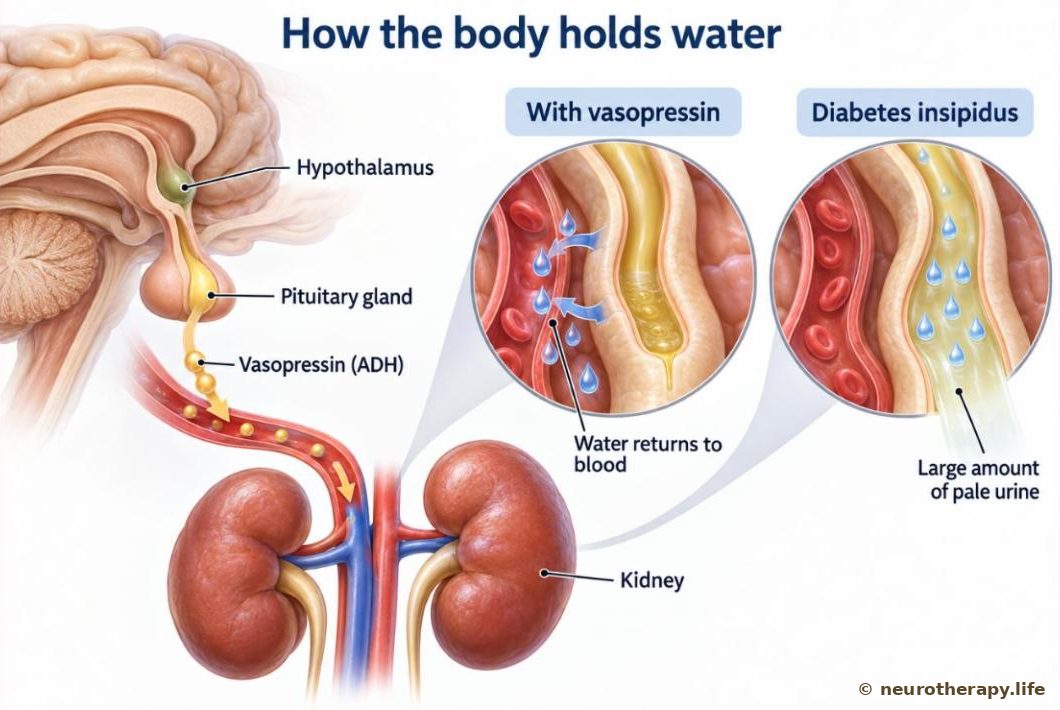
Your body has a hormone called vasopressin, also called ADH (antidiuretic hormone — the "hold-the-water" hormone). It is made in a part of the brain called the hypothalamus and stored in the pituitary gland. When you need water, it tells the kidneys to hold water back instead of sending it out as urine.
In diabetes insipidus this system fails. Either the brain does not make or release enough vasopressin (the central type, now also called AVP deficiency), or the kidneys do not answer it (the kidney type, now called AVP resistance). Either way, water pours out as urine, and thirst tries to catch up.
What are the symptoms?
- Strong, constant thirst — often wanting very cold water
- Passing large amounts of pale, watery urine
- Getting up again and again at night to pass urine and drink
- Tiredness, dizziness or a dry mouth when water is short (dehydration)
- In babies and children: very heavy wet nappies, bed-wetting, poor growth, vomiting or fever
What causes it, and who is more likely to get it?
Brain (central type)
- Head injury or brain surgery
- A tumour or infection near the pituitary gland
- In about 1 in 3 people, no cause is found
Kidneys (kidney type)
- Some medicines, especially lithium
- High calcium or low potassium in the blood
- Kidney disease, or a problem present from birth
Pregnancy
- A rare type in pregnancy, when the placenta breaks down vasopressin
How is it found?
Great thirst and heavy urine can have several causes, including sugar diabetes. A doctor finds out which one it is with urine and blood tests.
Urine tests
How much urine is passed in 24 hours, and how concentrated it is. In diabetes insipidus the urine is large in amount and very dilute.
Blood tests
Blood sugar (to rule out sugar diabetes), sodium, calcium, potassium and kidney function.
Water and hormone tests
Done in hospital under watch: a water-deprivation or hormone test, and sometimes a blood test called copeptin, to tell the brain type from the kidney type.
Brain MRI
A scan of the pituitary area, if the brain type is suspected.
A neurotherapist asks for these reports and for the blood pressure before the first treatment. The blood pressure decides whether the LMNT point for this condition may be given at all.
How Neurotherapy (LMNT) sees Diabetes insipidus
LMNT teaching places diabetes insipidus beside long-standing low blood pressure, because both are about one chemical: vasopressin. Guruji's teaching says vasopressin is a very powerful chemical — it narrows the blood vessels and makes the kidneys hold water, so the blood volume rises. In diabetes insipidus, it says, this chemical is short.
The water chain — where vasopressin works
- Hypothalamusmakes vasopressin at the base of the brain
- Pituitarystores it in its back lobe and releases it when needed
- Bloodcarries it to the kidneys and the blood vessels
- Kidneyshold water back instead of letting it out as urine
- Blood volumestays full, and thirst settles
LMNT gives (2) Para — two applications of the Para point — to help the body make vasopressin. Guruji's teaching warns: read the number before the point. (2) Para and (4) Para are two different treatments at one site; (4) Para works on calcium, not on water.
No other drink can be a substitute for water.
Neurotherapy (LMNT) treatment for Diabetes insipidus, step by step
Examine first
The therapist checks the diagnostic points Liv° and Mu°, looks at the urine and blood reports, and measures the blood pressure. High blood pressure, or a pressure that has fallen suddenly, changes the plan.
The Vasopressin formula — (2) Para
The shortest formula in LMNT: two applications of the Para point, and nothing else. Given lying on the back, on both sides, six seconds at each contact.
Read the count
(2) Para is never replaced by (4) Para. Same site, different count, different gland — (4) Para raises calcium in the blood.
Water and watching
Drink to thirst — never hold water back. Keep a simple record of how much you drink and pass each day, and share it with your doctor and therapist.
Points and formulas used
Vasopressin formula
(2) Para — given in LMNT to help the body make vasopressin, the hormone that makes the kidneys hold water.
Works through
Open →Never do this
- Never give (2) Para to a person with high blood pressure — vasopressin narrows the vessels and raises the pressure. (2) Para
- Never give (2) Para where low blood pressure has come on suddenly, as after blood loss — that needs a different plan and often a hospital. Low blood pressure come on suddenly
- (2) Para and (4) Para are two different treatments. Never swap the count. (4) Para
- Go to a hospital at once for confusion, fainting, extreme weakness, repeated vomiting, or sudden great thirst and urine after a head injury or brain surgery. A baby or child with very heavy wet nappies, vomiting or fever needs a doctor the same day.
- Children get half the adult dose and light treatment only, given by a trained therapist.
- Cancer: if the person has cancer, (10) Pan, Thymus, Pit, Lu + Sh, Rt. Ov / Lt. Ov and (30) Medulla are never given — the therapist changes the plan.
- Keep taking the medicines your doctor prescribed. Neurotherapy (LMNT) works alongside your medical care, never instead of it.
Watch

This video explains the Para point and how (2) Para differs from (4) Para, in relation to low calcium, bone pain and blood pressure.
(2) Para and (4) Para explained — one site, two counts, two different actions. Remember: (2) Para is never given in high blood pressure.
From Ayurveda and the kitchen
Test yourself
What research says
- Strong evidence
Vasopressin is made in the hypothalamus and released by the posterior pituitary. In the kidney it opens water channels (aquaporins) so that water is taken back into the blood and the urine becomes concentrated.
No clinical trial of Neurotherapy (LMNT) in diabetes insipidus has been published yet. Improvements reported by neurotherapists are clinical observations.
For you
Anyone very thirsty
Great thirst with heavy urine needs a doctor's check — first to rule out sugar diabetes. Never cut down water to pass less urine.
Parents
A child who wets heavily, drinks all the time or is not growing well should see a doctor. Children get only half-dose, light treatment.
People on long-term medicines
Some medicines, such as lithium, can cause this. Do not stop any medicine yourself — tell your doctor and your therapist.
This page explains; it does not diagnose. Neurotherapy (LMNT) works alongside your medical care — keep taking the medicines your doctor prescribed, and see a doctor for any new or severe symptom.